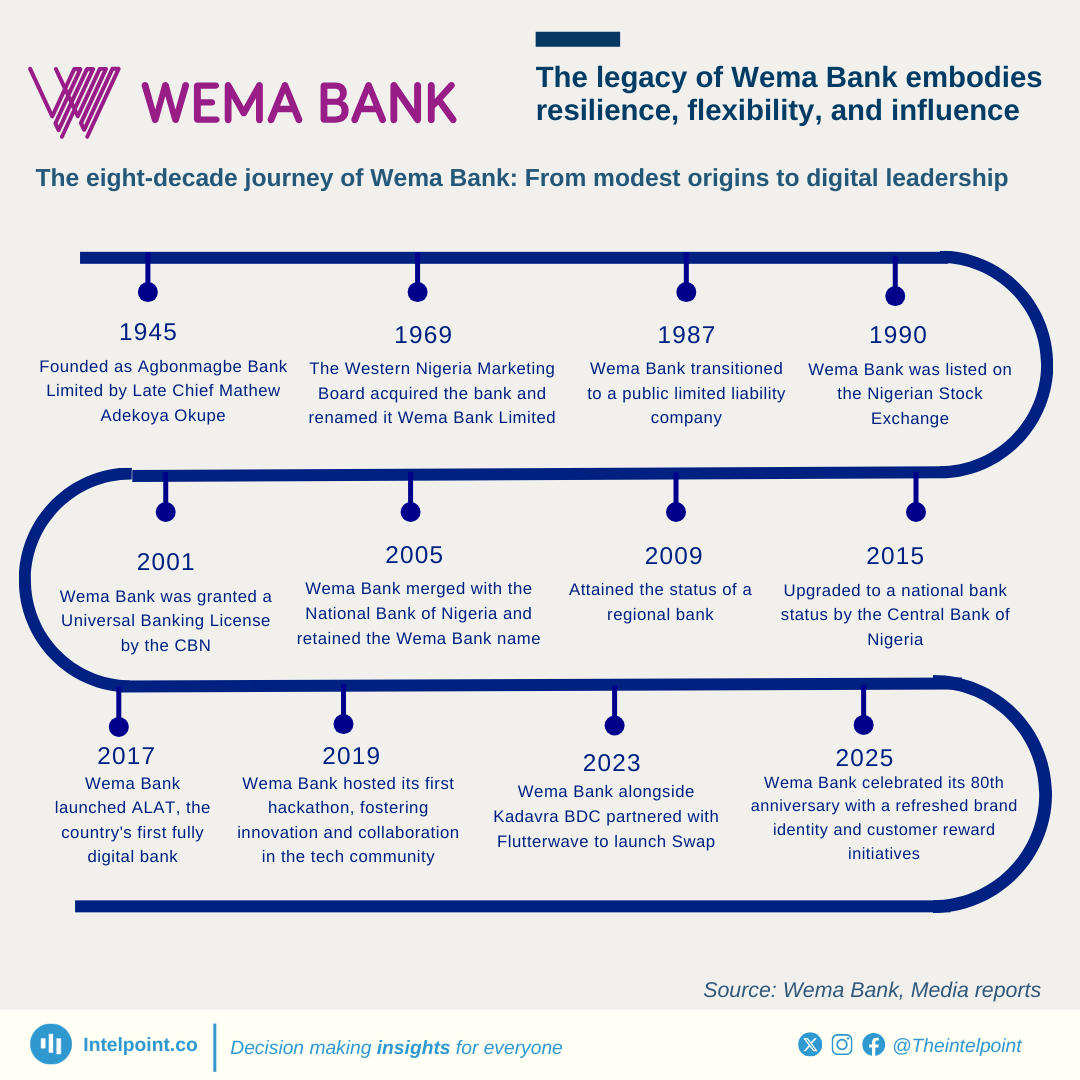
The legacy of Wema Bank embodies resilience, flexibility, and influence

Key takeaways:

  • In 2015, Wema Bank transitioned from being a regional bank to achieving national bank status.
  • To promote innovation and cooperation within the tech community, Wema Bank organised its inaugural hackathon, "Hackaholics", in 2019.
  • The bank has continually prioritised innovation, particularly with the introduction of ALAT, Nigeria's pioneer fully digital banking service.
  • Wema Bank holds the distinction of being Nigeria's oldest indigenous bank still in operation.

Wema Bank's journey commenced in 1945 when Chief Mathew Adekoya Okupe established Agbonmagbe Bank Limited. In 1969, it adopted the name Wema Bank Limited after its acquisition by the Western Nigeria Marketing Board.

The bank became a public limited liability company in 1987 and was listed on the Nigerian Stock Exchange in 1990. Wema Bank acquired a Universal Banking License in 2001, broadening its range of services. In 2005, Wema Bank merged with the National Bank of Nigeria and retained the Wema Bank name.

Following a strategic restructuring from 2009 to 2015, the bank secured a national banking license in 2015 and unveiled a new logo that represents synergy and innovation.

Showing its dedication to technological progress, Wema Bank launched ALAT in 2017, Nigeria's first fully digital bank. In celebration of its 80th anniversary in 2025, Wema Bank revealed a refreshed brand identity and introduced customer reward programmes, highlighting its legacy of resilience and innovation.
Source:

Wema Bank, Media reports

Period:

1945 - 2025
HTML code to embed chart
Want a bespoke report?
Reach out
Tags
Related Insights

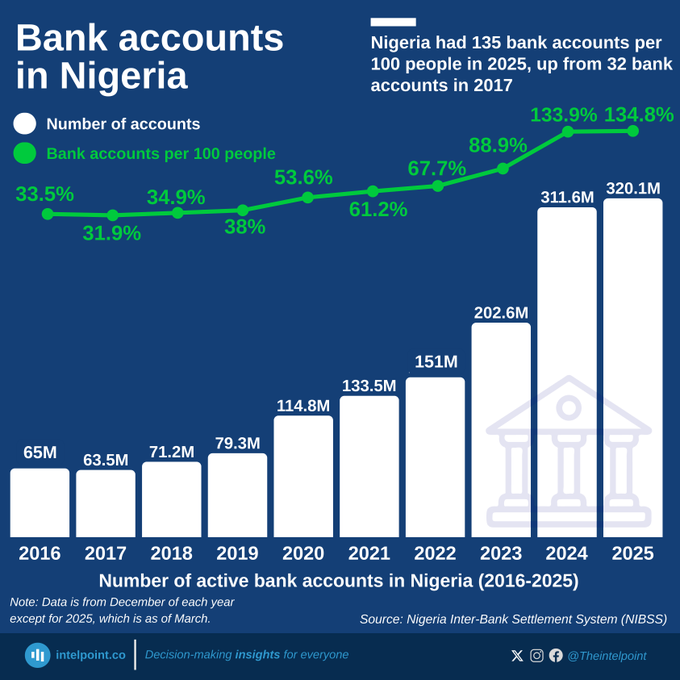
Nigeria had about 135 bank accounts per 100 people in 2025, up from 32 bank accounts in 2017
  • Active bank accounts grew from 65 million in 2016 to over 320 million in 2025 — almost a fivefold increase.
  • Bank accounts per 100 people rose from about 32 in 2017 to nearly 135 in 2025.
  • Nigeria now averages more than one bank account per person.
  • The fastest growth phase occurred between 2019 and 2024.
  • Digital banking and fintech adoption played a major role in the surge.
  • The jump after 2020 suggests technology-driven access, not just population growth.
  • Multiple account ownership is now common among users.

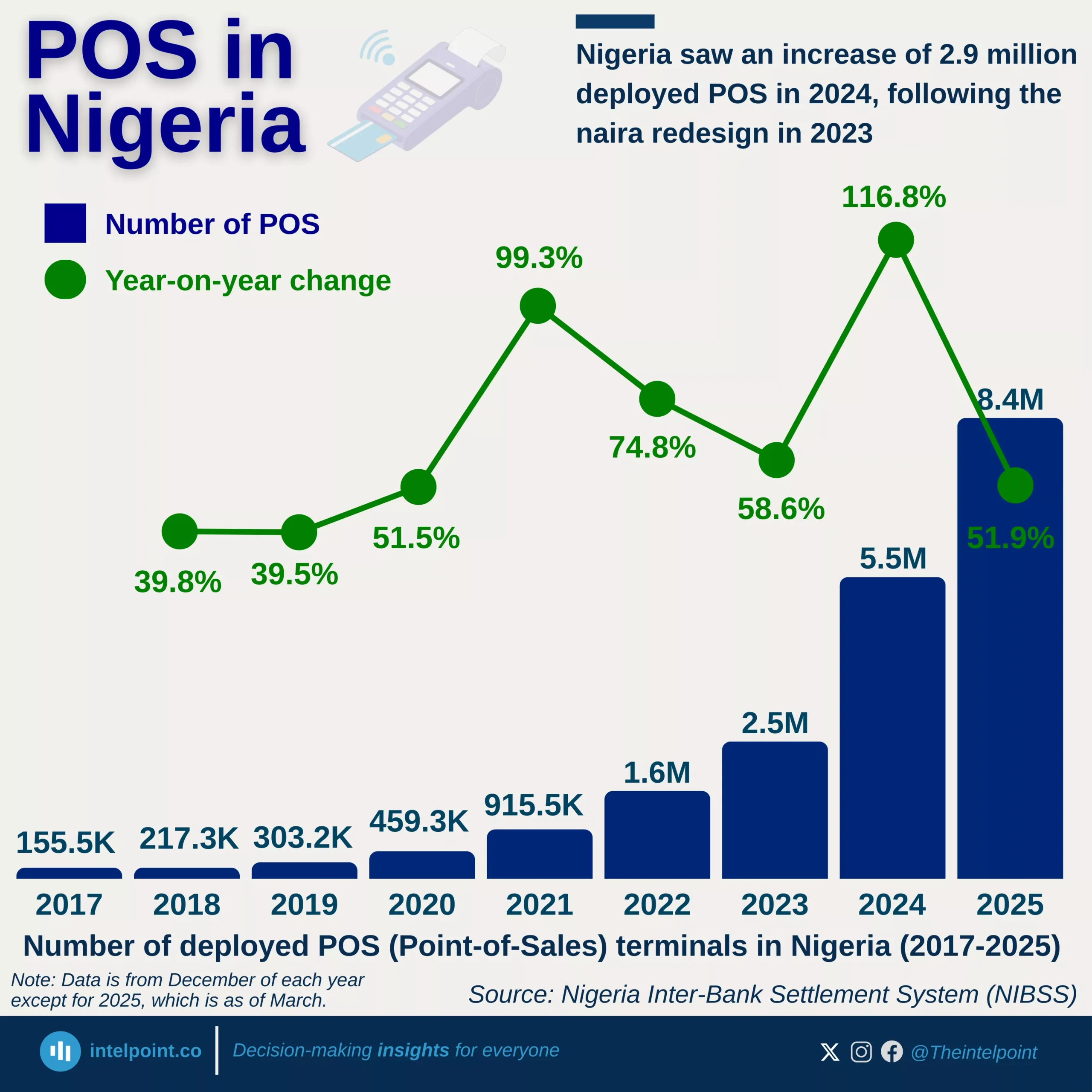
Nigeria saw an increase of 2.9 million deployed POS in 2024, following the naira redesign in 2023
  • Deployed POS terminals grew from about 156,000 in 2017 to 8.4 million in 2025.
  • Nigeria added more than eight million terminals in eight years, indicating rapid adoption of digital payments.
  • Growth accelerated sharply after 2020, marking a major shift toward cashless transactions.
  • The highest year-on-year growth (116.8%) occurred in 2024, following the naira redesign.
  • About three million terminals were added in 2024 alone.
  • POS agents became critical financial access points during the period of cash shortage.
  • POS terminals now function as mini-banks in many communities.
  • Financial inclusion has expanded through agent-based banking and POS networks.

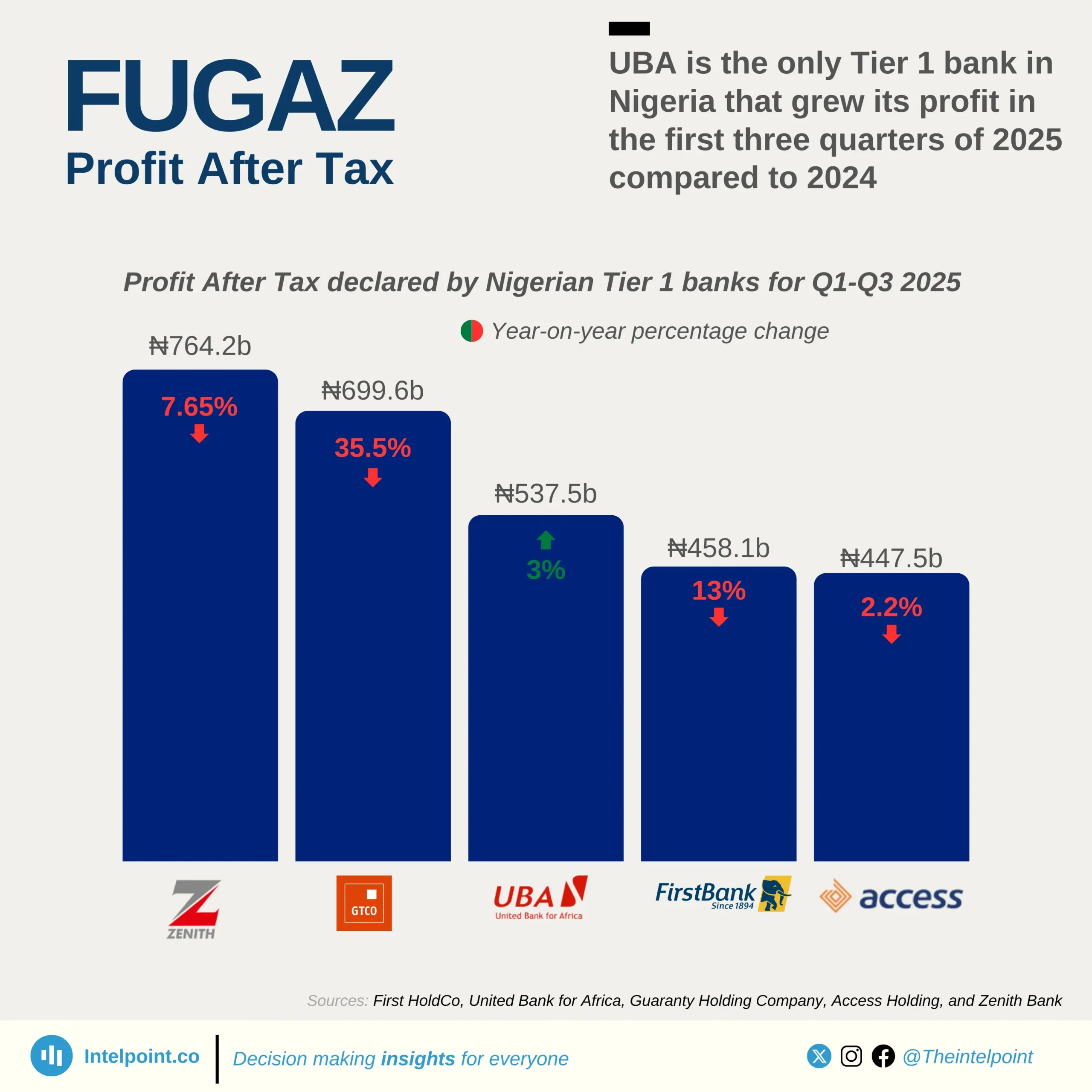
UBA is the only Tier 1 bank in Nigeria that grew its profit in the first three quarters of 2025 compared to 2024
  • FUGAZ posted a combined ₦2.91 trillion in profit from Q1 to Q3 of 2025.
  • Access Bank recorded the lowest PAT among the FUGAZ
  • UBA recorded a 3% year-on-year increase in PAT
  • FUGAZ recorded an average year-on-year percentage change of -11.2% for the period

GTCO declared ₦476b profit in H1 2025, with Nigeria contributing over 70% of African operations
  • Nigeria dominates with ₦339.6b, contributing over 70% of GTCO’s total profit after tax in Africa.
  • Ghana (₦61.9b) and Côte d’Ivoire (₦28.2b) followed as the strongest non-Nigerian subsidiaries.
  • Tanzania (₦46m) and Uganda (₦505m) contributed negligible profits compared to peers.
  • GTCO subsidiaries across Africa collectively generated around ₦476b profit after tax in the first half of 2025.

GTCO declared ₦476b profit in H1 2025, with Nigeria contributing over 70% of African operations
  • Nigeria dominates with ₦339.6b, contributing over 70% of GTCO’s total profit after tax in Africa.
  • Ghana (₦61.9b) and Côte d’Ivoire (₦28.2b) followed as the strongest non-Nigerian subsidiaries.
  • Tanzania (₦46m) and Uganda (₦505m) contributed negligible profits compared to peers.
  • GTCO subsidiaries across Africa collectively generated around ₦476b profit after tax in the first half of 2025.

Total microfinance deposits in Kenya only grew 1.66% CAGR over 10 years, ending at KSh 43.0B
  • Microfinance deposits in Kenya grew at only 1.66% CAGR between 2014 and 2024.
  • The peak occurred in 2021 at KSh 50.2B, after which deposits began a steady decline.
  • 2015 (+13.2%) and 2020 (+12.3%) posted the strongest year-on-year growth rates.
  • The sector saw consecutive contractions from 2022 (-7.3%), 2023 (-5.7%), to 2024 (-2.0%).
  • Despite small rebounds in 2018 (+7.3%) and 2019 (+12.3%), the long-term trend is weak.

POPULAR TOPICS
SIGN UP TO OUR NEWSLETTER
Get periodic updates about the African startup space, access to our reports, among others.
Subscribe Here
Subscription Form

A product of Techpoint Africa. All rights reserved