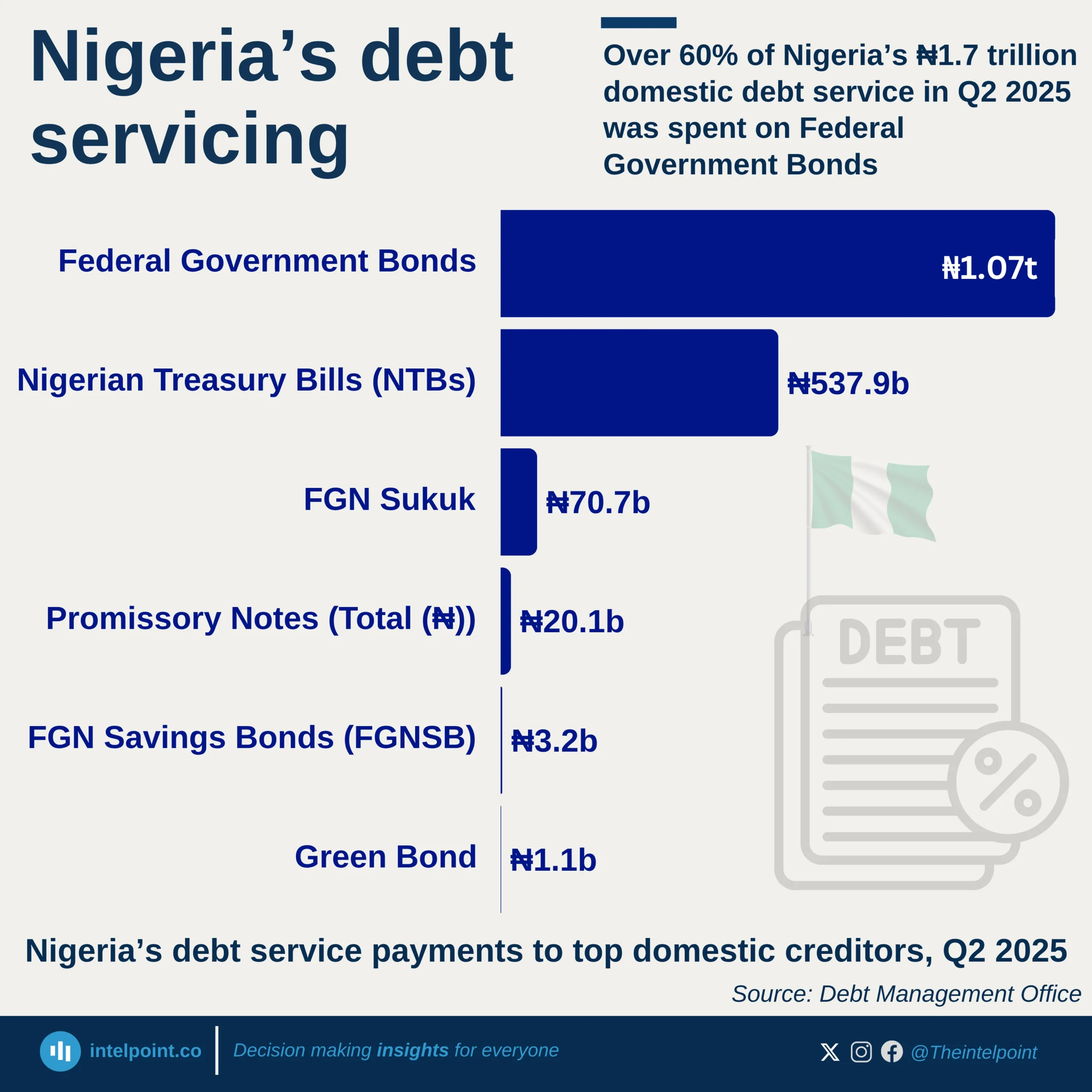
Over 60% of Nigeria’s ₦1.7 trillion domestic debt service in Q2 2025 was spent on Federal Government Bonds

Key Takeaways

  • FGN bonds dominated: ₦1.07 trillion went to Federal Government Bonds, accounting for about 63% of total domestic debt servicing.
  • Treasury bills followed: Payments on NTBs reached ₦537.9 billion, making up roughly 31% of the total.
  • Sukuk and promissory notes together cost ₦90.8 billion, reflecting Nigeria’s mix of infrastructure and settlement instruments.
  • Green and savings bonds remained minimal, together below ₦5 billion, showing limited traction for retail and sustainability-focused debt.

Between April and June 2025, Nigeria spent around ₦1.7 trillion repaying domestic debts, underscoring its reliance on internal borrowing to fund fiscal operations. FGN Bonds remained the government’s primary financing tool, taking up nearly two-thirds of total debt servicing, followed by Treasury Bills, which cover short-term funding needs.

Meanwhile, niche instruments like Sukuk, Promissory Notes, FGN Savings Bonds, and Green Bonds accounted for less than 6% combined, a reminder that while Nigeria has diversified its borrowing instruments, the debt burden still leans heavily on conventional bonds and bills. The pattern mirrors a government strategy balancing liquidity needs with long-term financing, but it also highlights persistent fiscal strain driven by high domestic interest obligations.
Source:

Debt Management Office

Period:

Q2 2025
HTML code to embed chart
Want a bespoke report?
Reach out
Tags
Related Insights

Nigeria beats Egypt to win AFCON bronze medal, extending its record to nine third-place finishes
  • Nigeria extends its AFCON bronze medal wins to nine, the highest in men’s AFCON history, with another podium finish.
  • The win over Egypt highlights Nigeria’s resilience, turning late-stage setbacks into tangible success.
  • Bronze medals remain rare for most nations, with the majority appearing only once or twice in AFCON history.

10 Nigerian states and the FCT cut their external debt by a combined $227.19 million in H1 2025
  • Ten states and the FCT collectively reduced their external debt by $227.19 million in H1 2025.
  • Lagos, Edo, and Rivers accounted for most of the reductions, making up more than three-quarters of the total.
  • Several smaller states also trimmed their balances, but by relatively modest amounts.
  • These reductions significantly offset the increases recorded by 26 other states, helping keep nationwide net external debt growth low.

26 Nigerian states added a combined $239m to their external debt in H1 2025
  • 26 states increased their external debt by a combined $239 million in H1 2025.
  • Imo, Oyo, Kaduna, Enugu, and Ogun recorded the biggest increases.
  • 11 states, including the FCT, reduced their debt through higher repayments.
  • Lagos, Edo, Rivers, and Bauchi accounted for most of the $227 million in reductions.
  • Total state external debt rose only slightly, from $4.8 billion to $4.812 billion.

Nigeria’s power grid is 69.9% powered by thermal plants
  • Thermal energy dominates Nigeria’s grid, supplying 69.9% of total power.
  • Hydro plants contribute 30.1%, making them the country’s second major source.
  • The heavy reliance on thermal generation shows Nigeria’s grid is still largely fossil-fuel driven.
  • Hydro remains a crucial but secondary source, supporting overall supply stability.

Nigeria's DisCos recorded ₦360bn revenue gap after collecting ₦1.12tn from ₦1.49tn billed in H1 2025
  • DisCos billed approximately ₦1.49 trillion but collected only ₦1.12 trillion in H1 2025.
  • Ikeja and Eko DisCos generated the highest revenues, collecting ₦206.22 billion and ₦210.59 billion, respectively.
  • Revenue collection gaps remain significant, with Jos, Kaduna, and Yola posting the weakest collection performances.
  • The wide gap between billings and actual collections suggests persistent challenges in customer payment compliance, metering, and distribution efficiency.

Nigeria has installed 3.65 million electricity metres since 2019; Ikeja DisCo leads with 823,000, and Aba Power at the bottom with 56,000
  • Approximately 3.65 million metres have been installed nationwide across all frameworks since 2019.
  • Ikeja DisCo leads by a wide margin with 823,000 installations, over twice the volume of most other DisCos.
  • Kaduna, Yola, and Aba Power recorded the lowest metre installations, each below 100,000.
  • The disparities in installation totals reveal uneven progress in achieving nationwide metering coverage.

POPULAR TOPICS
SIGN UP TO OUR NEWSLETTER
Get periodic updates about the African startup space, access to our reports, among others.
Subscribe Here
Subscription Form

A product of Techpoint Africa. All rights reserved