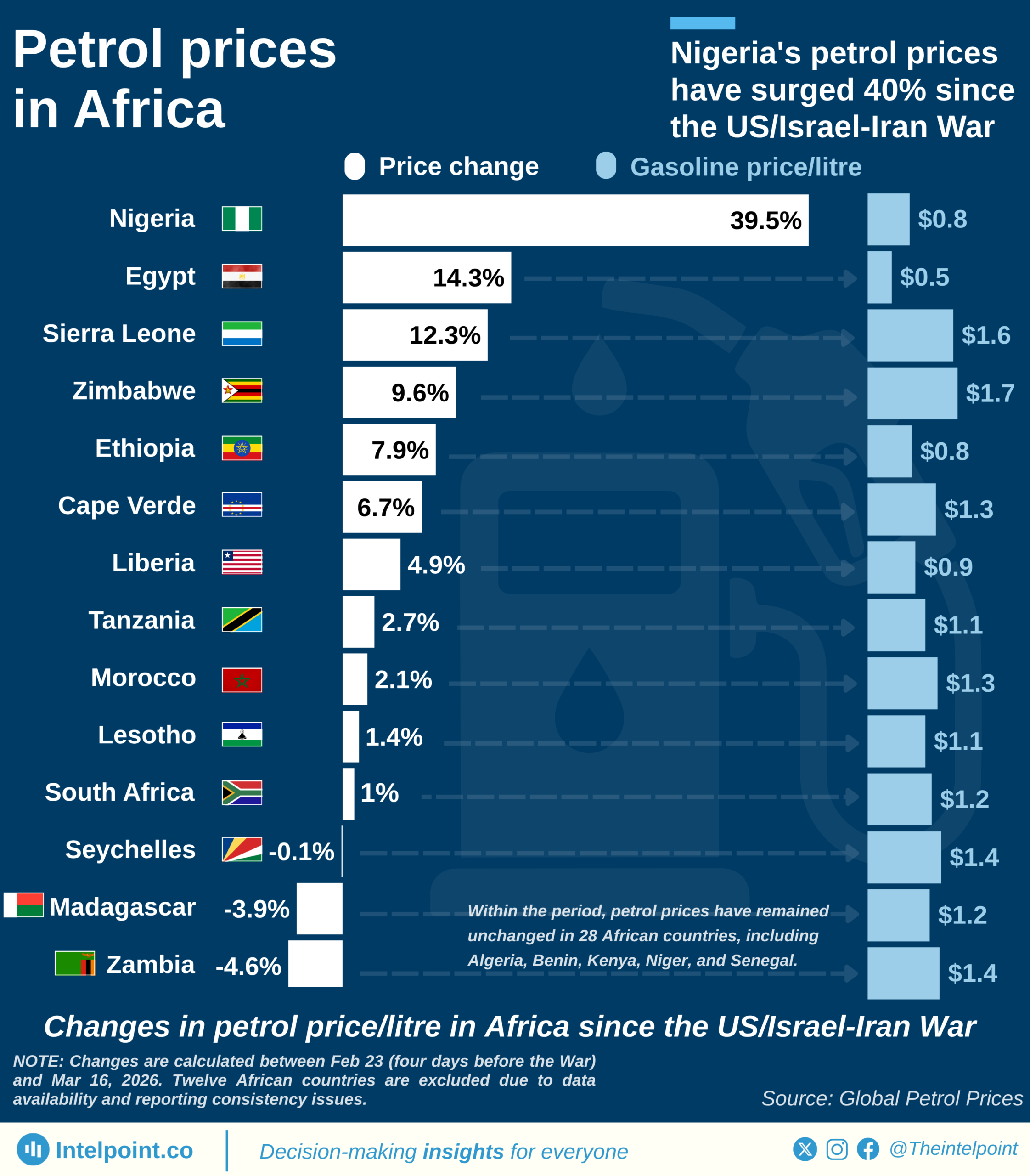
Nigeria's petrol prices have surged 40% since the US/Israel-Iran War

  • Nigeria recorded the largest petrol price increase in Africa, rising 39.5% between February 23 and March 16, 2026.
  • Egypt experienced a 14.3% increase, making it one of the largest price jumps in Africa.
  • Nigeria’s increase is more than double that of Egypt.
  • A number of African countries recorded very small price changes, including Tanzania (2.7%), Morocco (2.1%), and South Africa (1%).
  • A few countries actually saw declines in fuel prices, including Madagascar (-3.9%) and Zambia (-4.6%).
  • During the period, petrol prices remained unchanged in 28 African countries.

Global tensions often ripple through energy markets, but the recent price movements show that the impact has not been evenly distributed. Since the start of the US/Israel-Iran War, petrol prices in Nigeria have surged by about 39.5%, the largest increase in Africa.

Across Africa, the pattern is mixed. Some countries have seen moderate increases, while others have experienced minimal changes or even slight declines. The disparity highlights how fuel pricing structures, subsidy policies, exchange rates, and supply chains shape how global shocks filter into domestic fuel markets.

Geopolitical conflicts involving major oil-producing regions often create uncertainty in global crude markets. The current war involving the US, Israel, and Iran has added pressure to energy supply expectations and shipping routes. While these tensions broadly affect global oil prices, the local policy environment and market structure determine how sharply prices move in each country.
Source:

Global Petrol Prices

Period:

February 23, 2026-March 16, 2026.
HTML code to embed chart
Want a bespoke report?
Reach out
Tags
Related Insights

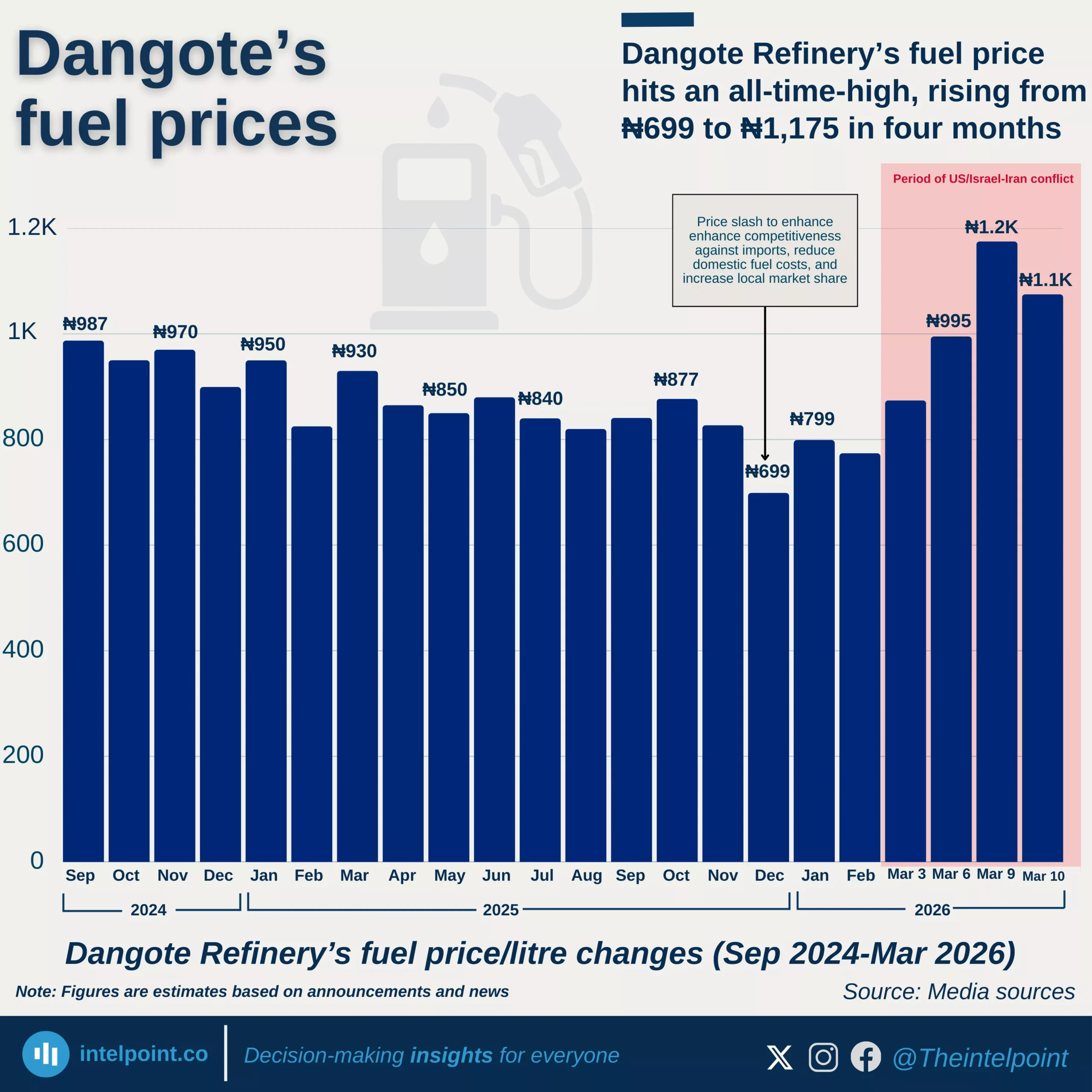
Dangote Refinery’s fuel price hits an all-time-high, rising from ₦699 to ₦1,175 in four months
Fuel prices from Dangote Refinery reached an all-time high of ₦1,175 per litre in March 2026. The lowest recorded price in the period was ₦699 per litre in December 2025, showing a wide price swing. The jump from ₦699 to ₦1,175 happened in roughly four months.
  • Prices earlier in the timeline hovered mostly between ₦820 and ₦987 during late 2024 and much of 2025.
  • The December 2025 price cut was aimed at making locally refined fuel more competitive against imports.
  • After the price drop, fuel costs began rising again in early 2026, reaching ₦995 by early March before climbing further.
  • Global geopolitical tensions affecting oil markets contributed to the upward pressure on prices.

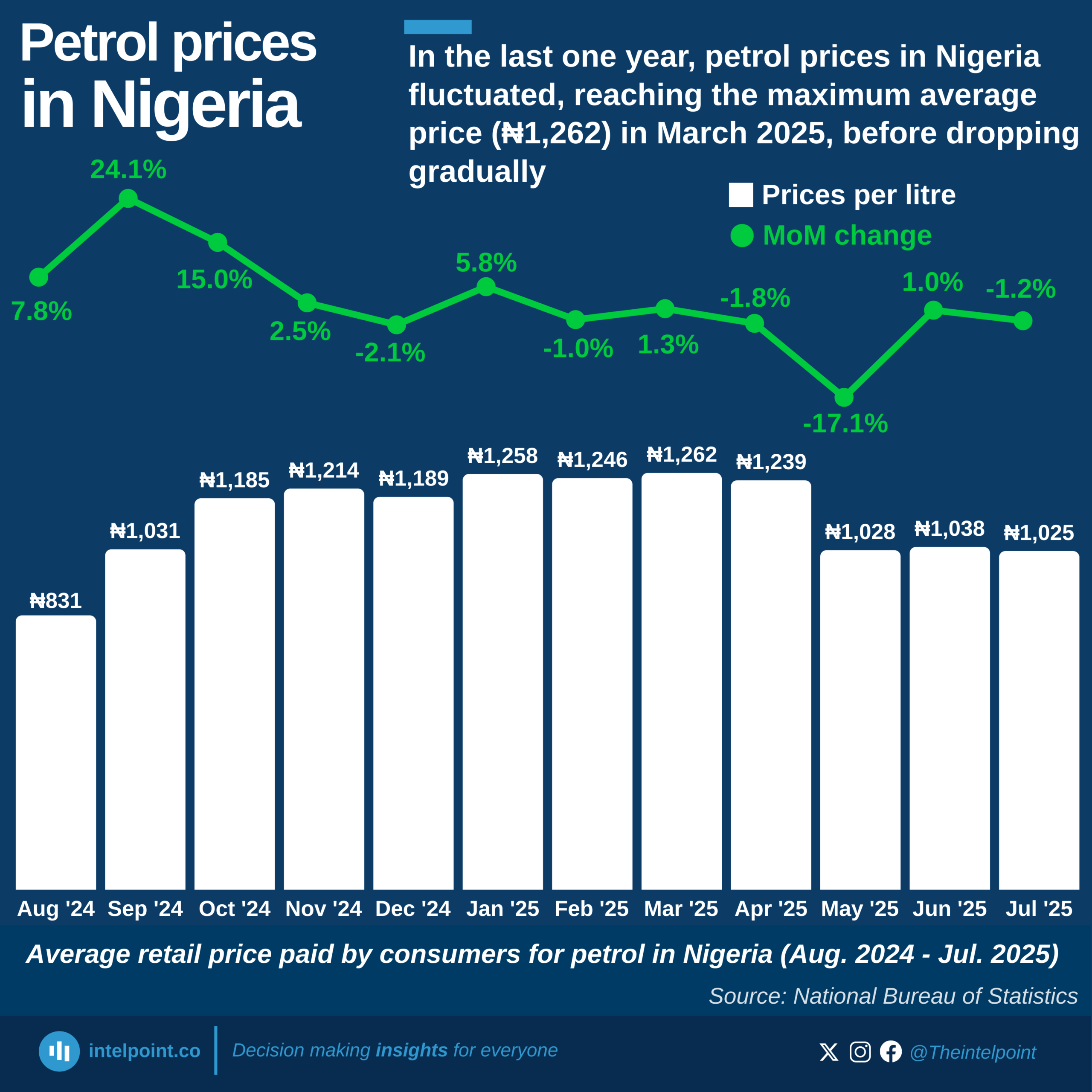
In the last one year, petrol prices in Nigeria fluctuated, reaching the maximum average price (₦1,262) in March 2025, before dropping gradually
  • Petrol prices in Nigeria rose by 52% between August 2024 (₦830.5) and March 2025 (₦1,261.7).
  • The highest monthly increase was in September 2024 (+24.1%), while the sharpest drop came in April 2025 (-17.1%).
  • By July 2025, prices had eased to ₦1,025, still 23% higher than a year earlier.
  • NNPC retail outlets offered significantly lower prices than the national average, with Abuja as low as ₦880 at the March 2025 peak.
  • Dangote Refinery offered relatively competitive pricing, ranging from ₦840 to ₦899, creating an alternative supply option.

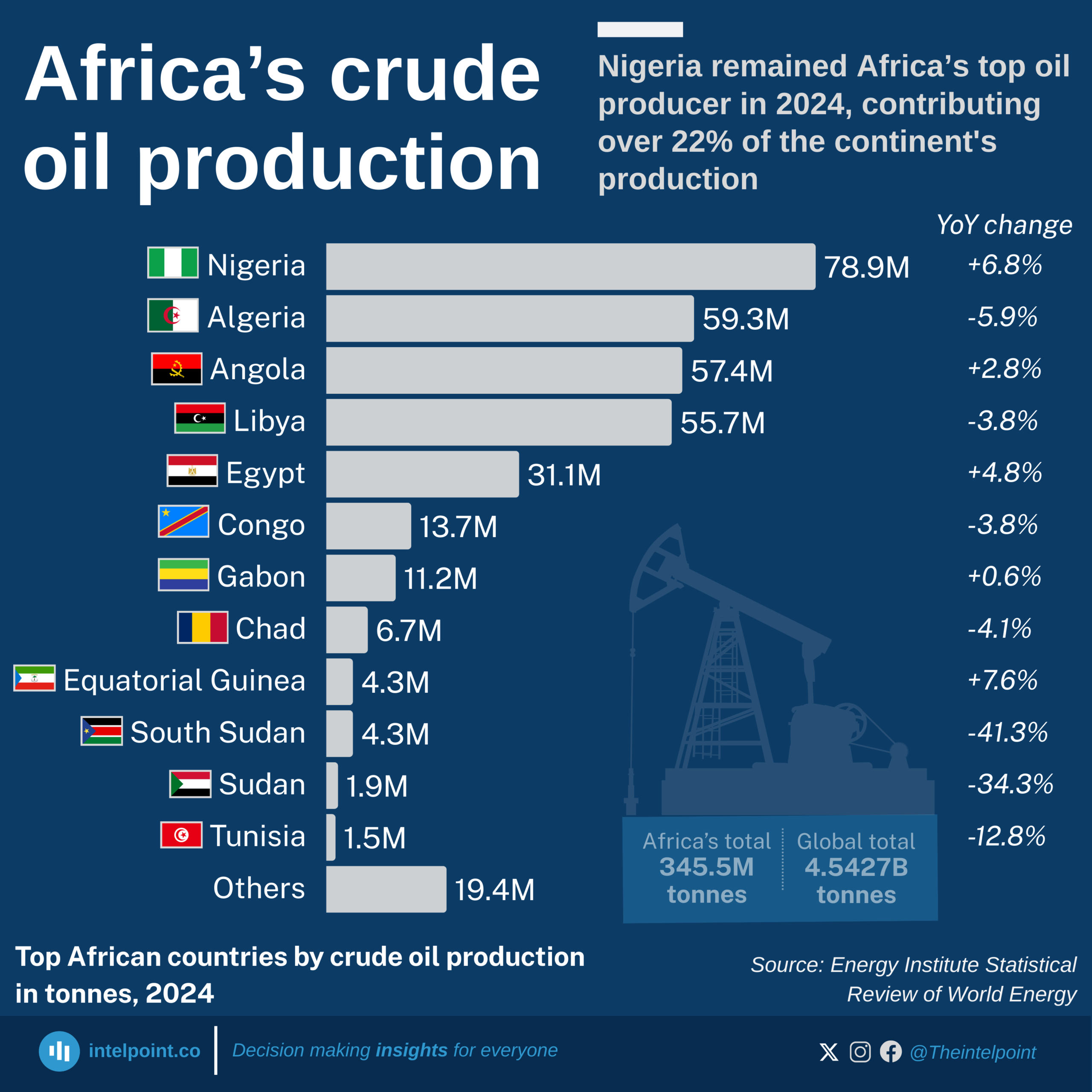
Nigeria remained Africa’s top oil producer in 2024, contributing over 22% of the continent's production
  • Nigeria led with 78.9 Mtoe, accounting for over 22% of Africa’s total oil output.
  • Algeria (59.3 Mtoe) and Angola (57.4 Mtoe) followed closely; the three top producers together supplied] 56% of the continent’s oil.
  • Africa’s total oil production was 345.5 Mtoe, just 7.6% of the global total (4,542.7 Mtoe).
  • The top 5 producers accounted for over 80% of Africa’s oil.

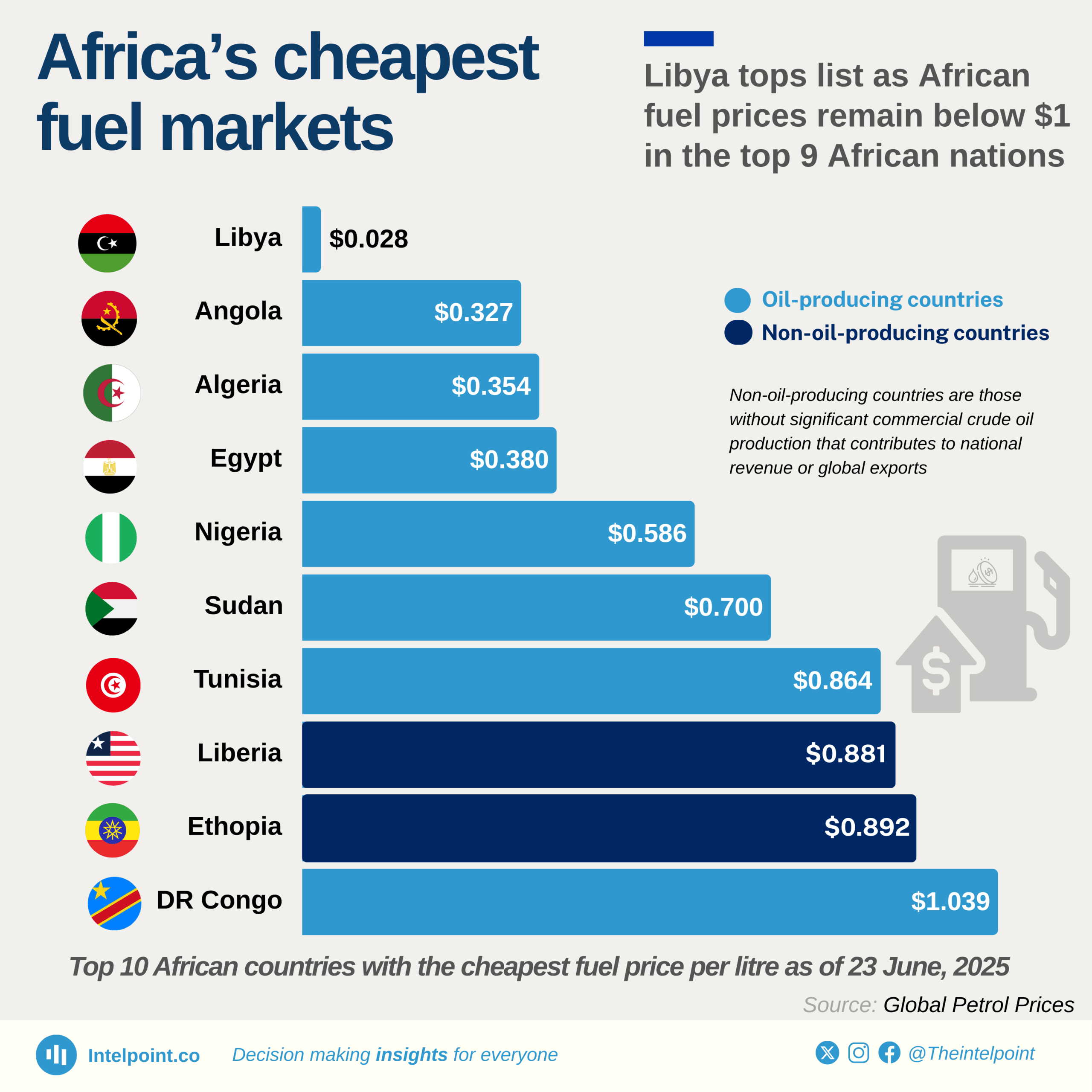
Libya tops list as African fuel prices remain below $1 in the top 9 African nations
  • Libya maintains its position as the cheapest fuel market in Africa with just $0.028 per litre.
  • Nine out of ten countries have fuel prices under $1 per litre, signalling widespread affordability across much of the continent.
  • Nigeria, despite partial subsidy reforms, still ranks among the cheapest with fuel priced at $0.586 per litre.
  • DR Congo is the only country in the top 10 where fuel costs exceed $1 per litre, standing at $1.039.
  • Ethiopia and Liberia are the only non-oil-producing countries among Africa’s top 10 cheapest fuel markets.

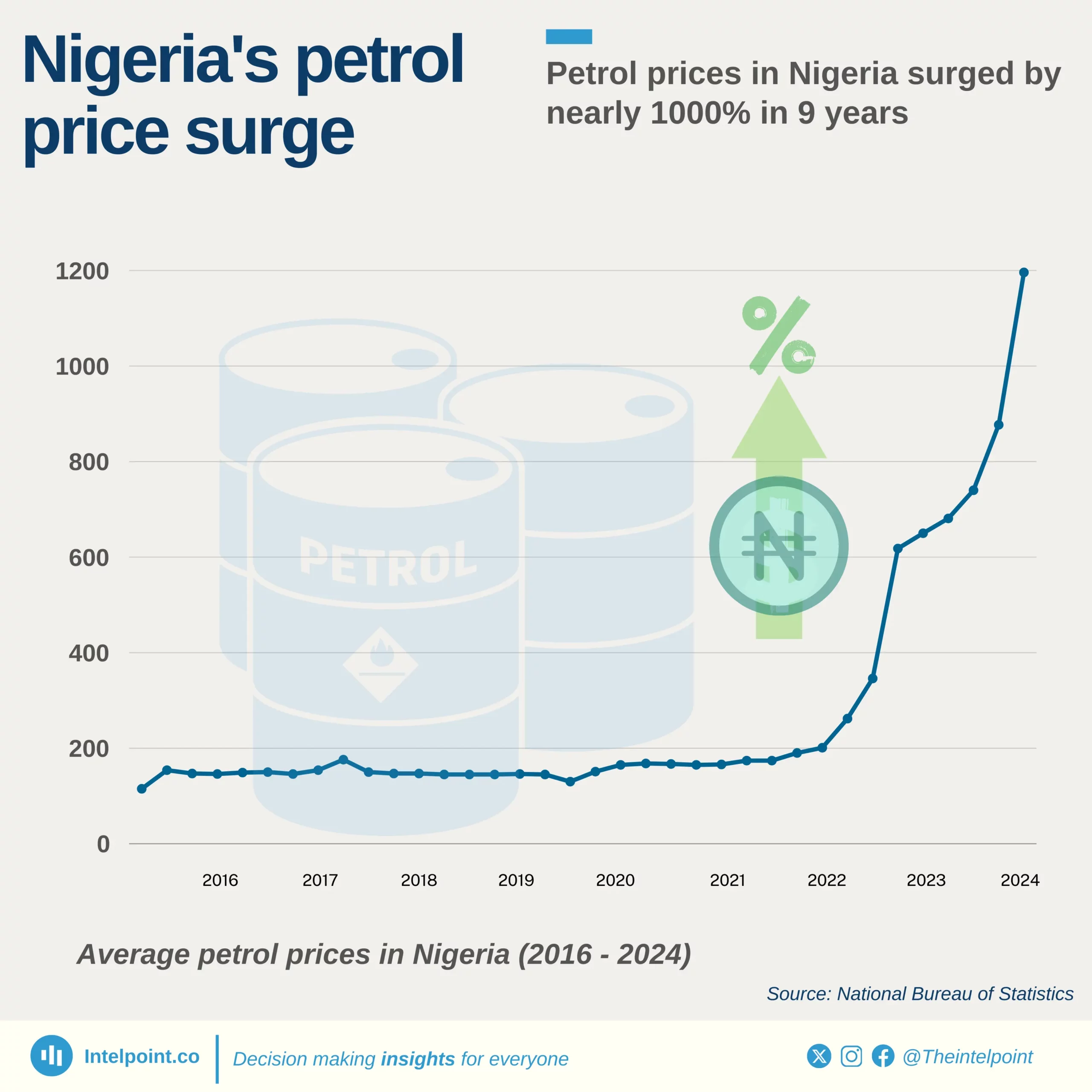
Petrol prices surged by nearly 1000% in 9 years
  • In February 2016, petrol was at its lowest price of 99.80 per litre, marking the last time fuel prices remained below 100.
  • By November 2024, petrol prices soared to an all-time high of 1,214.17 per litre, reflecting the compounded effects of inflation, currency depreciation, and global oil price volatility.
  • Over the nine-year period, the average petrol price stood at 272.65 per litre.
  • Between January 2016 and December 2024, petrol prices increased by 1,079.52, a staggering 984.96% rise, emphasising the long-term upward trajectory influenced by economic challenges, subsidy removals, and fluctuating exchange rates.
  • The most volatile period recorded a month-to-month price surge of over 129.23%.

Nigeria’s 2023 fuel imports declined by 13.7%, the biggest decline since 2015
In 2023, Nigeria saw a 17% reduction in petrol supply as imports fell by nearly 14% from 23.5 billion litres in 2022 to 20.3 billion litres. The removal of the fuel subsidy in May 2023 led to higher prices and lower demand, especially in the second half of the year. The Dangote refinery’s rising output could shape future supply.

POPULAR TOPICS
SIGN UP TO OUR NEWSLETTER
Get periodic updates about the African startup space, access to our reports, among others.
Subscribe Here
Subscription Form

A product of Techpoint Africa. All rights reserved