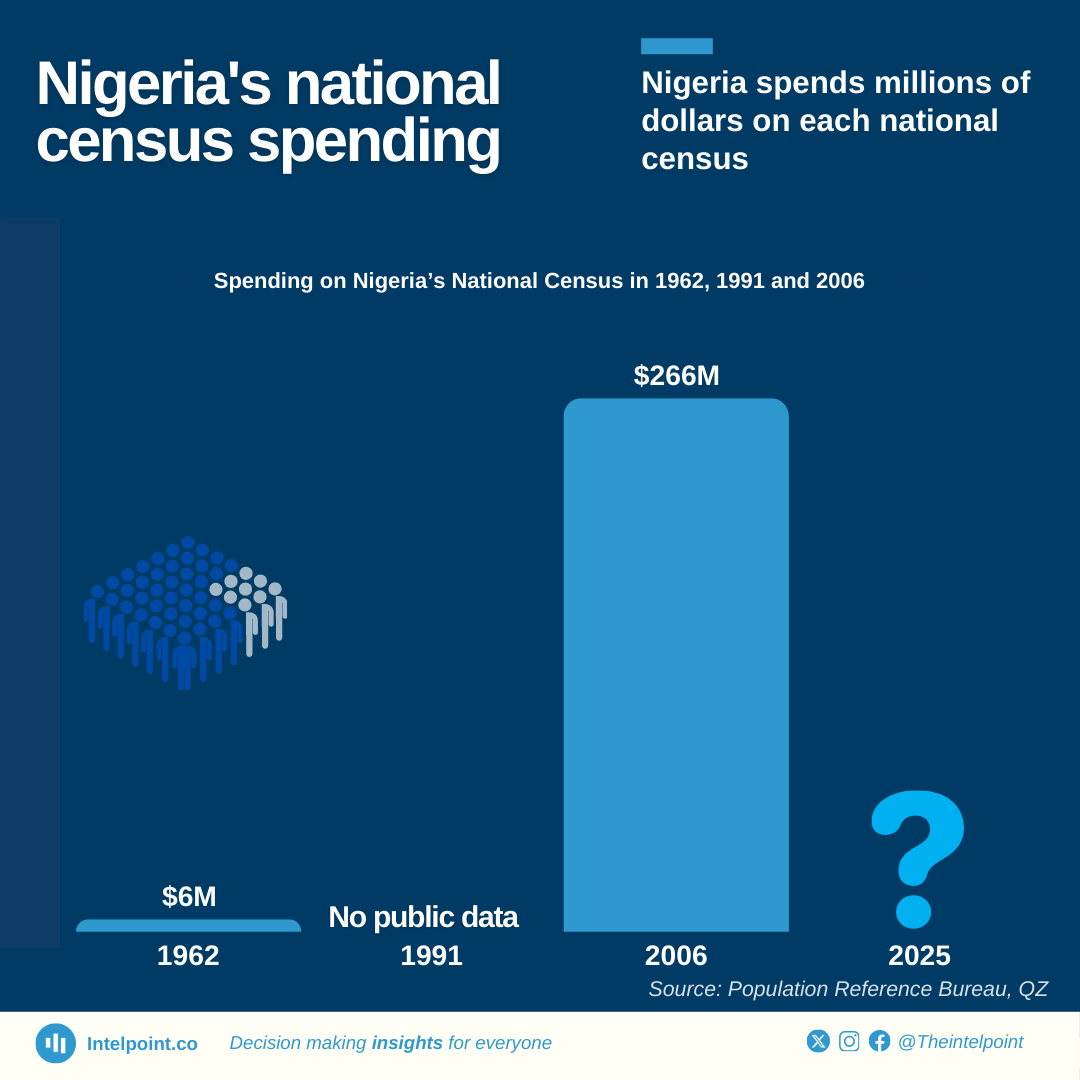
Nigeria spends millions of dollars on each national census

  • Nigeria spent $6 million on its first post-independence census in 1962.
  • There is no publicly available data on the amount spent during the 1991 census.
  • By 2006, census spending had surged to $266 million, highlighting a significant increase in the cost of national population counts.
  • The budget for the upcoming 2025 census has not yet been disclosed.
  • In April 2025, President Tinubu inaugurated the National Census Committee and gave a three-week deadline to submit a detailed report.

Census spending in Nigeria has increased since the country’s early years of independence , from just $6.2 million in 1962 to hundreds of millions in the early 2000s. While there is no public data for the 1991 census expenditure, the overall trend shows a growing investment in national data collection efforts. As the country awaits the exact budget for the upcoming 2025 census report, President Tinubu has formed a new Census Committee and given it a three-week deadline to deliver the report. With nearly two decades since the last census in 2006, this national exercise is critical for updating demographic and socio-economic data.
Source:

Population Reference Bureau, QZ

Period:

1962, 1991, 2006
HTML code to embed chart
Want a bespoke report?
Reach out
Tags
Related Insights

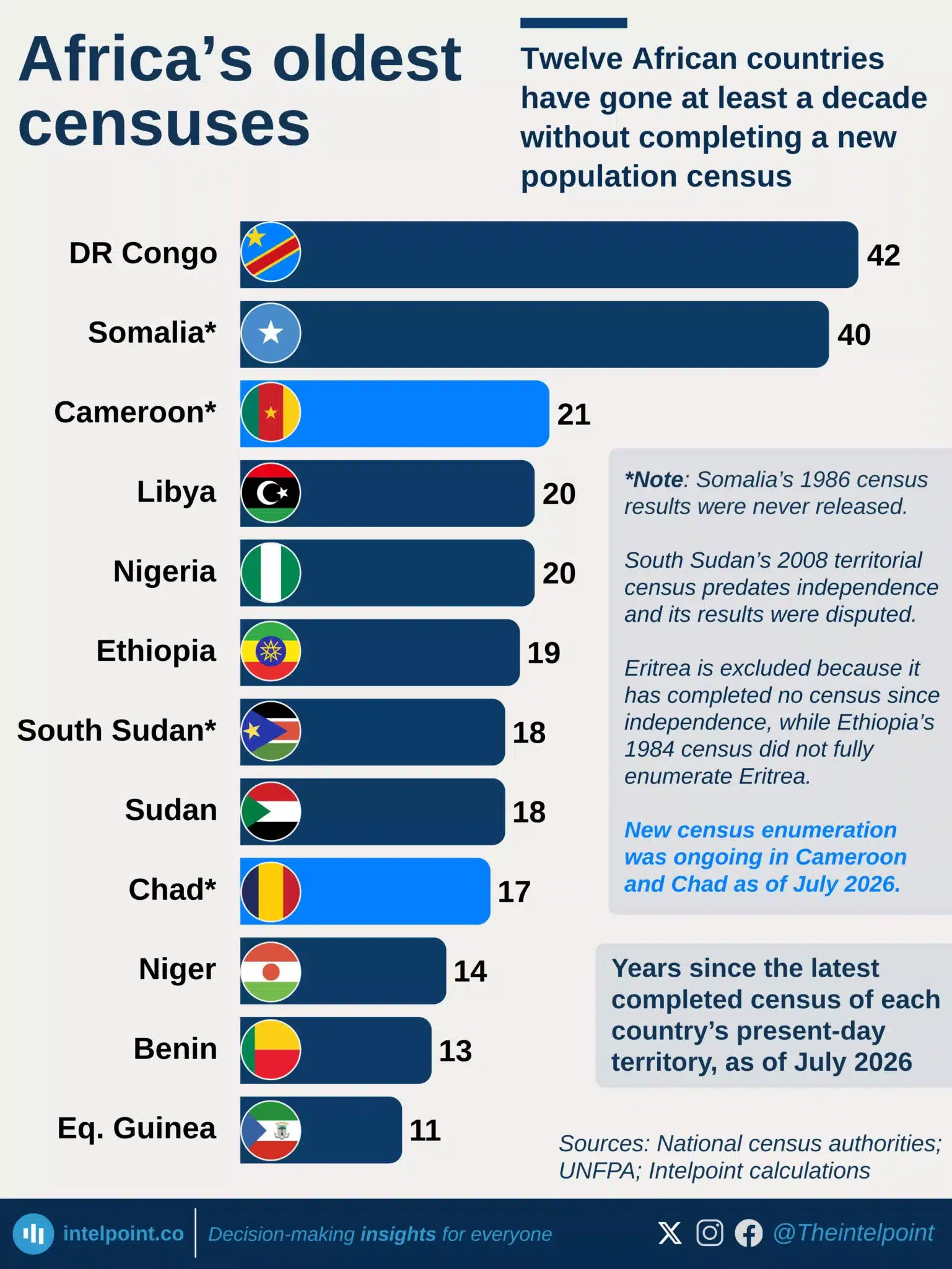
Twelve African countries have gone at least a decade without completing a new population census
  • Twelve African countries have not completed a census in at least 10 years.
  • DR Congo (42 years) and Somalia (40 years) have Africa's oldest censuses.
  • Guinea-Bissau has completed a new census, while Cameroon and Chad are still counting.
  • Nigeria and DR Congo are preparing new censuses, but fieldwork has not begun.
  • South Sudan's census is disputed, while Eritrea is excluded from the ranking.

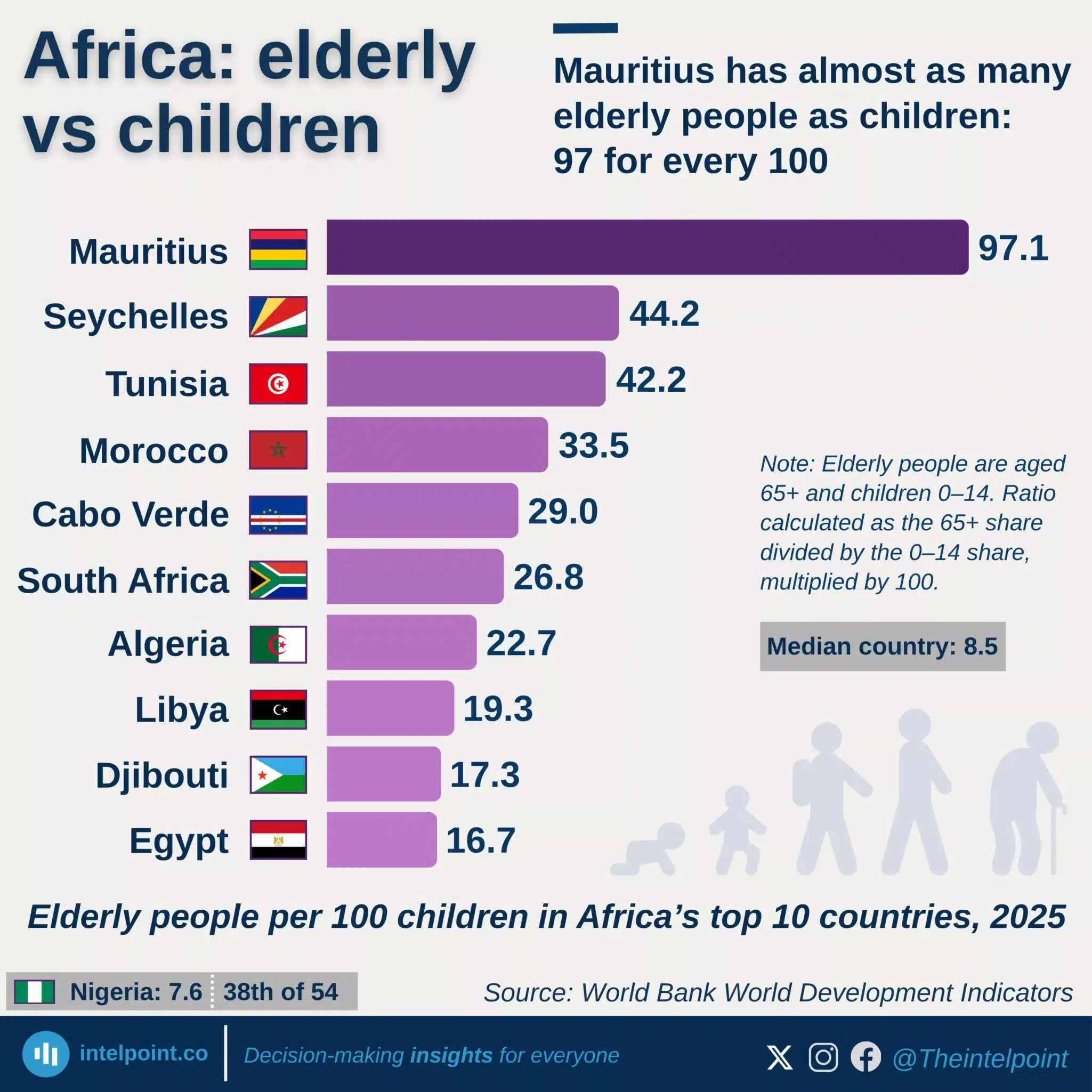
Mauritius has almost as many elderly people as children: 97 for every 100
  • Mauritius had 97 elderly people per 100 children in 2025, over 11 times Africa’s median of 8.5.
  • Its ratio increased from fewer than seven in 1960 to 24 in 2000, becoming Africa’s highest in 2009.
  • Seychelles ranked second with 44 elderly people per 100 children, followed by Tunisia with 42.
  • Mauritius’s child share fell from 25.6% to 14.5% between 2000 and 2025, while its elderly share increased from 6.1% to 14.1%.
  • Nigeria’s ratio moved from 6.9 to 7.6 between 2000 and 2025, placing it 38th among 54 countries.

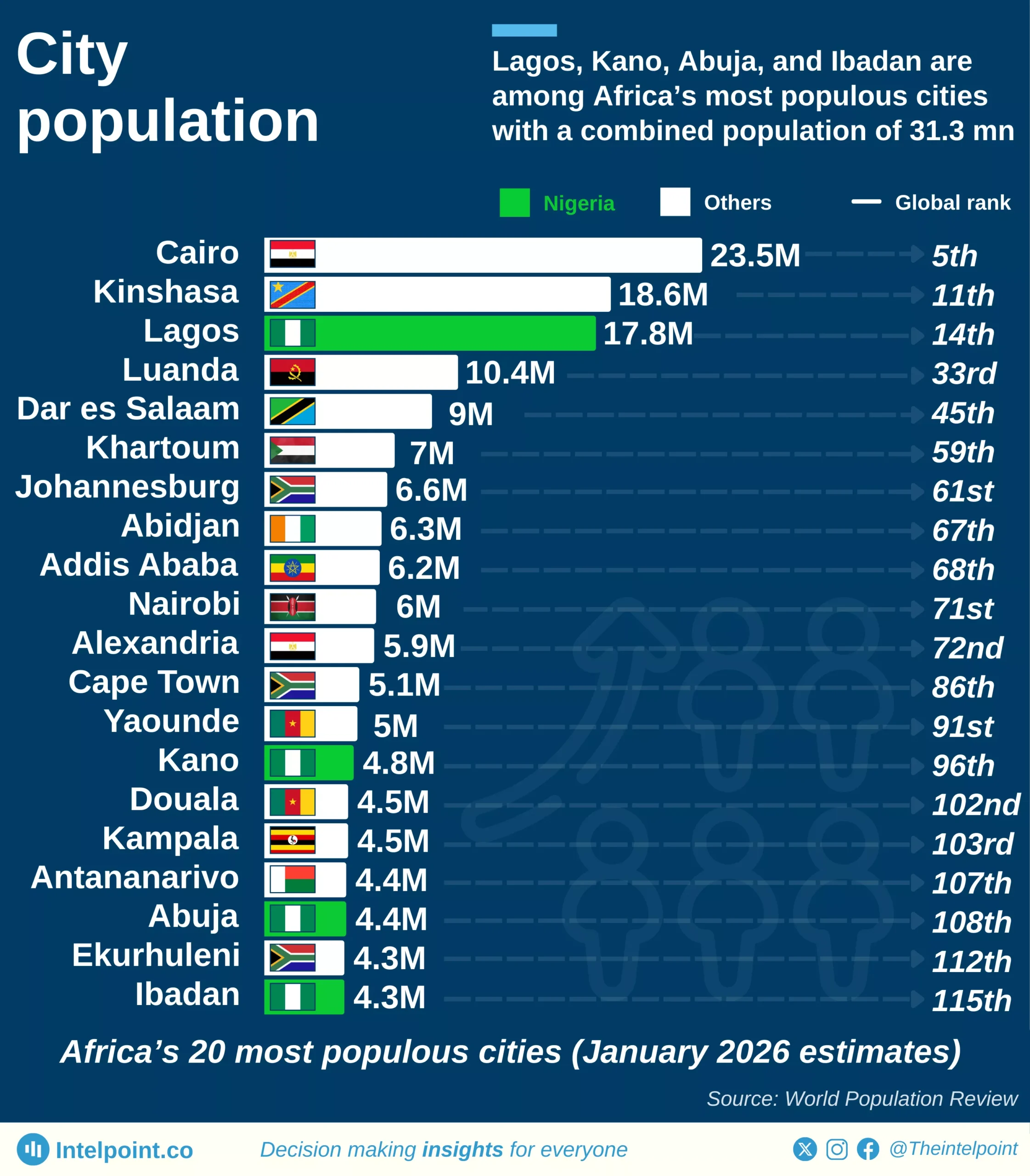
Lagos, Kano, Abuja, and Ibadan are among Africa’s most populous cities with a combined population of 31.3 mn
  • Lagos is Africa’s third-largest city and ranks 14th globally.
  • Cairo remains Africa’s largest city, with over 23 million people, keeping Egypt at the centre of the continent’s urban network.
  • Kinshasa’s position shows Central Africa’s rising urban influence.
  • There is a steep population gap after the top three cities.

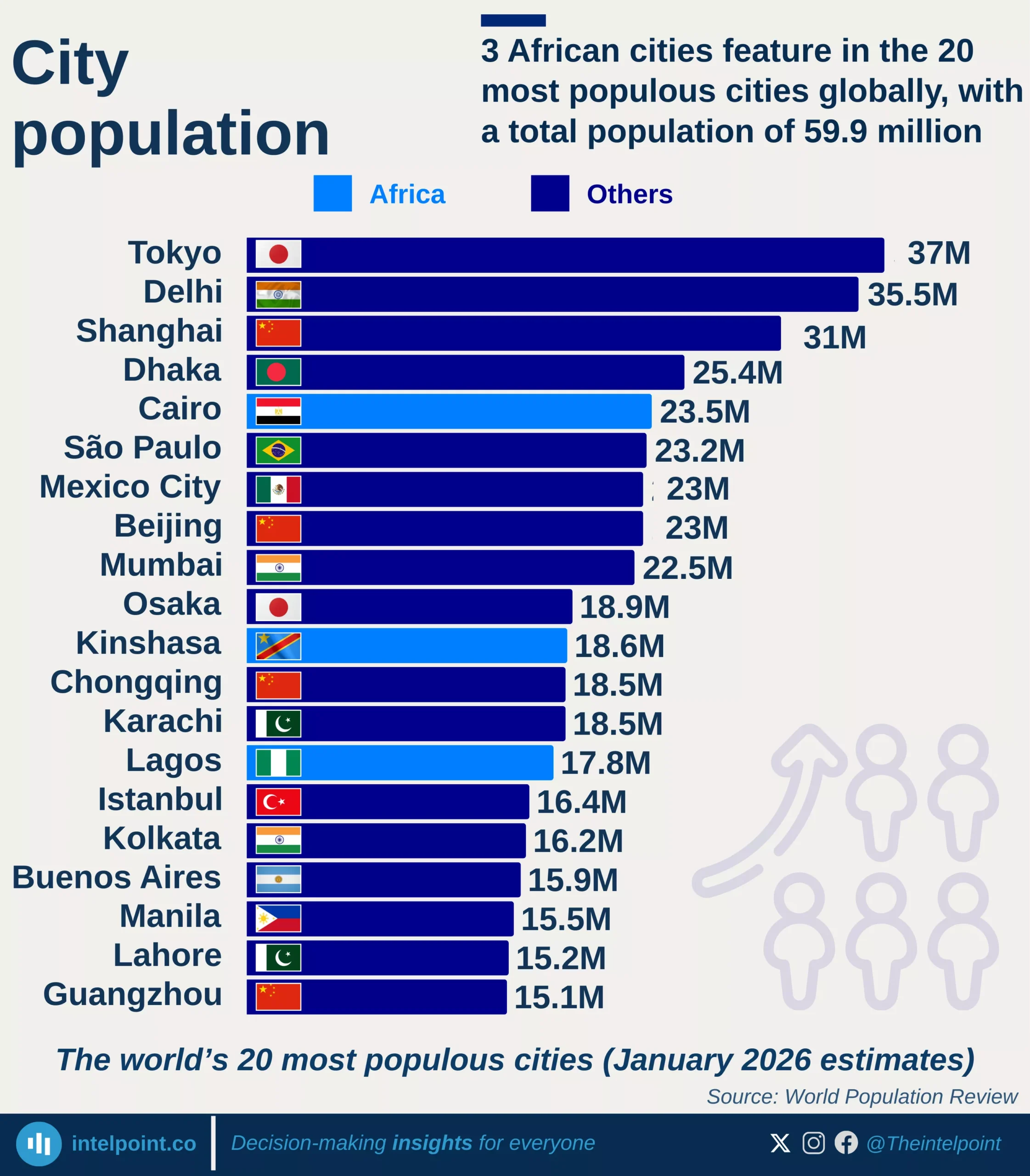
3 African cities feature in the 20 most populous cities globally, with a total population of 59.9 million
  • Together, the top three cities — Tokyo, Delhi, and Shanghai — have more than 100 million residents.
  • Asia dominates the ranking, with most of the top ten cities located on the continent.
  • Only three African cities — Cairo, Kinshasa, and Lagos — appear in the top 20.
  • Africa’s three mega-cities together account for nearly 60 million people, showing concentrated urban growth.
  • Urban population growth is driven by migration toward economic and commercial hubs.

Nigeria's age dependency ratio for the young dominates that of the old, on average, at 14:1
  • The young-to-old dependency ratio stands at 14:1, showing that youth dependency overwhelmingly drives the total ratio.
  • The total dependency ratio declined from 88.2% in 1976 to 78.8% in 2024, showing slow but steady improvement.
  • The youth dependency ratio has dropped from 82.2% to 73.3% over the same period.
  • The old-age dependency ratio remained almost flat, averaging around 5–6% for nearly 50 years.
  • The highest total dependency ratio was 95.0% in 1988.
  • The ratio’s slight downward trend after 2012 reflects a growing working-age population entering the labour market.

Six of the ten countries with the lowest share of older populations are in Africa
  • Qatar has the lowest share of seniors, with only 1.7% of its population aged 65+.
  • The UAE follows closely at 1.8%.
  • Zambia has 2.0% of its population aged 65 and above, totalling about 438,000 people.
  • Uganda, Chad, and the Central African Republic each have a senior population of around 2.1–2.2%, with totals exceeding 1 million seniors.
  • Qatar also has the smallest absolute number of seniors on the list—just 53,000 people.
  • Nigeria has 7.3 million seniors that represent only 3.1% of its population, ranking 25th worldwide.

POPULAR TOPICS
SIGN UP TO OUR NEWSLETTER
Get periodic updates about the African startup space, access to our reports, among others.
Subscribe Here
Subscription Form

A product of Techpoint Africa. All rights reserved