Nigeria: Generated Value Added Tax (VAT) for Q1 2012 - 2021
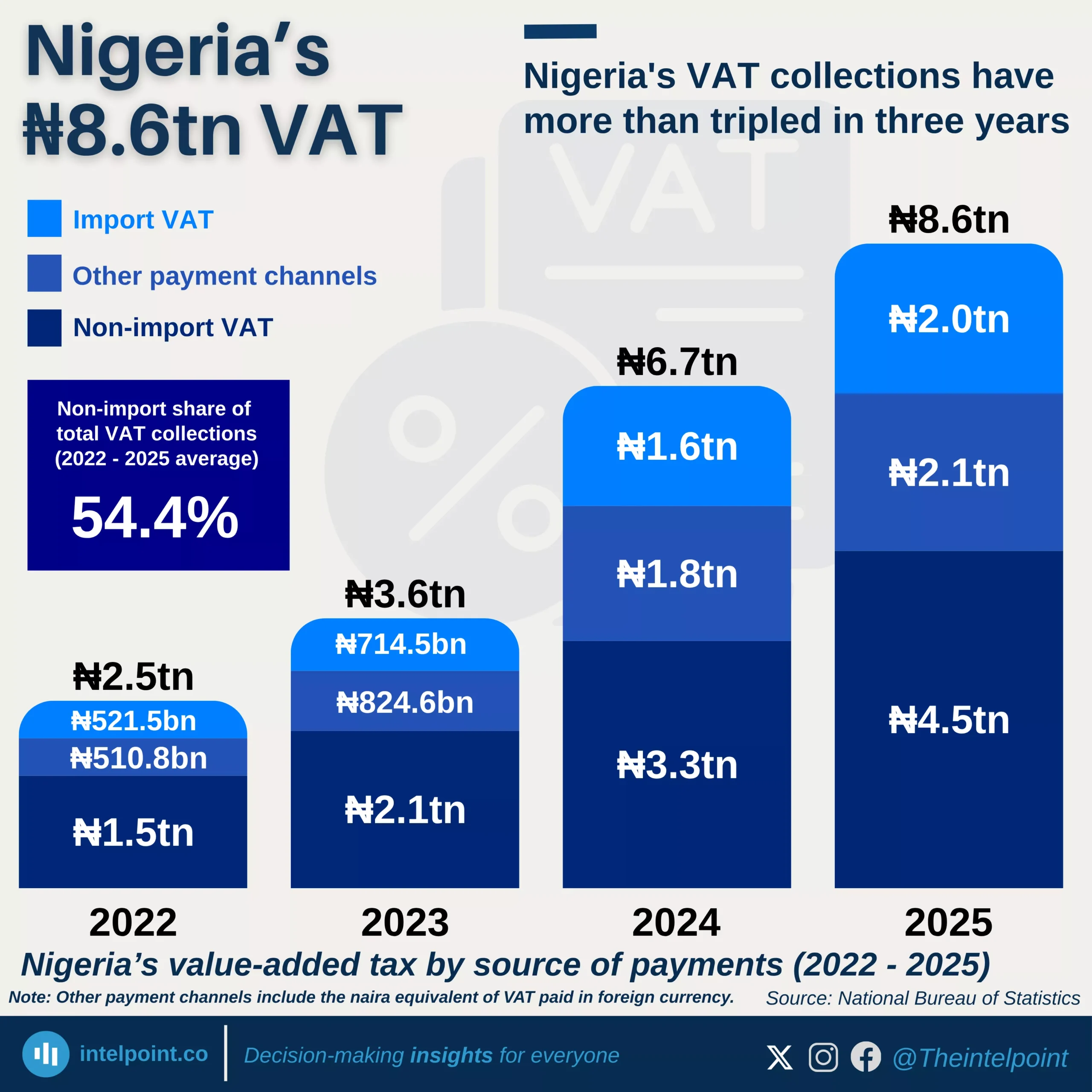
VAT in Nigeria was increased to 7.5% from 5%, effective from January 13, 2020. Though the increase didn’t affect Q1 2020’s figures that much, figures from Q1 2021 exceed Q1 2020’s by 53%. Here’s the total VAT generated for Q1 of the past ten years.
Source:
National Bureau of Statistics, Federal Inland Revenue Service
FIRS recorded ₦15.9 trillion of non-oil tax, almost three times the ₦5.8 trillion recorded for oil tax.
Non-oil tax revenue made up 73.3% of the total revenue collected in 2023.
From 2012 down to 2024, non-oil tax revenue surpassed oil tax revenue most of the time.
Oil taxes are petroleum profit tax and company income (oil & gas) tax while non-profit tax includes company income (non-oil) tax, gas tax, capital gains, stamp duty, NCS import VAT, and non-import VAT.
Company Income Tax (Non-Oil) emerged as the largest contributor, accounting for over 30% of total tax revenue.
NCS-Import VAT followed closely, contributing 23.63%, emphasising the significance of import-related taxes to Nigeria's revenue.
Traditional oil-based taxes such as Petroleum Profit Tax/Hydrocarbon Tax and CIT (Oil & Gas) jointly contributed over 26%, showing that oil remains a vital but declining pillar.
Newer tax streams like the Electronic Money Transfer Levy and NASENI (National Agency for Science and Engineering Infrastructure) funding have emerged, but still make up less than 2% of total revenue.
Minor tax categories like Capital Gains Tax, NITDEF (National Information Technology Development Fund), and NPTFL (Nigeria Police Trust Fund) had negligible impact, each contributing less than 0.5%