Nigeria and other sub-Saharan African nations show low readiness for AI adoption

Nigeria and other sub-Saharan African nations still lag in AI readiness, scoring 0.34 on the AI Preparedness Index. This shows the need for more investment, better infrastructure, and a willingness to embrace the AI revolution. For those who want to understand how global digital progress intersects with academic work, consider exploring services like dissertation ghostwriter – especially in regions where access to expert academic support may be limited.

The AI Preparedness Index measures the level of AI readiness across 173 countries and 13 regions. It evaluates factors such as digital infrastructure, workforce skills, innovation, economic policies, and ethical regulations.

Note: Scores range from 0 to 1, with 1 being the most prepared.
Source:

International Monetary Fund

Period:

2024
HTML code to embed chart
Want a bespoke report?
Reach out
Tags
Related Insights

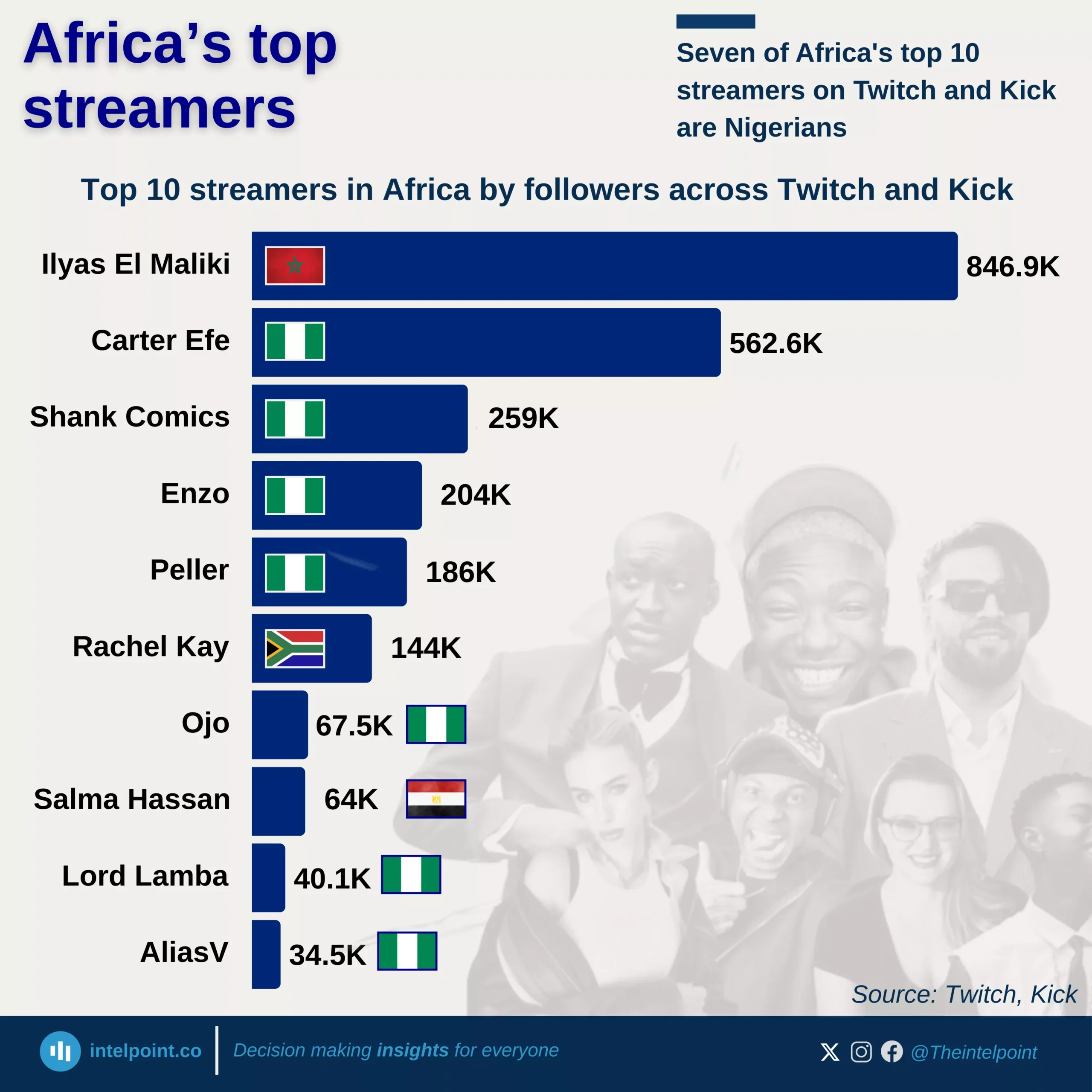
Seven of Africa's top 10 streamers on Twitch and Kick are Nigerians
  • Ilyas El Maliki is Africa’s most followed streamer, with 846,900 followers on Kick.
  • Nigeria dominates the top ten, contributing seven streamers to the list.
  • Nigeria’s top streamers have a combined 1.35 million followers, showing a strong concentration of influence.
  • Follower distribution drops sharply after the top two.
  • Streaming influence in Africa is country-clustered rather than evenly distributed across the continent.
  • Platforms such as Twitch and Kick are enabling African creators to compete globally.

Nathaniel Bassey's livestream crosses one million concurrent viewers, ranking among YouTube’s global top 10 in 2025
  • Nathaniel Bassey Main peaked at 1.02 million concurrent viewers, ranking 6th globally among YouTube’s most-watched livestreams in 2025.
  • Nigeria is one of the few countries to cross the one-million peak viewer mark, alongside major global entertainment creators.
  • Religious livestreams account for multiple top-ranking events, indicating strong real-time engagement beyond music and entertainment.
  • Peak viewership is tightly clustered at the top, with only about 700,000 viewers separating 1st and 10th place.

Pastor Jerry Eze places Nigeria in the global top three YouTube livestreams for 2025, with 105 million watch hours
  • Pastor Jerry Eze ranks 3rd globally, with 105 million hours watched, outperforming most entertainment and music livestream channels.
  • Faith-based livestreaming dominates the top tier, with religious creators accounting for four of the top ten.
  • Nigeria is the only African country represented in the global top ten, signalling a strong international reach.
  • Live spiritual content competes directly with relaxation and music streams, traditionally among YouTube’s most-watched formats.

Flutterwave’s UK arm quadruples turnover since 2021, hitting £6.6 million in 2024
  • Flutterwave UK’s turnover rose from £0.93M in 2021 to £6.61M in 2024, showing consistent expansion.
  • Growth cooled from 311% in 2022 to 21% in 2024, reflecting market maturity.
  • The UK unit’s performance is now tied to Flutterwave’s global surge, with over $31 billion in payments processed in 2024.
  • The focus is shifting from rapid scaling to sustainable growth, compliance, and strengthening cross-border infrastructure.

South Africa leads as Africa’s digitally delivered services exports hit $41.3 billion in 2024, less than 1 percent of the world total
  • Africa exported $41.3 billion in digital services in 2024, less than 1 percent of the world total.
  • South Africa was the continent’s top exporter with $7.05 billion.
  • Morocco ($6.74 billion) and Ghana ($5.18 billion) followed closely.
  • Egypt ($4.03 billion) and Mauritius ($3.53 billion) also ranked among the top five.
  • The top five countries together made up about two-thirds of Africa’s exports.

For every $1 Nigeria earned from exporting digital services between 2005 and 2024, it spent almost $10 on imports
  • Nigeria exported $10.81 billion in digital services between 2005 and 2024.
  • Imports during the same period reached $105.34 billion.
  • The result was a trade deficit of $94.53 billion over 20 years.
  • Exports rose from just $40 million in 2005 to $1.55 billion in 2024.
  • Imports were almost ten times larger than exports, showing a persistent imbalance.

POPULAR TOPICS
SIGN UP TO OUR NEWSLETTER
Get periodic updates about the African startup space, access to our reports, among others.
Subscribe Here
Subscription Form

A product of Techpoint Africa. All rights reserved