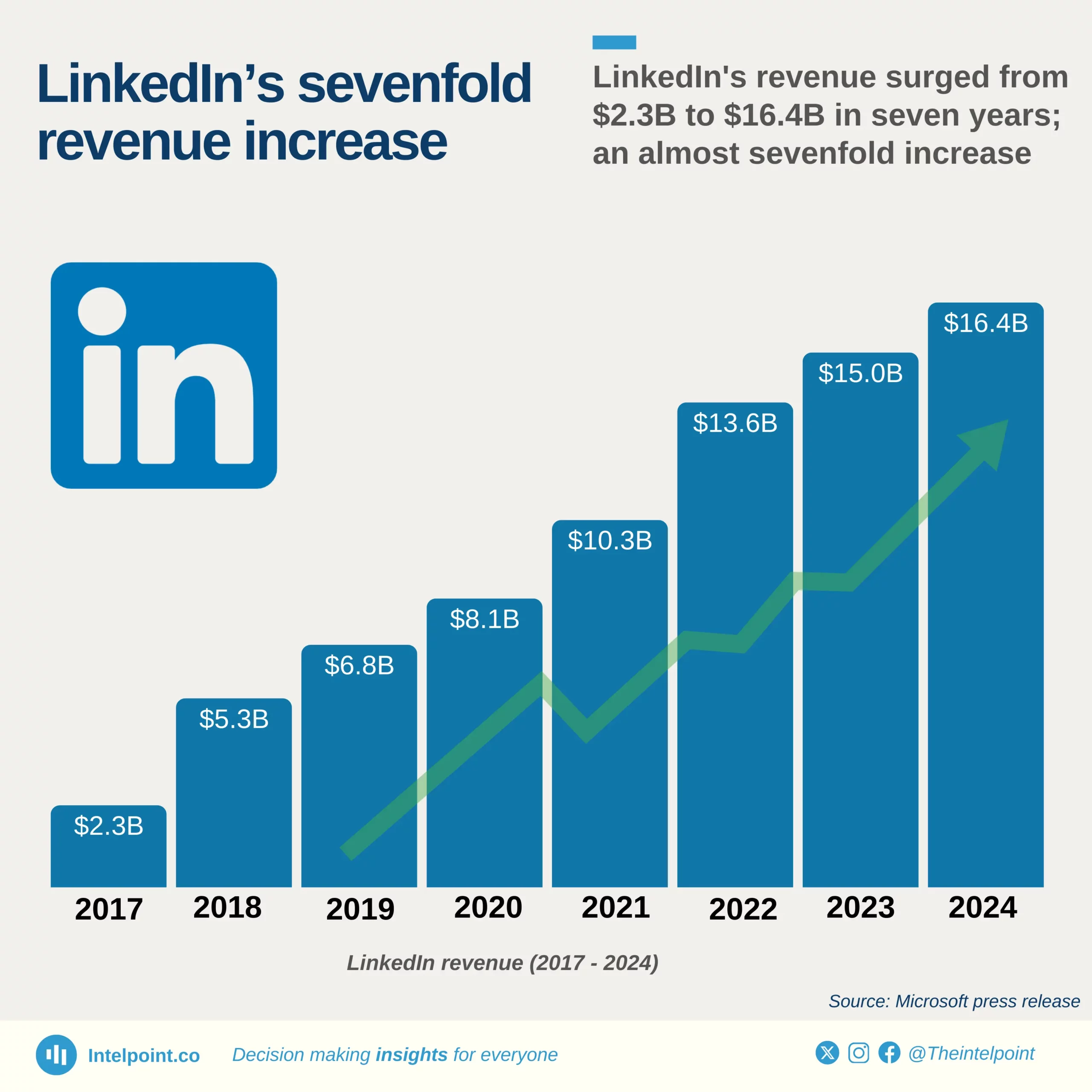
LinkedIn's revenue surged from $2.3B to $16.4B in seven years, an almost sevenfold increase.

Key Takeaways

- LinkedIn's revenue doubled from $2.3 billion in 2017 to $5.3 billion in 2018, marking a powerful initial surge.
- By 2019, the revenue reached $6.8 billion, indicating a consistent and reliable growth pattern.
- Between 2020 and 2022, the revenue climbed from $8.1 billion to $13.6 billion, showcasing a period of rapid expansion.
- By 2024, revenue soared to $16.4 billion, nearly seven times the 2017 figure, reflecting a highly effective monetisation strategy.
LinkedIn's financial trajectory from 2017 to 2024 tells a story of remarkable expansion. Beginning at $2.3B in 2017, the platform experienced an explosive start, with revenue more than doubling to $5.3B in 2018. This early momentum was built upon in subsequent years, reaching $6.8B in 2019 and $8.1B in 2020, before accelerating sharply to $10.3B in 2021 and $13.6B in 2022.
By 2024, LinkedIn's revenue soared to $16.4B, nearly a sevenfold increase over the period. This impressive growth not only highlights the company's successful monetisation strategy but also cements its position as a pivotal force in the professional networking and digital marketing space.

Source:

Microsoft press release

Period:

2017 - 2024
HTML code to embed chart
Want a bespoke report?
Reach out
Tags
Related Insights

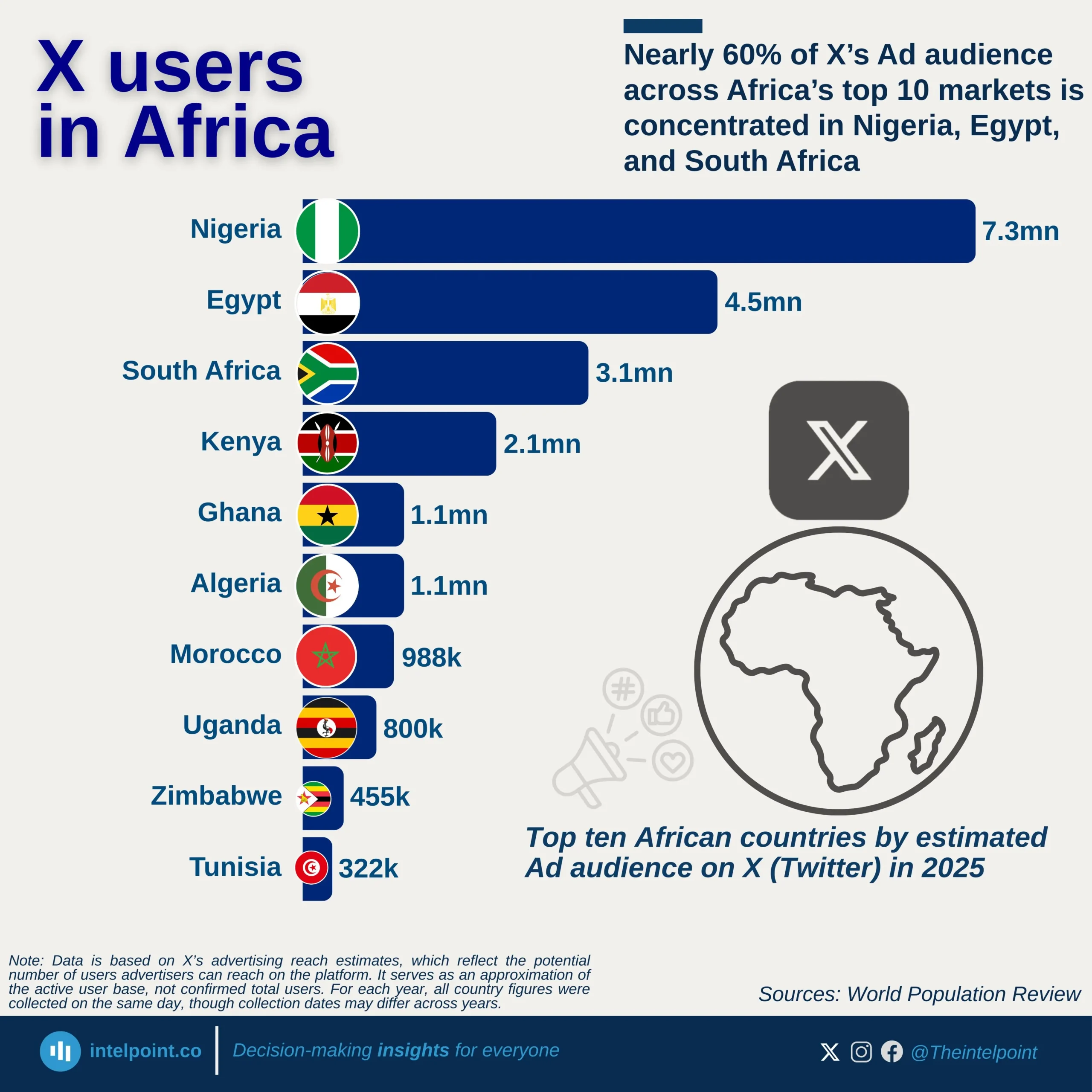
Nearly 60% of X’s Ad audience across Africa’s top 10 markets is concentrated in Nigeria, Egypt, and South Africa
  1. Nigeria ranks first with 7.3 million estimated users — over 2.8 million more than Egypt.
  2. Egypt (4.5 million) and South Africa (3.1 million) follow, forming the top three markets.
  3. The top three countries account for nearly 60% of the total users across the ten listed countries.
  4. The gap between first (7.3 million) and tenth (Tunisia, 322,000) is more than 6.9 million users, highlighting wide market disparities.

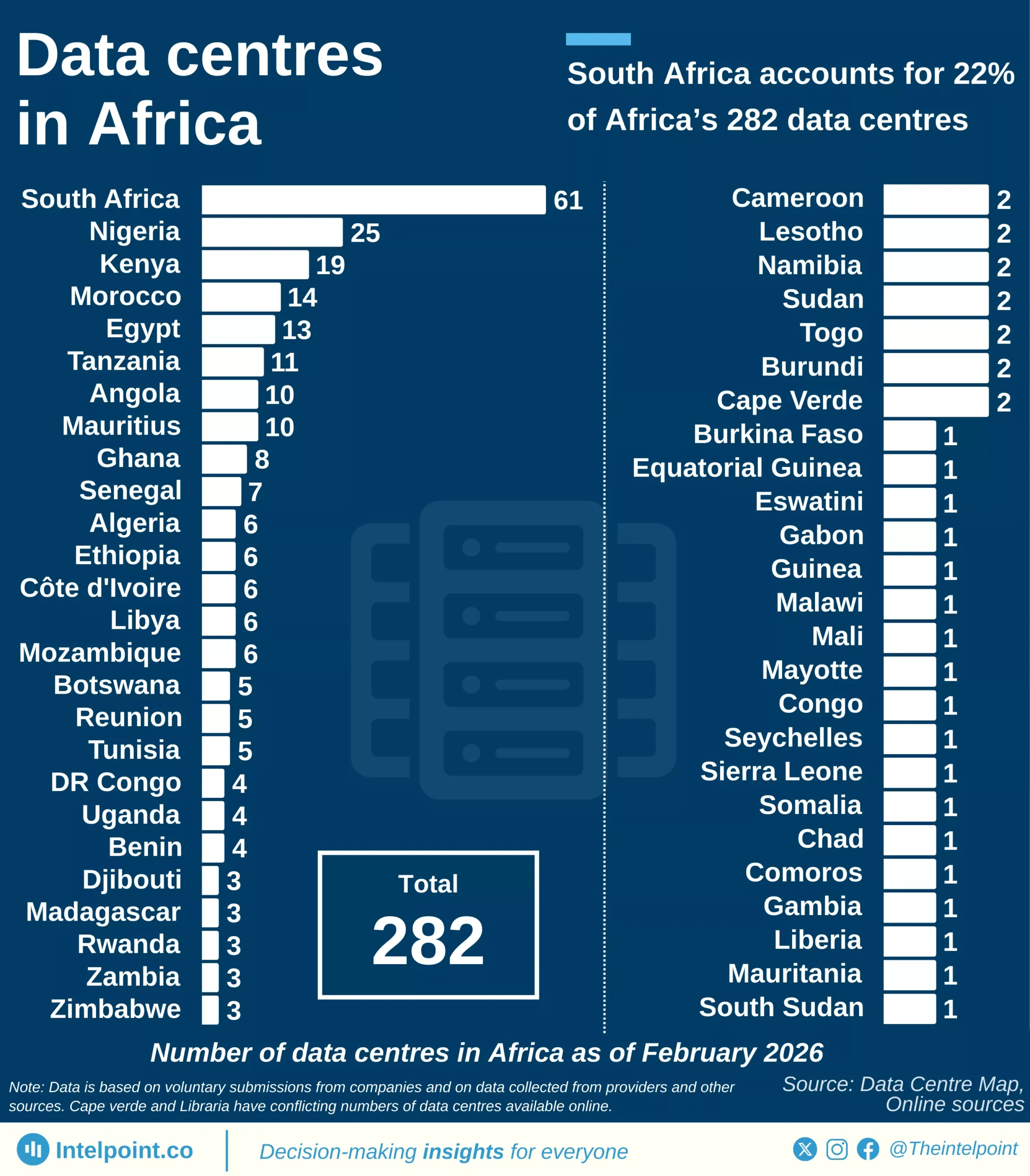
South Africa accounts for 22% of Africa’s 282 data centres
  • South Africa leads with 61 facilities, accounting for 21.6% of the continent’s total
  • Nigeria (25) and Kenya (19) complete the top three countries with major digital infrastructure hubs
  • Many countries operate with fewer than five facilities
  • Eighteen countries have just one data centre each
  • As cloud adoption, fintech, streaming, and AI grow, new regional hubs are likely to emerge beyond today’s leaders.

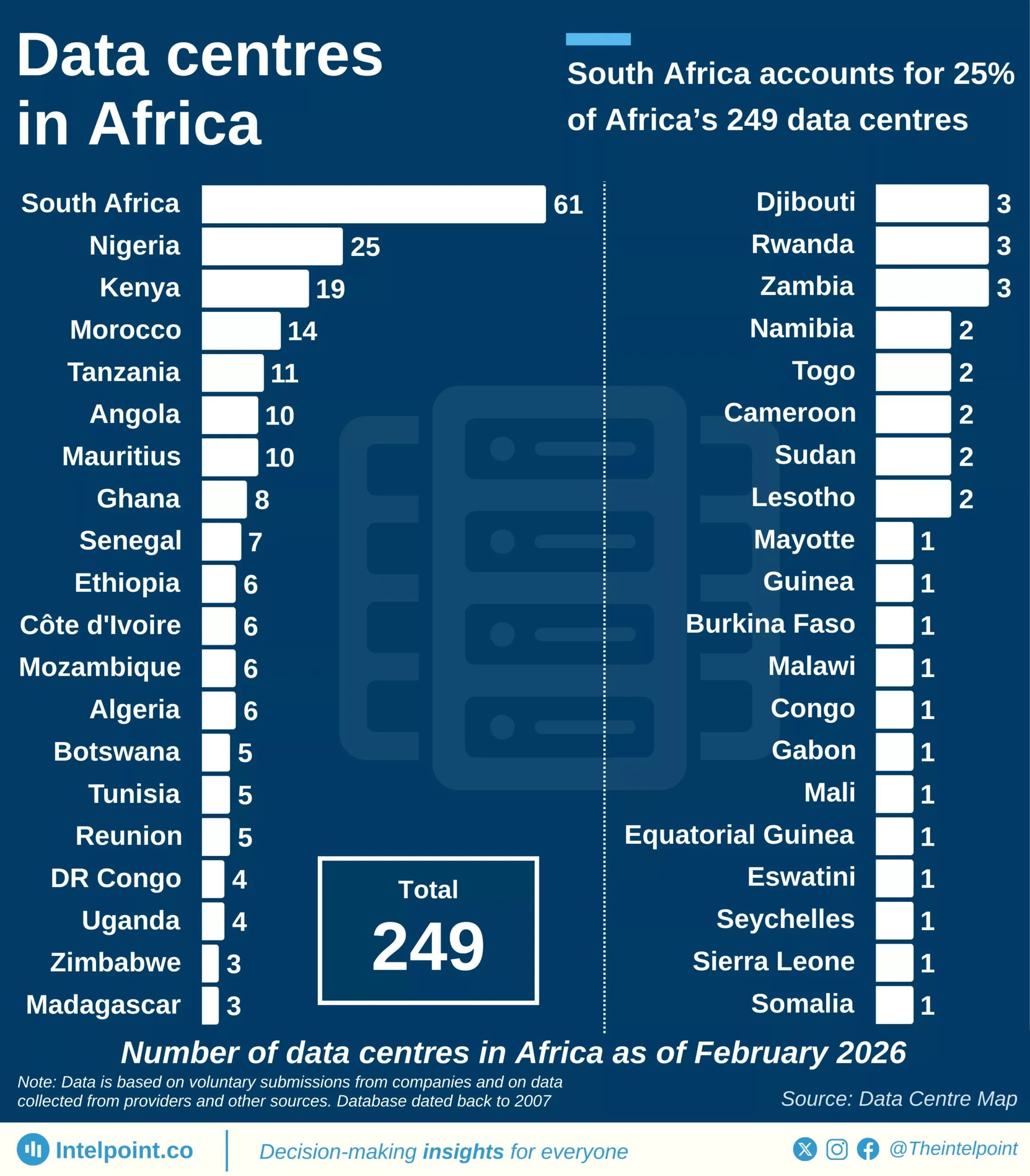
South Africa accounts for 25% of Africa’s 249 data centres
  • Africa had 249 data centres as of February 2026
  • South Africa leads with 61 facilities, accounting for 25% of the continent’s total
  • Nigeria (25) and Kenya (19) complete the top three countries with major digital infrastructure hubs
  • Many countries operate with fewer than five facilities
  • A dozen countries have just one data centre
  • Infrastructure concentration means cross-border data dependence for many smaller economies.
  • As cloud adoption, fintech, streaming, and AI grow, new regional hubs are likely to emerge beyond today’s leaders.

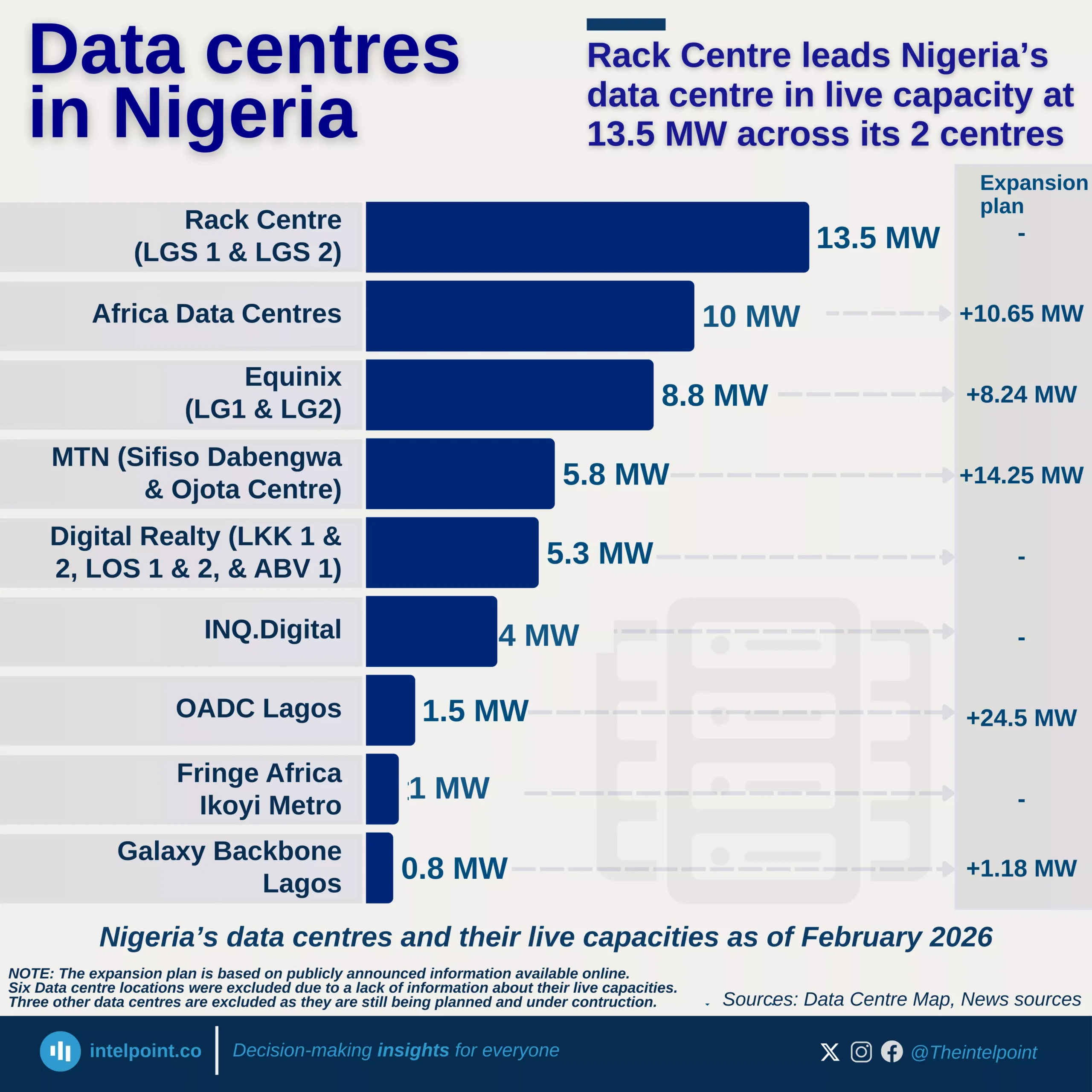
Rack Centre leads Nigeria’s data centre in live capacity at 13.5 MW across its 2 centres
  • Rack Centre leads Nigeria’s live capacity with 13.5 MW
  • Africa Data Centres (10 MW) and Equinix (8.8 MW) form the next tier of large operators
  • Lagos dominates capacity, reinforcing its role as Nigeria’s primary digital infrastructure hub
  • Several operators have major expansion plans, including Africa Data Centres (+10.65 MW addition) and OADC Lagos (+24.5 MW addition)

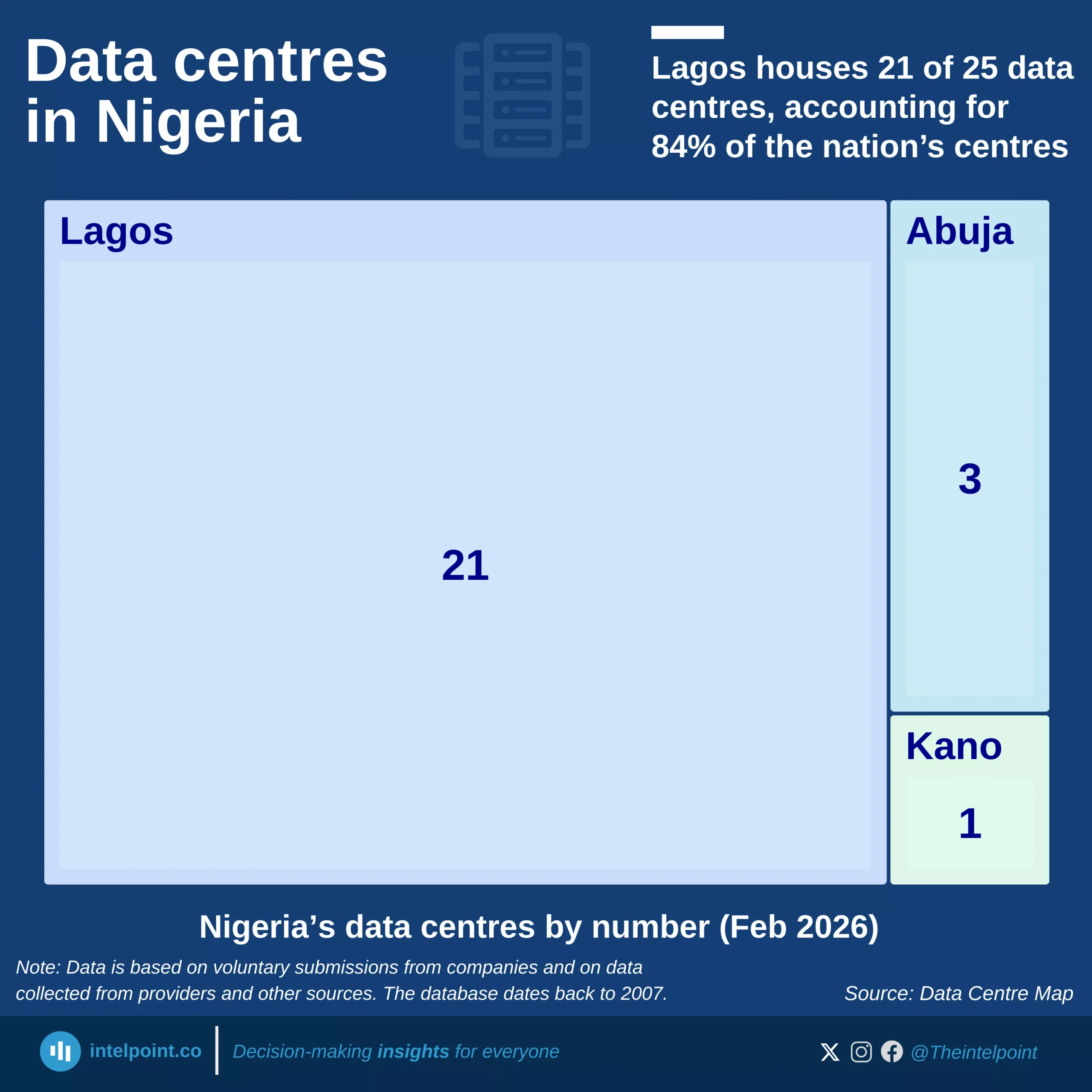
Lagos houses 21 of 25 data centres, accounting for 84% of the nation’s centres
  • Lagos hosts 21 of Nigeria’s 25 data centres.
  • Only Lagos, Abuja, and Kano currently host data centres.
  • Abuja holds 12% of the country’s data centres despite being the capital.
  • Kano’s single facility accounts for just 4% and highlights the limited digital infrastructure in northern Nigeria.
  • The distribution shows a high geographic concentration risk; national digital operations rely heavily on Lagos.
  • Lagos’ dominance reflects its advantages: commercial activity, connectivity, and proximity to submarine cable landings.

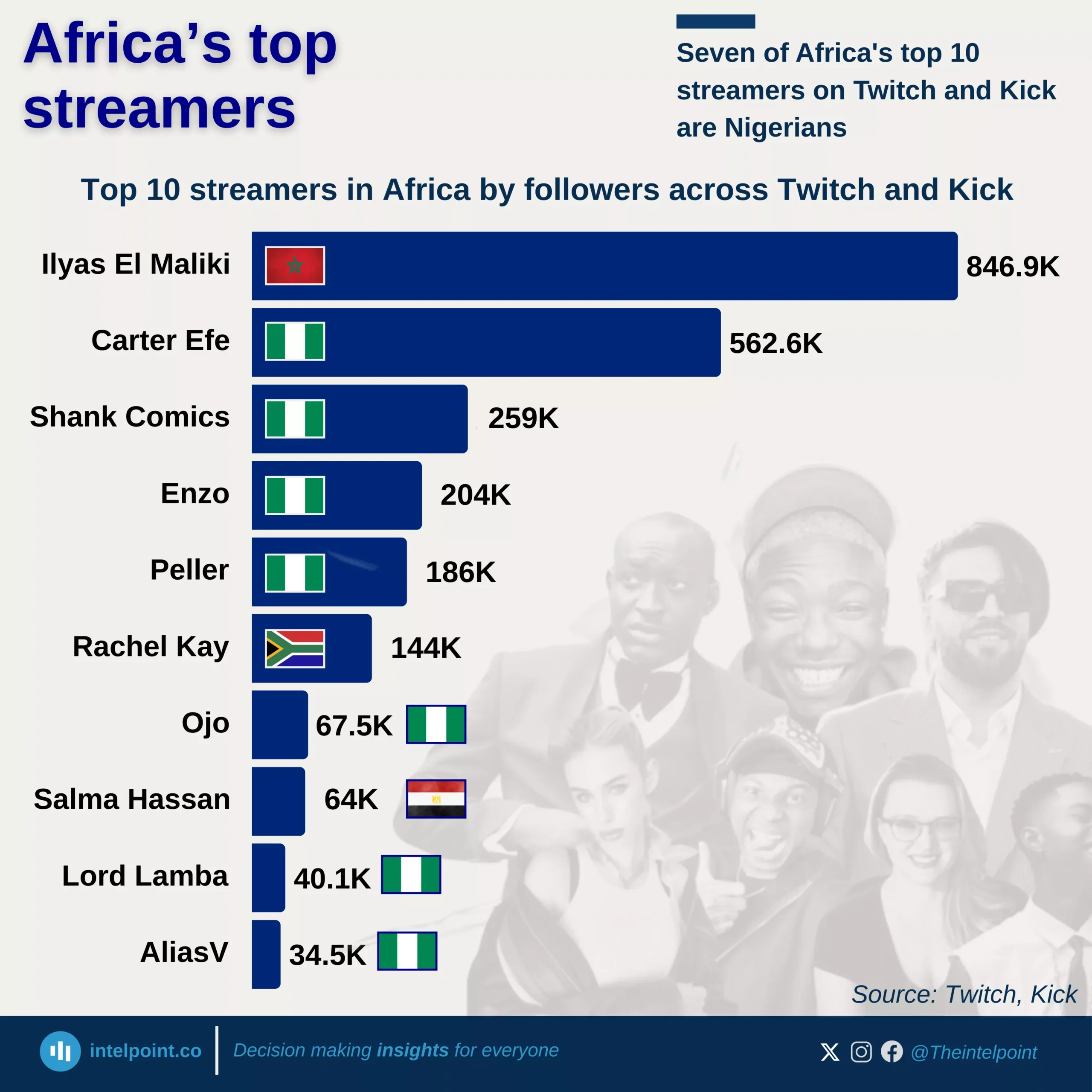
Seven of Africa's top 10 streamers on Twitch and Kick are Nigerians
  • Ilyas El Maliki is Africa’s most followed streamer, with 846,900 followers on Kick.
  • Nigeria dominates the top ten, contributing seven streamers to the list.
  • Nigeria’s top streamers have a combined 1.35 million followers, showing a strong concentration of influence.
  • Follower distribution drops sharply after the top two.
  • Streaming influence in Africa is country-clustered rather than evenly distributed across the continent.
  • Platforms such as Twitch and Kick are enabling African creators to compete globally.

POPULAR TOPICS
SIGN UP TO OUR NEWSLETTER
Get periodic updates about the African startup space, access to our reports, among others.
Subscribe Here
Subscription Form

A product of Techpoint Africa. All rights reserved