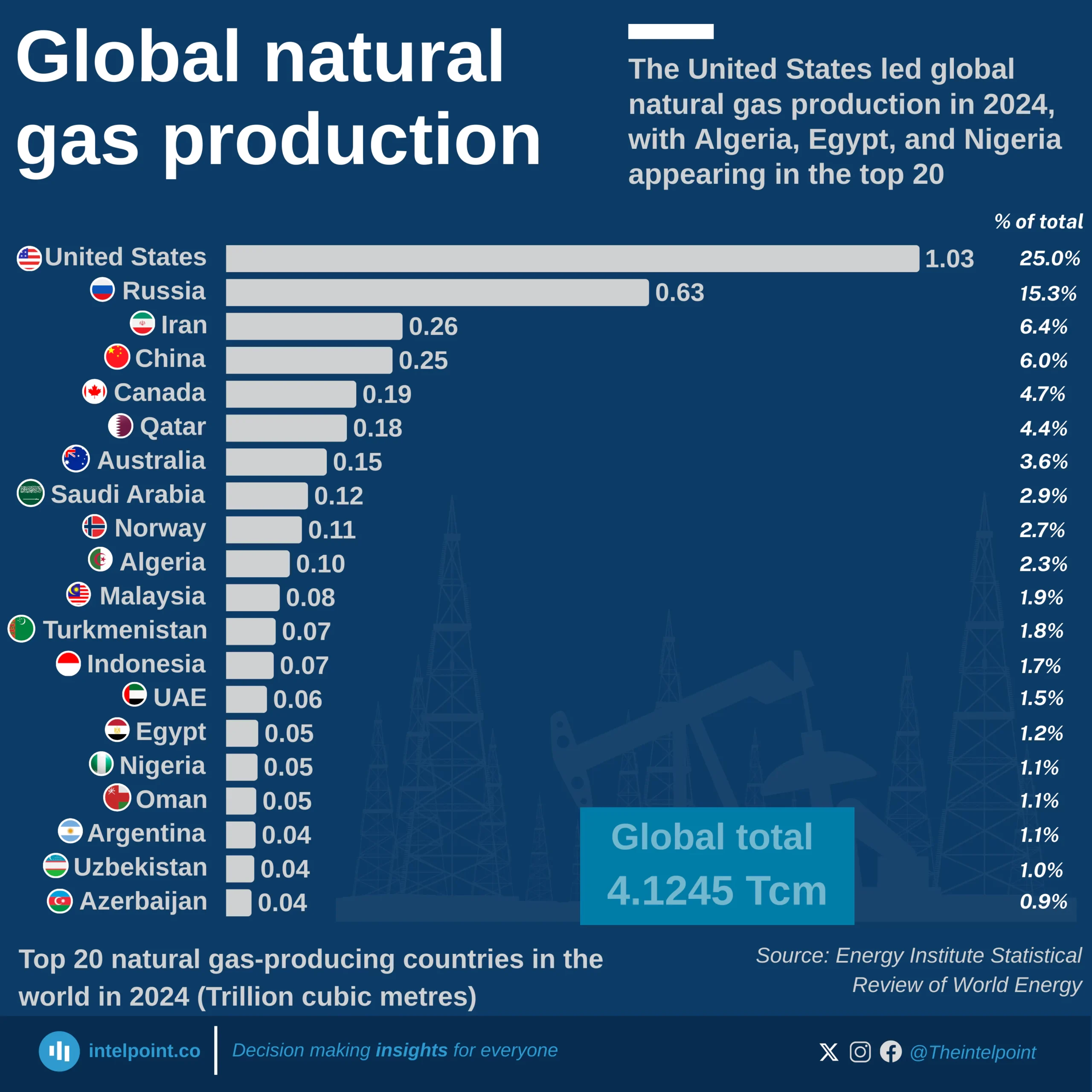
The United States led global natural gas production in 2024, with Algeria, Egypt, and Nigeria appearing in the top 20

  • The United States dominates global natural gas production in 2024, contributing 1.03 trillion cubic metres (Tcm), nearly one-quarter of the world’s total.

  • Russia (0.63Tcm) and Iran (0.26Tcm) follow as the second and third largest producers.

  • China (0.25Tcm) and Canada (0.19Tcm) also feature strongly, rounding out the top five producers.

  • Collectively, these top five countries account for more than 50% of global production.

  • Emerging producers like Nigeria, Egypt, and Azerbaijan contribute significantly to the supply but remain far behind the leading nations.

In 2024, global natural gas production was heavily concentrated among a few leading players. The United States stood out as the undisputed leader, producing more than one trillion cubic metres, outpacing Russia by a wide margin. This reflected the US’s continued investment in shale gas and advanced extraction technologies, which have made it a cornerstone of global energy markets.

Russia, while still a strong player, lagged significantly behind the US, yet remained a critical supplier for Europe and Asia. Iran, China, and Canada followed, each playing strategic roles in balancing regional supply and demand. Countries like Saudi Arabia, Qatar, and Australia also highlight how resource-rich nations in the Middle East and Oceania are shaping global energy flows.

Meanwhile, emerging producers such as Algeria, Nigeria, Egypt, and Egypt underscore the growing importance of Africa in diversifying natural gas supply. However, their production volumes were relatively modest compared to the top-tier producers.

Overall, these numbers shows a mix of dominance and diversity: while a handful of nations control the majority of output, smaller contributors ensure global supply resilience.
Source:

Energy Institute Statistical Review of World Energy

Period:

2024
HTML code to embed chart
Want a bespoke report?
Reach out
Tags
Related Insights

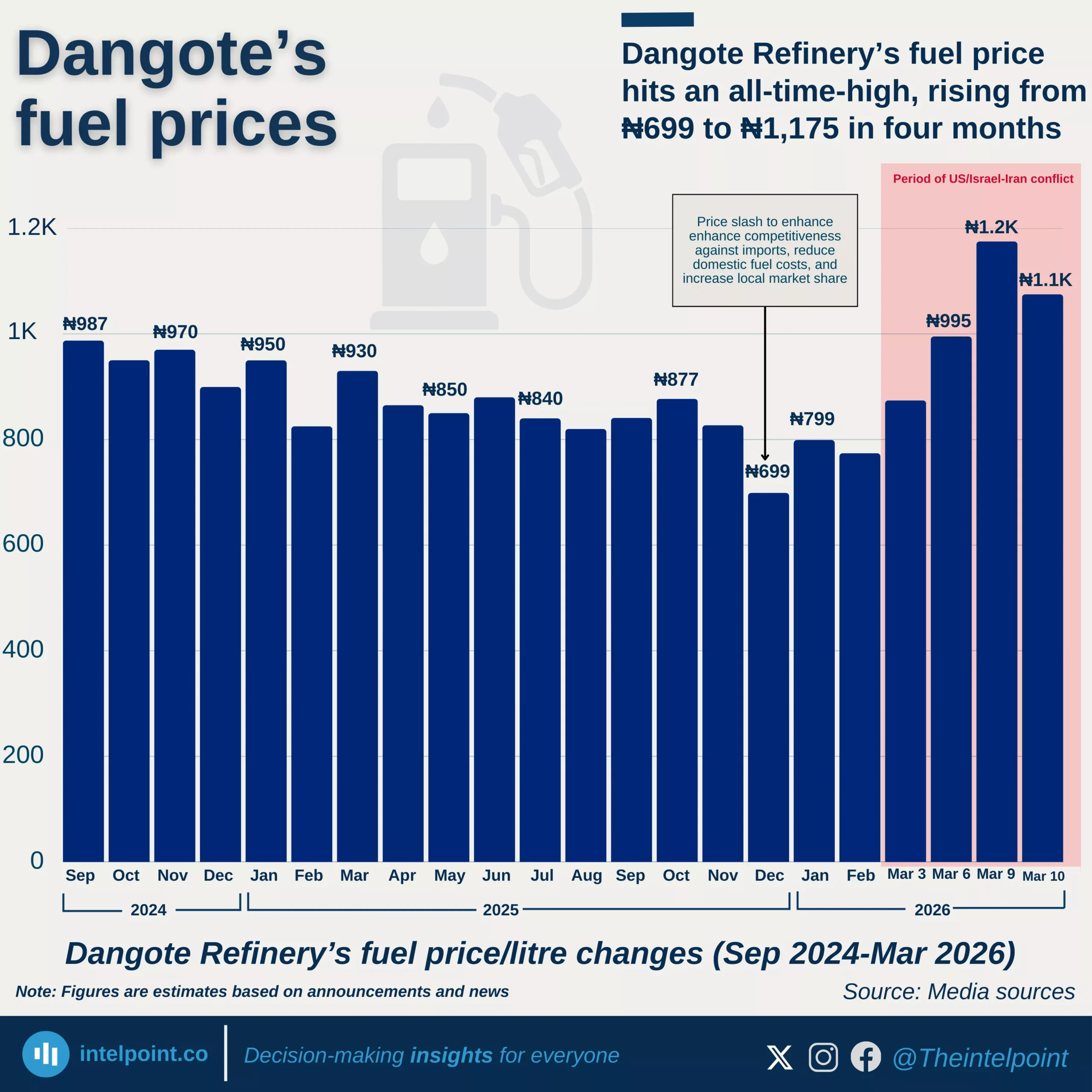
Dangote Refinery’s fuel price hits an all-time-high, rising from ₦699 to ₦1,175 in four months
Fuel prices from Dangote Refinery reached an all-time high of ₦1,175 per litre in March 2026. The lowest recorded price in the period was ₦699 per litre in December 2025, showing a wide price swing. The jump from ₦699 to ₦1,175 happened in roughly four months.
  • Prices earlier in the timeline hovered mostly between ₦820 and ₦987 during late 2024 and much of 2025.
  • The December 2025 price cut was aimed at making locally refined fuel more competitive against imports.
  • After the price drop, fuel costs began rising again in early 2026, reaching ₦995 by early March before climbing further.
  • Global geopolitical tensions affecting oil markets contributed to the upward pressure on prices.

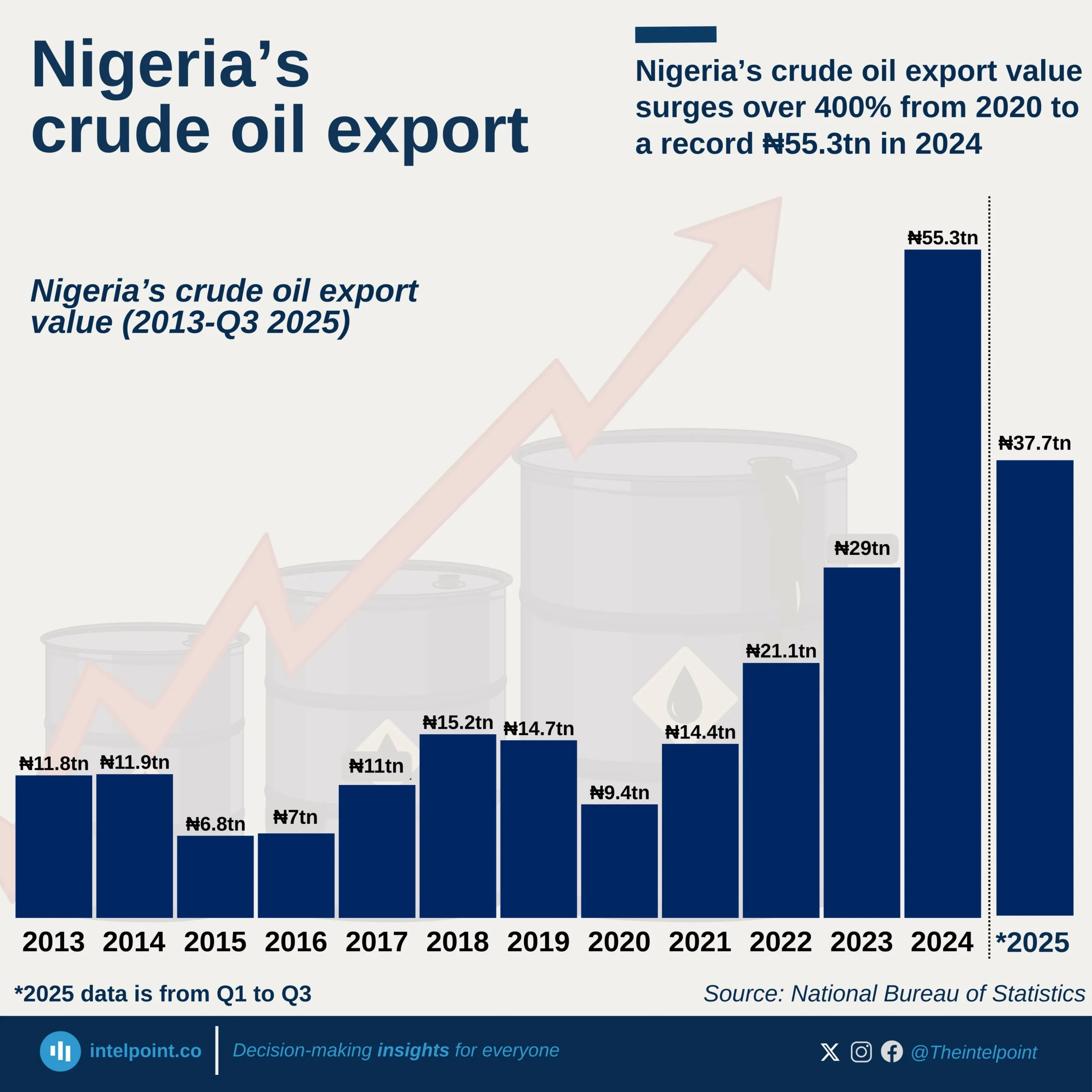
Nigeria’s crude oil export value surges over 400% from 2020 to a record ₦55.3tn in 2024
  • Export values have grown over 400%, rising from ₦11.8 trillion in 2013 to a peak of ₦55.3 trillion in 2024, a fivefold increase driven by rising oil prices and a weaker naira.
  • 2015 and 2016 were the hardest years, with export values crashing as low as ₦6.8 trillion in 2015, reflecting the brutal impact of the global oil price collapse on Nigeria's most critical export.
  • The most explosive growth came from 2023 onwards, with values surging past ₦29 trillion in 2023 and peaking at ₦55.3 trillion in 2024, largely driven by the naira depreciation following Nigeria's 2023 foreign exchange reforms.
  • The first nine months of 2025 saw a slower pace than the previous year, with ₦37.7 trillion recorded between Q1 and Q3, lower than the ₦41.5 trillion recorded during the same period in 2024.

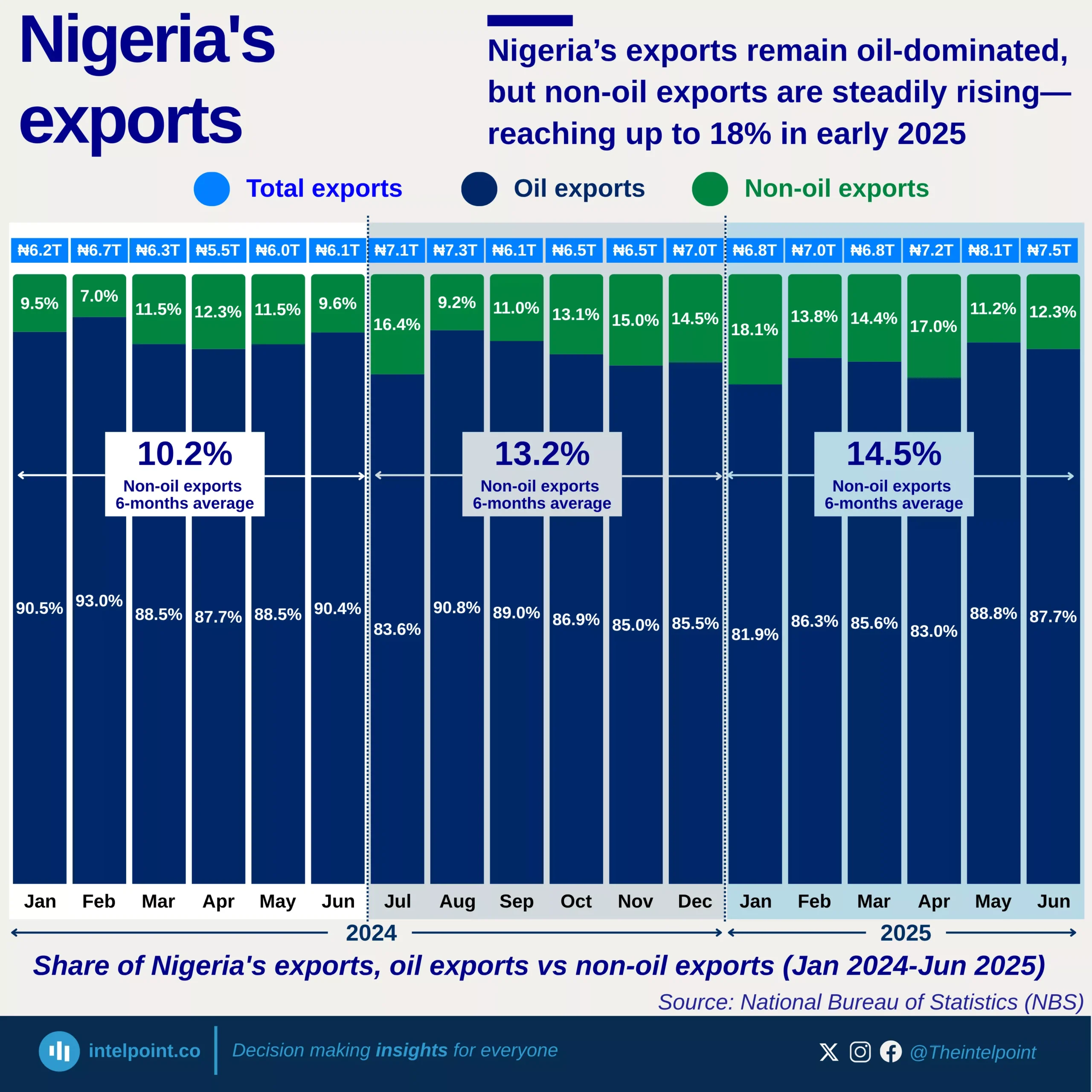
Nigeria’s exports remain oil-dominated, but non-oil exports are steadily rising—reaching up to 18% in early 2025
  • Oil exports continued to dominate, averaging over 88% of total exports in 2024 and remaining above 81% in the first half of 2025.
  • Non-oil exports rose gradually, from a low of 6.9% (February 2024) to a high of 18.1% (January 2025).
  • Peaks in non-oil export contributions occurred in July 2024 (16.4%) and January–April 2025 (13–18%), indicating progress toward diversification.
  • Total exports remained heavily oil-driven, though sustained double-digit non-oil shares in late 2024 and early 2025 show a slow shift.

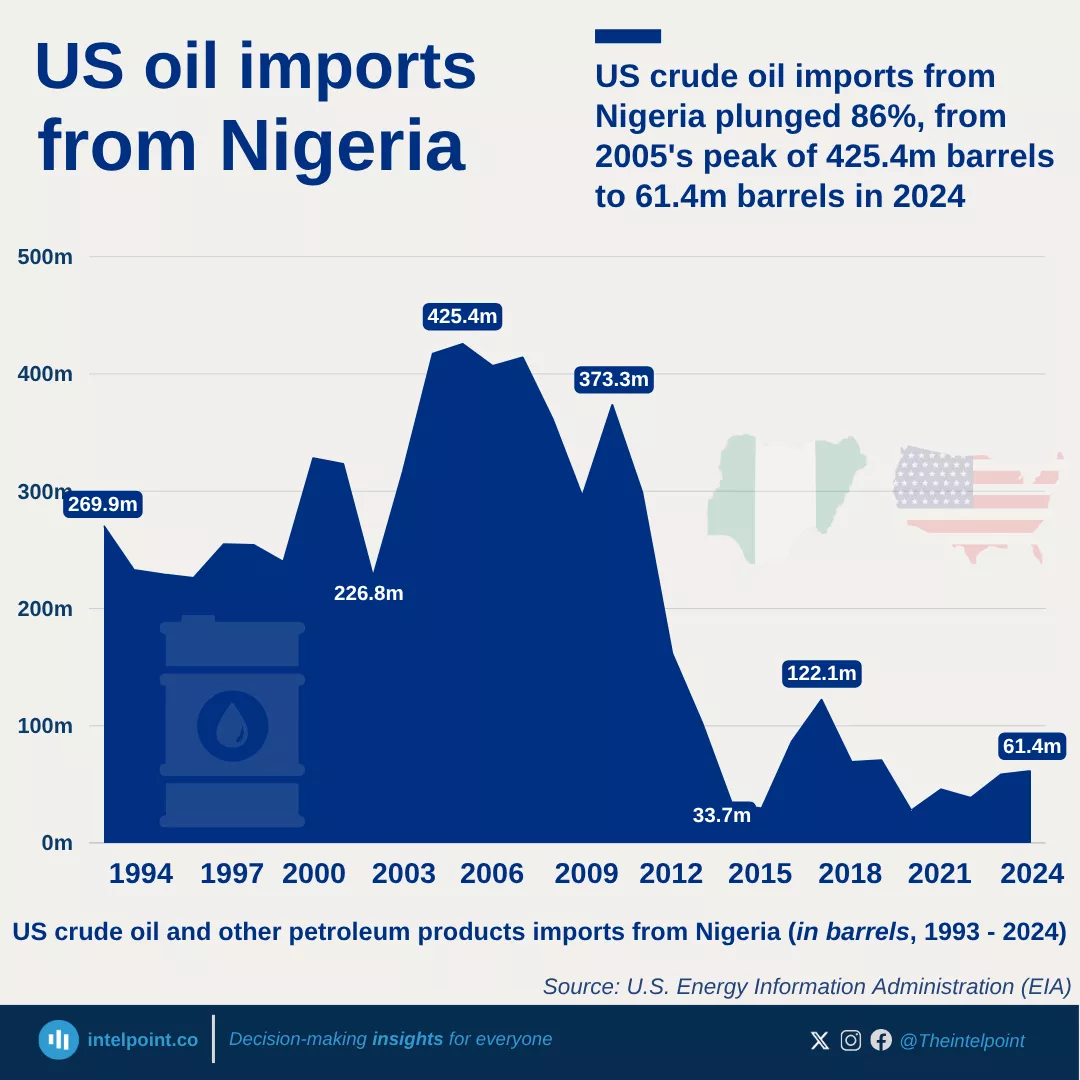
US crude oil imports from Nigeria plunged 86%, from 2005's peak of 425.4m barrels to 61.4m barrels in 2024
  • The US imported 425 million barrels of crude oil and other petroleum products from Nigeria in 2005, the highest in the past 32 years.
  • The US shale boom reduced America’s reliance on foreign crude.
  • The launch of the Dangote Refinery has increased domestic demand for crude oil, further reducing the amount available for export to the US.
  • Nigeria, which was regularly a top five crude oil supplier to the US in earlier decades, ranked ninth among its suppliers in 2024.

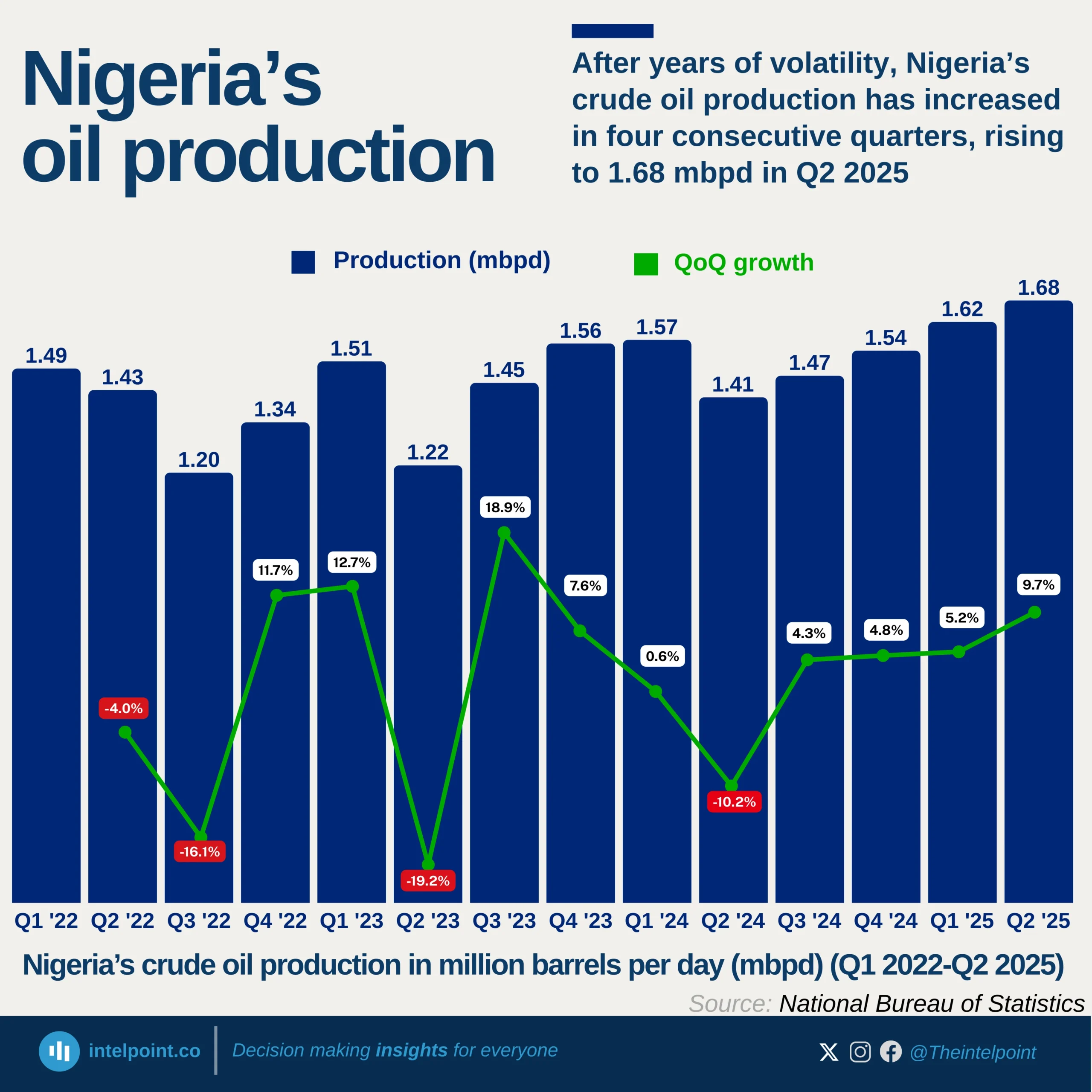
After years of volatility, Nigeria’s crude oil production has increased in four consecutive quarters, rising to 1.68 mbpd in Q2 2025
  • Production dipped sharply in 2022, with the steepest quarterly decline of –16.08% in Q3, before recovering at year-end.
  • 2023 marked a rebound year, highlighted by strong quarterly growth of 18.85% in Q3, lifting production back above 1.5 mbpd.
  • 2024 showed relative stability, with modest fluctuations; production only briefly fell below 1.5 mbpd before gradually recovering.
  • By Q2 2025, output hit 1.68 mbpd, the highest in the series, supported by consistent growth in three straight quarters.

The US remained the dominant producer of bio-diesel, with 15.25 million metric tons produced in 2023
  • Only 37 countries produced bio-diesel in 2023.
  • No African country produced bio-diesel.
  • The US remained the dominant producer of bio-diesel with 15.25 million metric tons produced in 2023, which is 36% of the total quantity produced globally.
  • Germany was the top exporter of bio diesel with 2.18 million metric tons.

POPULAR TOPICS
SIGN UP TO OUR NEWSLETTER
Get periodic updates about the African startup space, access to our reports, among others.
Subscribe Here
Subscription Form

A product of Techpoint Africa. All rights reserved