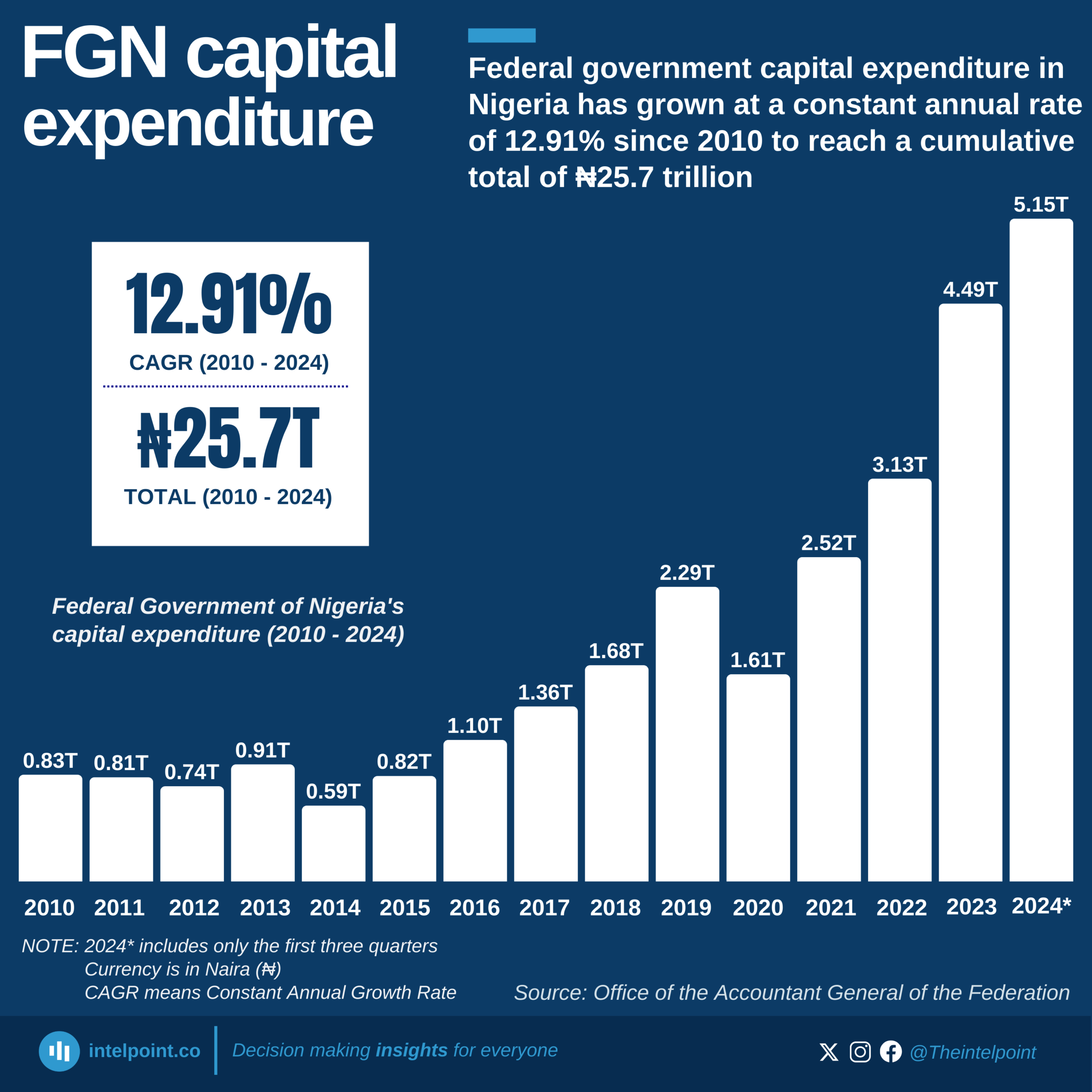
Federal government capital expenditure in Nigeria has grown at a constant annual rate of 12.91% since 2010 to reach a cumulative total of ₦25.7 trillion

Key takeaways:

  • Between 2010 and 2024 (a 15-year period), the federal government invested over ₦25.7 trillion in capital projects.
  • The post-2020 era saw a dramatic rise in capital expenditure, growing from ₦1.61 trillion in 2020 to ₦5.15 trillion in 2024, indicating accelerated investments in infrastructure.
  • The increase in expenditure after 2020 suggests the government prioritised economic recovery efforts, allocating more resources to capital projects post-pandemic.
  • Nigeria recorded its highest-ever capital expenditure in 2023 (₦4.49 trillion) and 2024 (₦5.15 trillion), showing a more aggressive investment approach in recent years.
  • 2014 recorded the lowest capital expenditure (₦0.59 trillion) in the 15-year span, possibly due to revenue shortfalls, oil price fluctuations, or policy shifts at the time.

Since 2010, Nigeria’s federal government capital expenditure has seen a 12.91% Constant Annual Growth Rate (CAGR), reaching a cumulative ₦25.7 trillion by 2024. The post-2020 era saw the highest rate of increase, growing from ₦1.61 trillion in 2020 to ₦5.15 trillion in 2024, and totaling ₦15.3 trillion (59.5% of total 15-year cumulative investment), indicating accelerated investments in infrastructure.
Source:

Office of the Accountant General of the Federation

Period:

2010 - 2024
HTML code to embed chart
Want a bespoke report?
Reach out
Tags
Related Insights

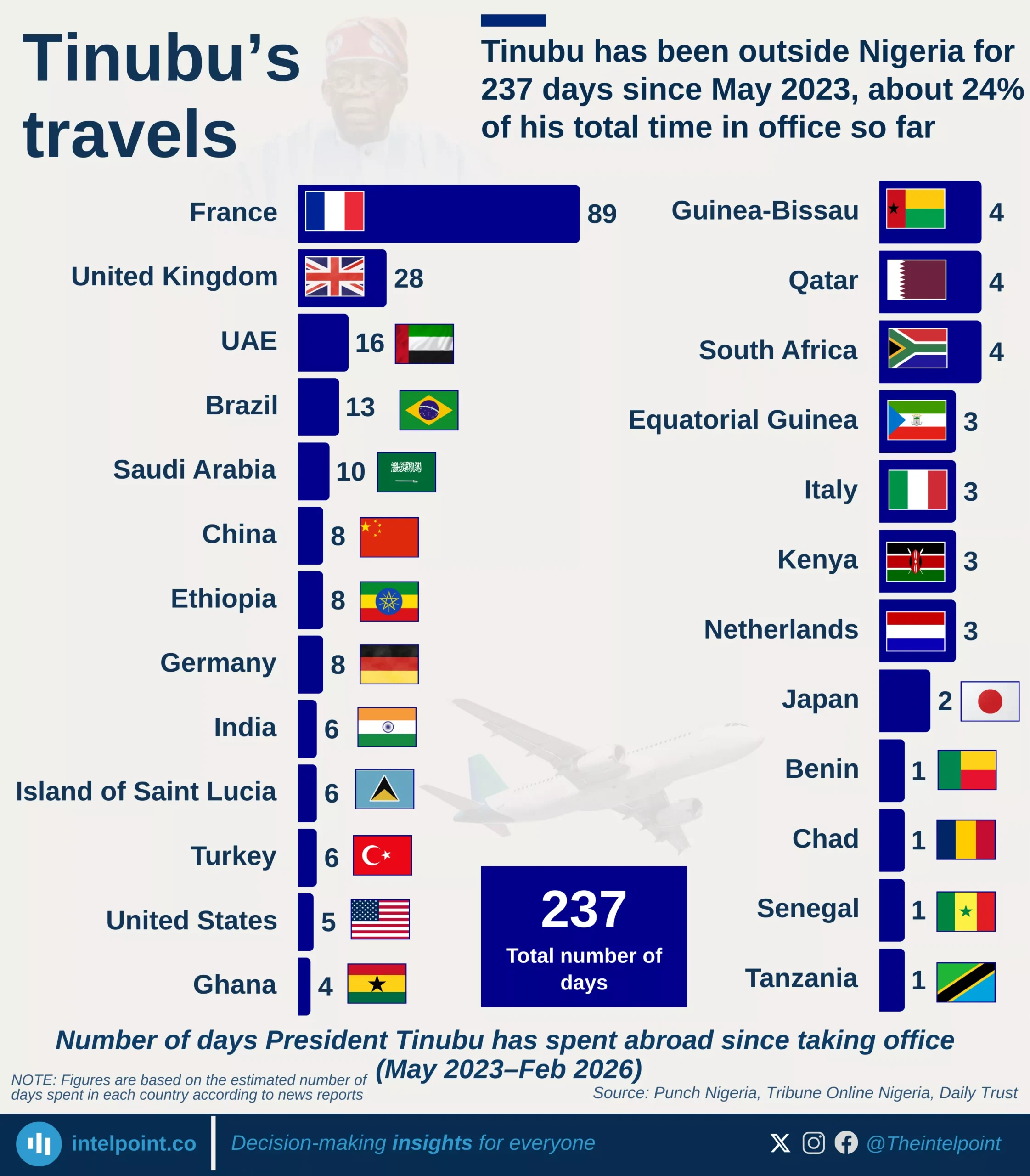
President Tinubu has been outside Nigeria for 237 days since May 2023, about 24% of his total time in office so far
  • President Tinubu has spent 237 days (about eight months) abroad since 2023.
  • France alone accounts for 89 days, making it his most-visited country.
  • The UK ranks second with 28 days.
  • The UAE, Brazil, and Saudi Arabia feature prominently.
  • Asia is well represented by China, India, and Japan, indicating growing engagement with Eastern economies.
  • Several African countries appear on the list, showing continued regional diplomacy.
  • Most countries recorded fewer than ten days, suggesting many short, targeted visits.

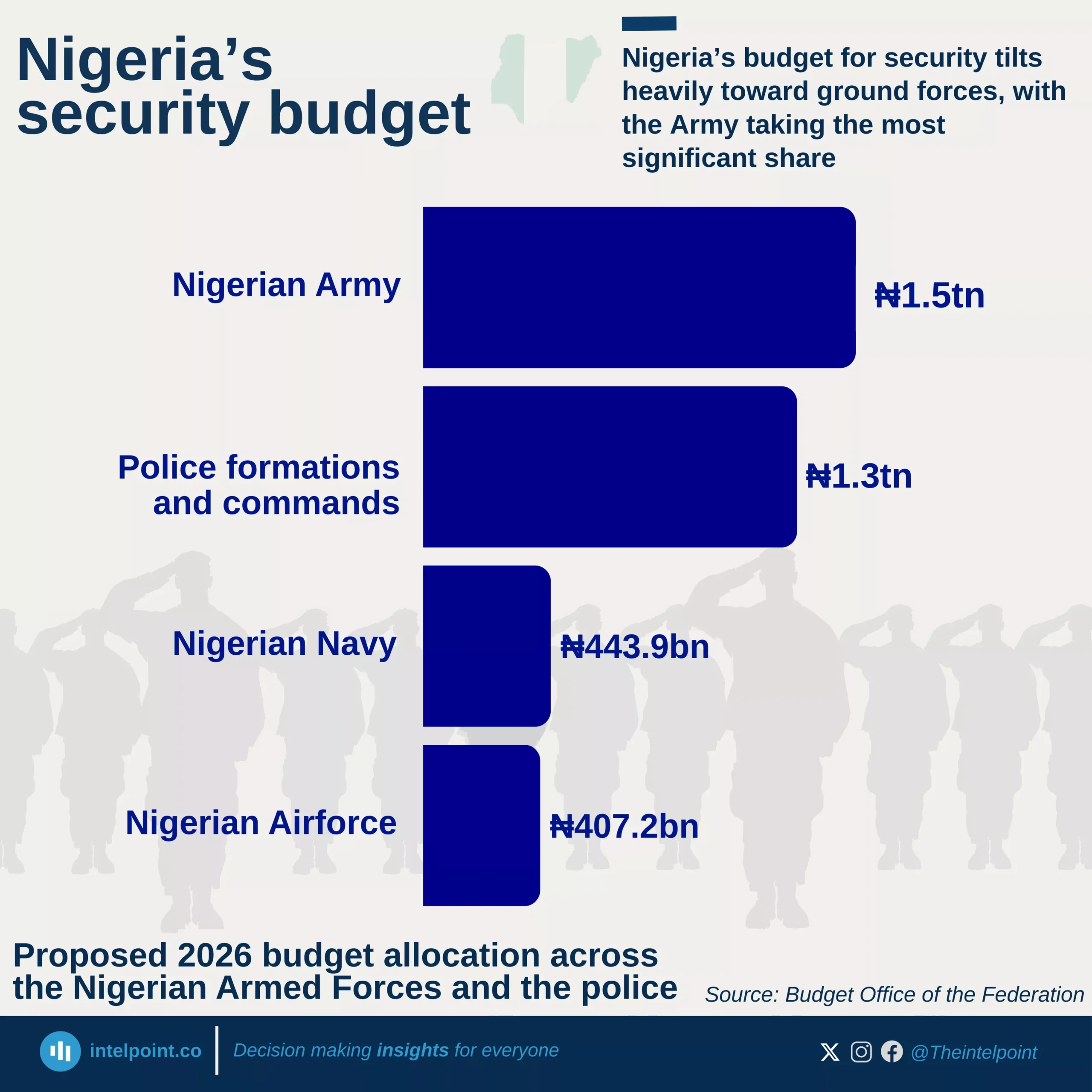
Nigeria’s budget for security tilts heavily toward ground forces, with the Army taking the most significant share
  • The Nigerian Army is allocated ₦1.5 trillion, surpassing the ₦1 trillion mark and making it the highest-funded force in the proposal.
  • Police formations and commands receive ₦1.3 trillion, exceeding the ₦ 1 trillion threshold in the 2026 budget.
  • The Nigerian Navy’s proposed allocation stands at ₦443.9 billion, keeping it well below the trillion-naira range reached by the top two.
  • The Nigerian Air Force is allocated ₦407.2 billion.

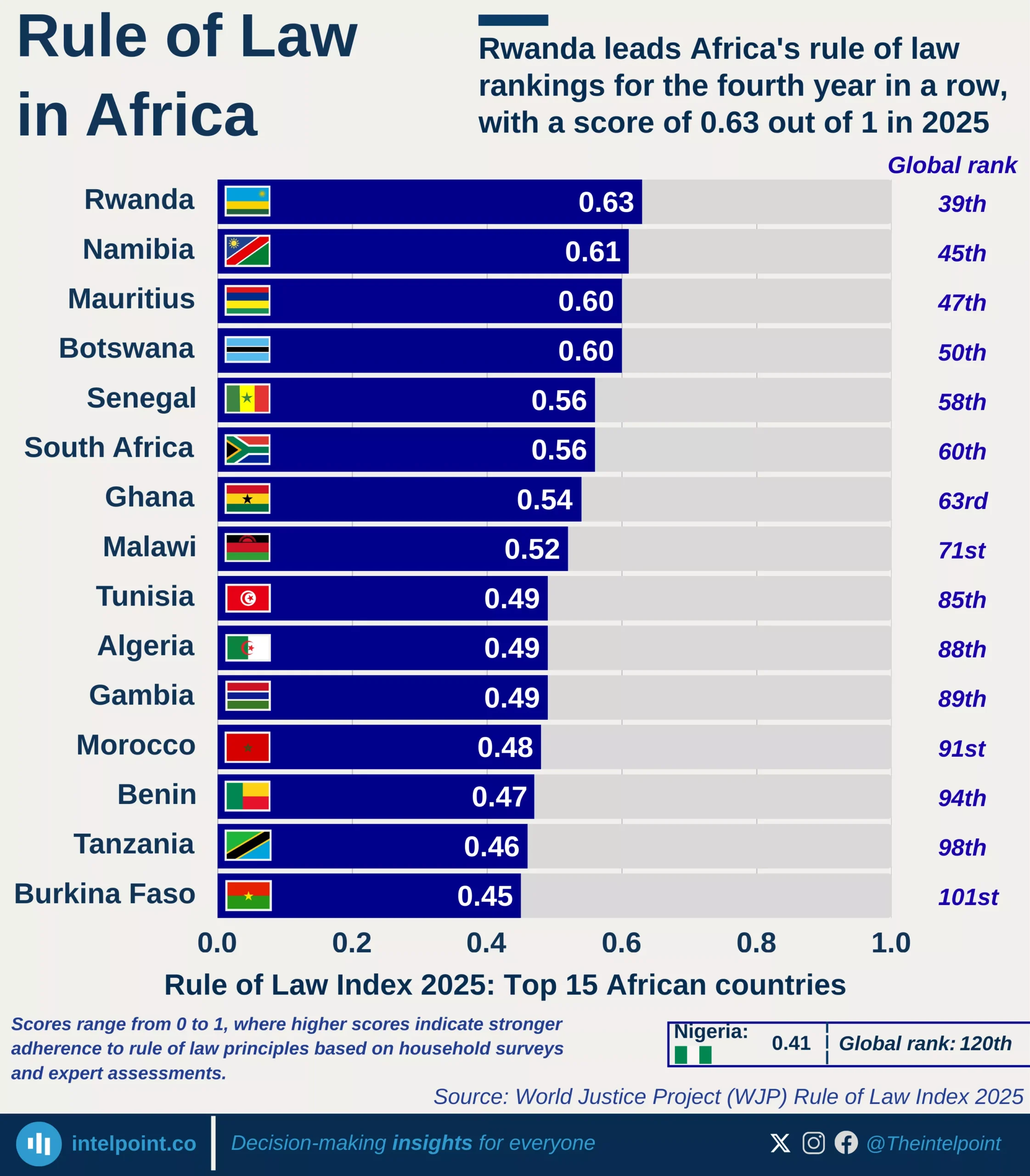
Rwanda leads Africa's rule of law rankings for the fourth year in a row, with a score of 0.63 out of 1 in 2025
  • Rwanda leads Africa with a rule of law score of 0.63, ranking 39th globally.
  • Namibia, Mauritius, and Botswana also place within the global top 50.
  • Senegal and South Africa are next, both scoring 0.56 in 2025.
  • Nigeria ranks 120th with a score of 0.41, below the regional average.
  • The Index evaluates justice, corruption, accountability, and fundamental rights.
  • A strong ranking reflects effective governance and respect for citizens’ rights.

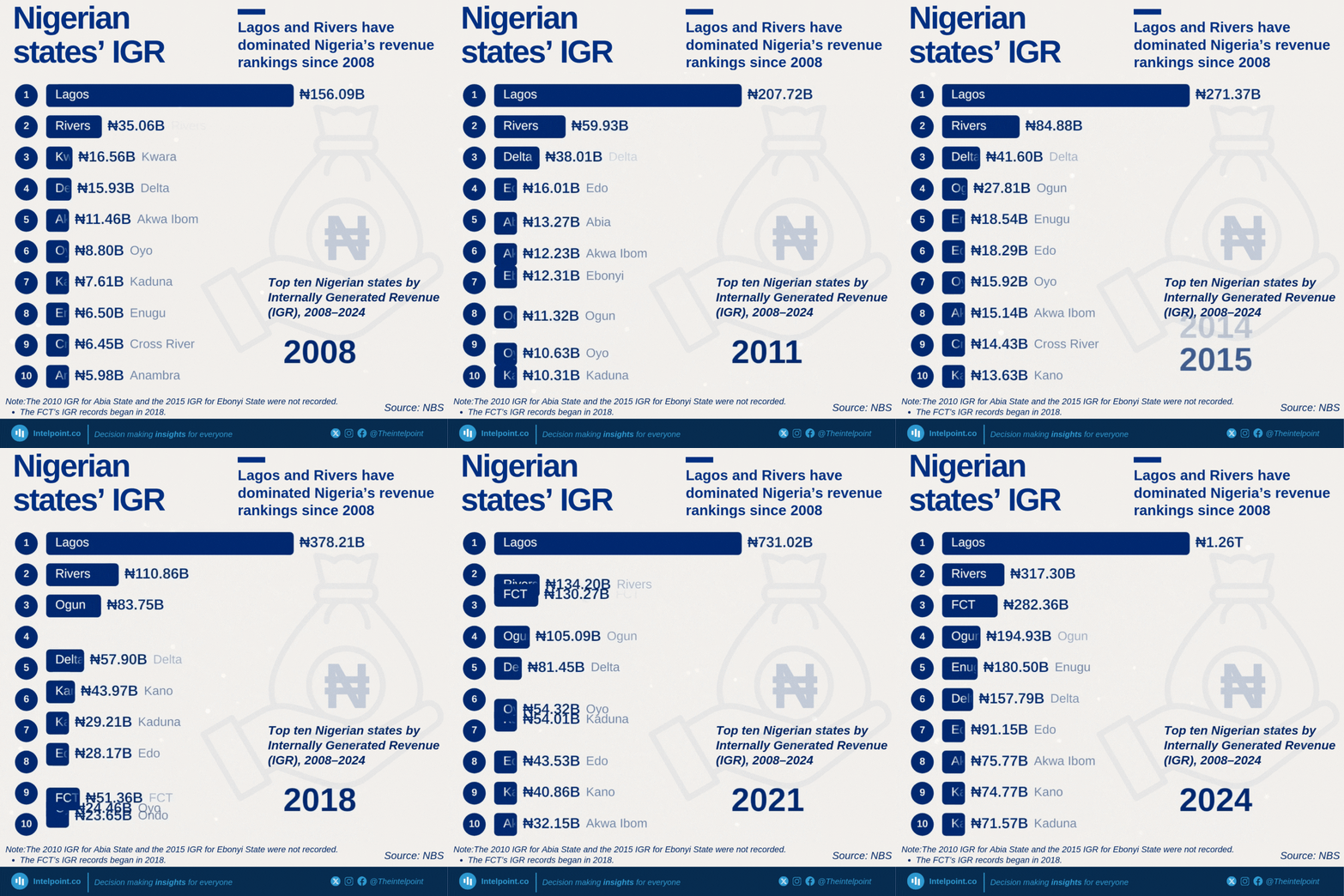
Lagos and Rivers have dominated Nigeria’s revenue rankings since 2008
  • A total of ₦20.45 trillion in Internally Generated Revenue (IGR) has been recorded nationwide since 2008.
  • Lagos State generated ₦1.26 trillion in 2024, maintaining its position as the top revenue-generating state.
  • For five consecutive years, Yobe and Taraba have consistently ranked among the bottom five states in revenue generation.
  • FCT IGR records began in 2018.
  • Enugu State recorded a remarkable 433.03% year-on-year increase in 2024.
  • Ebonyi (–57.27%), Ondo (–24.70%), and Yobe (–0.99%) were the only states that experienced a decline in IGR in 2024.

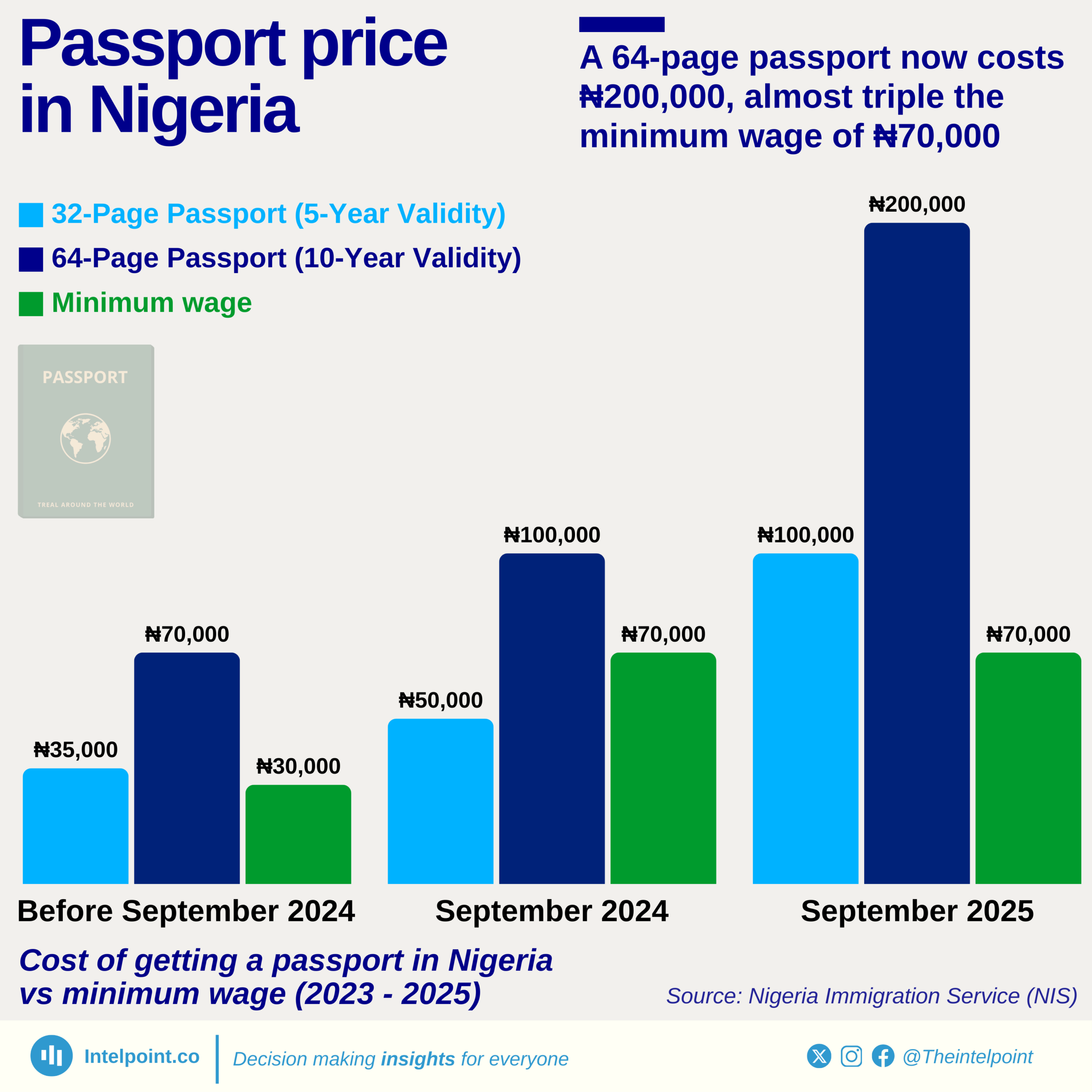
A 64-page passport now costs ₦200,000, almost triple the minimum wage of ₦70,000
  • The cost of a 64-page Nigerian passport increased from ₦70,000 before September 2024 to ₦200,000 by September 2025.
  • A 32-page passport rose from ₦35,000 before September 2024 to ₦100,000 by September 2025.
  • The minimum wage only rose once within this period—from ₦30,000 to ₦70,000 in September 2024.
  • In 2025, the 64-page passport costs nearly three times the minimum wage.
  • Affording a passport now requires significantly higher financial sacrifice, particularly for low-income earners.

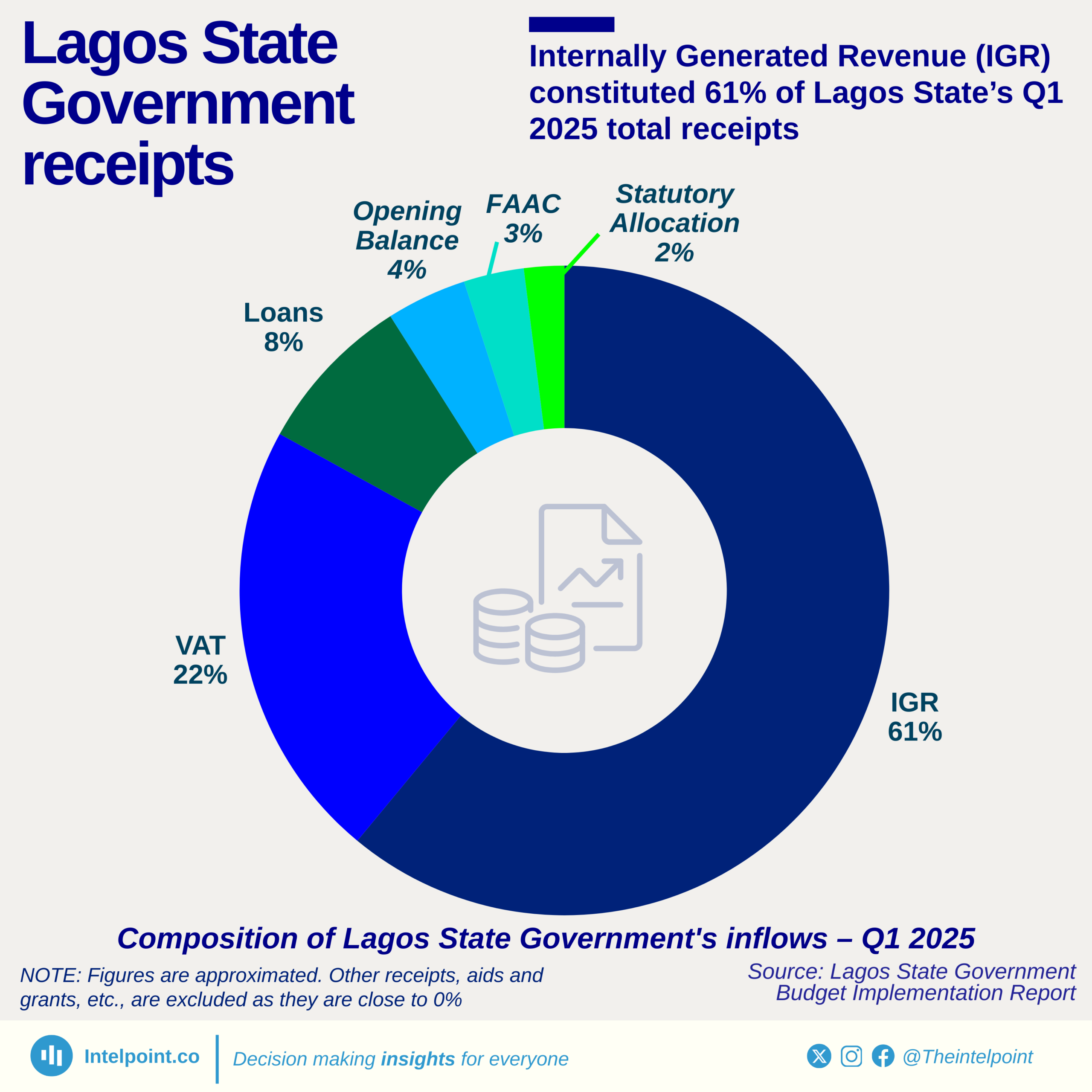
Internally Generated Revenue (IGR) constituted 61% of Lagos State’s Q1 2025 total receipts
  • Internally Generated Revenue (IGR) accounted for 61% of Lagos State’s Q1 2025 receipts.
  • VAT was the second-largest funding source, contributing 22%.
  • Loans made up 8% of total inflows for the quarter.
  • Opening balance accounted for 4%, indicating a moderate carryover from the previous year.

POPULAR TOPICS
SIGN UP TO OUR NEWSLETTER
Get periodic updates about the African startup space, access to our reports, among others.
Subscribe Here
Subscription Form

A product of Techpoint Africa. All rights reserved