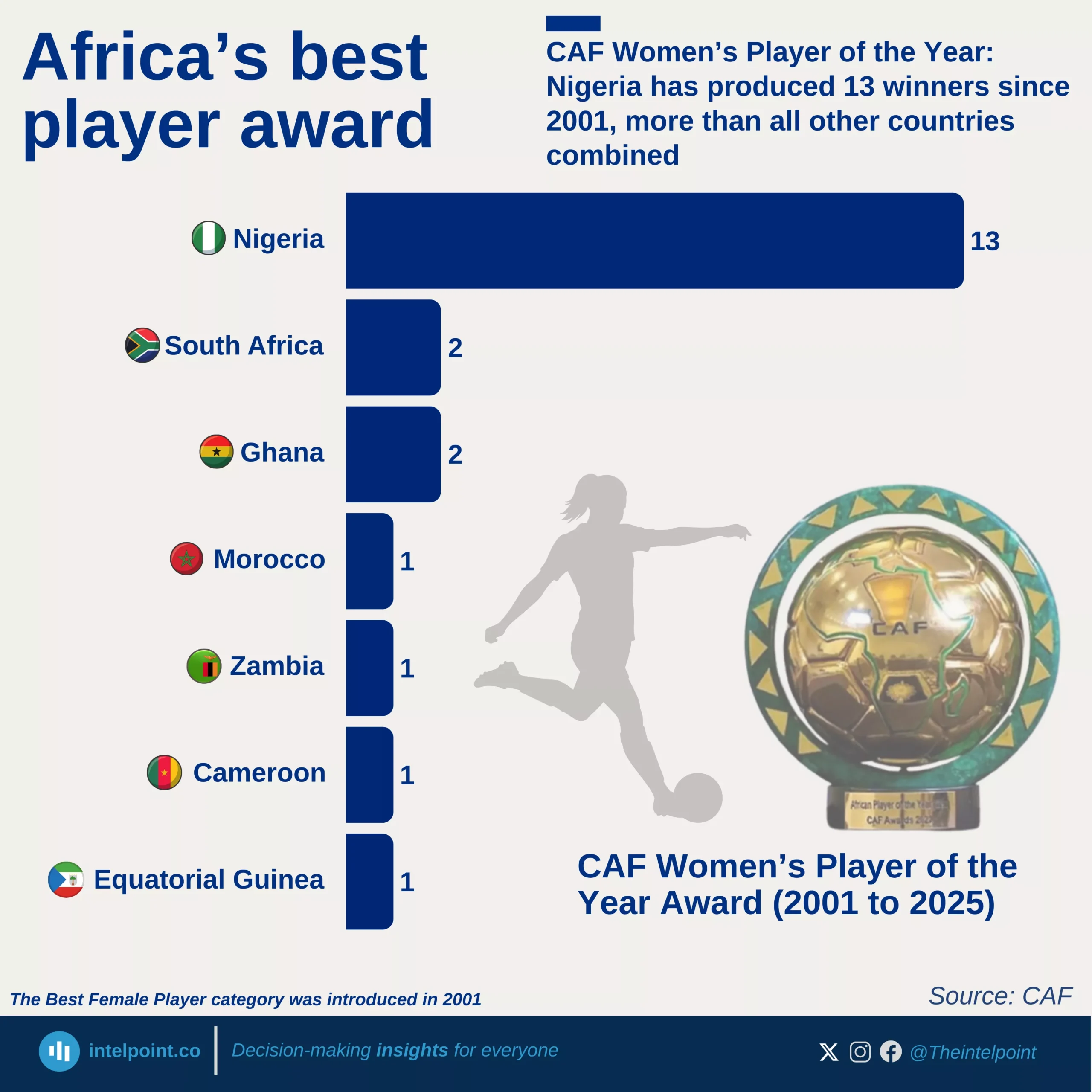
CAF Women’s Player of the Year: Nigeria has produced 13 winners since 2001, more than all other countries combined

  • Nigeria remains the country with the most overall winners.
  • Three Nigerian players — Asisat Oshoala (6), Perpetua Nkwocha (4), and Cynthia Uwak (2) — have won the award more than once.
  • Outside Nigeria, only Ghana, South Africa, Equatorial Guinea, and Cameroon have produced winners, showing limited spread beyond Nigeria in the first two decades.
  • In recent years, the award has become more competitive, with new winners emerging from Morocco, Zambia, and South Africa, signaling a noticeable shift away from long-standing Nigerian dominance.

The CAF Women’s Player of the Year category was introduced in 2001, marking a defining moment in the recognition of women’s football on the continent. From its earliest years, the award reflected Nigeria's extraordinary dominance. This dominance was driven by standout players who won not once, but multiple times. Asisat Oshoala emerged as the award’s most decorated figure with six wins, followed by Perpetua Nkwocha with four and Cynthia Uwak with two. Their collective achievements created a sustained era of Nigerian superiority that shaped the award’s identity for more than two decades. Beyond Nigeria’s core, only South Africa and Ghana secured two wins each, while Morocco, Zambia, Cameroon, and Equatorial Guinea each recorded one win.
Source:

CAF

Period:

2001-2025
HTML code to embed chart
Want a bespoke report?
Reach out
Tags
Related Insights

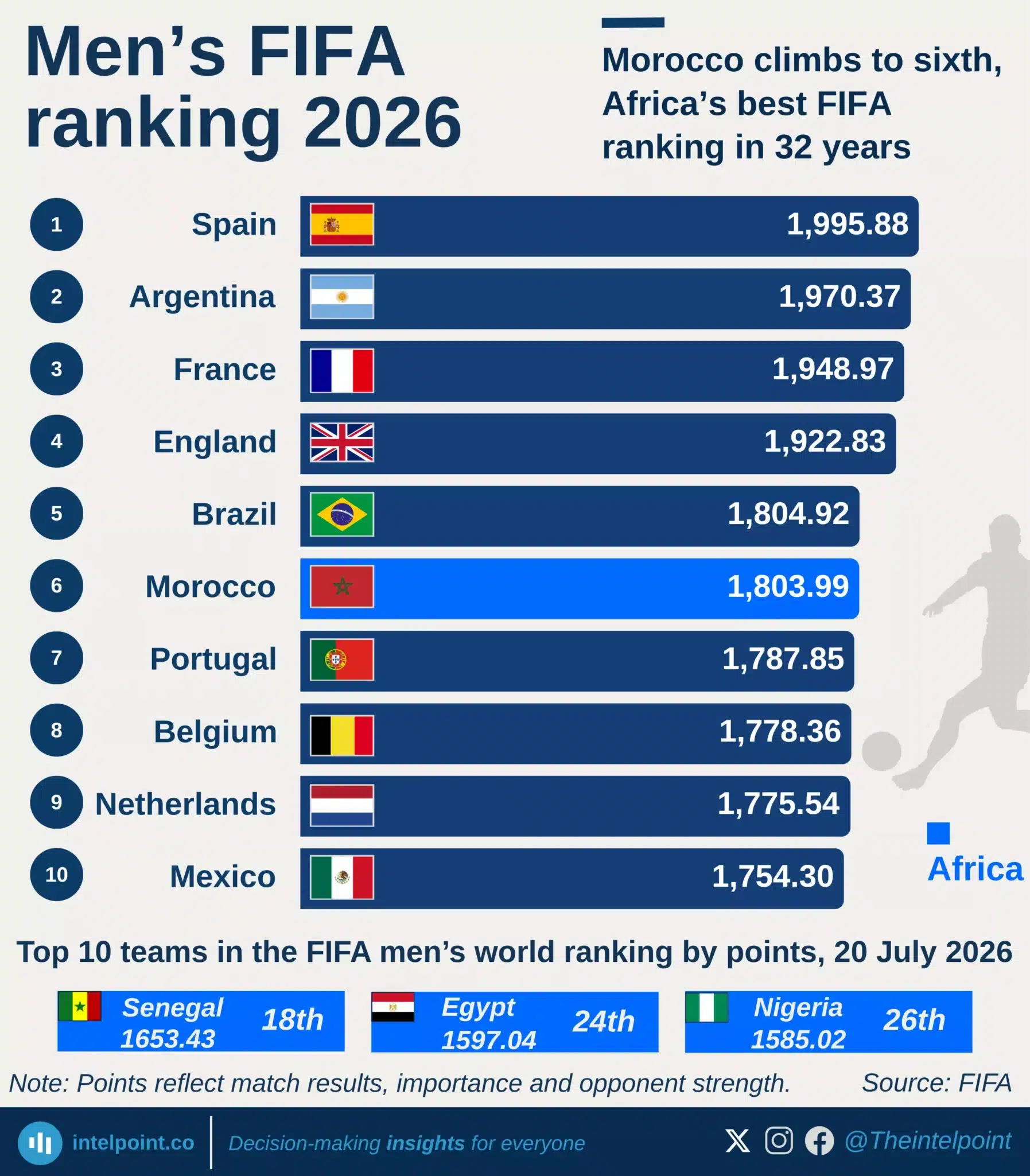
Morocco climbs to sixth, Africa’s best FIFA ranking in 32 years
  • Spain replaced Argentina at the top after beating them in the 2026 FIFA World Cup final.
  • Morocco moved from seventh on 11 June to sixth on 20 July, Africa’s highest position in 32 years.
  • Morocco is 0.93 points behind fifth-placed Brazil and remains the only African team in the global top 10.
  • FIFA adds or subtracts points based on match results, match importance and opponent strength.

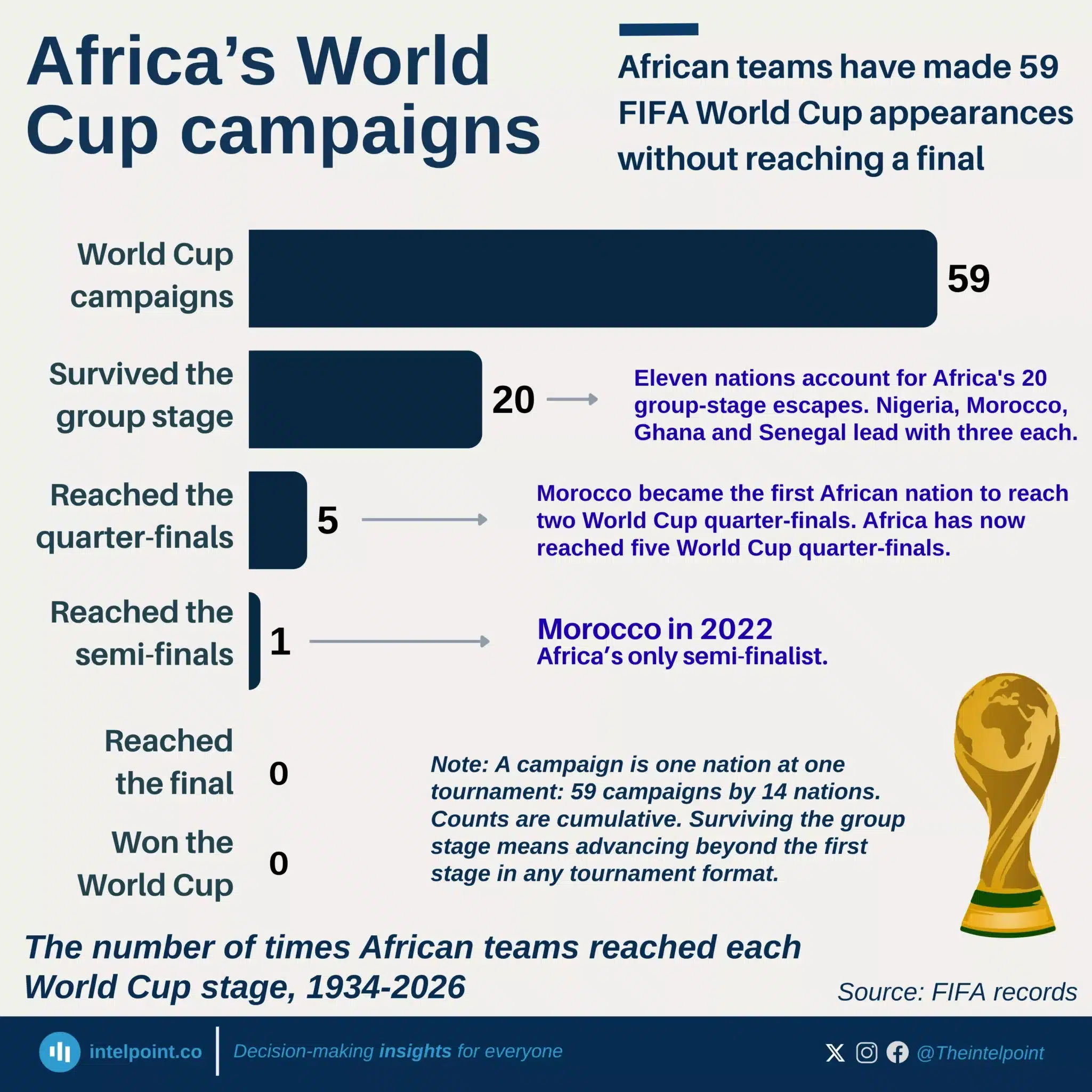
African teams have made 59 FIFA World Cup appearances without reaching a final
  • African teams have made 59 FIFA World Cup appearances since 1934.
  • Africa has advanced beyond the first stage 20 times.
  • Five African campaigns have reached the quarter-finals.
  • Morocco is the only African nation to reach the semi-finals.
  • Morocco is also the first African nation to reach two World Cup quarter-finals.
  • No African team has reached the final or won the World Cup.

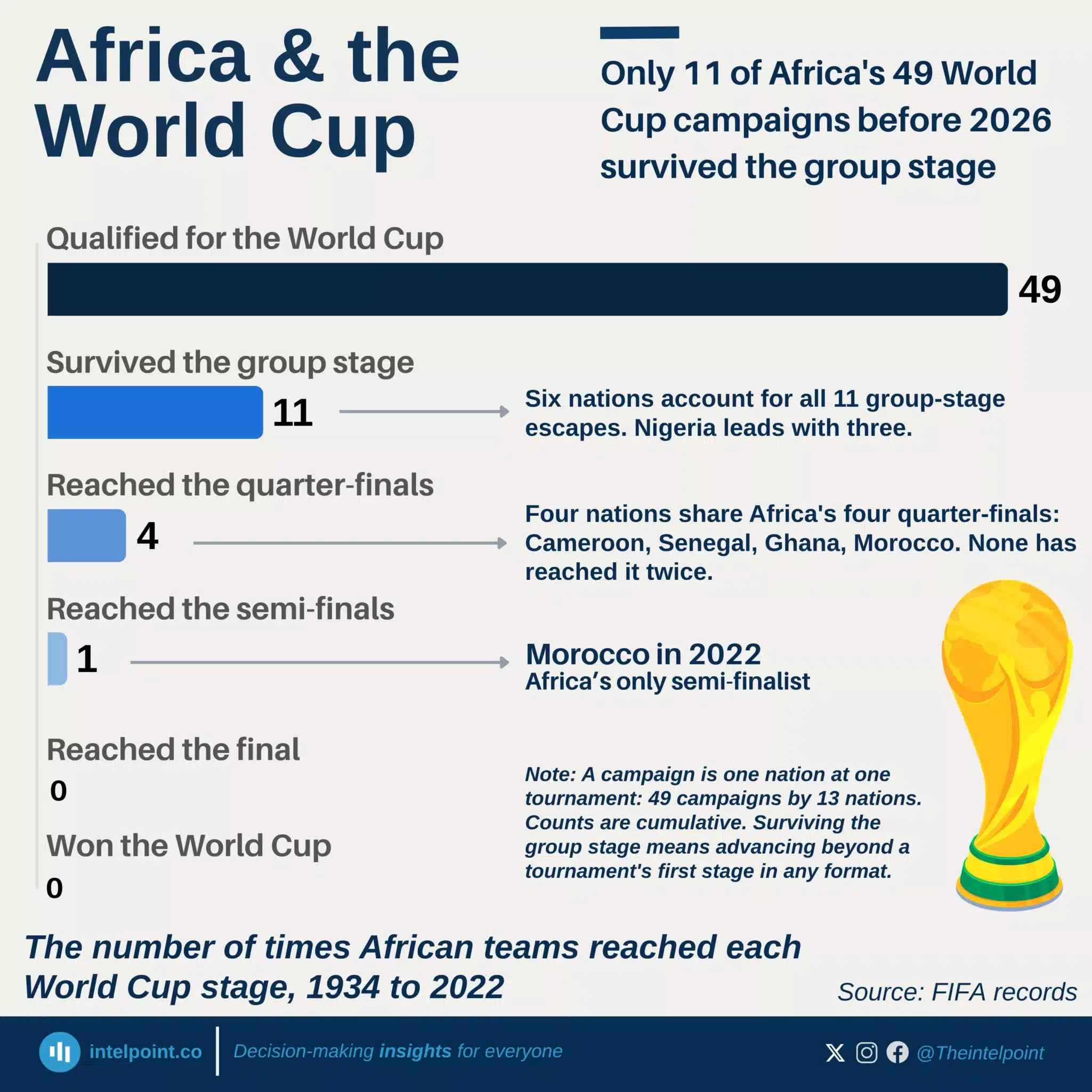
Only 11 of Africa's 49 World Cup campaigns before 2026 survived the group stage
  • African teams have made 49 World Cup appearances, but only 11 campaigns progressed beyond the opening stage.
  • Nigeria leads Africa with three group-stage escapes, despite missing the 2026 tournament.
  • Cameroon, Senegal, Ghana, and Morocco are Africa’s only World Cup quarter-finalists.
  • Morocco remains Africa’s only semi-finalist, while no African team has reached the final.

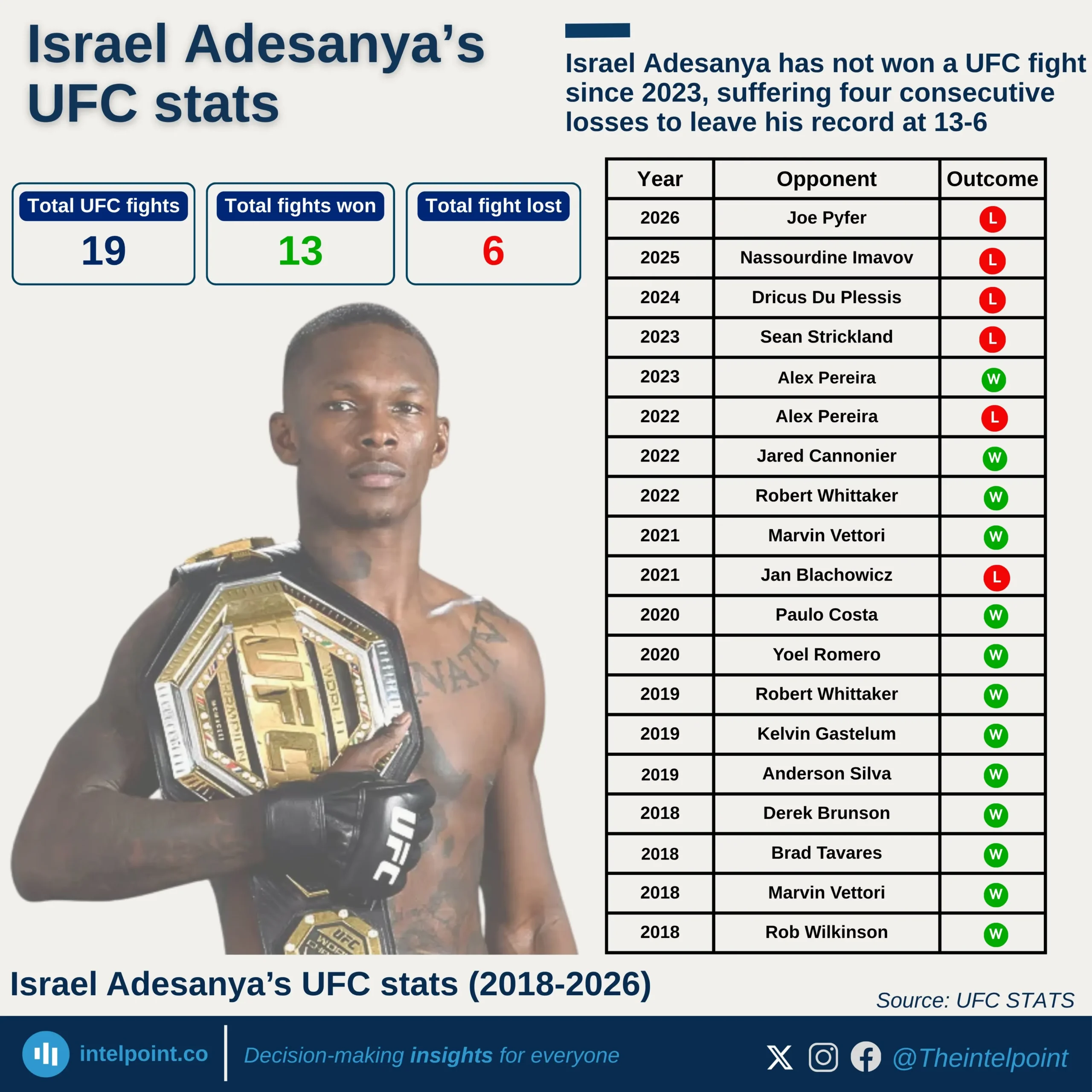
Israel Adesanya has not won a UFC fight since 2023, suffering four consecutive losses to leave his record at 13-6
  • Israel Adesanya has not won a bout since regaining middleweight gold at UFC 287 in April 2023, marking a nearly three-year drought from the winner's circle.
  • Adesanya has lost his past four consecutive appearances, a sharp contrast to his earlier career, where his elite striking defence made stoppage losses rare.
  • Adesanya has been tested at the highest level and has come up short each time, with all four defeats arriving between 2023 and 2026.
  • Six of his losses have come in the past five years of his career.

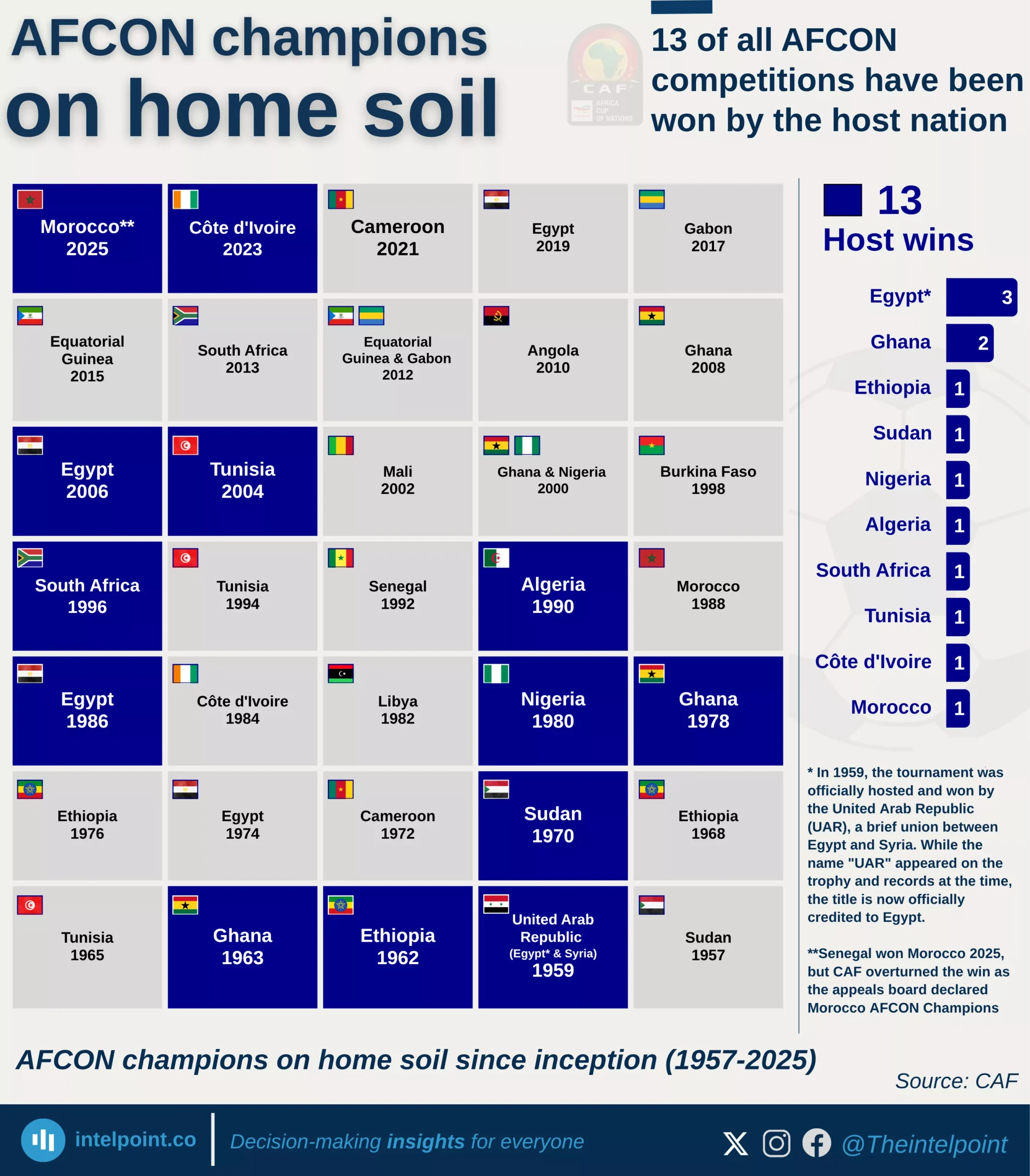
13 of all AFCON competitions have been won by the host nation
  • 13 out of 35 AFCON tournaments (37.1%) have been won by host nations
  • A larger share — 22 tournaments (62.9%) — were won by visiting teams.
  • The early AFCON years (1960s–1980s) saw more frequent home wins compared to recent decades.
  • Egypt has the most home-soil victories (3), followed by Ghana (2)
  • Despite high expectations, several hosts have failed to win.
  • Hosting provides crowd support and familiarity, but also brings heightened expectations and pressure.

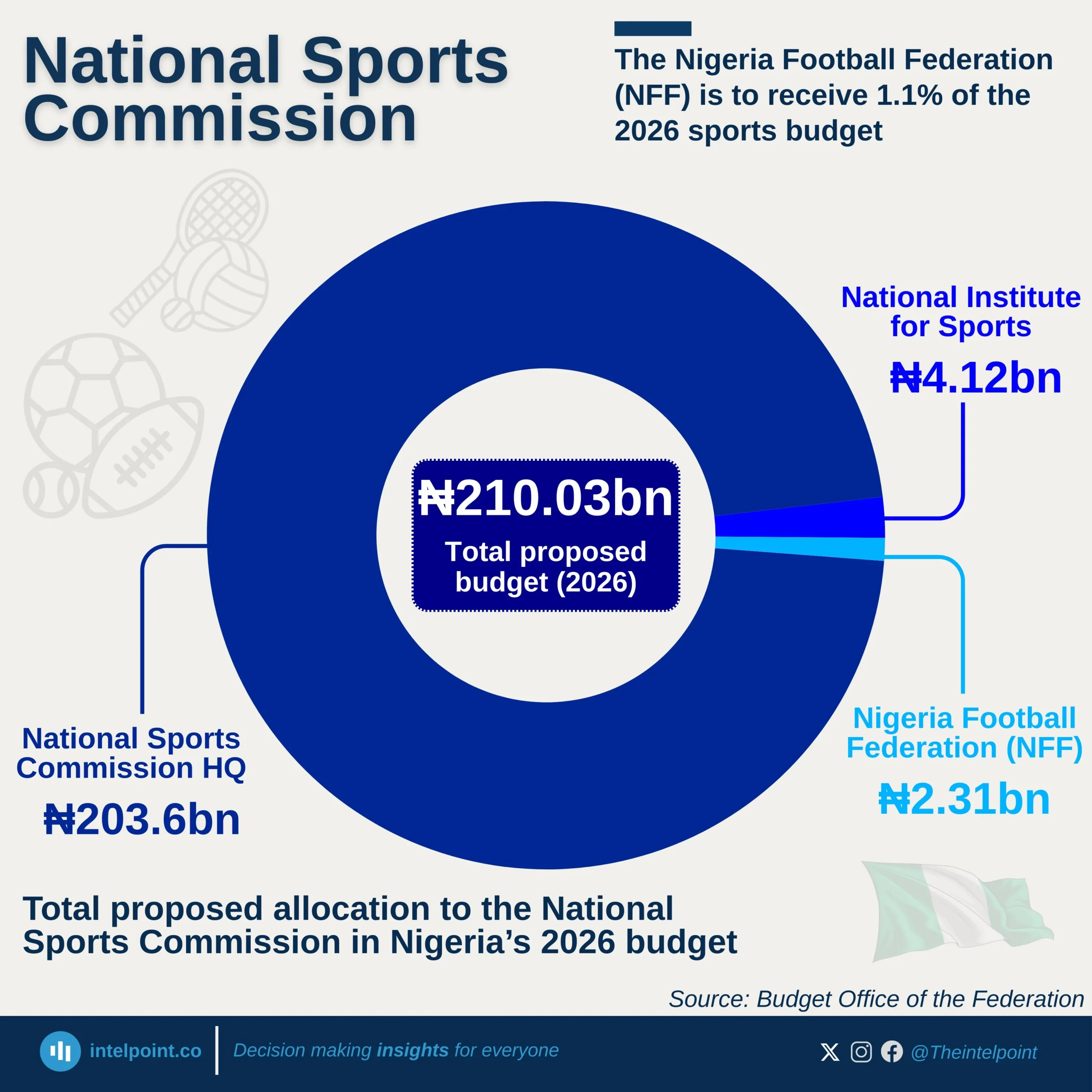
The Nigeria Football Federation (NFF) is to receive 1.1% of the 2026 sports budget
  • The NFF’s allocation of ₦2.31 billion is under 1.1% of the total sports budget.
  • The National Sports Commission HQ gets the most, with ₦203.6 billion, over 96% of the total.
  • The National Institute for Sports is to receive ₦4.12 billion, highlighting minimal federal investment in sports development.
  • Budget heavily favours administration over football development and grassroots programs.

POPULAR TOPICS
SIGN UP TO OUR NEWSLETTER
Get periodic updates about the African startup space, access to our reports, among others.
Subscribe Here
Subscription Form

A product of Techpoint Africa. All rights reserved