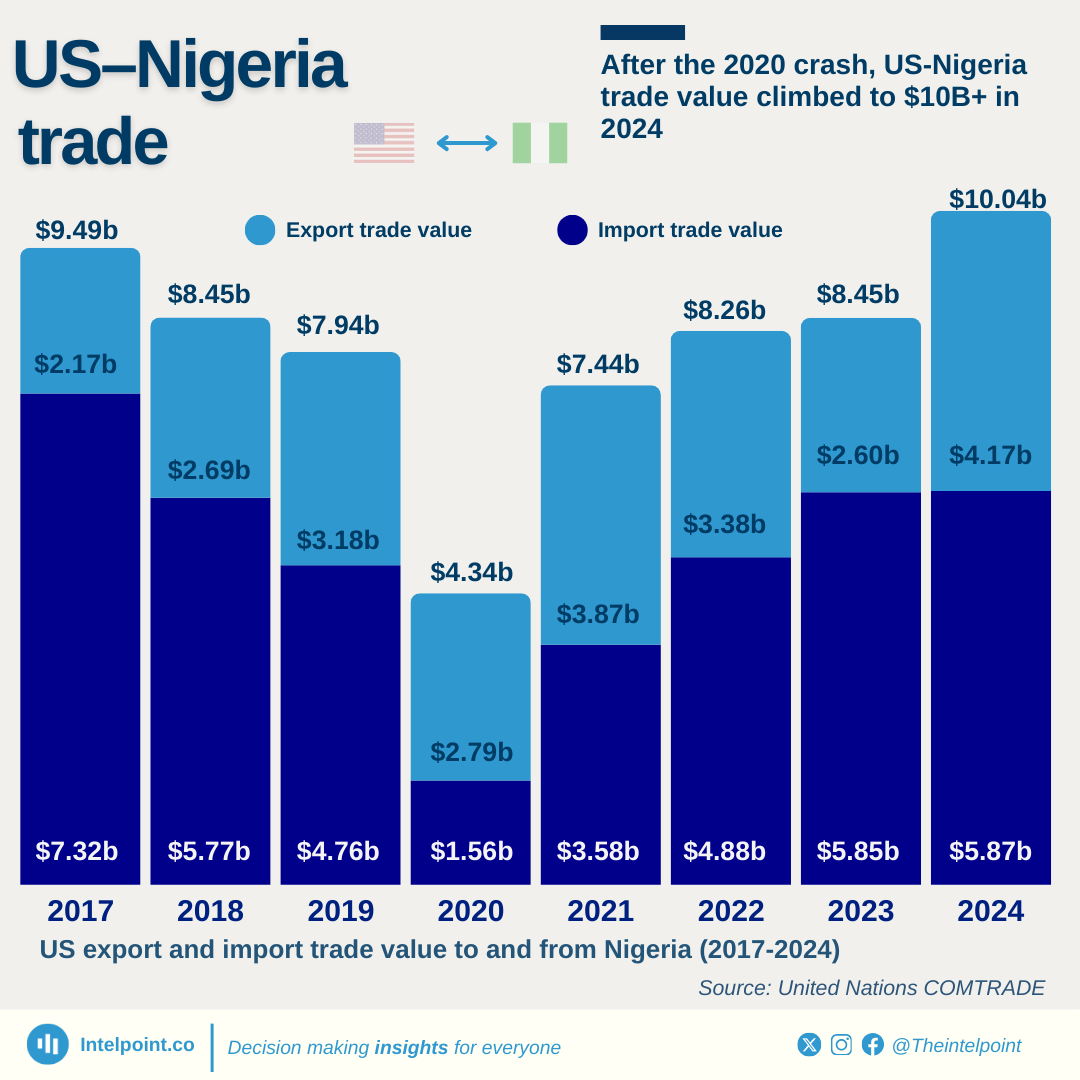
After the 2020 crash, US-Nigeria trade value climbed to $10B+ in 2024

Key Takeaways: 

  • The US' trade deficit with Nigeria narrowed significantly, shifting from a $5.14 billion deficit in 2017 to a $1.69 billion surplus in 2024.
  • US goods exports to Nigeria reached $4.2 billion in 2024, representing a 92% increase from the $2.2 billion recorded in 2017.
  • US goods imports from Nigeria totalled $5.9 billion in 2024, a 20% decrease from the $7.3 billion recorded in 2017.
  • The COVID-19 pandemic severely disrupted bilateral trade in 2020, but both imports and exports began recovering steadily from 2021 onwards.
  • By 2024, trade had rebounded substantially, with US imports from Nigeria reaching $5.87 billion and exports to Nigeria reaching $4.17 billion.
  • Despite experiencing persistent trade deficits from 2017 through most of the period, the US achieved trade surpluses with Nigeria in 2020 and 2021.
  • Total goods trade between the US and Nigeria ranged from $4 billion to approximately $10 billion.

Between 2017 and 2024, US–Nigeria trade relations underwent notable changes shaped by global economic shifts, most prominently the COVID-19 pandemic. In 2017, the US' imports from Nigeria stood at a peak of $7.3 billion but plummeted to just $1.55 billion by 2020 due to pandemic-related disruptions.

The US' imports from Nigeria have steadily increased, reaching $5.87 billion by 2024. Simultaneously, its exports to Nigeria have demonstrated exceptional resilience and growth, expanding from $2.17 billion in 2017 to $4.17 billion in 2024.

Overall, total goods trade between the two nations ranged from $4 billion during the pandemic's peak to nearly $10 billion by 2024. The trade balance has shifted dramatically in the United States' favour during this period. The trade balance that began as a substantial $5.14 billion deficit for the US in 2017 narrowed to just $1.7 billion by 2024, with the US even achieving trade surpluses in 2020 and 2021.
Source:

United Nations COMTRADE

Period:

2017-2024
HTML code to embed chart
Want a bespoke report?
Reach out
Tags
Related Insights

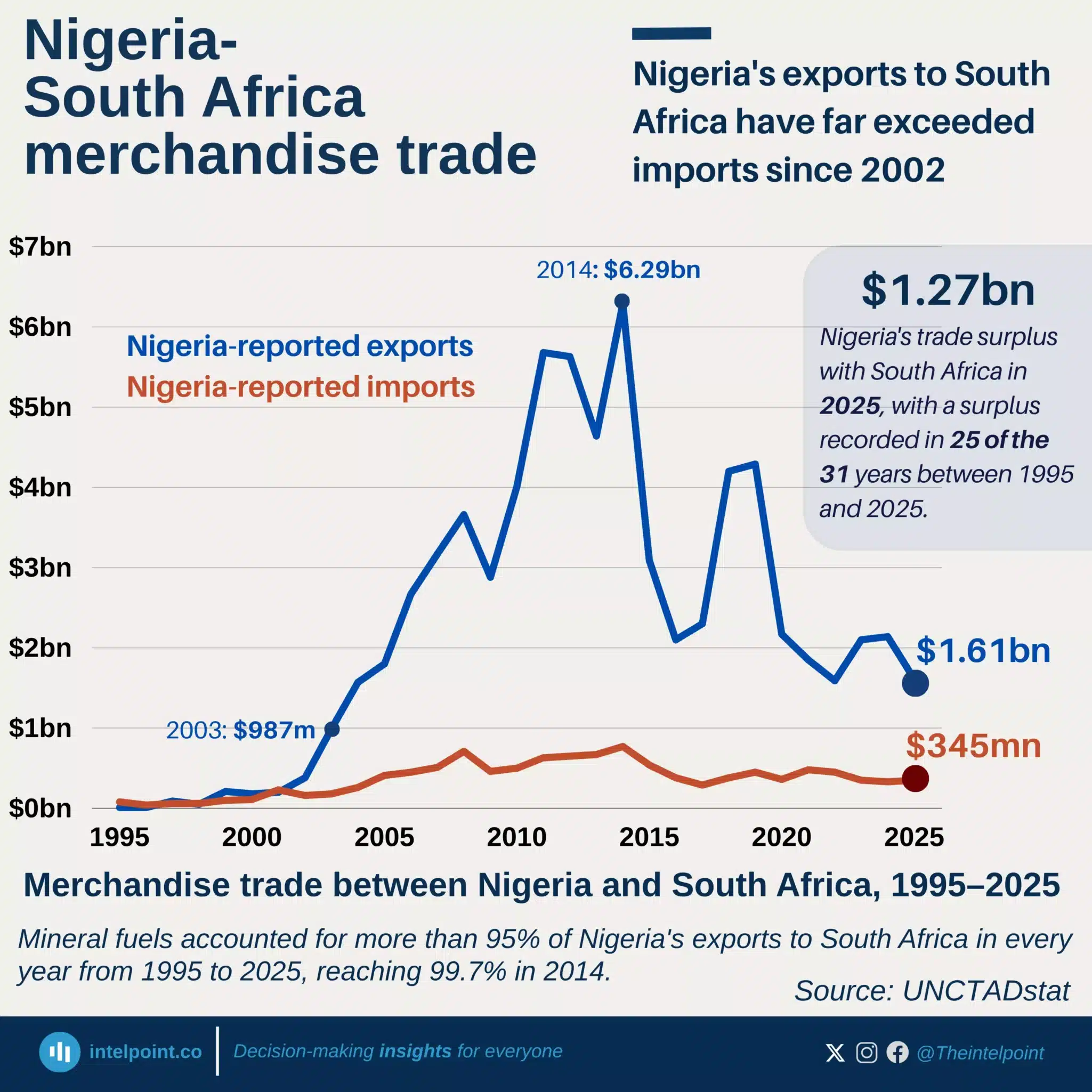
Nigeria's exports to South Africa have far exceeded imports since 2002
  • Nigeria has exported more to South Africa than it has imported every year since 2002.
  • Exports peaked at $6.29 billion in 2014, driven almost entirely by mineral fuels.
  • Imports from South Africa have remained below $1 billion annually.
  • Nigeria recorded a $1.27 billion trade surplus with South Africa in 2025.
  • Mineral fuels made up over 95% of Nigeria's exports throughout 1995-2025.

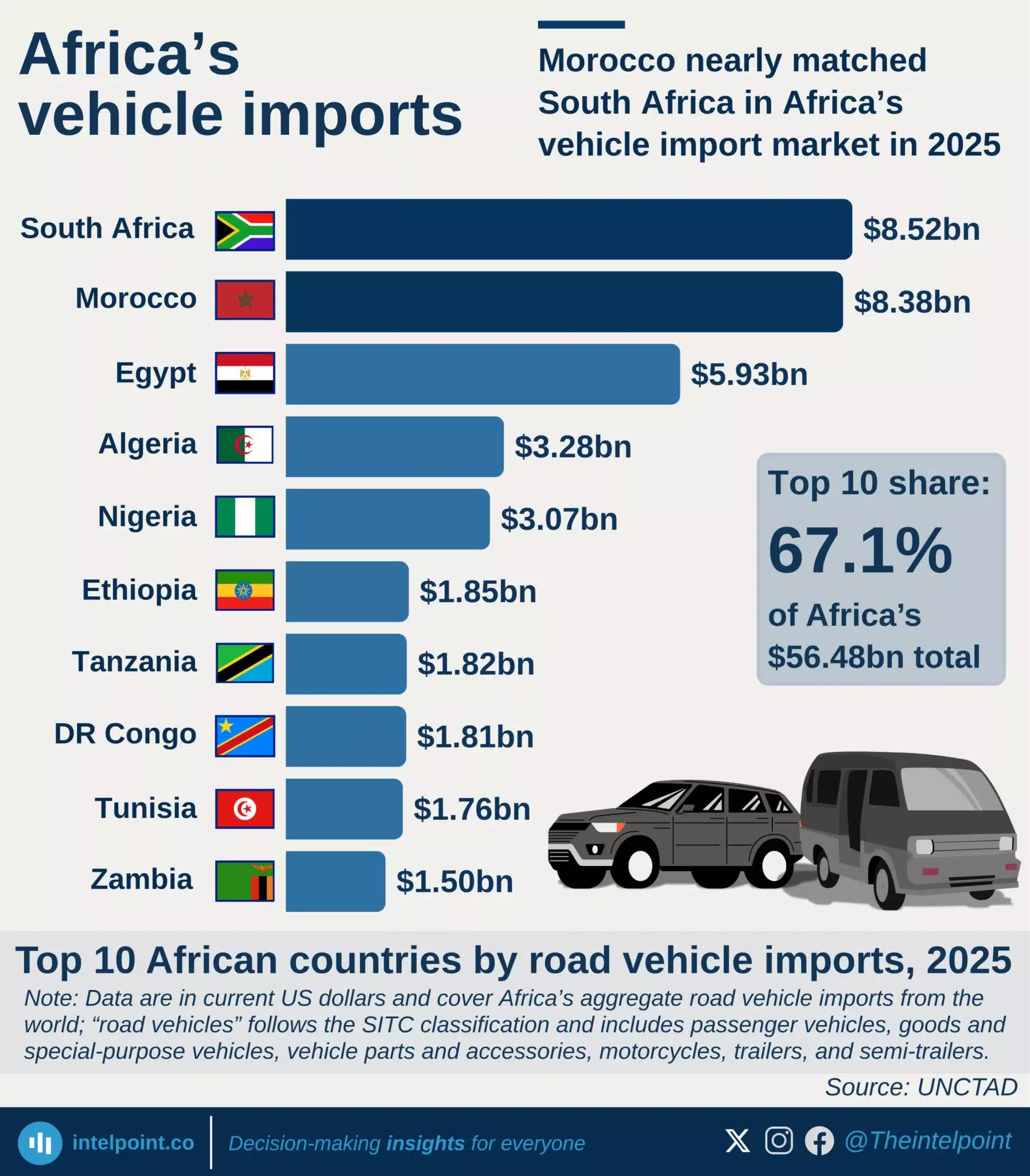
Morocco nearly matched South Africa in Africa’s vehicle import market in 2025
  • South Africa led with $8.52 billion, only $140 million ahead of Morocco.
  • Morocco’s imports have grown steadily, while South Africa’s 2025 figure was a recovery toward its 2012 peak.
  • Egypt ranked third, followed by Algeria and Nigeria.
  • The top 10 markets accounted for 67.1% of Africa’s $56.48 billion total.
  • Road vehicle imports include vehicles, parts, motorcycles, trailers, and semi-trailers.

Africa’s merchandise exports to China in 2025
  • Africa exported a record $86.2bn worth of goods to China in 2025.
  • China received about 12.5% of Africa’s total merchandise exports.
  • Annual exports remained below $10bn until 2004, before accelerating sharply.
  • Export values have remained relatively high since 2021 despite earlier downturns.
  • The trade relationship remains heavily commodity-led, with limited manufactured exports.

Africa’s export map changed, but only three economies escaped heavy reliance on one buyer
  • Only 3 of 52 African economies met the export-market diversification test in 2025.
  • Nigeria recorded the largest and most sustained shift, with its top-buyer share falling from 43.1% to 9.9%.
  • Madagascar’s top-market share dropped from 40.0% to 14.9% and has remained below 20% since 2021.
  • Libya narrowly qualified at 19.5%, after remaining above the threshold in 2024.
  • The test measures reduced dependence on one export destination, not greater product diversification.

South Africa, Egypt and Morocco accounted for nearly 40% ($313b) of Africa’s merchandise imports in 2025
  • Africa imported merchandise worth $788.9 billion in 2025, representing about 3% of global merchandise imports.
  • South Africa was Africa’s largest merchandise importer, with imports valued at $128.1 billion.
  • Egypt ranked second at $97.5 billion, followed by Morocco at $87.4 billion.
  • The three largest importers accounted for $313 billion, or 39.7% of Africa’s total merchandise imports.
  • South Africa alone accounted for about 16.2% of the continental total.
  • The five largest importers, including Algeria and Nigeria, were responsible for $404.6 billion, or 51.3% of Africa’s imports.
  • Nigeria ranked fifth, with merchandise imports valued at $41.5 billion.

Africa has never sold more than 20% of its goods exports within the continent in three decades
  • Only 16.9% of Africa’s merchandise exports were sold to other African countries in 2024.
  • Africa had the second-lowest intra-continental export share, ahead only of Oceania’s 4.8%.
  • Europe recorded the highest share at 65.6%, followed by Asia at 58.4% and the Americas at 54.0%.
  • Europe’s intra-continental export share was nearly four times Africa’s.
  • Africa’s share increased from 12.1% in 1995 to 16.9% in 2024, a rise of 4.8 percentage points.
  • Despite this long-term improvement, Africa remained below its 2015 peak of 18.8%.
  • Africa has not crossed the 20% mark at any point in the three decades covered.

POPULAR TOPICS
SIGN UP TO OUR NEWSLETTER
Get periodic updates about the African startup space, access to our reports, among others.
Subscribe Here
Subscription Form

A product of Techpoint Africa. All rights reserved