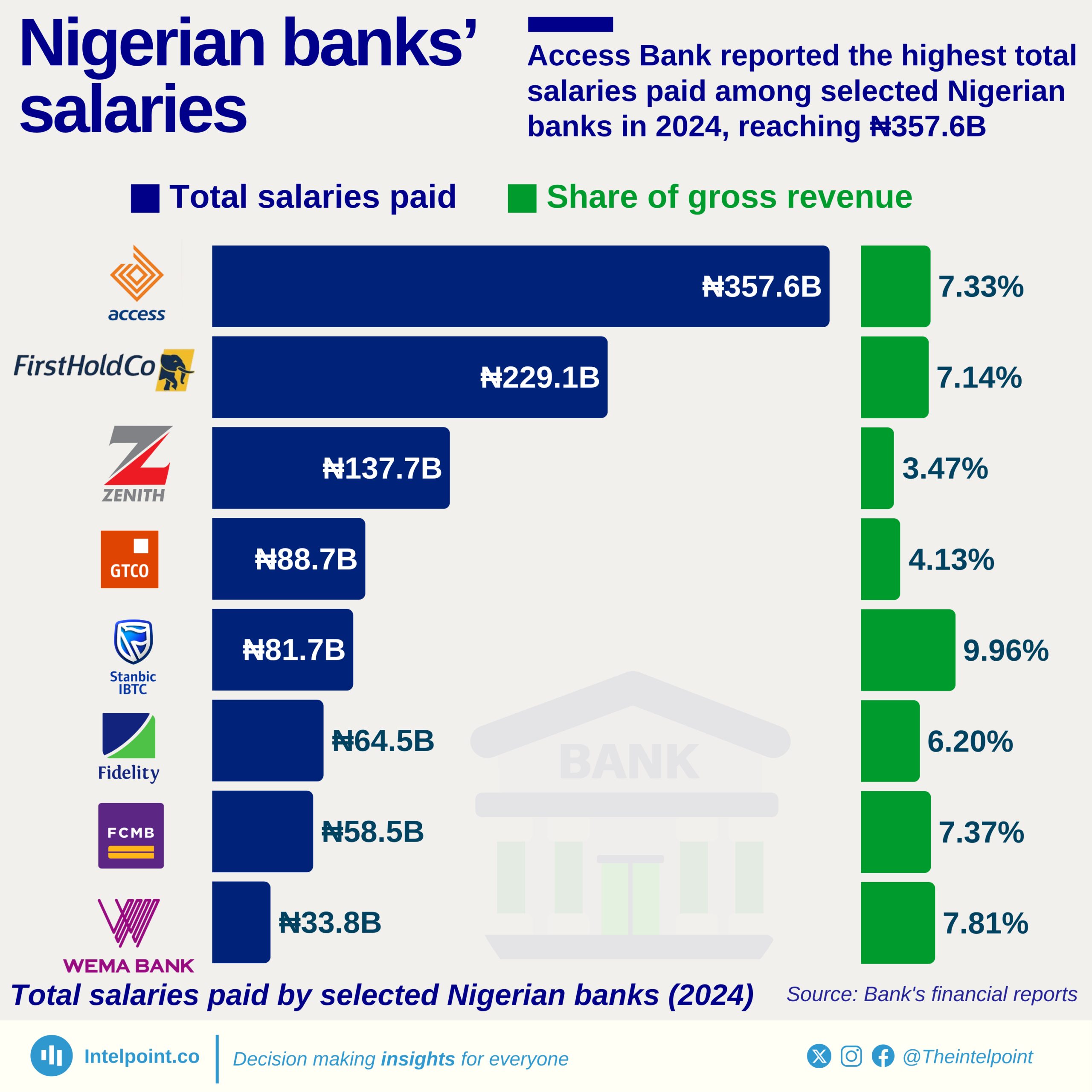
Access Bank reported the highest total salaries paid among selected Nigerian banks in 2024, reaching ₦357.6B

  • Access Bank paid the highest total salaries in 2024, amounting to ₦357.6 billion.
  • Stanbic IBTC devoted the largest share of its revenue to salaries at 9.96%, despite a much lower total salary bill than Access or FirstHoldCo.
  • Zenith Bank had one of the highest salary bills (₦137.7 billion) but spent the smallest portion of its revenue on staff at just 3.47%.
  • Wema Bank, though paying the lowest in total salaries (₦33.8 billion), had one of the highest salary-to-revenue ratios at 7.81%.
  • FirstHoldCo, with ₦229.1 billion in staff costs, maintained a moderate salary-to-revenue ratio of 7.14%.
  • The gap between total salary spend and salary-to-revenue ratios reveals more about each bank’s internal cost structure.

Access Bank, led in 2024, paid the highest total staff salaries among selected Nigerian banks, reaching ₦357.6 billion. This salary outlay accounted for 7.33% of its gross revenue, indicating both the scale of its operations and the size of its workforce. It was followed by First Bank’s holding company (FirstHoldCo), which paid ₦229.1 billion in staff salaries—just over 7% of its gross revenue.

While Access Bank paid the most in naira terms, Stanbic IBTC stood out with the highest salary-to-revenue ratio at 9.96%, meaning nearly one-tenth of its total earnings went to staff salaries. This suggests a more compensation-heavy structure, potentially due to a smaller workforce or stronger emphasis on human capital per unit of revenue. On the other hand, Zenith Bank’s salary spend stood at ₦137.7 billion, accounting for only 3.47% of its gross revenue—the lowest among the listed banks, indicating a leaner cost structure or higher gross income.
Source:

Banks’ audited financial reports

Period:

2024
HTML code to embed chart
Want a bespoke report?
Reach out
Tags
Related Insights

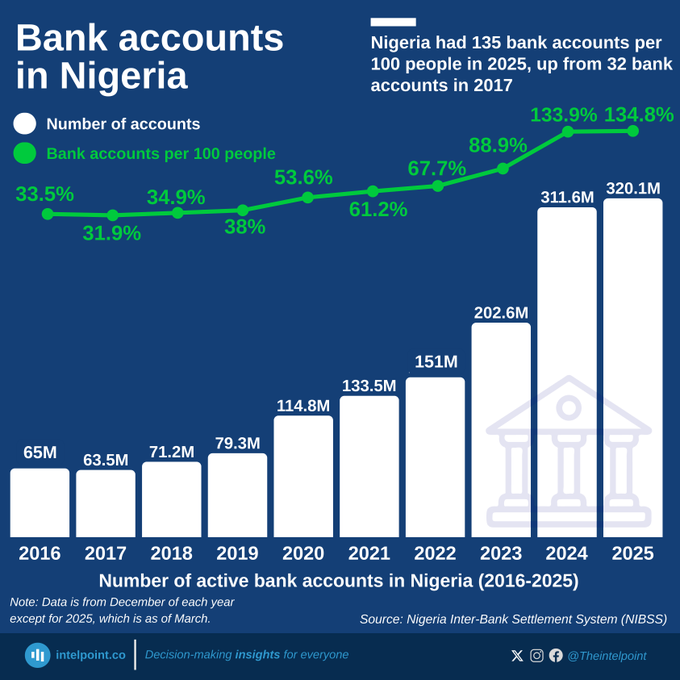
Nigeria had about 135 bank accounts per 100 people in 2025, up from 32 bank accounts in 2017
  • Active bank accounts grew from 65 million in 2016 to over 320 million in 2025 — almost a fivefold increase.
  • Bank accounts per 100 people rose from about 32 in 2017 to nearly 135 in 2025.
  • Nigeria now averages more than one bank account per person.
  • The fastest growth phase occurred between 2019 and 2024.
  • Digital banking and fintech adoption played a major role in the surge.
  • The jump after 2020 suggests technology-driven access, not just population growth.
  • Multiple account ownership is now common among users.

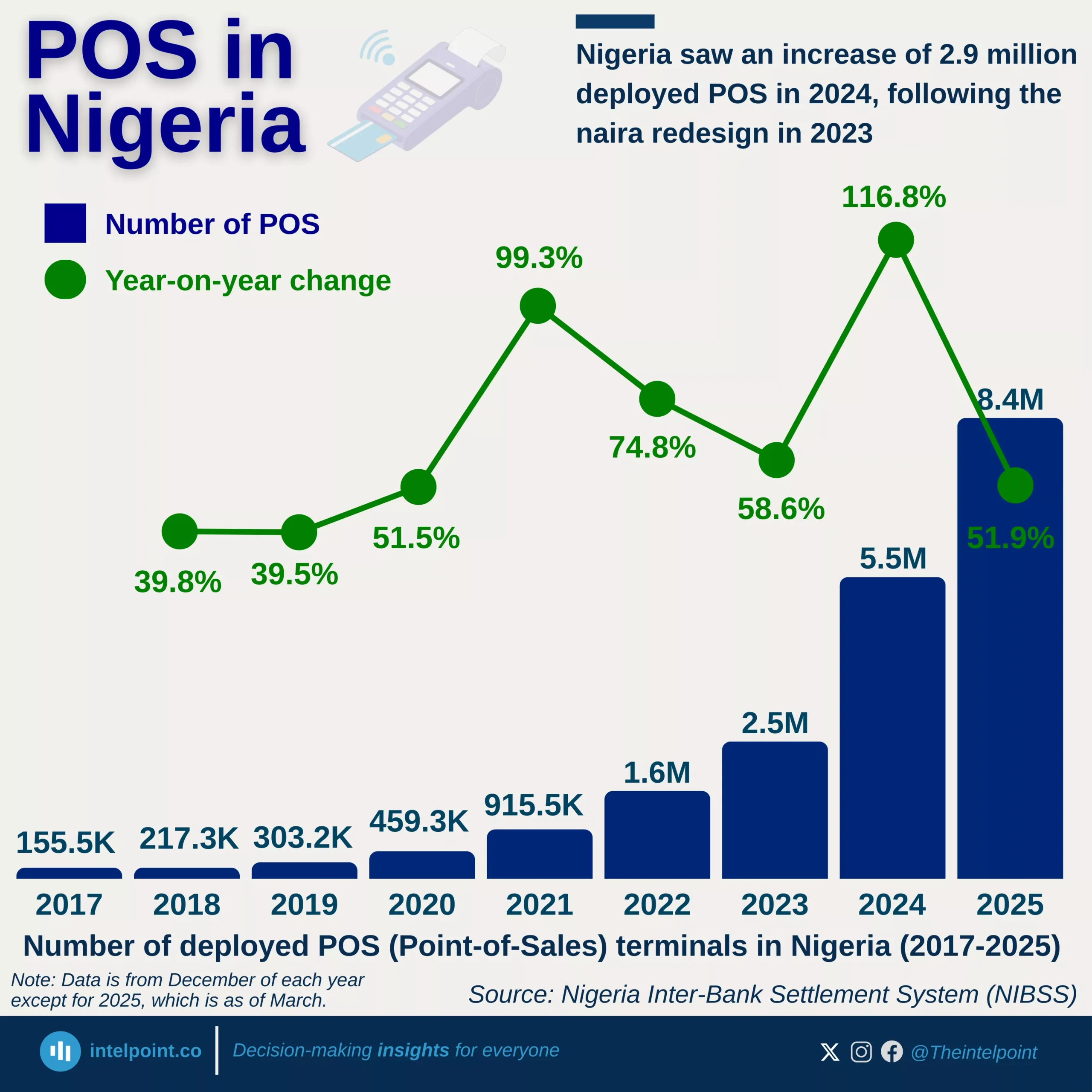
Nigeria saw an increase of 2.9 million deployed POS in 2024, following the naira redesign in 2023
  • Deployed POS terminals grew from about 156,000 in 2017 to 8.4 million in 2025.
  • Nigeria added more than eight million terminals in eight years, indicating rapid adoption of digital payments.
  • Growth accelerated sharply after 2020, marking a major shift toward cashless transactions.
  • The highest year-on-year growth (116.8%) occurred in 2024, following the naira redesign.
  • About three million terminals were added in 2024 alone.
  • POS agents became critical financial access points during the period of cash shortage.
  • POS terminals now function as mini-banks in many communities.
  • Financial inclusion has expanded through agent-based banking and POS networks.

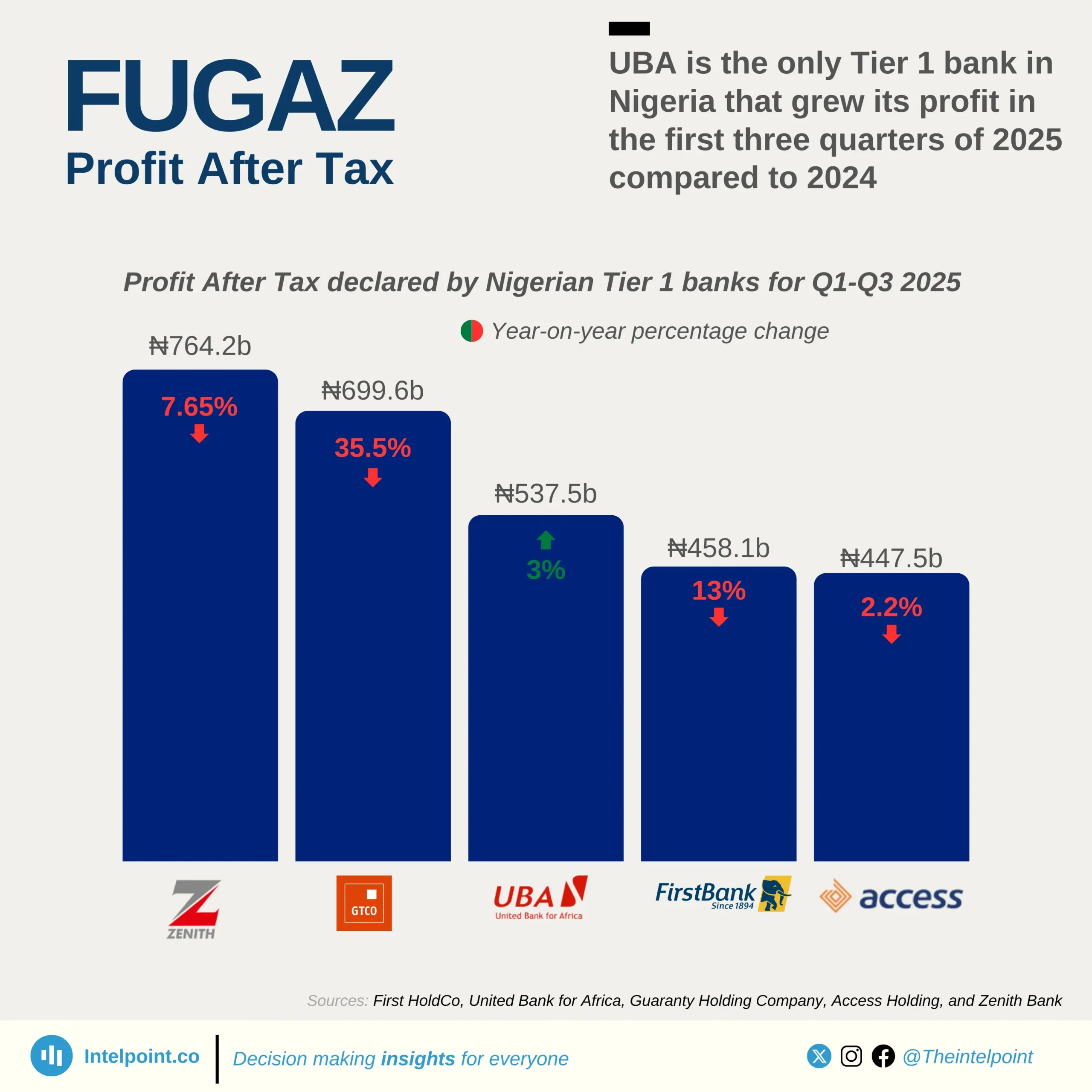
UBA is the only Tier 1 bank in Nigeria that grew its profit in the first three quarters of 2025 compared to 2024
  • FUGAZ posted a combined ₦2.91 trillion in profit from Q1 to Q3 of 2025.
  • Access Bank recorded the lowest PAT among the FUGAZ
  • UBA recorded a 3% year-on-year increase in PAT
  • FUGAZ recorded an average year-on-year percentage change of -11.2% for the period

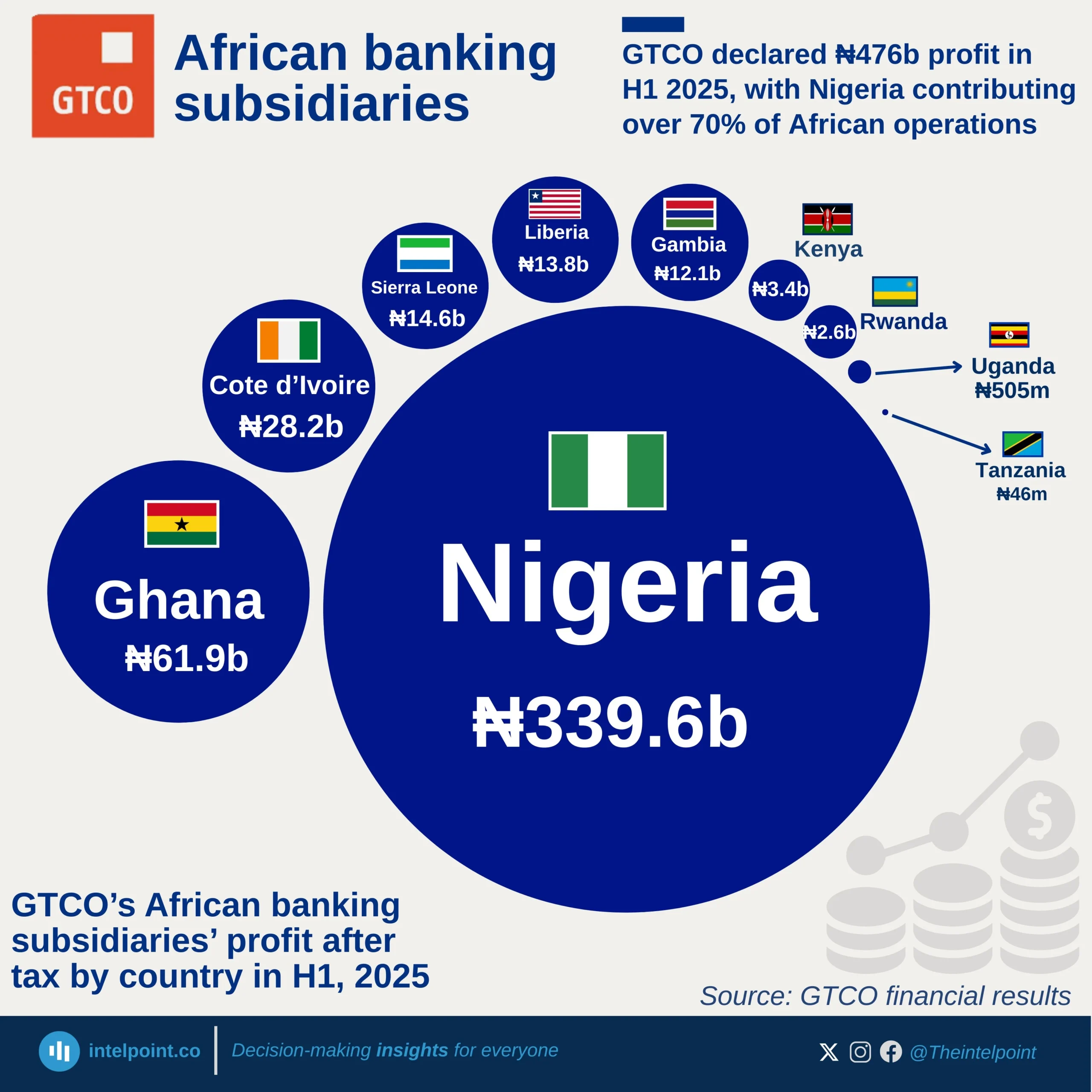
GTCO declared ₦476b profit in H1 2025, with Nigeria contributing over 70% of African operations
  • Nigeria dominates with ₦339.6b, contributing over 70% of GTCO’s total profit after tax in Africa.
  • Ghana (₦61.9b) and Côte d’Ivoire (₦28.2b) followed as the strongest non-Nigerian subsidiaries.
  • Tanzania (₦46m) and Uganda (₦505m) contributed negligible profits compared to peers.
  • GTCO subsidiaries across Africa collectively generated around ₦476b profit after tax in the first half of 2025.

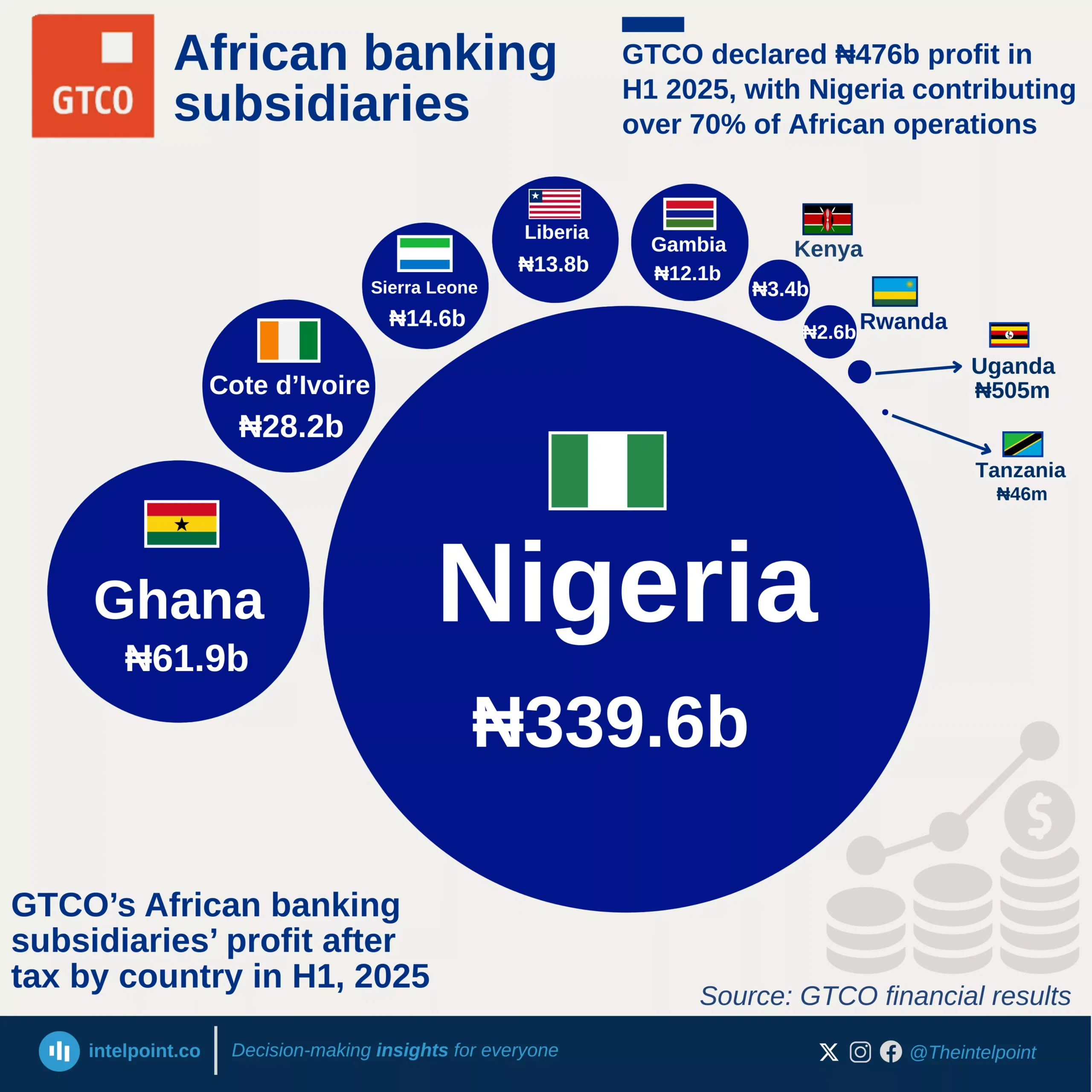
GTCO declared ₦476b profit in H1 2025, with Nigeria contributing over 70% of African operations
  • Nigeria dominates with ₦339.6b, contributing over 70% of GTCO’s total profit after tax in Africa.
  • Ghana (₦61.9b) and Côte d’Ivoire (₦28.2b) followed as the strongest non-Nigerian subsidiaries.
  • Tanzania (₦46m) and Uganda (₦505m) contributed negligible profits compared to peers.
  • GTCO subsidiaries across Africa collectively generated around ₦476b profit after tax in the first half of 2025.

Total microfinance deposits in Kenya only grew 1.66% CAGR over 10 years, ending at KSh 43.0B
  • Microfinance deposits in Kenya grew at only 1.66% CAGR between 2014 and 2024.
  • The peak occurred in 2021 at KSh 50.2B, after which deposits began a steady decline.
  • 2015 (+13.2%) and 2020 (+12.3%) posted the strongest year-on-year growth rates.
  • The sector saw consecutive contractions from 2022 (-7.3%), 2023 (-5.7%), to 2024 (-2.0%).
  • Despite small rebounds in 2018 (+7.3%) and 2019 (+12.3%), the long-term trend is weak.

POPULAR TOPICS
SIGN UP TO OUR NEWSLETTER
Get periodic updates about the African startup space, access to our reports, among others.
Subscribe Here
Subscription Form

A product of Techpoint Africa. All rights reserved