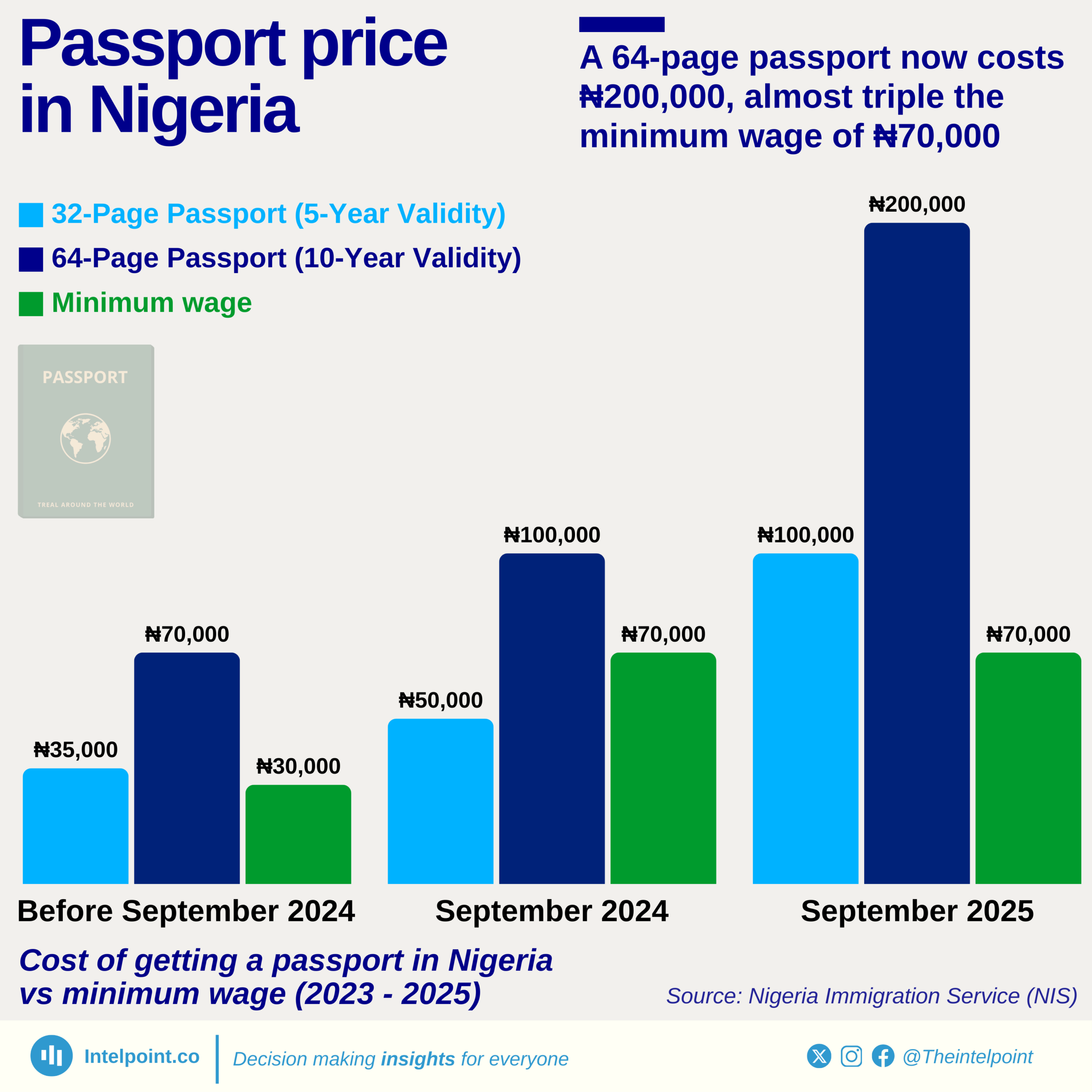
A 64-page passport now costs ₦200,000, almost triple the minimum wage of ₦70,000

  • The cost of a 64-page Nigerian passport increased from ₦70,000 before September 2024 to ₦200,000 by September 2025.
  • A 32-page passport rose from ₦35,000 before September 2024 to ₦100,000 by September 2025.
  • The minimum wage only rose once within this period—from ₦30,000 to ₦70,000 in September 2024.
  • In 2025, the 64-page passport costs nearly three times the minimum wage.
  • Affording a passport now requires significantly higher financial sacrifice, particularly for low-income earners.

There is a sharp rise in the cost of obtaining a Nigerian passport compared to the country’s minimum wage. Before September 2024, a standard 32-page passport cost ₦35,000, while the 64-page version was ₦70,000. However, by September 2024, the costs had almost doubled, with the 32-page passport rising to ₦50,000 and the 64-page version to ₦100,000. The trend became more striking with the announcement that in September 2025, the 64-page passport will cost ₦200,000—almost three times the minimum wage of ₦70,000.

This surge in passport costs places a heavy financial burden on many Nigerians, particularly when viewed against stagnant wages. Earning the new minimum wage of ₦70,000 means a worker would have to dedicate nearly three months’ income just to afford a 64-page passport.

The comparison also underscores a widening gap between official fees and workers’ earnings. While the minimum wage increased from ₦30,000 to ₦70,000 between 2023 and 2024, passport fees rose at a much faster pace, outstripping wage growth. This raises questions around affordability and whether passport acquisition is becoming a luxury for only higher-income earners.
Source:

Nigeria Immigration Service (NIS

Period:

2023-2025
HTML code to embed chart
Want a bespoke report?
Reach out
Tags
Related Insights

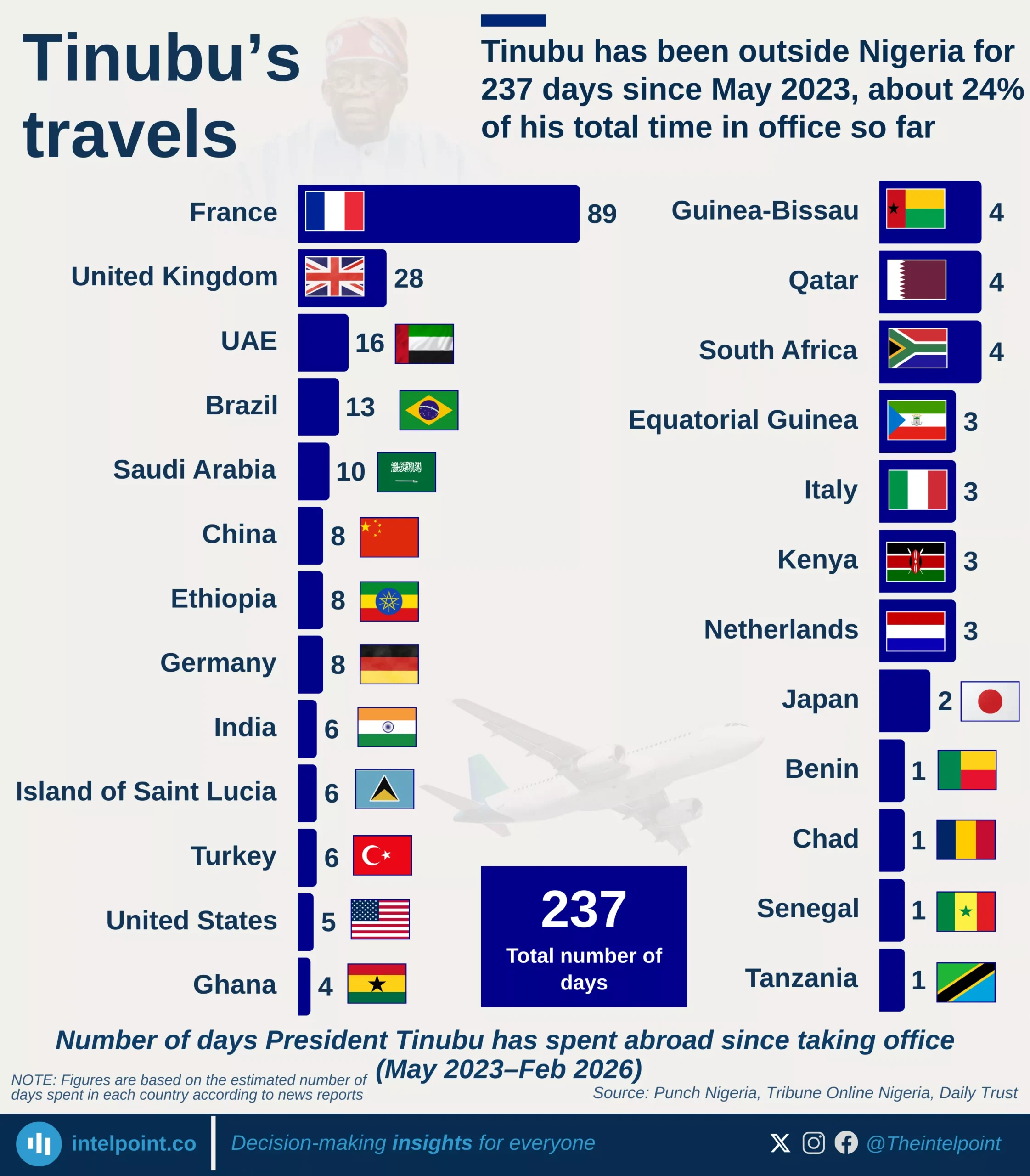
President Tinubu has been outside Nigeria for 237 days since May 2023, about 24% of his total time in office so far
  • President Tinubu has spent 237 days (about eight months) abroad since 2023.
  • France alone accounts for 89 days, making it his most-visited country.
  • The UK ranks second with 28 days.
  • The UAE, Brazil, and Saudi Arabia feature prominently.
  • Asia is well represented by China, India, and Japan, indicating growing engagement with Eastern economies.
  • Several African countries appear on the list, showing continued regional diplomacy.
  • Most countries recorded fewer than ten days, suggesting many short, targeted visits.

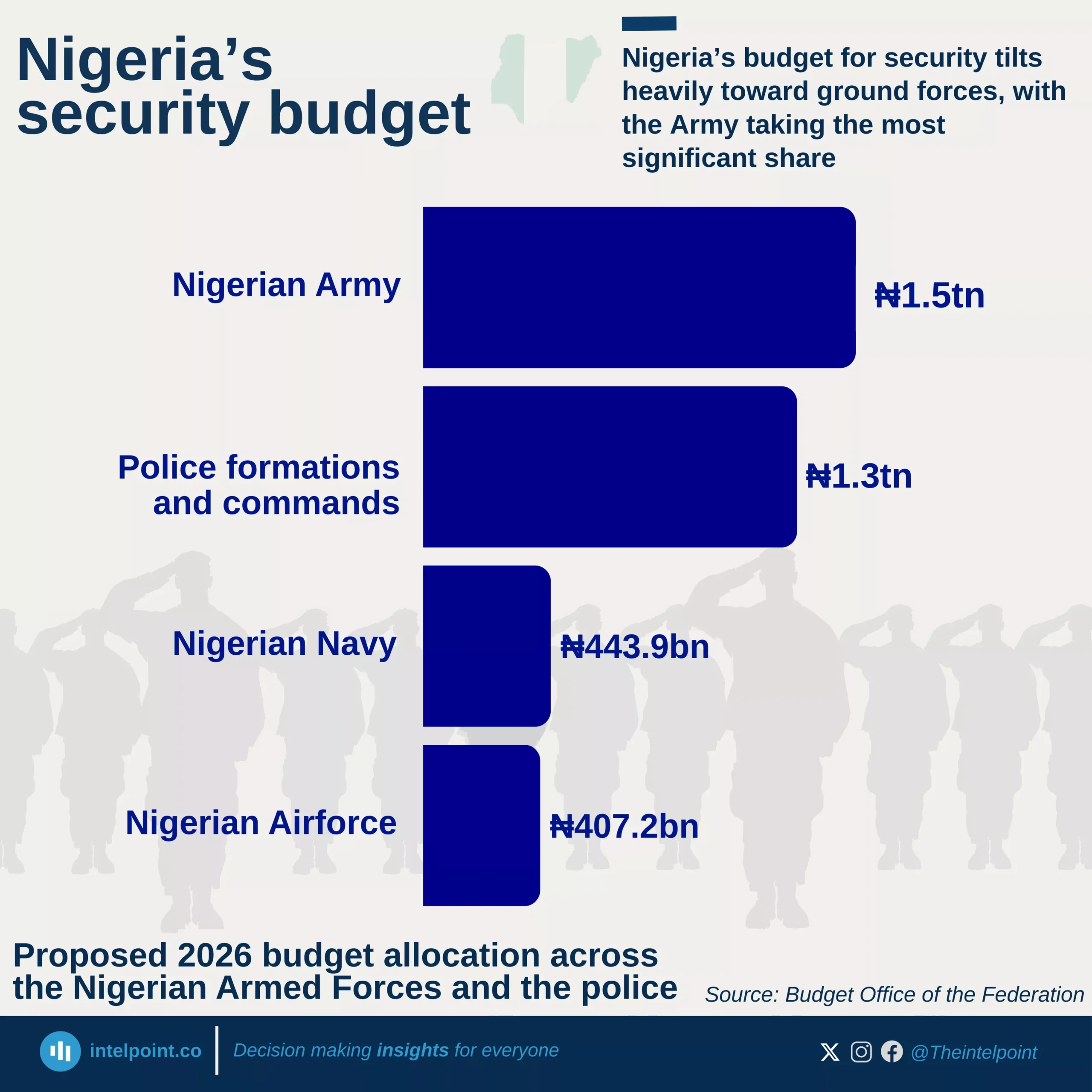
Nigeria’s budget for security tilts heavily toward ground forces, with the Army taking the most significant share
  • The Nigerian Army is allocated ₦1.5 trillion, surpassing the ₦1 trillion mark and making it the highest-funded force in the proposal.
  • Police formations and commands receive ₦1.3 trillion, exceeding the ₦ 1 trillion threshold in the 2026 budget.
  • The Nigerian Navy’s proposed allocation stands at ₦443.9 billion, keeping it well below the trillion-naira range reached by the top two.
  • The Nigerian Air Force is allocated ₦407.2 billion.

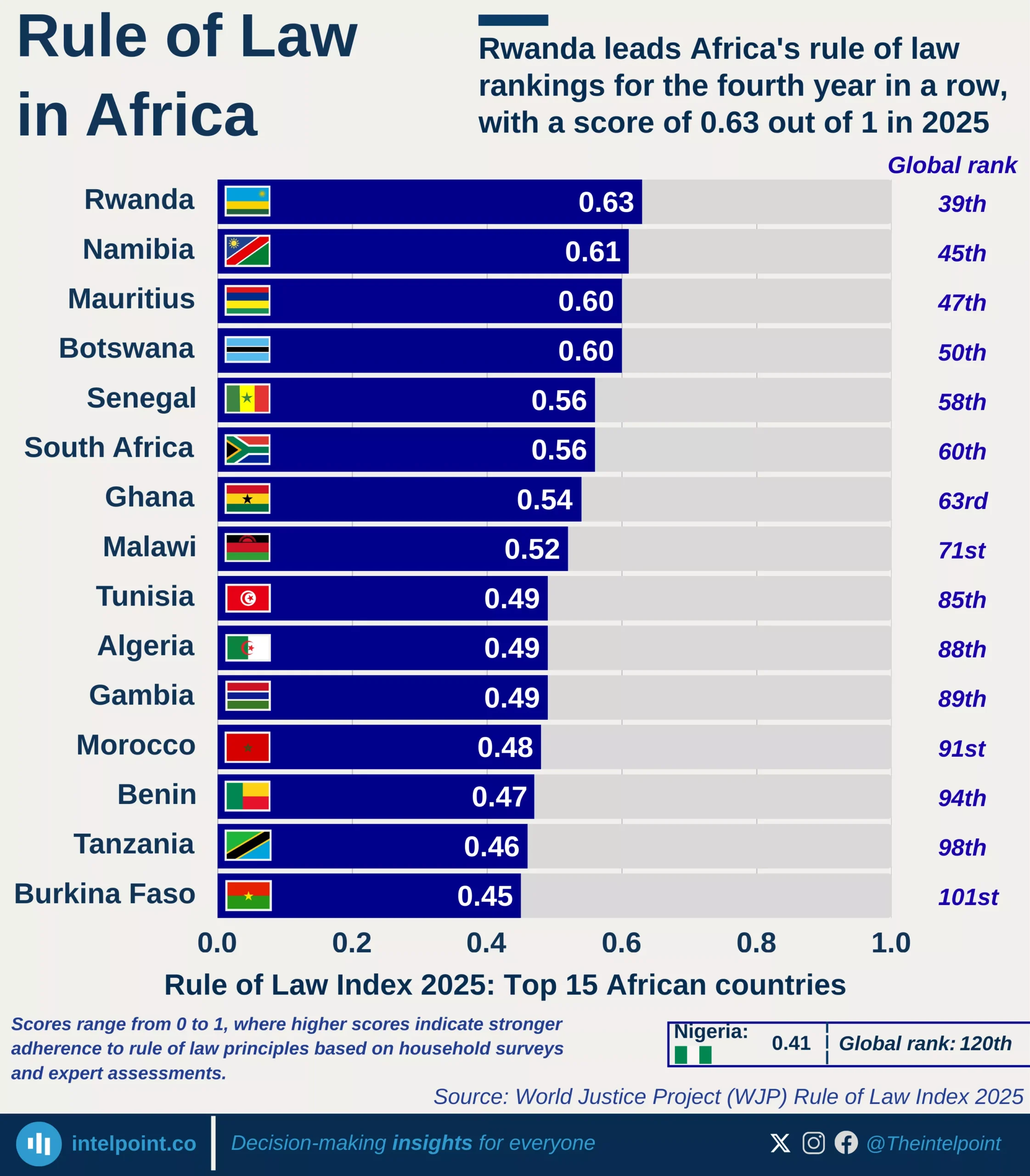
Rwanda leads Africa's rule of law rankings for the fourth year in a row, with a score of 0.63 out of 1 in 2025
  • Rwanda leads Africa with a rule of law score of 0.63, ranking 39th globally.
  • Namibia, Mauritius, and Botswana also place within the global top 50.
  • Senegal and South Africa are next, both scoring 0.56 in 2025.
  • Nigeria ranks 120th with a score of 0.41, below the regional average.
  • The Index evaluates justice, corruption, accountability, and fundamental rights.
  • A strong ranking reflects effective governance and respect for citizens’ rights.

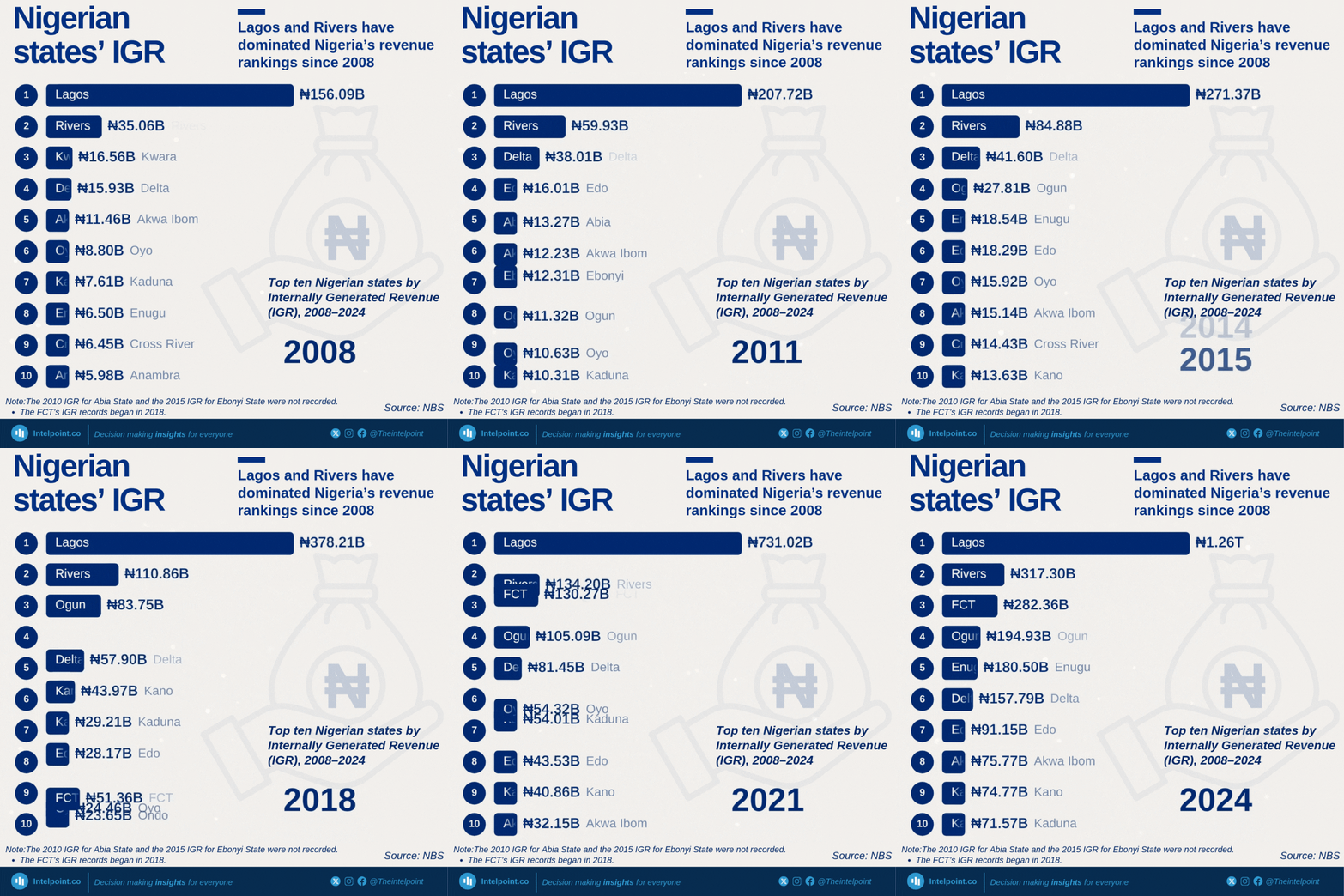
Lagos and Rivers have dominated Nigeria’s revenue rankings since 2008
  • A total of ₦20.45 trillion in Internally Generated Revenue (IGR) has been recorded nationwide since 2008.
  • Lagos State generated ₦1.26 trillion in 2024, maintaining its position as the top revenue-generating state.
  • For five consecutive years, Yobe and Taraba have consistently ranked among the bottom five states in revenue generation.
  • FCT IGR records began in 2018.
  • Enugu State recorded a remarkable 433.03% year-on-year increase in 2024.
  • Ebonyi (–57.27%), Ondo (–24.70%), and Yobe (–0.99%) were the only states that experienced a decline in IGR in 2024.

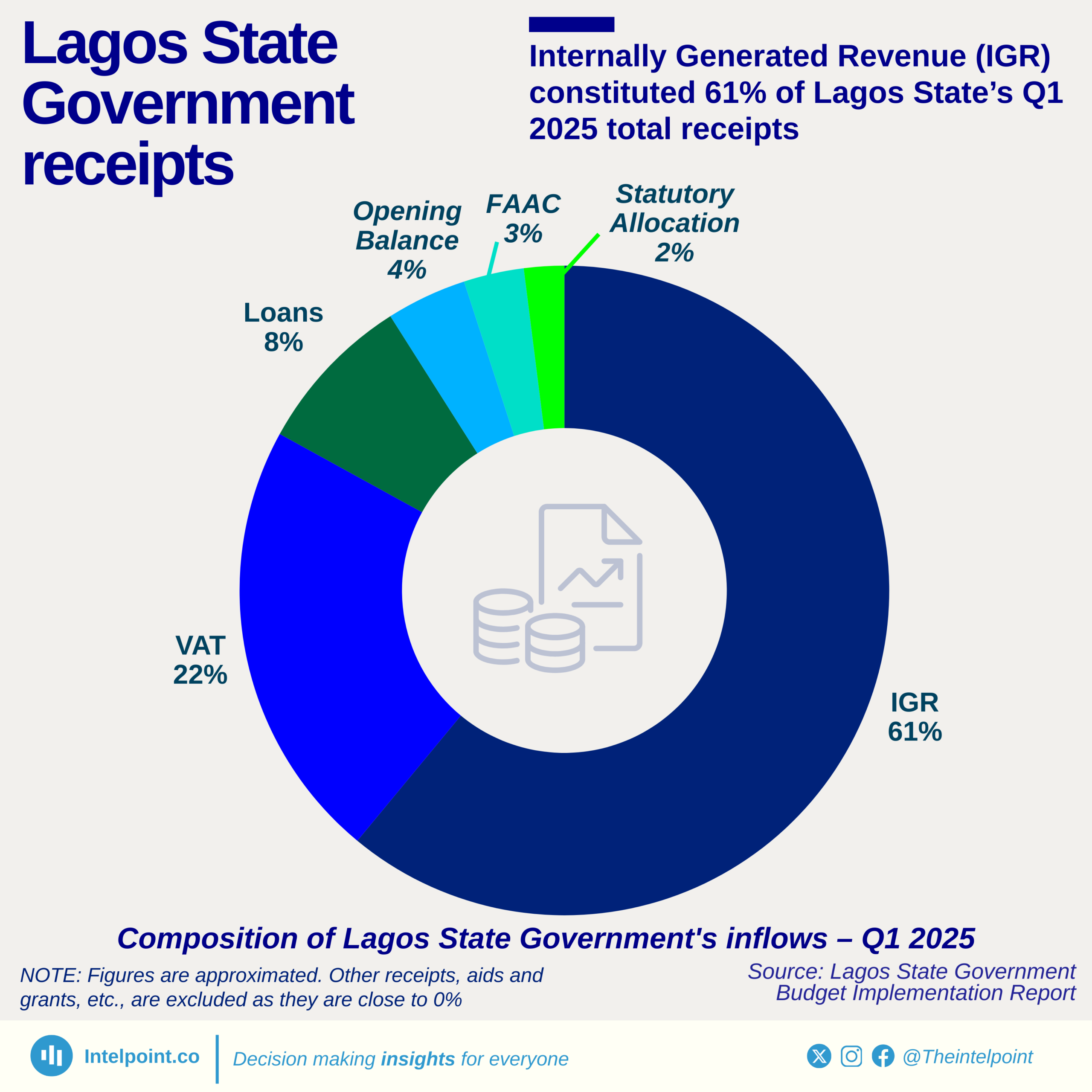
Internally Generated Revenue (IGR) constituted 61% of Lagos State’s Q1 2025 total receipts
  • Internally Generated Revenue (IGR) accounted for 61% of Lagos State’s Q1 2025 receipts.
  • VAT was the second-largest funding source, contributing 22%.
  • Loans made up 8% of total inflows for the quarter.
  • Opening balance accounted for 4%, indicating a moderate carryover from the previous year.

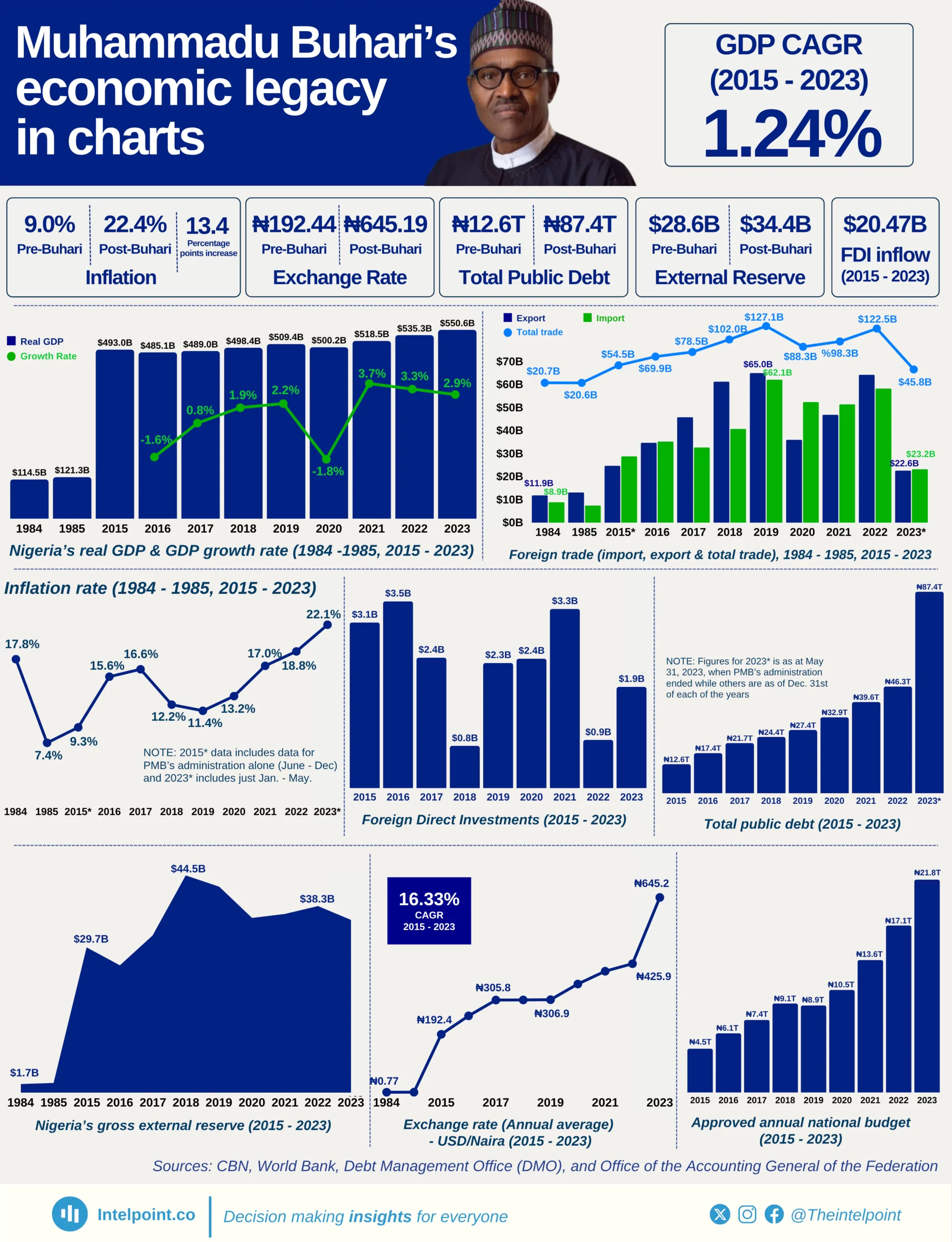
Muhammadu Buhari’s economic legacy in charts
  • Inflation jumped by 13.4 percentage points, from 9.0% pre-Buhari to 22.4% post-Buhari.
  • The value of the naira] depreciated by over 235% during Buhari’s tenure, ending at ₦645.2/$.
  • Total public debt increased nearly 7x, from ₦12.6 trillion in 2015 to ₦87.4 trillion in 2023.
  • Nigeria’s GDP growth rate averaged just 1.24% annually between 2015 and 2023.
  • Foreign reserves peaked at $44.5 billion in 2018 but dropped to $38.3 billion by 2023.
  • FDI inflows showed volatility, with the highest being $3.5 billion in 2021 and the lowest at $0.8 billion.
  • Nigeria's GDP growth rate was modest, with the country experiencing a recession in 2016.

POPULAR TOPICS
SIGN UP TO OUR NEWSLETTER
Get periodic updates about the African startup space, access to our reports, among others.
Subscribe Here
Subscription Form

A product of Techpoint Africa. All rights reserved