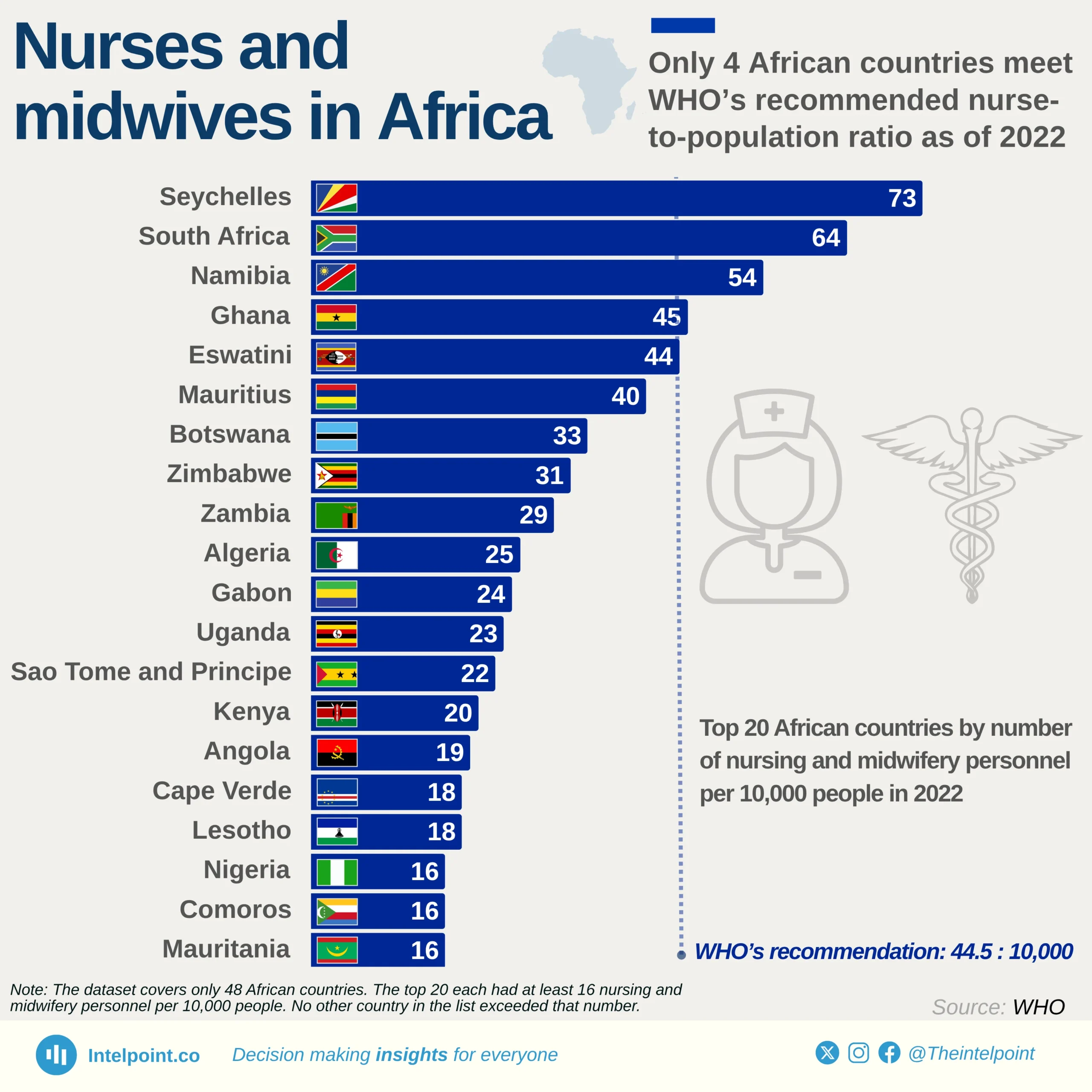
Only four African countries, Seychelles, South Africa, Namibia, and Ghana, meet or exceed the WHO’s recommended minimum of 44.5 nursing and midwifery personnel per 10,000 people.
Seychelles leads the continent with 73 personnel per 10,000, followed by South Africa (64), Namibia (54), and Ghana (45).
The lowest number within the top 20 is 16, shared by Nigeria, Comoros, and Mauritania.
The dataset includes 47 African countries, and no country outside the top 20 has more than 16 nursing and midwifery personnel per 10,000 people.
Rwanda is performing relatively well in terms of governance and rule of law, leading sub-Saharan Africa for the third consecutive year with a score of 0.63 in the 2024 Rule of Law Index. Namibia (0.61) and Mauritius (0.60) closely follow, showcasing relatively stronger legal frameworks.
At the lower end, Nigeria, Congo, and Gabon score 0.40, highlighting persistent governance challenges.
Globally, Denmark tops the list of 142 countries, with a score of 0.90, while Venezuela ranks last at 0.26, emphasising the gap between SSA's highest performers and global leaders. This mix of progress and struggles illustrates the varied state of governance across the region.
In 2023, Morocco led Africa’s phone export market with $192.2 million, making up 0.07% of the global total, followed by South Africa at $85.9 million, with a global share of 0.03%.
Though Tunisia, Mauritius, and Kenya contributed smaller shares, Tunisia’s remarkable 5,456% growth stands out, positioning it for greater involvement in the global market.
However, Mauritius and Kenya faced declines of -38% and -52%.
As of October 2024, only nine African countries are certified malaria-free: Egypt, Cape Verde, Tunisia, Algeria, Mauritius, Libya, Morocco, Seychelles, and Lesotho.
Egypt and Cape Verde are the newest members of this group.
Over 40 African countries remain uncertified, with the continent recording 233 million malaria cases in 2022.
In 2023, Libya led Africa in labour productivity, generating $29.7 per hour worked. Gabon and Mauritius followed at $25.6 and $25.5.
Meanwhile, Nigeria's workers generated $6.8 per hour, and Burundi recorded the lowest at $0.8.
Globally, Luxembourg and Ireland topped the list with $146 and $143 per hour, showcasing the efficiency and quality of human capital in these economies.
In H1 2024, the UK accounted for nearly half (48.9%) of Nigeria’s capital investments, totalling $2.93 billion, followed by South Africa (14%) and the Netherlands (11%).
This highlights the UK's long-standing economic ties with Nigeria, having invested over $47.5 billion over the past ten years. The UK remains Nigeria's top capital import source.
As of 2022, only seven African countries met the WHO's recommended doctor-to-population ratio of 10 doctors per 10,000 people.
Cape Verde, Seychelles, Libya, Eswatini, Tunisia, Mauritius, and Algeria are leading the way in healthcare accessibility in Africa. However, the continent still averages only 2.6 doctors per 10,000 people.
A country with strong infrastructure, affordable services, and high digital literacy, enabling everyone to use fast and reliable mobile internet will have a perfect score (100) on the GSMA's Mobile Connectivity Index 2023. South Africa leads in Africa with 69.53.
Globally, Singapore is first, with a score of 93.7, setting the benchmark for mobile internet adoption. Only four African countries — South Africa, Mauritius, Seychelles, and Egypt — surpassed the global average score.
Tunisia, Ghana, and Nigeria scored below the global average.
The Mobile Connectivity Index analysed measured 173 countries' mobile internet adoption from 2014-2023, normalising indicators to a 0-100 scale for consistency. The factors assessed include infrastructure, affordability, digital literacy, and policy frameworks.