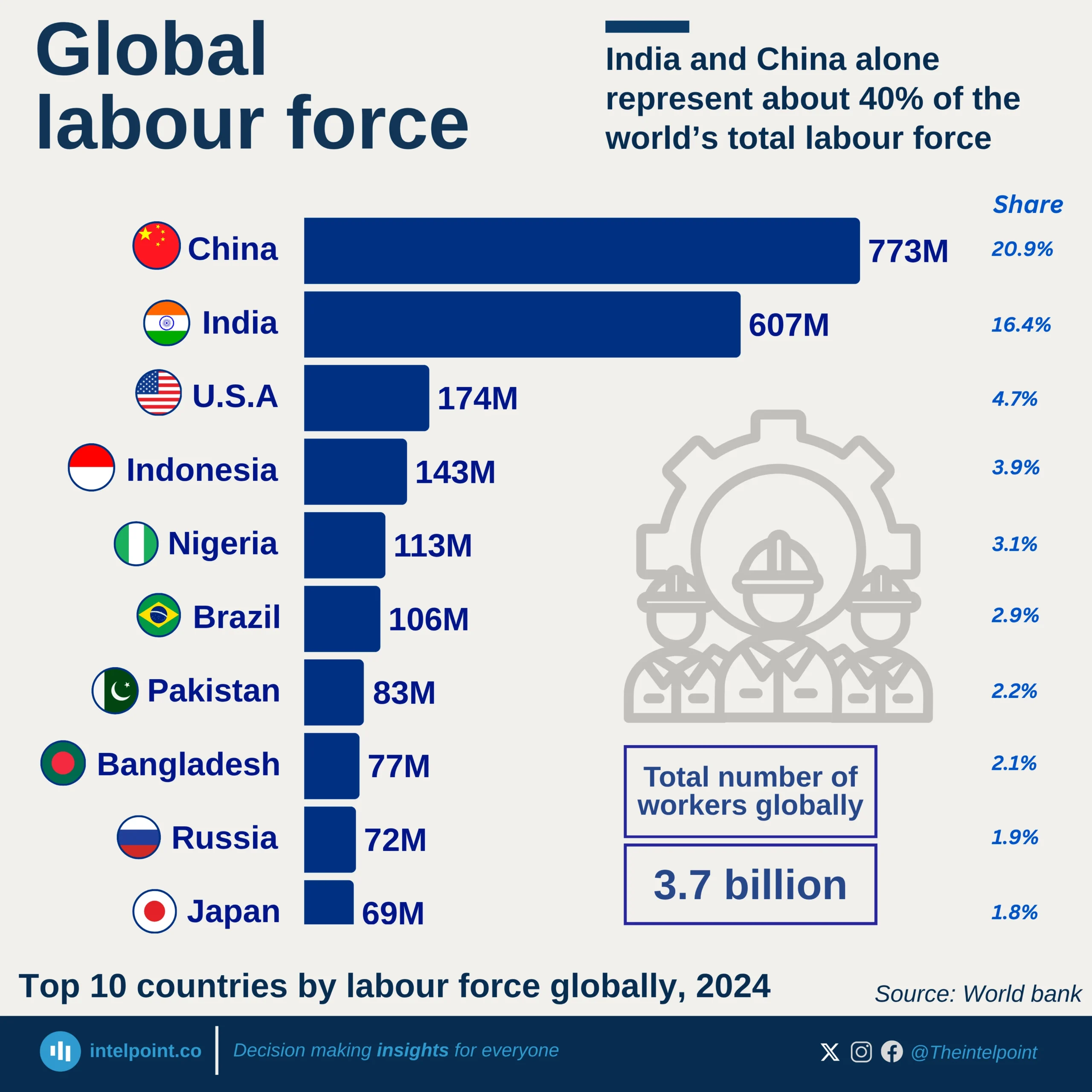
China (773M) and India (607M) together make up for about 40% of the world’s total labour force.
Nigeria ranks 5th globally with 113 million workers, the largest in Africa and only African country in the top 10.
Asia dominates, accounting for over 47% of global workers, highlighting the region’s population and production strength.
The U.S.A. (174M) ranks third, representing just about 5% of global labour but producing almost a quarter of global GDP, proving productivity, not size, drives wealth.
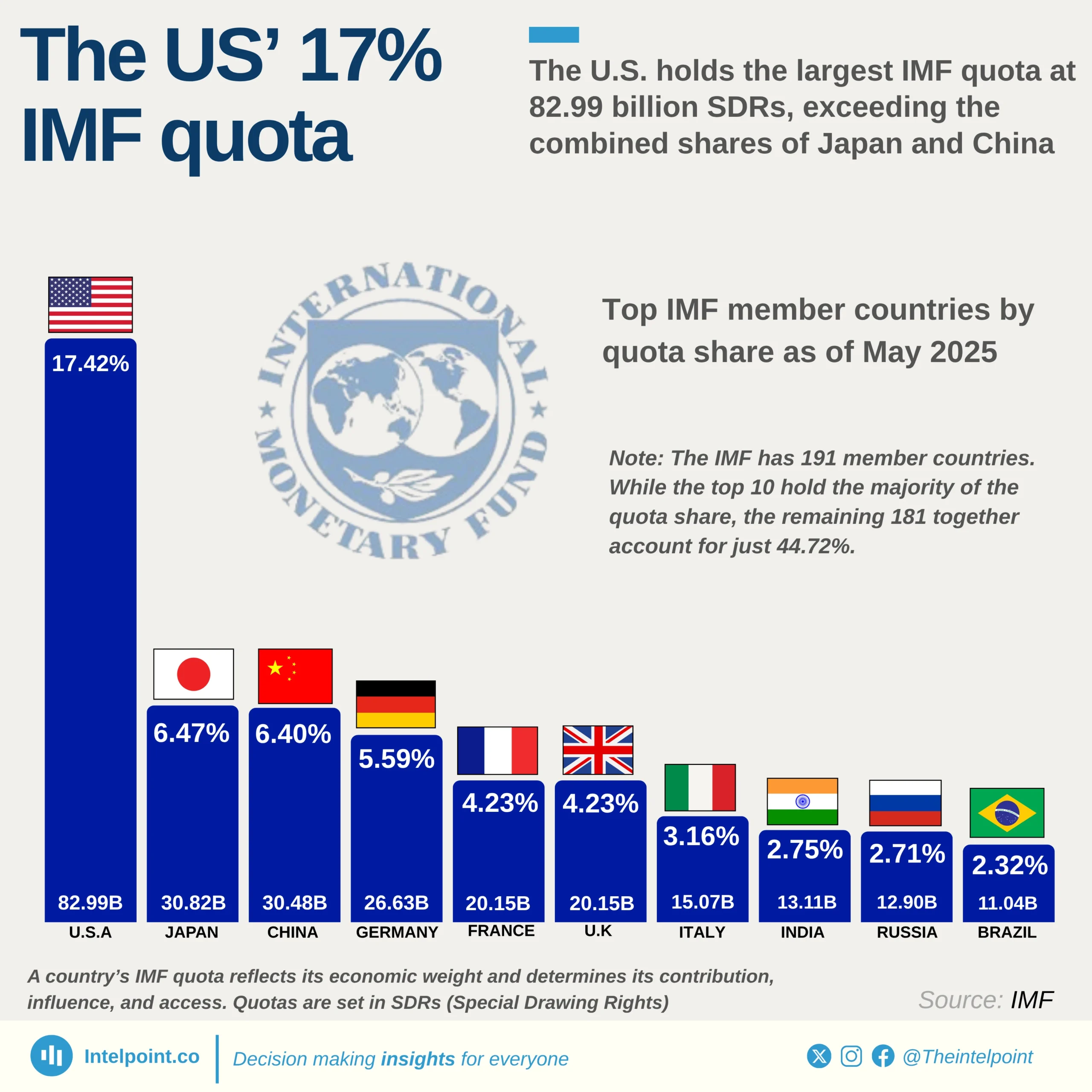
The United States holds the largest IMF quota by far, with 82,994.2 billion SDRs, accounting for 17.42%, more than double the quota of any other country.
Japan, China, and Germany follow as the next largest contributors, each holding between 5.5% and 6.5% of total quota shares.
European countries (Germany, France, the U.K., Italy) collectively maintain a strong presence, together accounting for nearly 17.21%, almost equal to the U.S. alone.
Emerging economies like India and Russia have relatively modest shares (2.75% and 2.71%, respectively) despite their growing roles in global economic affairs, indicating an imbalance between global influence and IMF voting power.
In 1961, China produced just 167,000 tonnes of apples, accounting for a mere 1% of global production.
Over the next six decades, this figure surged by 28,300%, reaching 47.5 million tonnes by 2022 and capturing 50% of global production — growing at an average rate of around 7.5% per year.
China's rise began with agricultural reforms in the late 1970s and gained momentum in the 1980s and 1990s.
These are the top ten apple-producing countries over the years.
Since the 1950s, the top sources of international students in the US have changed, with Canada initially leading, followed by Iran in the 1970s, Taiwan and Japan in the 1980s and 90s, and China and India taking the lead from the 2000s onward.
China and India account for a combined 54% of the total international students in the US as of the 2023/2024 academic year.
By 2021, Nigeria entered the top ten, reaching 7th place by 2024.
In 2023, global vehicle production surged, led by China with over 30 million vehicles — a 12% increase from 2022.
The US and Japan followed, holding 11% and 10% shares, respectively.
Global output rose 10%, reaching 93.55 million vehicles, up from 85.02 million in 2022.
Only two African countries — South Africa and Morocco — made the top 25, highlighting the continent's developing automotive sector.