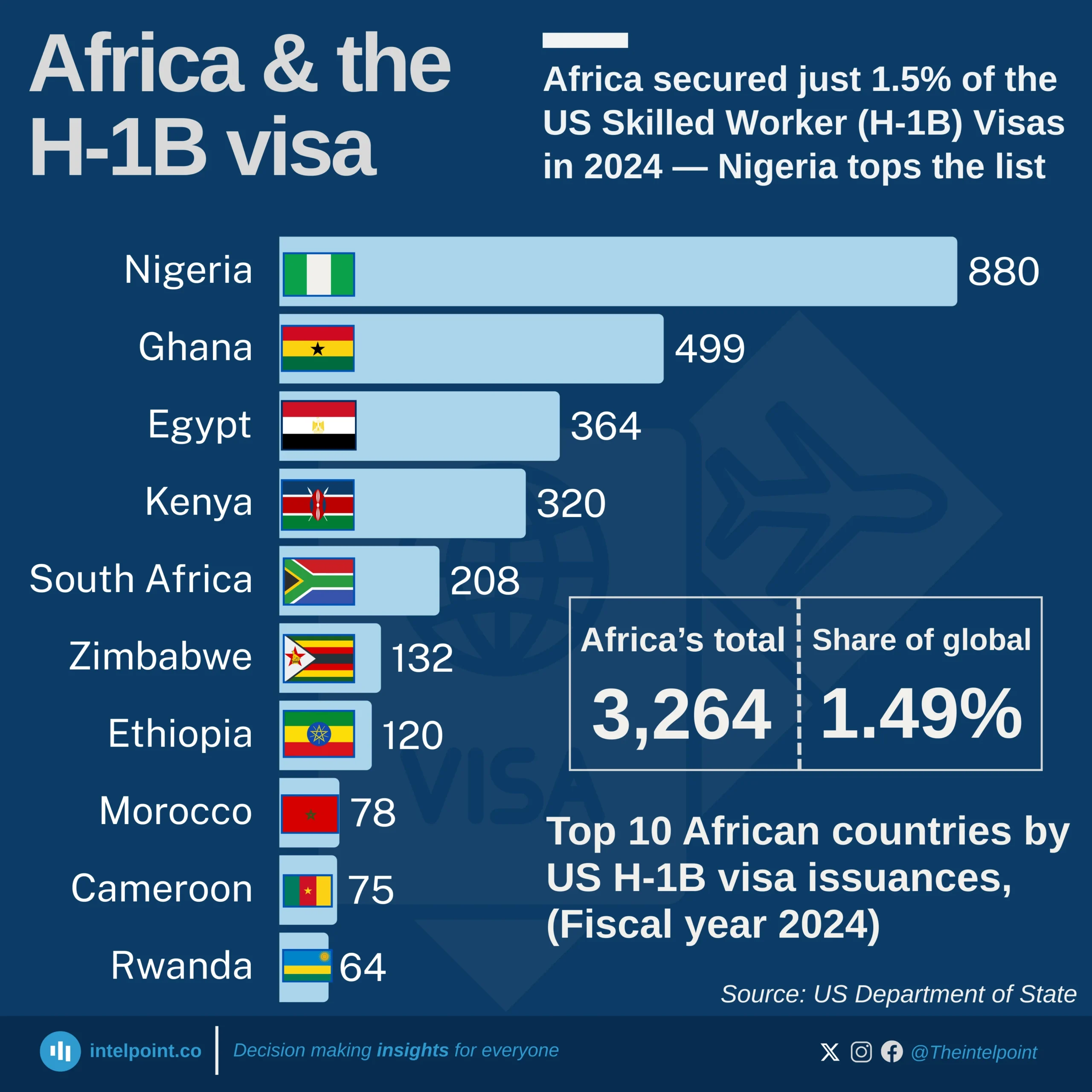
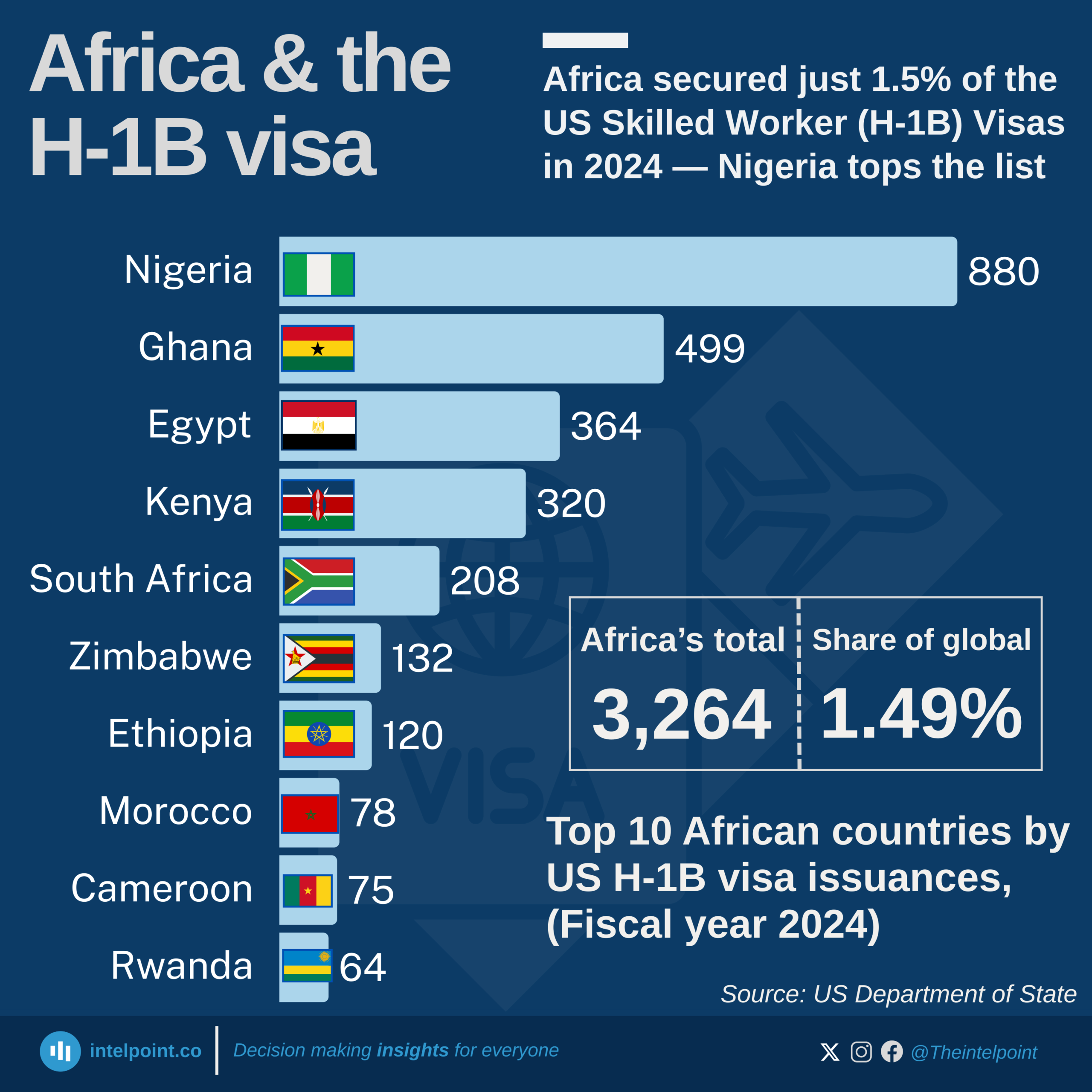
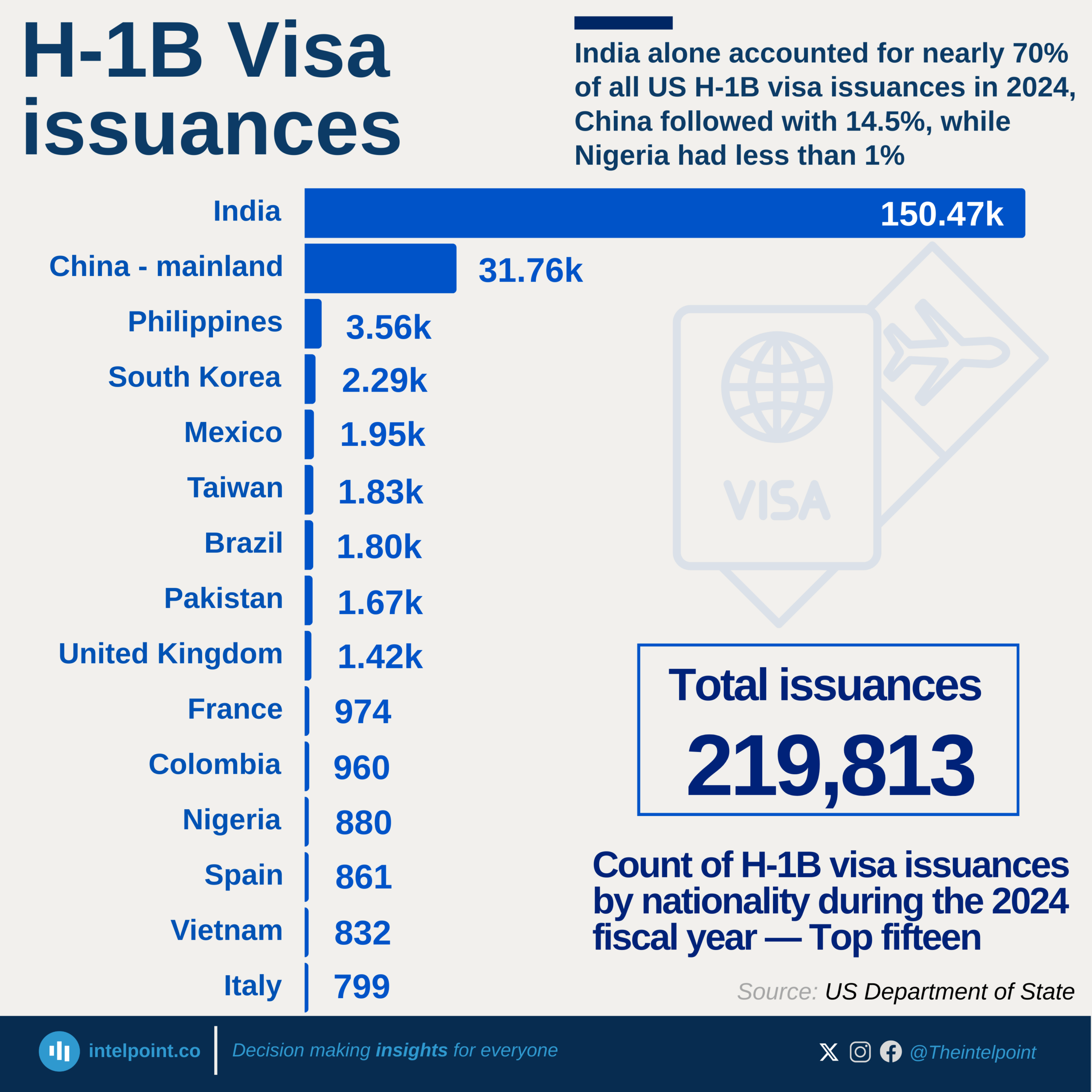
Nigeria ranked first in Africa, with 880 H-1B visas issued in FY 2024, far ahead of Ghana (499) and Egypt (364).
East and Southern Africa featured prominently, with Kenya (320), South Africa (208), and Zimbabwe (132) among the top 10.
North African representation was modest, with Morocco (78) and Egypt (364) being the only countries in the region on the list.
Despite these numbers, Africa’s collective total is marginal globally, especially compared to India’s ~150,000 issuances and China’s large volumes.
President Donald Trump’s $100,000 fee for new U.S. H-1B skilled worker visas will have limited impact on Africa, which has historically received only a small fraction of these visas.
Nigeria ranked first in Africa, with 880 H-1B visas issued in FY 2024, far ahead of Ghana (499) and Egypt (364).
East and Southern Africa featured prominently, with Kenya (320), South Africa (208), and Zimbabwe (132) among the top 10.
North African representation was modest, with Morocco (78) and Egypt (364) being the only countries in the region on the list.
Despite these numbers, Africa’s collective total is marginal globally, especially compared to India’s ~150,000 issuances and China’s large volumes.
President Donald Trump’s $100,000 fee for new U.S. H-1B skilled worker visas will have limited impact on Africa, which has historically received only a small fraction of these visas.
The US granted 219,813 H-1B visas in FY 2024 to skilled workers worldwide.
India received nearly 70%, followed by China at 14.5%.
The Philippines (1.6%), South Korea (1%), Mexico (0.9%), and Nigeria (0.4%) received smaller shares.
427,091 petitions were filed in 2024, 399,402 approved, but only 219,813 visas issued, showing the difference between approvals and actual visas used.
Starting September 21, 2025, a $100,000 fee on new H-1B petitions will be implemented, exempting existing visa holders and renewals, potentially impacting top recipient countries like India and China.
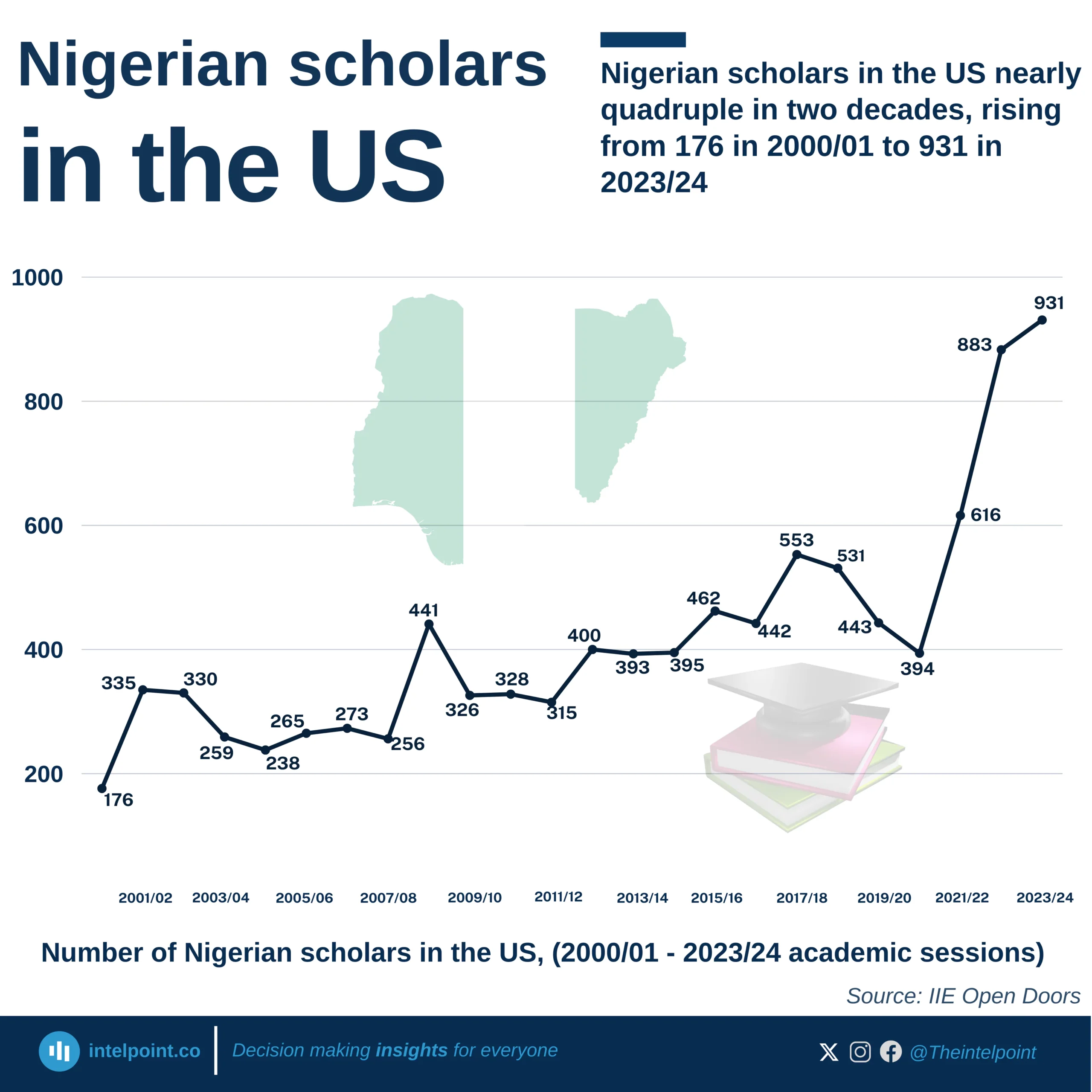
Since the 2007/08 academic year, Nigeria has consistently held the top spot for the number of African international students in the US. Before this, Kenya and Egypt also led in certain periods.
This trend highlights the evolving landscape of African students pursuing education in the US over the decades.