Bite-sized Insights about
 
Providing you with data-based insights about things happening around you.
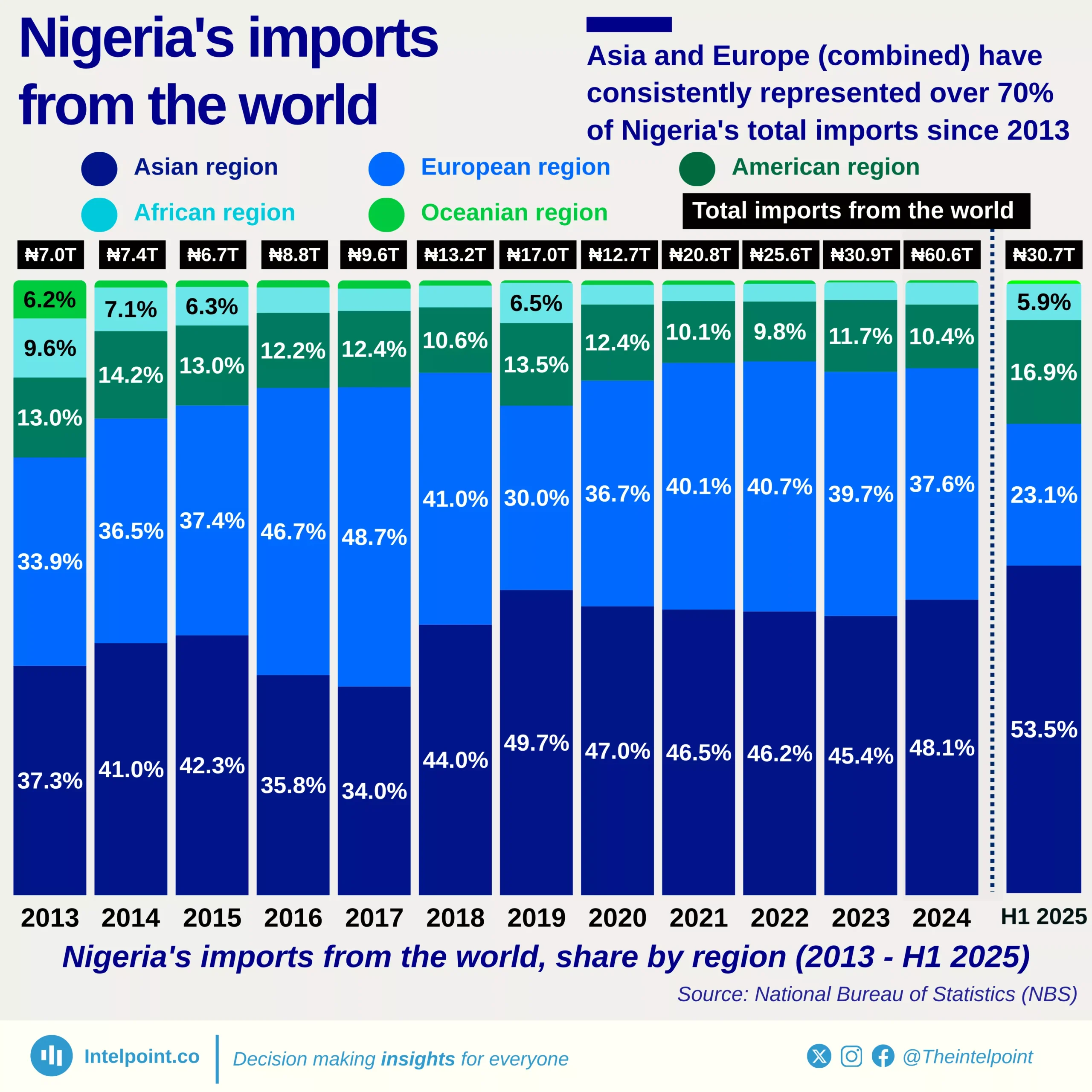
Asia and Europe (combined) have consistently represented over 70% of Nigeria's total imports since 2013
  • Asia and Europe have consistently represented over 70% of Nigeria’s imports since 2013.
  • Asia’s share of imports reached a record 53.5% in H1 2025.
  • Europe contributed 23.1% of total imports in H1 2025.
  • Imports from the American region averaged between 10%–14% over the period.
  • Africa’s import share remained below 10%, showing limited regional trade.

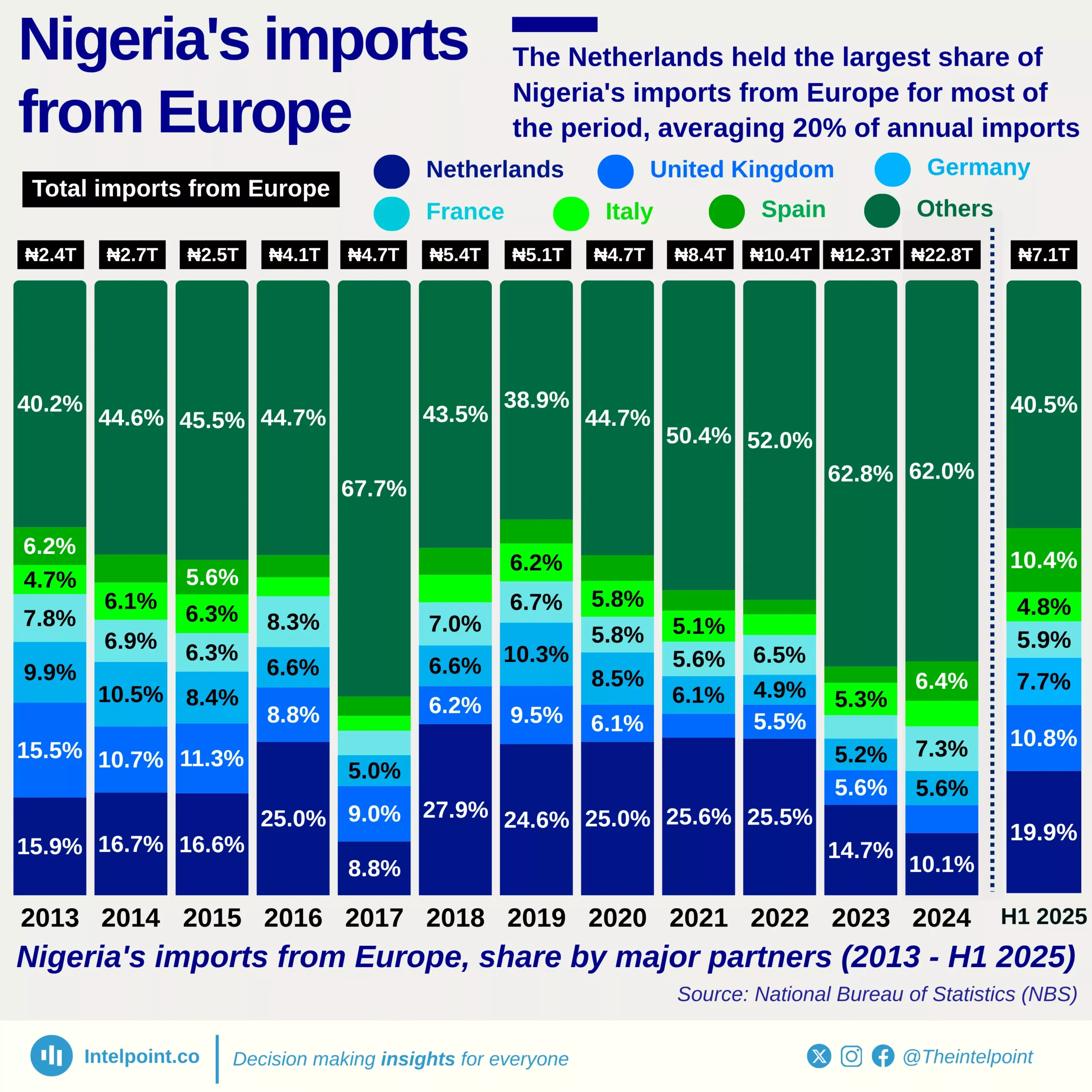
The Netherlands held the largest share of Nigeria's imports from Europe for most of the period, averaging 20% of annual imports
  • The Netherlands has mostly been the top European import source, with Nigeria averaging 20% of annual imports from the region.
  • Netherlands' highest share of Nigeria's imports was 27.9% in 2018.
  • The United Kingdom consistently contributed around 5–15% of Nigeria’s European imports.
  • Germany’s share remained relatively stable at 5–10% over the years.
  • France, Italy, and Spain maintained smaller shares, mostly under 7%.

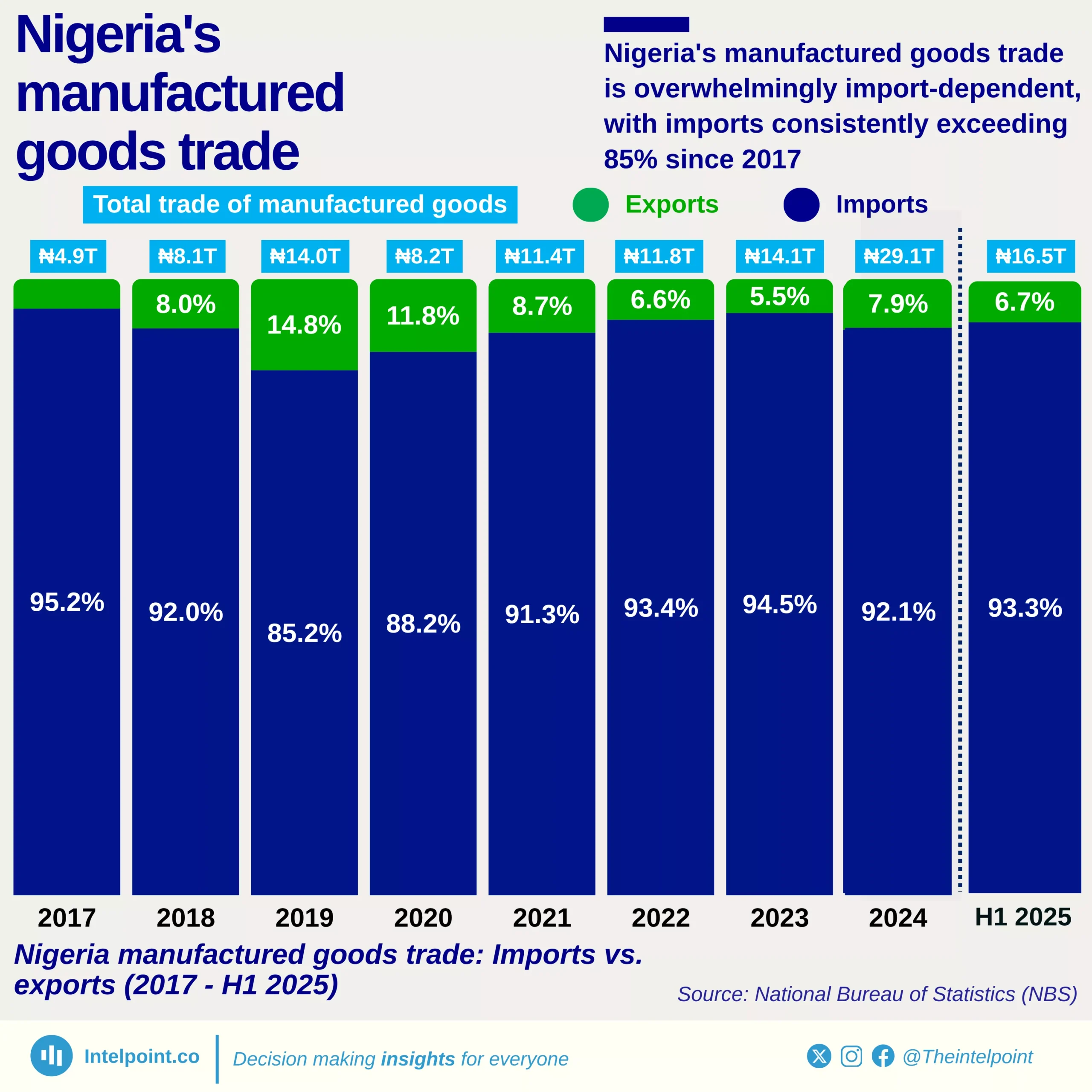
Nigeria's manufactured goods trade is overwhelmingly import-dependent, with imports consistently exceeding 85% since 2017
  • Imports have consistently exceeded 85% of Nigeria's manufactured goods trade since 2017.
  • In H1 2025, imports accounted for 93.3% of the total ₦16.5 trillion trade.
  • Nigeria’s export share in the manufactured goods trade was only 6.7% in H1 2025.
  • The highest export share in the past eight years was 14.8% in 2019.
  • Total manufactured goods trade grew from ₦4.9 trillion in 2017 to ₦29.1 trillion in 2024.

Nigeria's imports of food and beverage have grown in value by 265% since 2020, reaching ₦6.6T in 2024
  • Nigeria’s food and beverage imports increased almost ninefold, from ₦0.7 trillion in 2013 to ₦6.6 trillion in 2024.
  • Imports remained relatively stable between 2015 and 2019, averaging around ₦1.1–₦1.6 trillion.
  • A major spike occurred in 2021, when imports surged by 62%, reaching ₦2.9 trillion.
  • Overall, the trend underscores Nigeria’s ongoing challenge of reducing dependency on imported food and beverages despite policies aimed at self-sufficiency.

Fuels and lubricants dominated 2024 imports, accounting for 37.4% (₦22.7T) of the total ₦60.6T
  • Nigeria imported a total of ₦60.6 trillion worth of goods in 2024.
  • Fuels and lubricants dominated imports with ₦22.7 trillion (37.4%).
  • Industrial supplies accounted for ₦13.4 trillion (22.1%), showing strong demand for production inputs.
  • Capital goods and parts represented ₦9.1 trillion (15%).
  • Food and beverage imports reached ₦6.6 trillion (10.9%), signalling a high reliance on external food sources.

Nigeria is buying more from ECOWAS, with their share of African imports up to 32.4% in H1 2025
  • ECOWAS’s share of Nigeria’s African imports grew to 32.4% in H1 2025, up from 15.0% in 2021.
  • The lowest ECOWAS import share was recorded in 2014 (8.8%), showing significant progress since then.
  • The share of ECOWAS imports has more than doubled since 2021, signalling stronger regional trade ties.
  • Nigeria’s total imports from Africa rose to ₦1.8 trillion in 2025 (H1), indicating expanding trade activity.

For every $1 Ghana earns from exporting pharmaceutical products, it spends about $22 on imports
  • For every $1 Ghana earns from pharmaceutical exports, it spends about $22 on imports, underscoring the country’s overwhelming dependence on foreign pharmaceutical products.
  • Ghana is a net importer of medicine and has been for nearly two decades.
  • By 2015, Ghana’s pharmaceutical imports reached its peak with $348.12m while exports were $3.10m, meaning imports were nearly 100 times larger.
  • In 2016, Ghana recorded its highest-ever export performance at $78.33 million, but even then, imports stood at $154.96m, almost two times higher.

For the first time in 17 years, Ghana’s ceramic exports recorded a $19.9m surplus in 2023
  • In 2023, Ghana recorded $91.9m in ceramic exports, amassing $19.9m profit, after 17 years of consistent trade losses and heavy dependence on imported ceramic products.
  • For 17 years, Ghana’s ceramic market was largely import-driven, with local industries struggling to compete against foreign products.
  • Ghana's ceramic products trade recorded $1.397 billion in trade deficit in almost two decades.
  • Ghana's ceramic industry has finally moved from dependency to a driver of profit and progress.

Over the past two decades, Egypt exported roughly twice as much ceramic products as it imported
  • Over the past two decades, Egypt exported roughly twice as much ceramic products as it imported, positioning itself as a key player in regional and global ceramic products trade.
  • In 2012, exports peaked at $488.51 million, more than double imports at $178.23 million, setting a clear demonstration of strong industrial and commodity output.
  • In 2008, exports soared to $325.86 million, more than doubling imports at $126.21 million.
  • Between 2017 and 2021, the export sector showed stable performance, averaging $327 million annually.
  • The year 2021 was a standout, with exports reaching $401.12 million, reflecting a strong rebound that reaffirmed Egypt’s export capacity post-pandemic.

The U.S. consistently leads Nigeria’s imports from the Americas, accounting for 57–73% in 13 years
  • The U.S. consistently leads Nigeria’s imports from the Americas, accounting for 57–73% between 2013 and 2025.
  • Brazil ranks second, with shares ranging between 11% and 24%, highlighting its steady trade ties with Nigeria.
  • During the period, the combined share of the U.S. and Brazil never fell below 76%, even at its lowest point in 2022.
  • Total imports from the Americas surged from ₦0.9 trillion in 2013 to a peak of ₦6.3 trillion in 2024.
  • Canada’s import share peaked at 16.4% in 2022, showing a rare moment of diversification.

1 2 3 4 12

Can’t find what you’re looking for? Please fill the form below
Contact Form Demo
SIGN UP TO OUR NEWSLETTER
Get periodic updates about the African startup space, access to our reports, among others.
Subscribe Here
Subscription Form

A product of Techpoint Africa. All rights reserved