Bite-sized Insights about
 
Providing you with data-based insights about things happening around you.
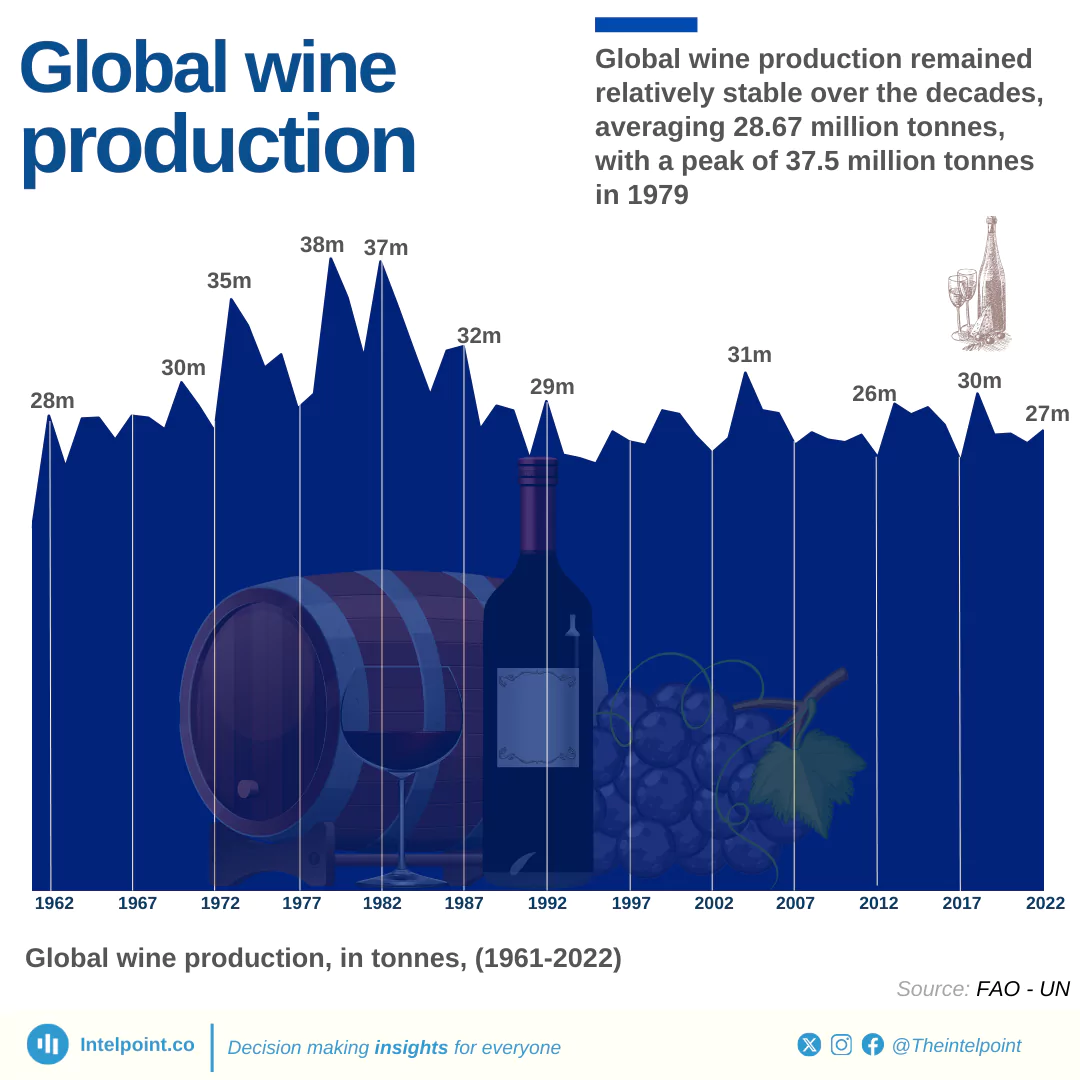
Global wine production remained relatively stable over the decades, averaging 28.67 million tonnes, with a peak of 37.5 million tonnes in 1979
Key takeaways:
  • Over the past six decades, global wine production has remained relatively stable, averaging around 28 million tonnes annually.
  • Wine production increased from 21.5 million tonnes in 1961 to 27.4 million tonnes in 2022.
  • The highest production was recorded in 1979, reaching 37.5 million tonnes.
  • The second-highest year was 1982, with a production of 37.4 million tonnes.
  • Wine production exceeded 30 million tonnes in ten different years between 1961 and 2022.
  • Between 2000 and 2022, production was consistently stable, averaging about 27 million tonnes.
  • The 2022 production of 27.4 million tonnes represented a 27.3% increase compared to 1961.

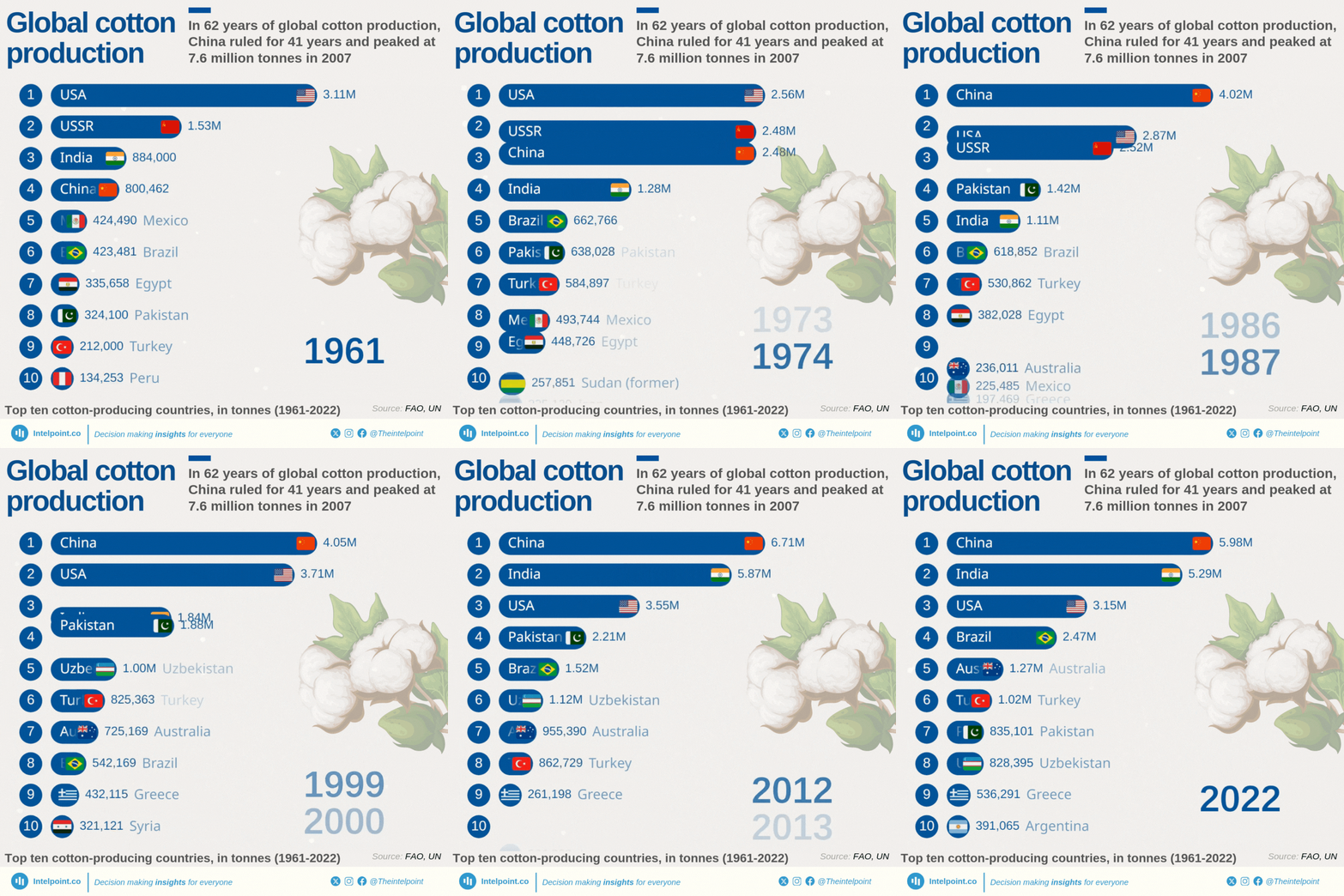
In 62 years of global cotton production, China ruled 41 years and peaked at 7.6 million tonnes in 2007
  • Global cotton production grew by over 160%, from about 9.5 million tonnes in 1961 to 24.8 million tonnes in 2022.
  • China’s Reign: 41 years at number one. Biggest output: 7.62M tonnes in 2007.
  • USA’s Era: 13 years at the top. Peak production: 5.20M tonnes in 2005.
  • USSR’s Legacy: 5 years crowned. Best year: 2.89M tonnes in 1981.
  • India’s Late Charge: Only 3 years at number one, but a huge 6.13M tonnes in 2020.
  • Shift to Asia: In the early decades, USA dominated; now, it’s mostly China and India running the game.

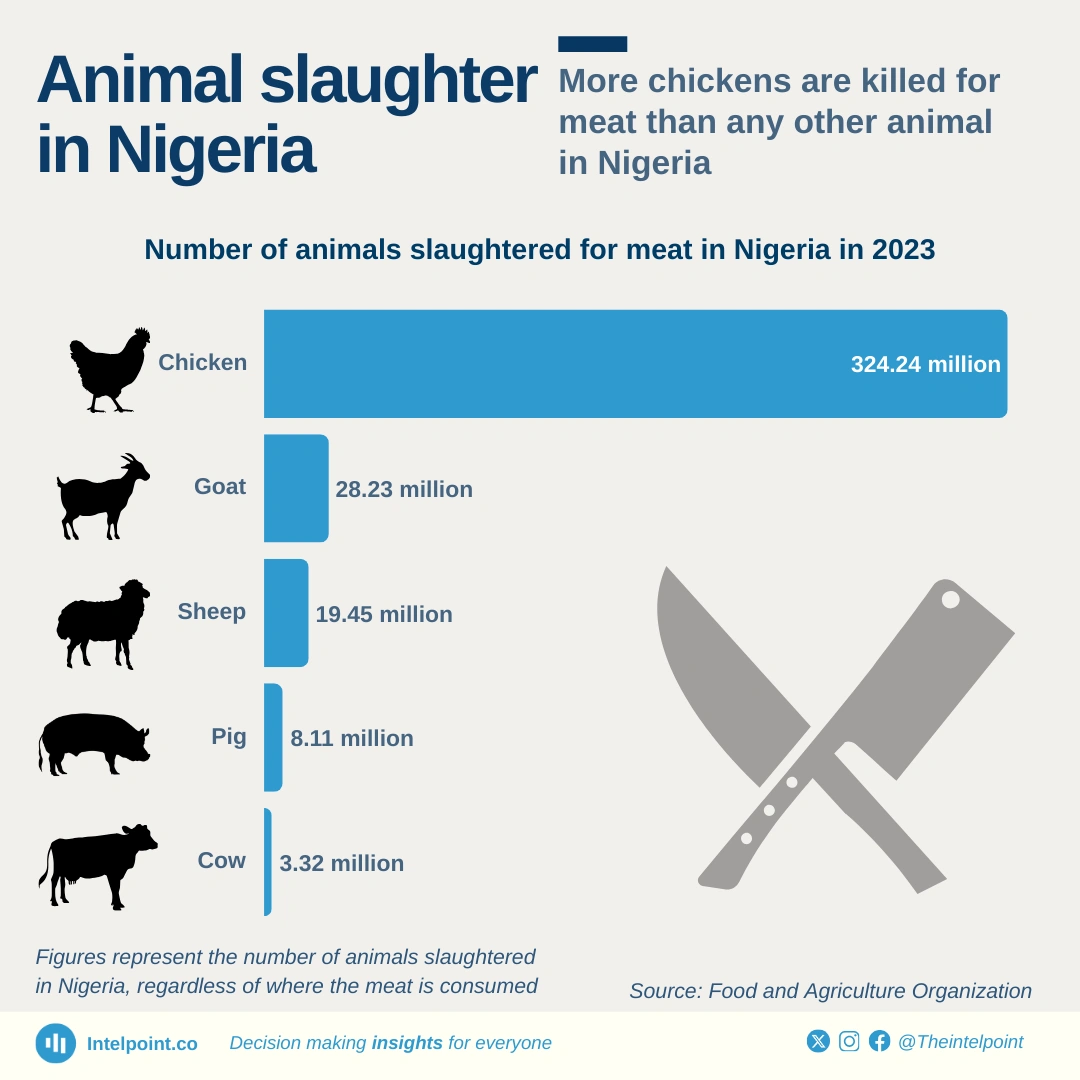
More chickens are killed for meat than any other animal in Nigeria
  • In 2023, over 324 million chickens were slaughtered in Nigeria, making them the dominant source of meat.
  • Goats and sheep followed at 28.23 million and 19.45 million, respectively, but their slaughter numbers were far lower than poultry.
  • Pigs accounted for 8.11 million slaughters, while cows were the least slaughtered at 3.32 million, likely due to their higher economic value.
  • The disparity in slaughter numbers highlights Nigeria's preference for poultry over red meat, aligning with global trends in cost-effective protein consumption.

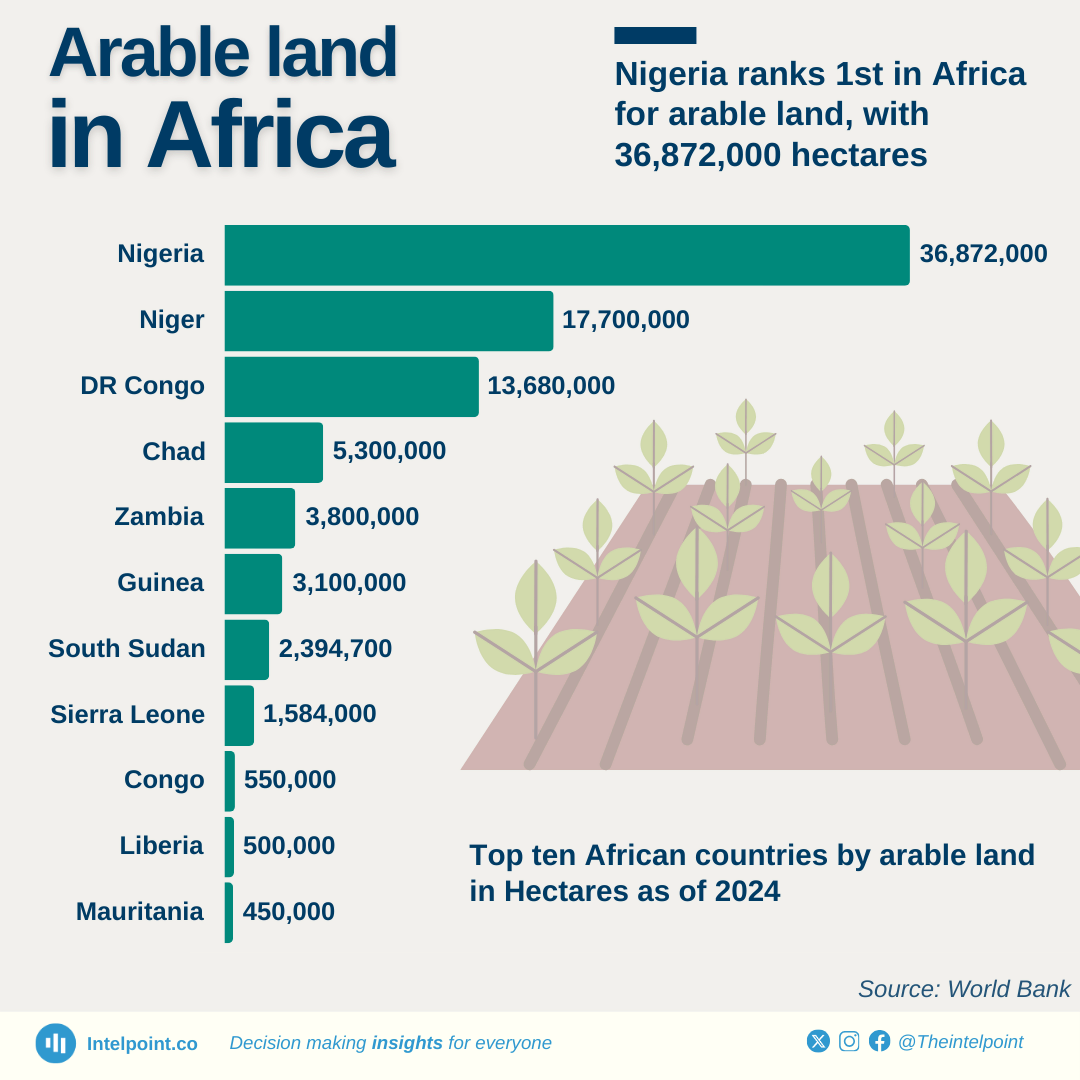
Top ten African countries by arable land in hectares as of 2024
  • Nigeria leads Africa in total arable land with 36,872,000 hectares, more than twice that of Niger, the second-ranking country.
  • Niger ranks second with 17,700,000 hectares.
  • The Democratic Republic of Congo (DRC) ranks third with 13,680,000 hectares, revealing the role of Central Africa in agricultural land availability.
  • Other notable countries include Chad (5.3M hectares), Zambia (3.8M hectares), and Guinea (3.1M hectares).
  • The countries at the bottom of the top ten list, such as Congo (550,000 hectares), Liberia (500,000 hectares), and Mauritania (450,000 hectares), have relatively limited arable land compared to leading nations.

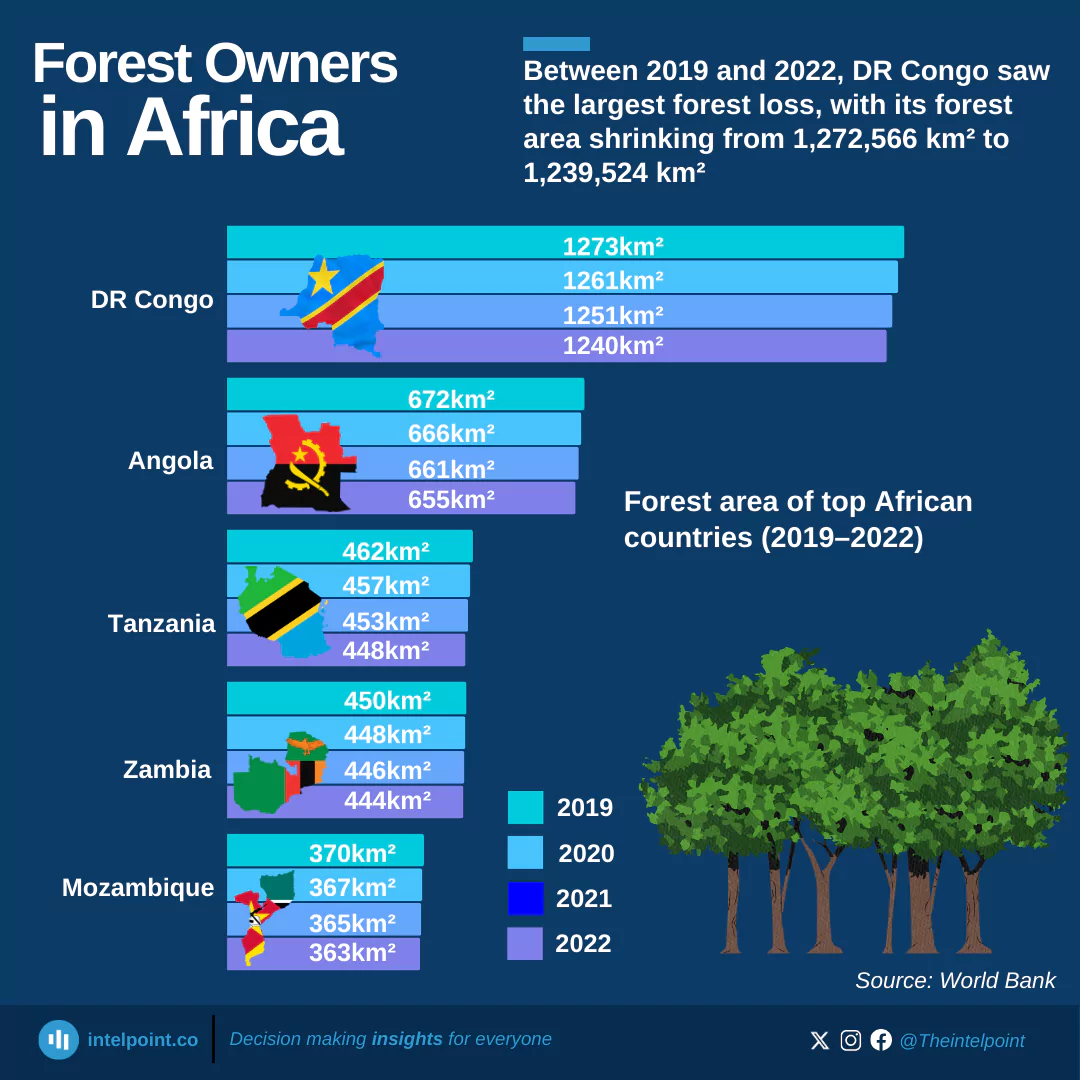
Between 2019 and 2022, DR Congo saw the largest forest loss, with its forest area shrinking from 1,272,566 km² to 1,239,524 km²
  • DR Congo holds the largest forest area in Africa, but it declined by nearly 33,000 km² from 2019 to 2022.
  • Angola lost over 16,000 km² of forest, decreasing from 671,624 km² to 654,972 km².
  • Tanzania, Zambia, and Mozambique forests recorded declines, though at different rates.
  • Mozambique has the smallest forest area among the top countries, standing at 362,673 km² in 2022.

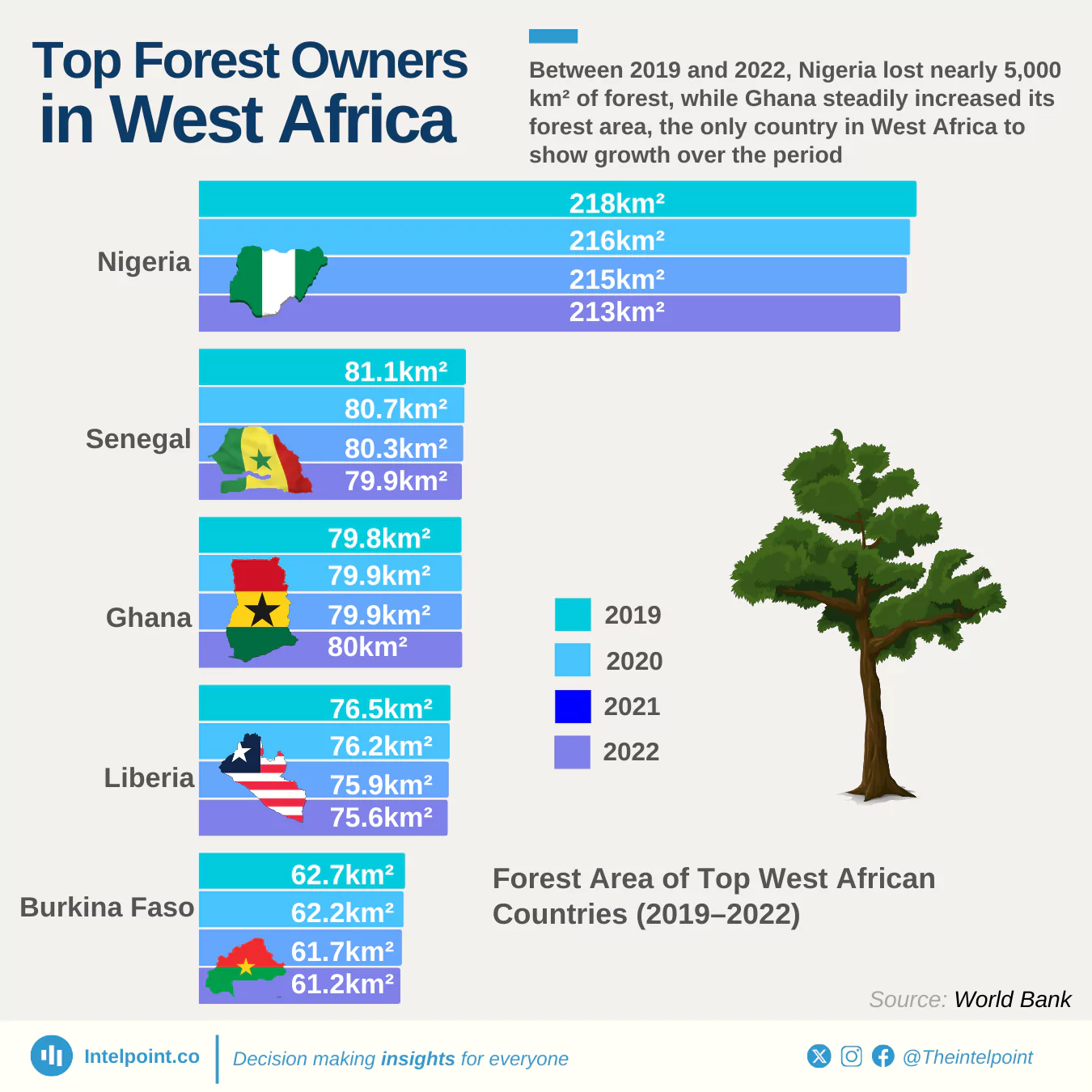
Nigeria Leads in Forest Area but Faces Decline, While Ghana Sees Growth from 2019 to 2022
  • Nigeria remains the largest forest owner in West Africa, despite a steady decline in forest area from 217,902.5 km² in 2019 to 213,003.5 km² in 2022.
  • Ghana is the only top forest-owning country with increasing forest area, growing from 79,784.8 km² in 2019 to 80,001.6 km² in 2022.
  • Liberia, Senegal, and Burkina Faso all experienced gradual declines in forest area over the period.
  • Burkina Faso has the smallest forest area among these countries, with 61,164 km² in 2022.

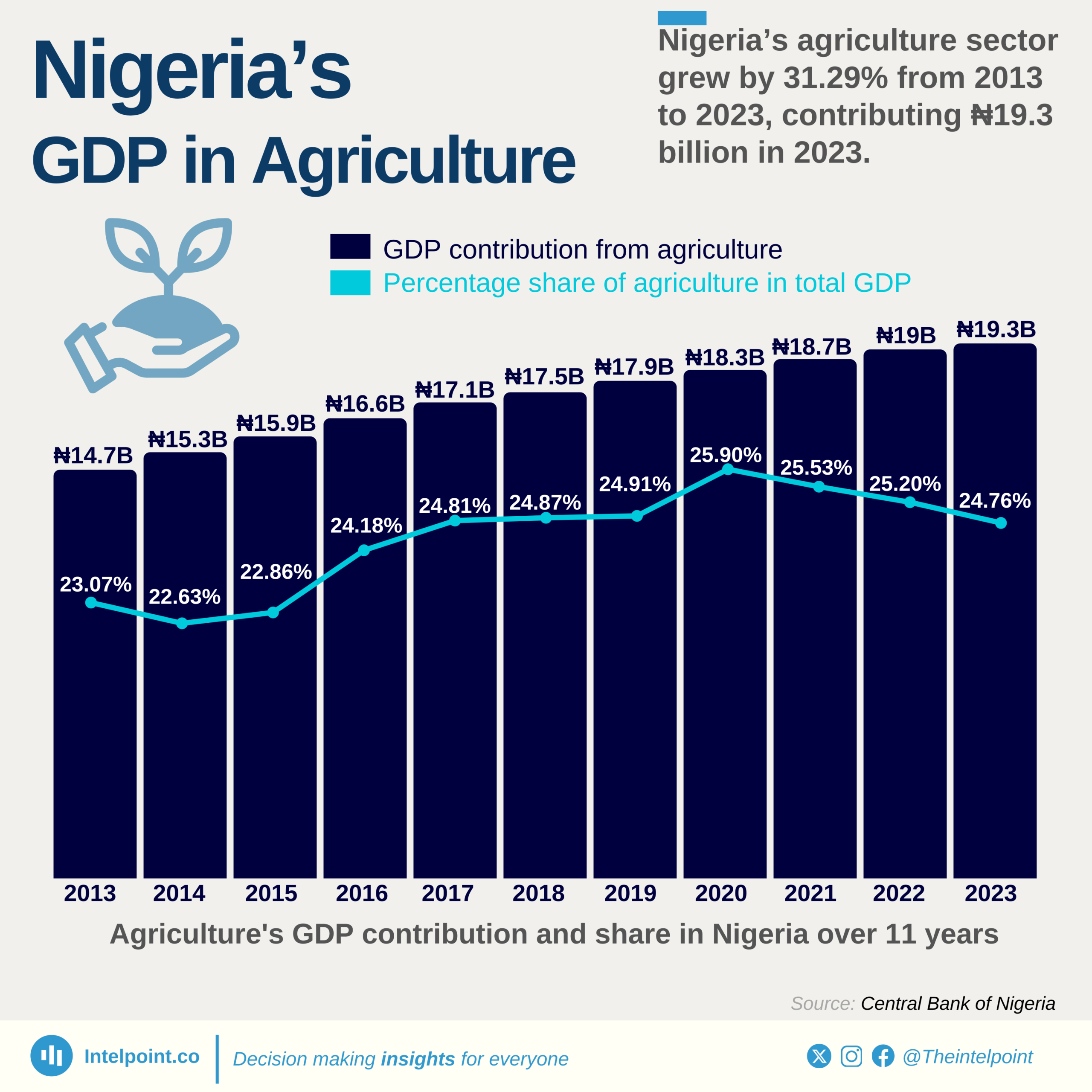
Nigeria's Agriculture Sector Contributes ₦19.3 Billion to GDP in 2023
  • Nigeria’s agricultural GDP reached ₦19.3 billion in 2023, showing minimal growth.
  • From 2013 to 2023, agriculture played a key role in Nigeria’s economic growth, averaging 24.43% of the total annual GDP.
  • Agriculture's share in the total GDP in 2020 (25.90%) dropped to 24.76% in 2023.
  • Post-pandemic recovery in the agricultural sector has been robust, with consistent growth from ₦18.3 billion in 2020 to ₦19.3 billion in 2023.
  • Agriculture remains a critical driver of Nigeria’s economy, ensuring food security and supporting livelihoods across the country.

South Africa and three others dominated Africa's apple production in 2022, accounting for a combined 96%
Many African countries can't grow apples naturally due to unfavourable climate and the required chilling hours. Despite this, Africa's share of global apple output has grown from 0.66% (1962) to nearly 4% in 2022, averaging 2.3% over 60+ years. South Africa has been the biggest contributor, but Egypt, Morocco, and Algeria also play key roles, with the top four countries making up 96% of Africa's total production in 2022. Since 1961, South Africa has led Africa in apple production, consistently topping the charts.

China dominated apple production since 1992 and was growing half of the world’s apples by 2022
In 1961, China produced just 167,000 tonnes of apples, accounting for a mere 1% of global production. Over the next six decades, this figure surged by 28,300%, reaching 47.5 million tonnes by 2022 and capturing 50% of global production — growing at an average rate of around 7.5% per year. China's rise began with agricultural reforms in the late 1970s and gained momentum in the 1980s and 1990s. These are the top ten apple-producing countries over the years.

Ethiopia leads Africa in cattle population, dominating 53 of the past 62 years
From the early 1960s through the 1990s, Ethiopia's cattle population growth placed it at the forefront of African livestock rearers, holding the top position with millions of cattle. This leadership continued into the 2000s, reflecting Ethiopia's robust cattle industry on the continent. Sudan managed to take the top position a few times, mostly around the 2000s. However, Ethiopia quickly reclaimed the top spot. Nigeria's cattle population grew from about 6.03 million in 1961 to 20.9 million in 2022, claiming 6th position in Africa as of 2022. Africa accounted for one-fourth of the global cattle population as of 2022.

Can’t find what you’re looking for? Please fill the form below
Contact Form Demo
SIGN UP TO OUR NEWSLETTER
Get periodic updates about the African startup space, access to our reports, among others.
Subscribe Here
Subscription Form

A product of Techpoint Africa. All rights reserved