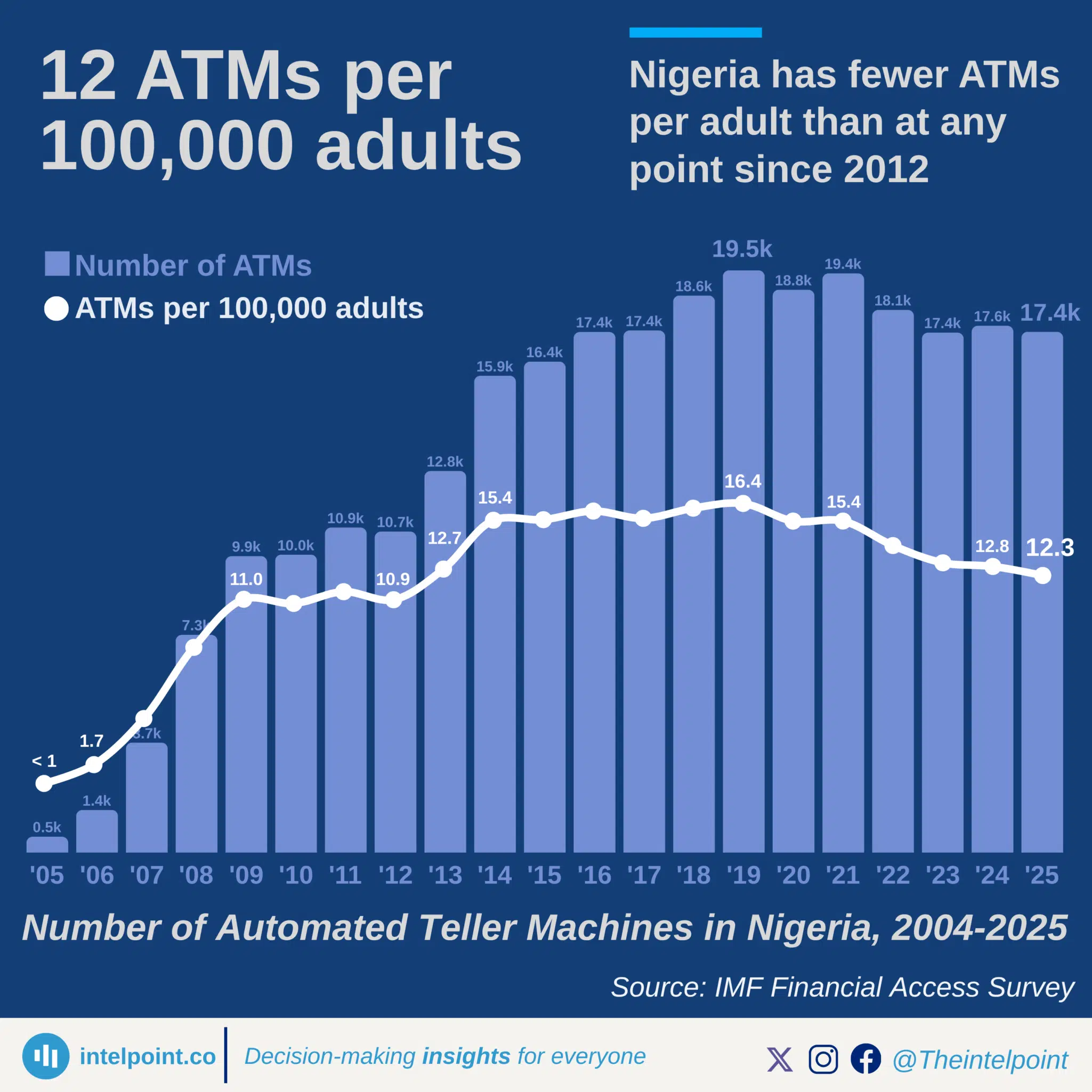
Nigeria’s ATM network has fallen behind its population. The country had 19,459 ATMs in 2019, its peak, and 17,404 in 2025, a loss of 2,055 machines (−11%).
Over the same period, ATMs per 100,000 adults fell from 16.4 to 12.3, a 25% drop, because the adult population (implied at roughly 119 million in 2019 and 141 million in 2025, +19%) grew while the machine count shrank. Density has declined four years running and is now below its 2013 level (12.7), the lowest since 2012.
The count itself has barely moved since 2023 (17,377 to 17,404), so the recent slide in coverage comes almost entirely from population growth. The earlier build-out was fast: 9,907 ATMs in 2009 to 15,935 in 2014 (+61%), after which density held at roughly 15 to 16 until 2021. Restoring 2019’s density at today’s adult population would take about 23,100 ATMs, roughly 5,700 more than the country has.