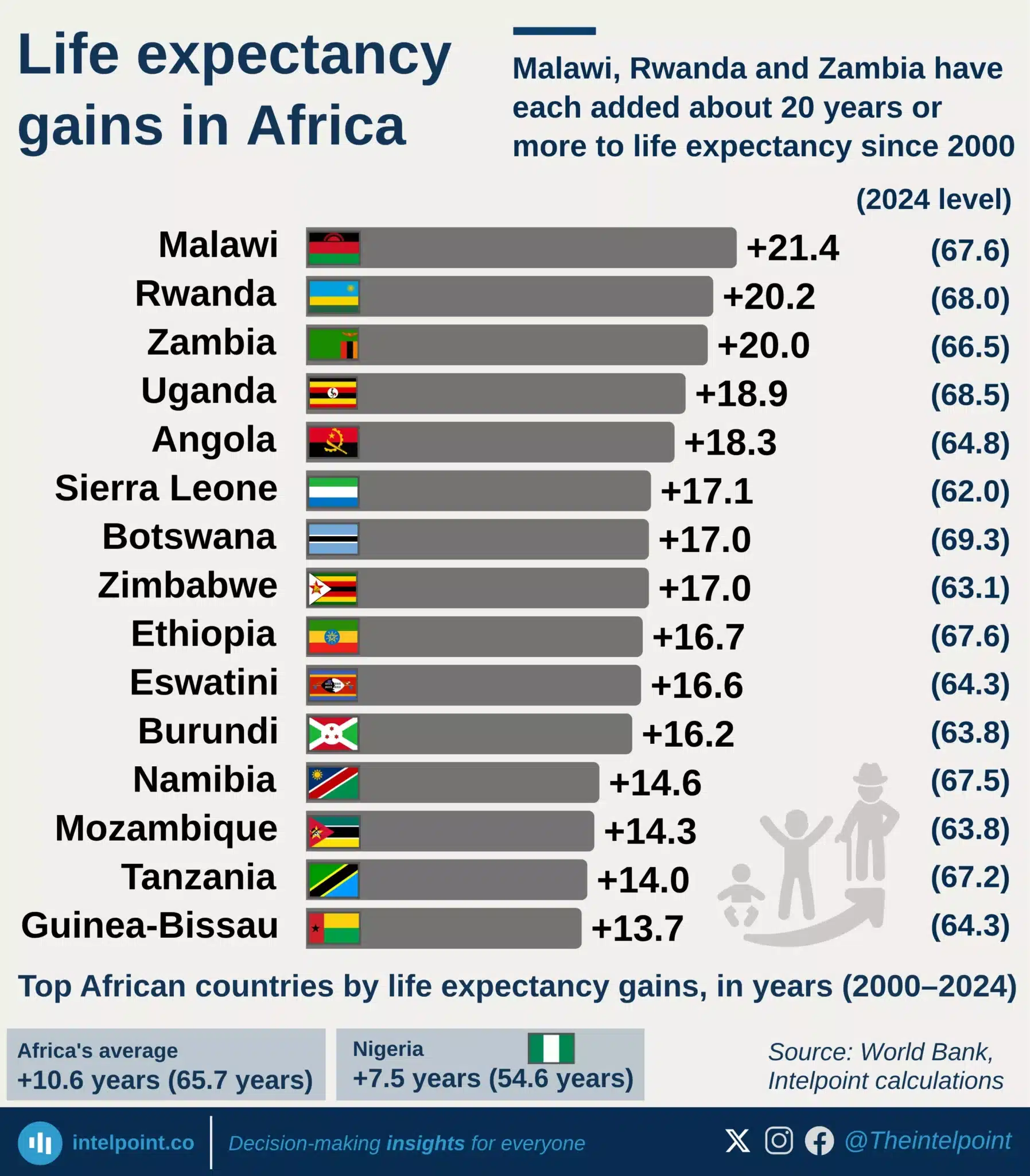
Malawi, Rwanda and Zambia have each added about 20 years or more to life expectancy since 2000

Key Takeaways

  • Malawi recorded Africa’s largest life expectancy gain, adding 21.4 years between 2000 and 2024.
  • Rwanda and Zambia also added about 20 years each.
  • Africa’s average life expectancy gain was 10.6 years, higher than the global gain of 5.8 years.
  • Nigeria added 7.5 years, rising to 54.6 years in 2024.
  • Despite improvement, Nigeria remained below both the African average of 65.7 years and the gains recorded by the top improvers.
  • Most of the biggest gains came from countries that started the period with very low life expectancy levels.

Many African countries are living significantly longer today than they were at the turn of the century, with the biggest gains coming from countries that had some of the lowest life expectancy levels in 2000.

Between 2000 and 2024, Malawi added 21.4 years to life expectancy at birth, the largest increase on the continent. Rwanda followed with 20.2 years, while Zambia added 20.0 years. Uganda and Angola also recorded gains above 18 years.

Africa as a whole gained an average of 10.6 years over the period, nearly double the global gain of 5.8 years. However, the improvement was uneven. While the top 15 African countries added at least 13.7 years, Nigeria gained 7.5 years, rising from 47.1 years in 2000 to 54.6 years in 2024.

Despite the progress, Nigeria’s 2024 life expectancy remained well below Africa’s average of 65.7 years and far behind several top improvers, including Botswana, Uganda, Rwanda and Malawi, all of which were above 67 years by 2024.

Source:

World Bank, Intelpoint calculations

Period:

2000–2024
HTML code to embed chart
Want a bespoke report?
Reach out
Tags
Related Insights

POPULAR TOPICS
SIGN UP TO OUR NEWSLETTER
Get periodic updates about the African startup space, access to our reports, among others.
Subscribe Here
Subscription Form

A product of Techpoint Africa. All rights reserved