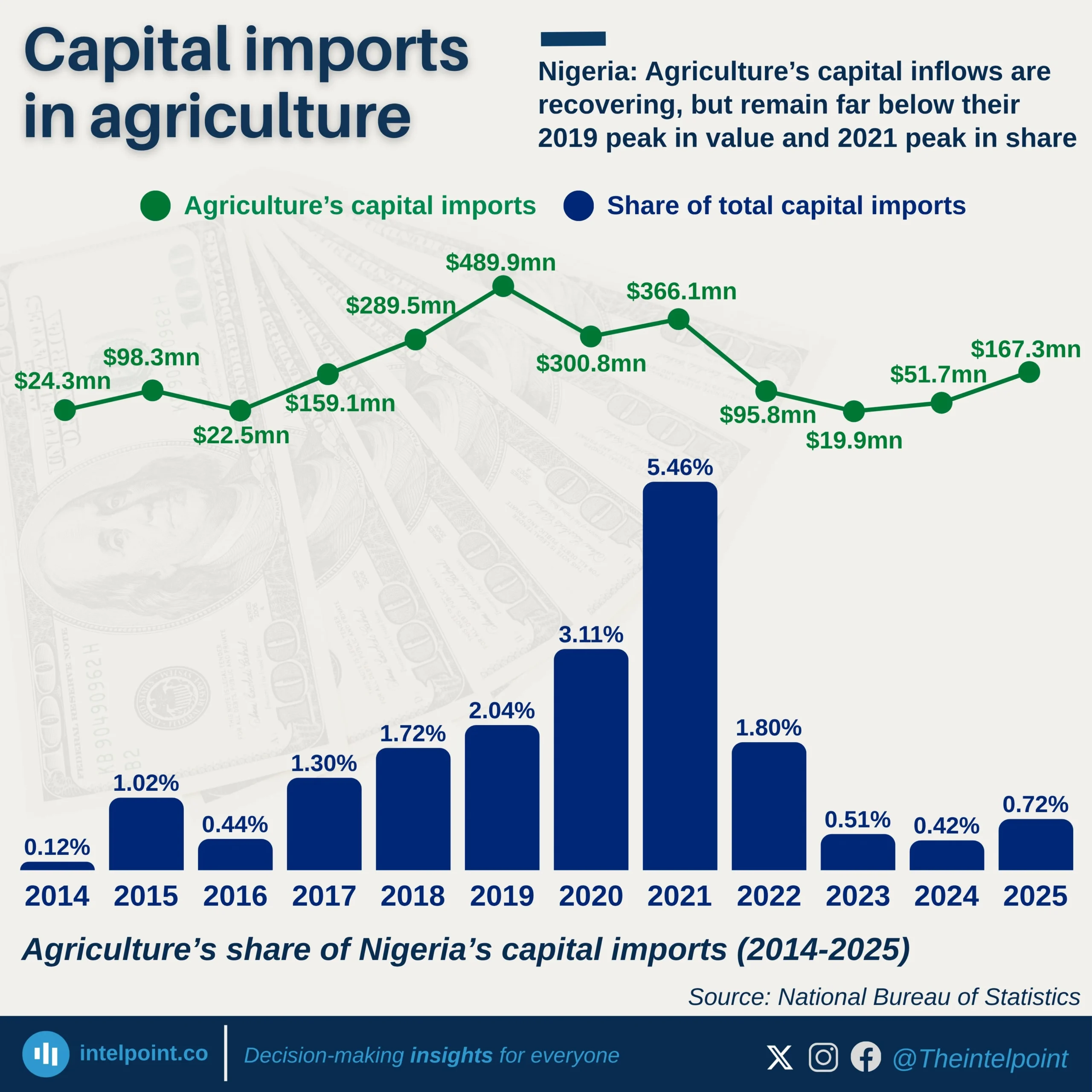
Agriculture’s share of Nigeria’s capital imports peaked at 5.46% in 2021 before falling to 0.72% in 2025

Key Takeaways

  • Agriculture’s share of Nigeria’s capital imports peaked at 5.46% in 2021
  • After 2025, agriculture's share started falling sharply, reaching 0.72% in 2025.
  • Between 2017 and 2021, the sector experienced consistent growth in both value and share.
  • Capital import value peaked at at $489.9 million in 2019.

There’s a quiet contradiction in Nigeria’s investment story — agriculture, a major sector, receives attention in policy conversations but not in capital inflows. Data shows that agriculture’s share of capital imports climbed steadily to a peak of 5.46% in 2021, only to collapse sharply to 0.72% by 2025. That drop is not gradual; it’s a steep reversal, suggesting that whatever momentum the sector had in attracting foreign capital has significantly weakened. It’s like a sector that briefly caught investor attention, only to slip back out of focus just as quickly.
Source:

National Bureau of Statistics

Period:

2014 - 2025
HTML code to embed chart
Want a bespoke report?
Reach out
Tags
Related Insights

Nigeria’s foreign trade
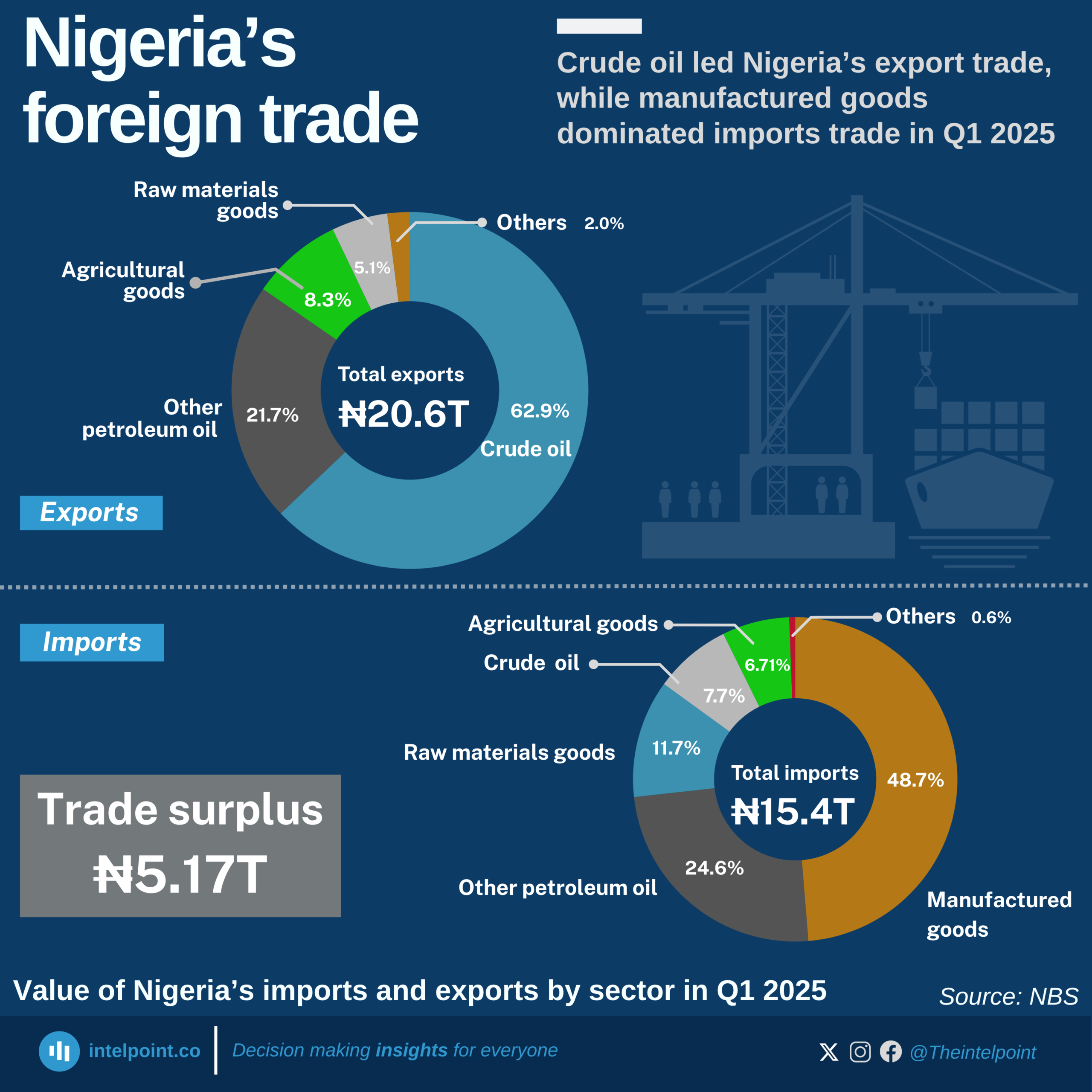
  • Total Trade Volume in Q1 2025 stood at ₦36.02 trillion, with exports totalling ₦20.6 trillion and imports at ₦15.4 trillion, resulting in a surplus of ₦5.17 trillion.
  • Crude oil dominates Nigeria’s export trade, accounting for the largest share of export revenue. -
  • Other petroleum oil products are also a major export item, reflecting the significance of both raw and refined oil-based commodities in Nigeria’s trade portfolio. -
  • On the import side, manufactured goods dominate, showing Nigeria’s continued reliance on foreign machinery, technology, and consumer goods.
  • While Nigeria exports mostly raw and oil-based products, it imports refined, processed, or industrial goods, indicating a structural trade gap and limited local industrial capacity. -
  • Agricultural and raw material goods feature on both sides of trade, but their value is significantly less than petroleum-related trade.

Nigeria's FDI made up only 2.5% of the country's capital imports in H1 2024
In H1 2024, Nigeria's FDI accounted for just 2.5% of the country's $5.98 billion total capital imports, down from 14% in H2 2023 and 6.2% in H1 2023. This highlights a shift towards other capital inflows like portfolio investments. Portfolio investments rose significantly to $3.48 billion, rebounding from $397 million in H2 2023 and $756 million in H1 2023.

Nigeria's FDI hasn't reached $200 million in any quarter Since 2022
Nigeria's FDI has dropped significantly. From an average of $417m per quarter (2013-2015) to less than $100m (Q1 2022 - Q2 2024), it hit its lowest ($29.8m) in Q2 2024. The trend shows declines since 2013, with key fluctuations and a shift in investment priorities.
  • 2013-2015: FDI was mostly above $200 million per quarter, peaking at $769 million in Q4 2014.
  • 2016-2021: FDI mostly stayed under $400 million, with a $531 million spike in Q3 2018.
  • 2022-2024: FDI hit new lows, bottoming out at $48 million in Q1 2023 and falling even further to $29.8 million in Q2 2024 — the lowest in 46 quarters.

POPULAR TOPICS
SIGN UP TO OUR NEWSLETTER
Get periodic updates about the African startup space, access to our reports, among others.
Subscribe Here
Subscription Form

A product of Techpoint Africa. All rights reserved