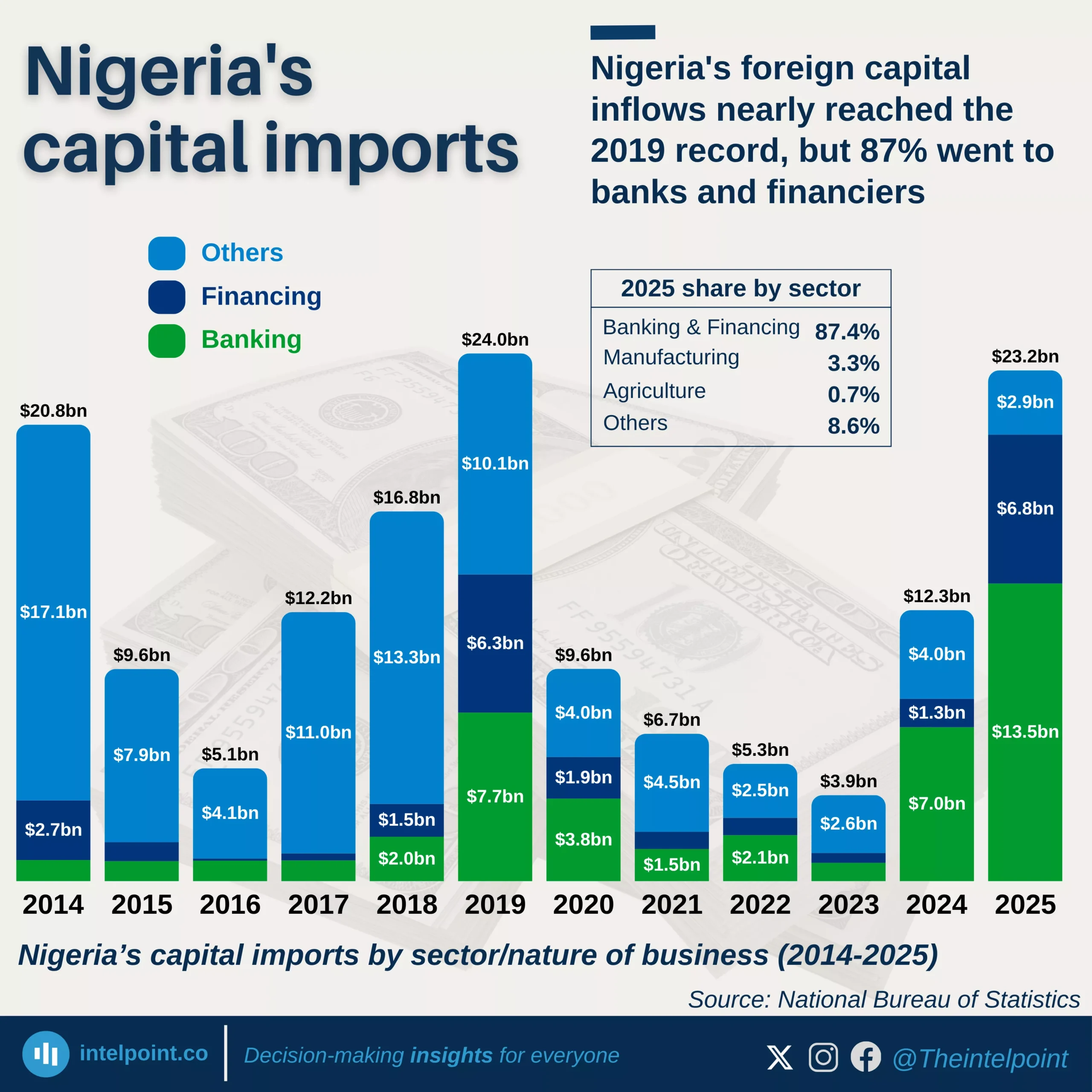
Nigeria's foreign capital inflows nearly reached the 2019 record, but 87% went to banks and financiers

  • Inflows surged from $3.9B in 2023 to $23.2B in 2025, near the all-time record.
  • Banking and financing captured 87% of all inflows.
  • Agriculture got $167M, oil and gas $18M, and construction $6M, .
  • The recovery is real, but it is not yet reaching ordinary Nigerians.

Foreign investment is returning to Nigeria, but the sectors that feed, employ, and house most Nigerians are still waiting at the door.

After hitting a decade-low of $3.9 billion in 2023, Nigeria's foreign capital inflows have surged back to $23.2 billion in 2025, nearly matching the record of $24 billion set in 2019. On paper, that is a remarkable turnaround, the kind of number a government puts on a billboard.

But a look at the data halts the celebration. Banking and financing alone swallowed 87 cents of every dollar that came in, leaving manufacturers, farmers, builders, and tech entrepreneurs to share 13 cents.

The productive economy — the part that creates jobs, feeds families, and builds infrastructure — received almost nothing. Agriculture received $167 million, construction received $6 million, while oil and gas — the sector Nigeria has staked its identity on for decades — received just $18 million.
Source:

National Bureau of Statistics

Period:

2014-2025
HTML code to embed chart
Want a bespoke report?
Reach out
Tags
Related Insights

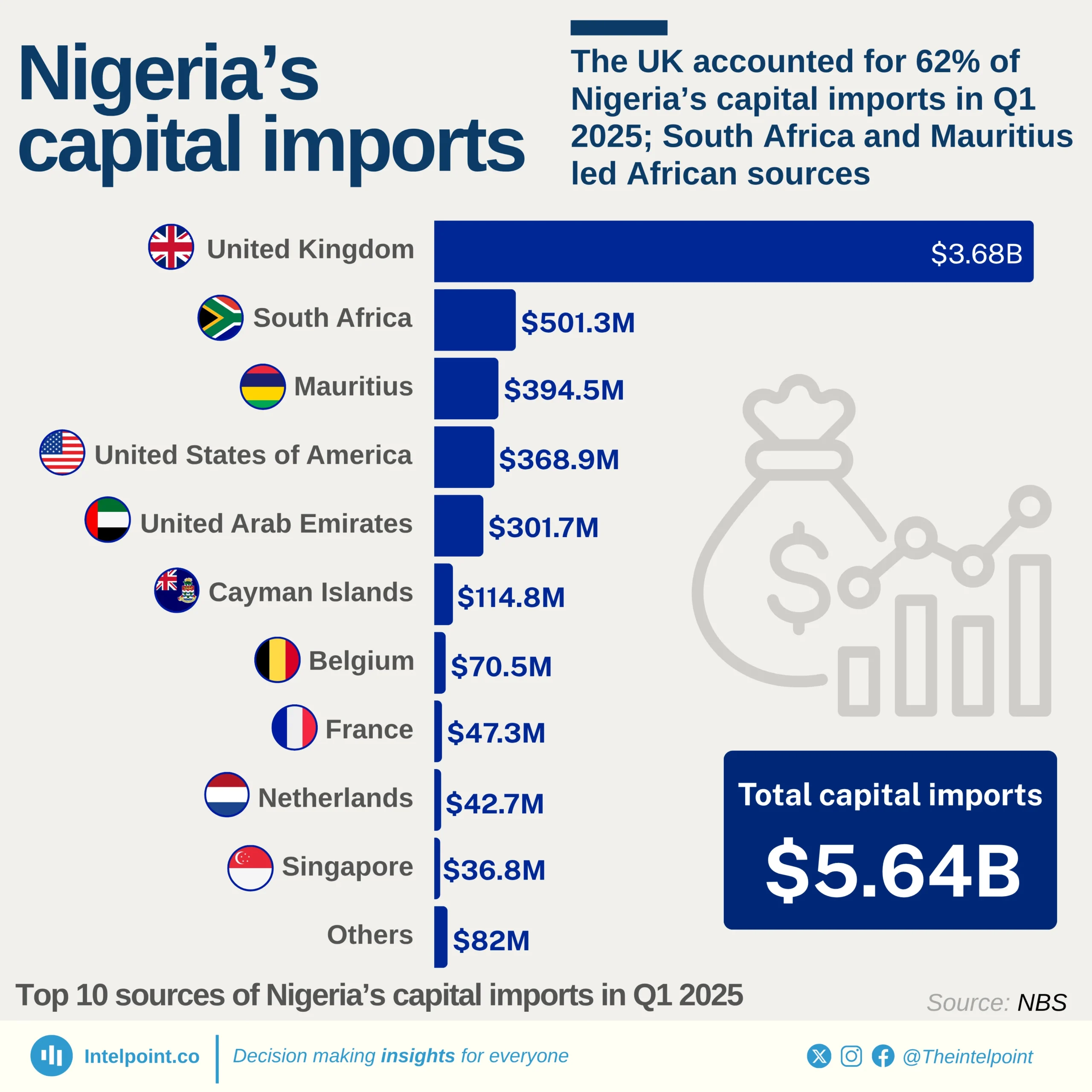
The UK accounted for 62% of Nigeria’s capital imports in Q1 2025; South Africa and Mauritius led African sources
  • The United Kingdom accounted for over 62% of total capital imports into Nigeria in Q1 2025.
  • South Africa and Mauritius are the only African countries in the top 10, ranking 2nd and 3rd respectively.
  • Traditional powerhouses like the US and UAE contributed significantly less than the UK.
  • Emerging markets like the Cayman Islands and Singapore also made the list, reflecting Nigeria’s diverse capital origin base.

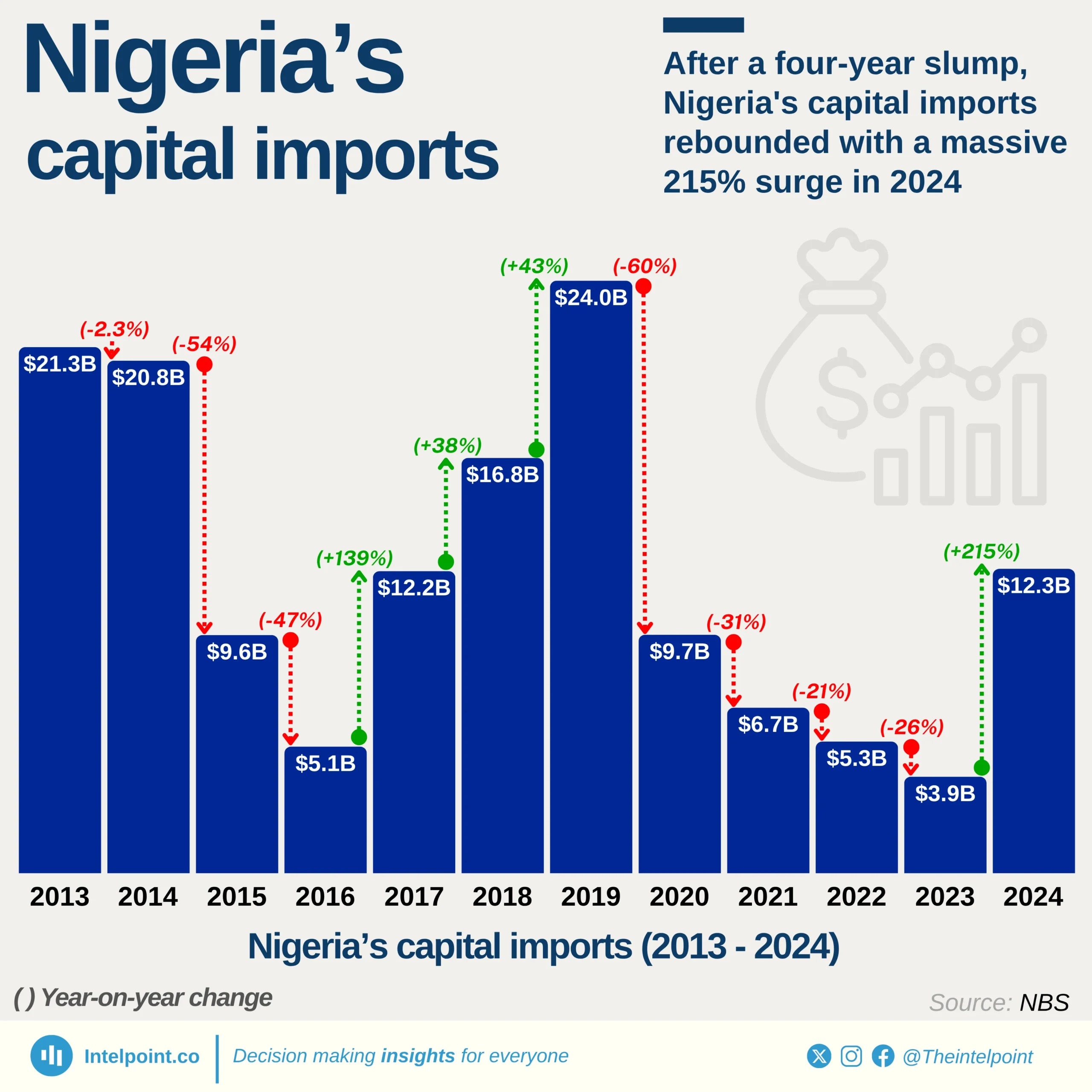
After a four-year slump, Nigeria's capital imports rebounded with a massive 215% surge in 2024
  • Nigeria’s capital importation fell from $21.3 billion in 2013 to $12.3 billion in 2024, marking a 42% decline over the 12-year period.
  • After four years of consistent decline, capital inflows surged by 215% in 2024, rising from $3.9 billion in 2023 to $12.3 billion.
  • The data reflects sharp swings, with 2019 peaking at $24 billion, followed by a 60% plunge in 2020 due to global and domestic disruptions.
  • In 2023, capital imports plummeted to their lowest point of the 12-year period, reaching just $3.9 billion.

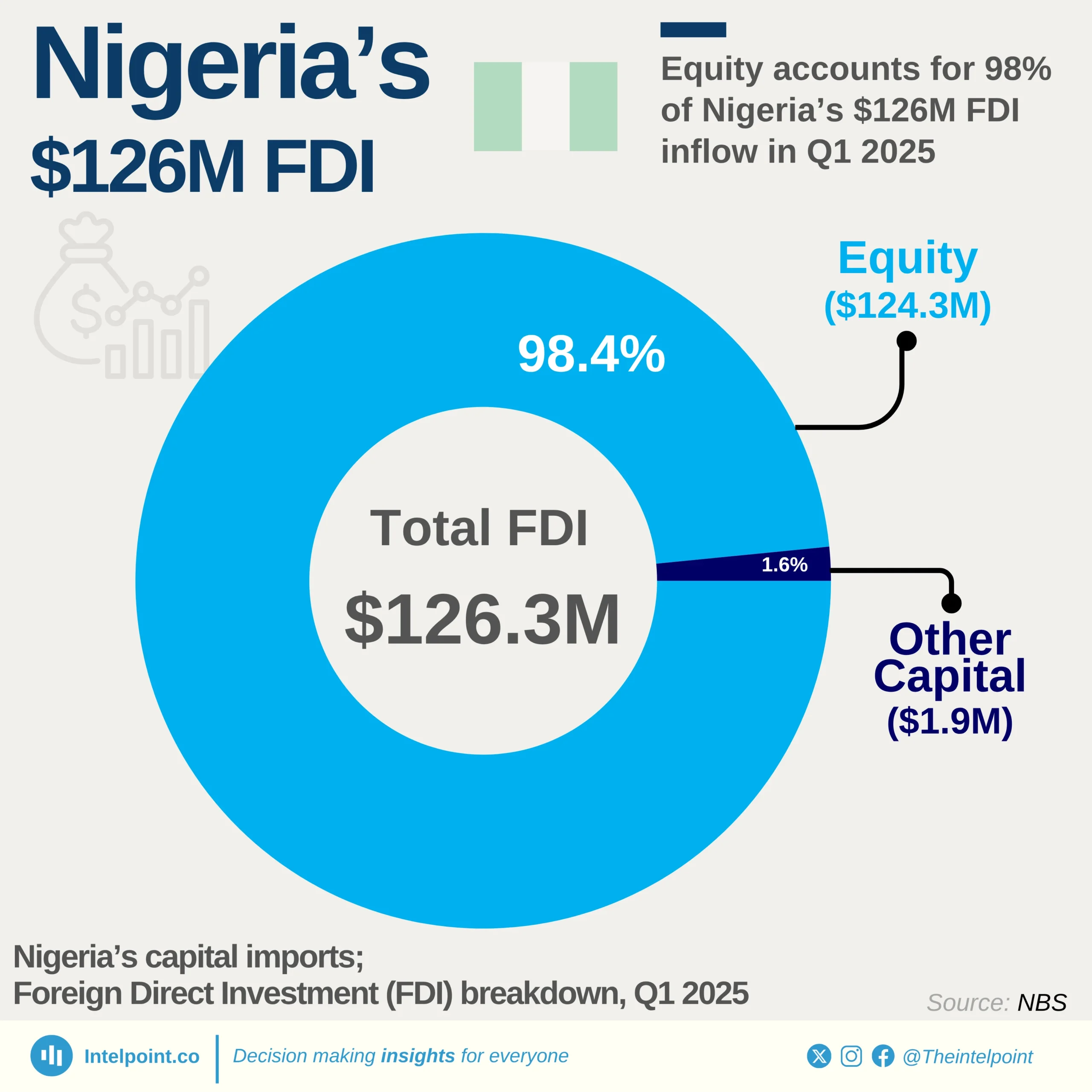
Equity accounts for 98% of Nigeria’s $126M FDI inflow in Q1 2025
  • Nigeria recorded $126.3 million in foreign direct investment during Q1 2025, comprising 2.2% of the country's total capital importation.
  • Equity investment was the primary FDI channel, accounting for $124.31 million or 98.4% of the total FDI.
  • "Other Capital" (possibly intra-company loans or reinvested earnings) contributed just $1.98 million, a marginal 1.6% share.
  • The dominance of equity suggests that foreign investors are committing more to long-term ownership and participation in Nigerian businesses rather than short-term financing

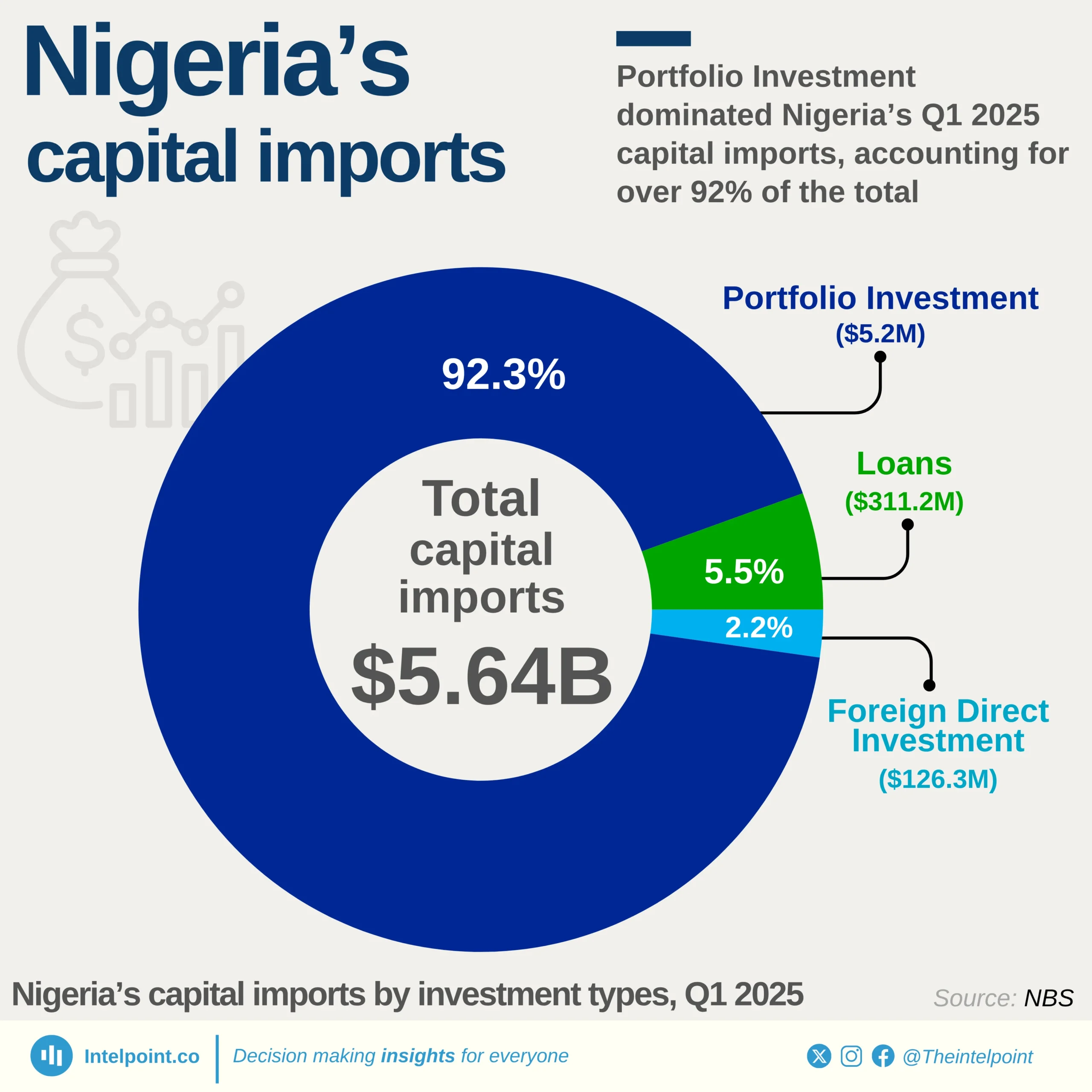
Portfolio Investment dominated Nigeria’s Q1 2025 capital imports, accounting for over 92% of the total
  • Nigeria recorded $5.64 billion in total capital importation in Q1 2025.
  • Portfolio investment alone contributed a massive $5.2 billion, 92.3% of total inflows.
  • FDI contributed just $126.29 million, making up only 2.2% of total capital importation.
  • Loans totalled $311.17 million, accounting for 5.5% of the total inflow.

Money market instruments dominate over 80% of Nigeria’s $5.2B portfolio investment in Q1 2025
  • Nigeria attracted $5.2 billion in portfolio inflows in Q1 2025, making up 92.3% of all capital importation.
  • With $4.2 billion, money market instruments accounted for a dominant 80.9% of portfolio investments.
  • Bonds contributed $877.4 million, roughly 16.8% of portfolio inflows.
  • Equities saw the smallest share, at $117.3 million or just 2.3% of portfolio capital inflows.

POPULAR TOPICS
SIGN UP TO OUR NEWSLETTER
Get periodic updates about the African startup space, access to our reports, among others.
Subscribe Here
Subscription Form

A product of Techpoint Africa. All rights reserved