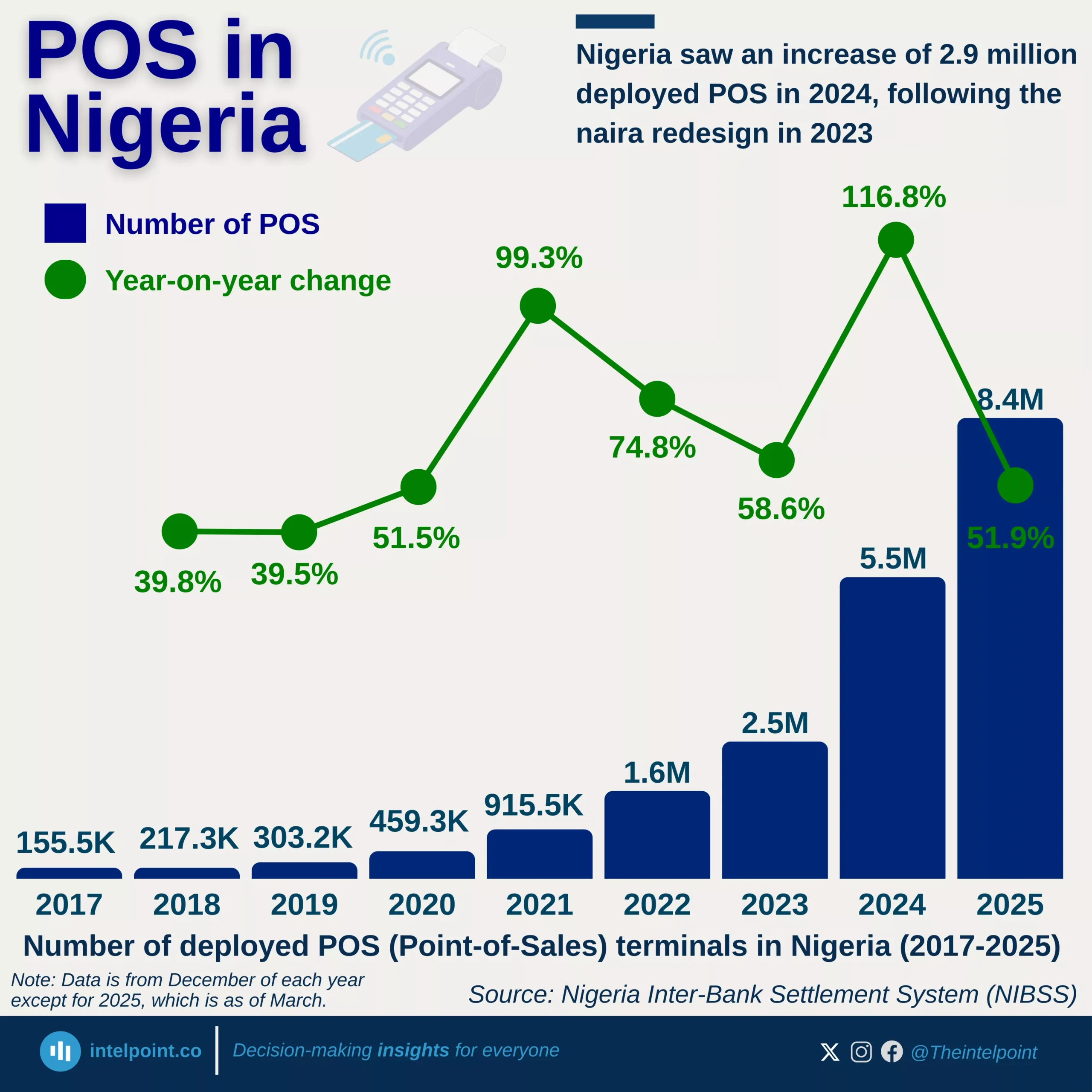
Nigeria saw an increase of 2.9 million deployed POS in 2024, following the naira redesign in 2023

  • Deployed POS terminals grew from about 156,000 in 2017 to 8.4 million in 2025.
  • Nigeria added more than eight million terminals in eight years, indicating rapid adoption of digital payments.
  • Growth accelerated sharply after 2020, marking a major shift toward cashless transactions.
  • The highest year-on-year growth (116.8%) occurred in 2024, following the naira redesign.
  • About three million terminals were added in 2024 alone.
  • POS agents became critical financial access points during the period of cash shortage.
  • POS terminals now function as mini-banks in many communities.
  • Financial inclusion has expanded through agent-based banking and POS networks.

Nigeria’s POS ecosystem has expanded at a pace few would have predicted a decade ago. From just about 156,000 terminals in 2017, the country now hosts roughly 8.4 million POS devices in 2025. This is a structural shift in how money moves across the economy. What started as a banking tool has evolved into a nationwide payment network, embedded in markets, street corners, pharmacies, fuel stations, and roadside kiosks.

The turning point came after 2020, when deployment accelerated sharply. POS terminals nearly doubled in 2021 and continued rising through 2023. But the most dramatic jump followed the 2023 naira redesign and cash scarcity. In 2024 alone, Nigeria added about three million new terminals, pushing growth to over 116% year-on-year. Cash shortages did not just inconvenience people; they permanently changed payment habits, forcing businesses and consumers to rely more heavily on electronic channels.
Source:

Nigeria Inter-Bank Settlement System (NIBSS)

Period:

2017-2025
HTML code to embed chart
Want a bespoke report?
Reach out
Tags
Related Insights

Zero Losses: Every Access Holdings’ subsidiary made a profit in H1 2025
  • Every subsidiary reported profit in H1 2025, compared to three loss-making units in H1 2024.
  • Nigeria’s profit eased, but stronger performance across other African markets helped support overall group results.
  • Zambia, Sierra Leone, the DRC, Cameroon, and Kenya showed notable turnarounds from previous low or negative earnings.
  • The UK operation remained a major contributor, reinforcing the benefits of Access Holdings’ diversified regional presence.

UBA is the only Tier 1 bank in Nigeria that grew its profit in the first three quarters of 2025 compared to 2024
  • FUGAZ posted a combined ₦2.91 trillion in profit from Q1 to Q3 of 2025.
  • Access Bank recorded the lowest PAT among the FUGAZ
  • UBA recorded a 3% year-on-year increase in PAT
  • FUGAZ recorded an average year-on-year percentage change of -11.2% for the period

Conoil's profit after tax soared 585% from 2020 to the 2023 peak; profit before tax jumped 471%
  • Profit Before Tax (PBT) surged 471% from ₦2.15 billion (2020) to ₦12.28 billion (2023); Profit After Tax (PAT) jumped 585% to ₦9.87 billion.
  • Both metrics declined ~11% from the 2023 peak but remained well above historical averages.
  • Effective tax rate fell from 38% (2012) to 20% (2024), allowing the company to retain 80% of pre-tax profits.
  • Absolute tax payments increased from an average of ₦1.01 billion (2011-2020) to ₦2.30 billion (2021-2024), reflecting higher profitability.

Nigeria exited the FATF grey list in October 2025, after being placed on it in February 2023, approximately 32 months later
  • Nigeria exited the FATF grey list in October 2025, after 32 months of monitoring.
  • The country was added to the grey list in February 2023 due to technical compliance shortcomings.
  • FATF conducted an assessment of Nigeria’s AML/CFT measures in 2008, marking the beginning of its oversight of the measures.
  • Between 2010 and 2013, Nigeria appeared repeatedly in FATF statements for strategic AML/CFT deficiencies.

Stablecoins are the most frequently transacted asset for outbound payments among Nigerian users (38.3%), outpacing bitcoin (27.3%)
  • Stablecoins lead the market, accounting for 38.3% of all crypto sent, highlighting Nigerians’ preference for stability and dollar-backed assets.
  • Bitcoin ranks second at 27.3%, showing it remains a major channel for store-of-value transfers and remittances.
  • Altcoins like SOL, ADA, SHIB, and DOGE (15.4%) attract younger and experimental users but remain secondary to stable assets.
  • Ethereum (10.2%) and BNB (8.9%) maintain moderate transaction volumes, suggesting users favor low-fee and widely accepted tokens for transfers.

Over 40% of surveyed Nigerian crypto users are students
  • Students are the largest crypto-holding group (43.6%), underscoring the youthful nature of Nigeria’s crypto community and their early adoption of digital finance.
  • Entrepreneurs follow closely (25.7%), showing strong participation from self-employed Nigerians, traders, business owners, and hustlers who use crypto for investment and business flexibility.
  • Traditional employees make up 17.4%, indicating growing acceptance of crypto beyond informal or youth circles, even among salary earners.
  • Freelancers and gig workers (5.6%) also feature, reflecting crypto’s role in global online work and cross-border earnings. Unemployed and retired individuals remain a small minority, under 3.5% combined.

POPULAR TOPICS
SIGN UP TO OUR NEWSLETTER
Get periodic updates about the African startup space, access to our reports, among others.
Subscribe Here
Subscription Form

A product of Techpoint Africa. All rights reserved