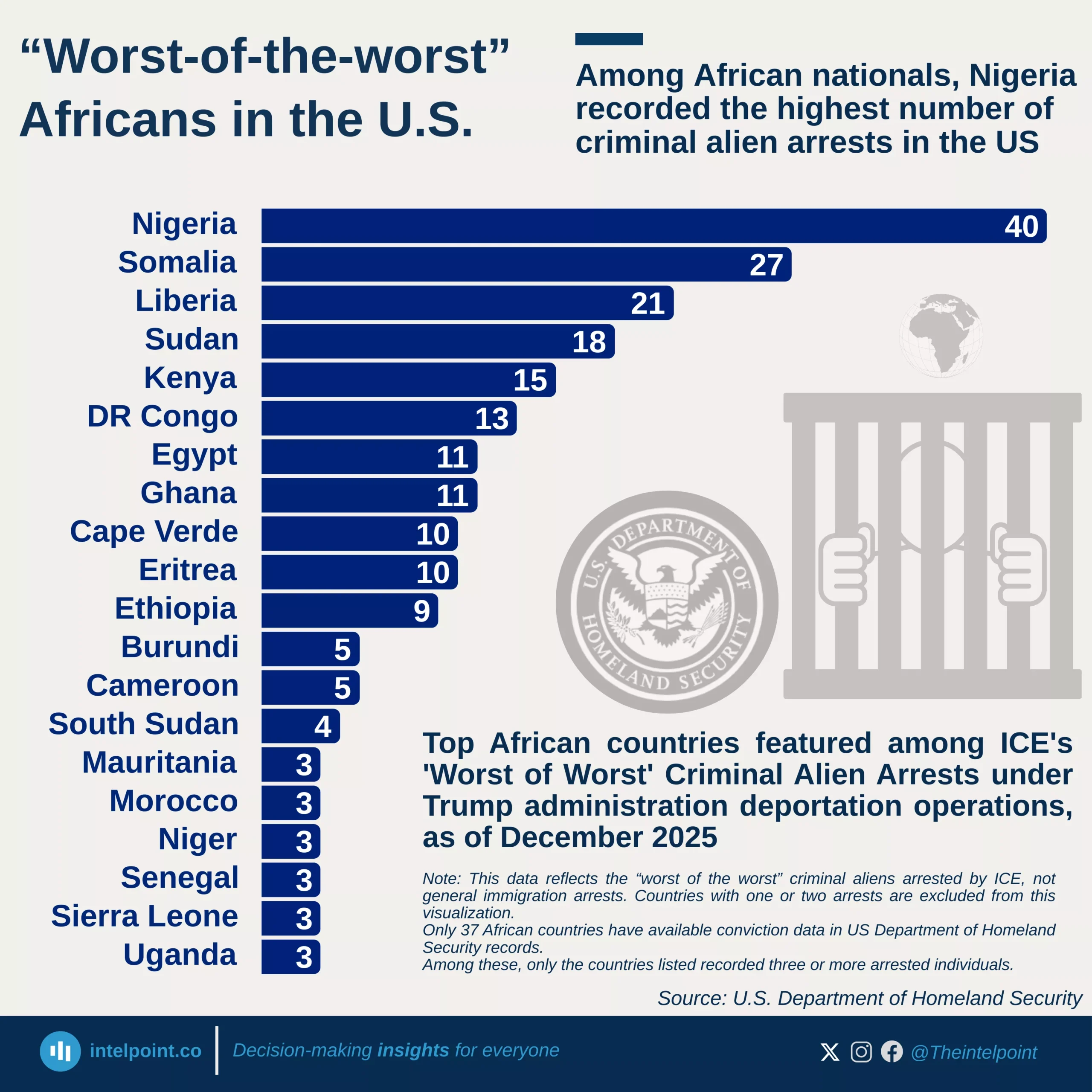
Among African nationals, Nigeria recorded the highest number of criminal alien arrests in the US

  • The U.S Department of Homeland Security specifies that the data reflects the “worst of the worst” criminal aliens arrested by ICE, not general immigration arrests.
  • Nigeria leads the list with 40 arrests, the highest among all African nationals reported.
  • Somalia (27) and Liberia (21) follow, forming a concentrated top tier.
  • Most countries report fewer than 10 arrests, showing a sharp decline beyond the top group.

During his campaign, Donald Trump pledged sweeping deportations, vowing to remove what he repeatedly described as the “worst criminal illegal aliens.” The U.S. Department of Homeland Security’s data offers a glimpse into the African nationals who fall under that category - individuals the agency labels as the “worst of the worst.”

Among African countries, the arrest figures are heavily concentrated in a small cluster of nations. Nigeria leads with 40 arrests, followed by Somalia (27) and Liberia (21), forming the highest tier. A second tier - Sudan, Kenya, DR Congo, Egypt, Ghana, Cape Verde, Eritrea, and Ethiopia - recorded between 9 and 18 arrests each. Most other African countries appear only sparingly, with three or fewer cases in the dataset. In total, only 37 African countries have available arrest data, and only those listed had at least three individuals flagged.

The U.S. Department of Homeland Security explains that this category includes individuals already convicted of serious crimes as well as others facing pending criminal charges at the time they are encountered. In other words, not everyone in the dataset has been newly convicted in U.S. courts, but all are placed under DHS’s highest-severity tier because of their connection to major offenses such as murder, aggravated assault, sexual offenses, child exploitation, burglary, identity theft, robbery, drug related offences, fraud schemes, and weapons violations. These are the types of crimes DHS cites when identifying those considered the “worst of the worst
Source:

U.S. Department of Homeland Security

Period:

2025
HTML code to embed chart
Want a bespoke report?
Reach out
Tags
Related Insights

Policemen dedicated to VIP protection account for nearly one-third of 371,800 personnel in the Nigeria Police Force (NPF)
  • Nigeria has 371,800 police personnel as of 2025
  • 100,000 officers, 26.9% of the NPF, are dedicated to VIP and politician protection
  • Only 73.1% of personnel (271,800 officers) remain available for general public policing
  • Nearly one-third of the police workforce is focused on elite protection rather than community safety
  • The heavy VIP-protection allocation reduces manpower available for daily security operations

Nigeria's Peace Index scores have worsened since 2008, reaching the highest to date in 2015
  • Nigeria has consistently ranked among the least peaceful countries, with scores remaining in the lower band from 2008 to 2025.
  • Peacefulness worsened sharply between 2013 and 2015, marking one of Nigeria’s most unstable periods.
  • A mild improvement occurred between 2017 and 2022, although overall peacefulness remained low.
  • Nigeria’s score deteriorated again in 2025, rising from 2.77 to 2.87 and reversing recent stability.

Protest activity in Nigeria increased significantly during Goodluck Jonathan's tenure, growing from 53 in 2011 to 696 in 2015
  • Nigeria recorded 971 protests and violent demonstrations in 2024.
  • Protest numbers have grown 50-fold since 2000, signalling a consistent rise in public mobilisation.
  • The most significant surge occurred between 2011 and 2015, under Goodluck Jonathan’s administration.
  • Muhammadu Buhari’s tenure saw the highest number of recorded protests — peaking at 1,008 in 2020.
  • Despite a change in leadership, protest activity remains elevated under Bola Tinubu.

The number of protests in Kenya skyrocketed to a record 2,008 events in 2024, marking a seven-fold increase from the 2022 total of 239
  • Kenya recorded 2,008 protests in 2024, the highest in its modern history.
  • The number of protest events increased seven-fold between 2022 and 2024.
  • Social media has become a major mobilisation tool for civic expression.
  • Rising cost of living, taxation, and unemployment remain the top drivers of unrest.

North African countries led in protests in Africa, topped by Morocco, which recorded 3,654 protests in 2024
  • Africa recorded 12,581 protests and violent demonstrations in 2024.
  • Morocco led the continent with 3,654 protests, far ahead of others.
  • Kenya ranked second with 2,008 protests.
  • South Africa (1,715) and Nigeria (971) followed, driven by economic and political frustrations.
  • North African countries, such as Morocco, Tunisia, and Libya, accounted for a significant share of protests.
  • The bottom 10 countries, including Lesotho, Gambia, and Seychelles, recorded fewer than 10 protests each.
  • Djibouti and Eritrea reported zero protests.

India leads the world in protest events with 22.1K, while Morocco leads in Africa, making it into the top 15 globally
  • India recorded the highest number of protests and demonstration events globally in 2024 (22.1K).
  • The United States followed with 10.5K protest events.
  • Yemen (8.2K) ranked third, reflecting the instability and ongoing conflict-driven unrest.
  • Pakistan (7.3K) and France (6.9K) rounded out the top five, underscoring the diverse sources of civic agitation.
  • Morocco (3.7K) was Africa’s leading country for protest activity, placing 12th globally.
  • The global total of protest and violent demonstration events reached 153,573 in 2024.

POPULAR TOPICS
SIGN UP TO OUR NEWSLETTER
Get periodic updates about the African startup space, access to our reports, among others.
Subscribe Here
Subscription Form

A product of Techpoint Africa. All rights reserved