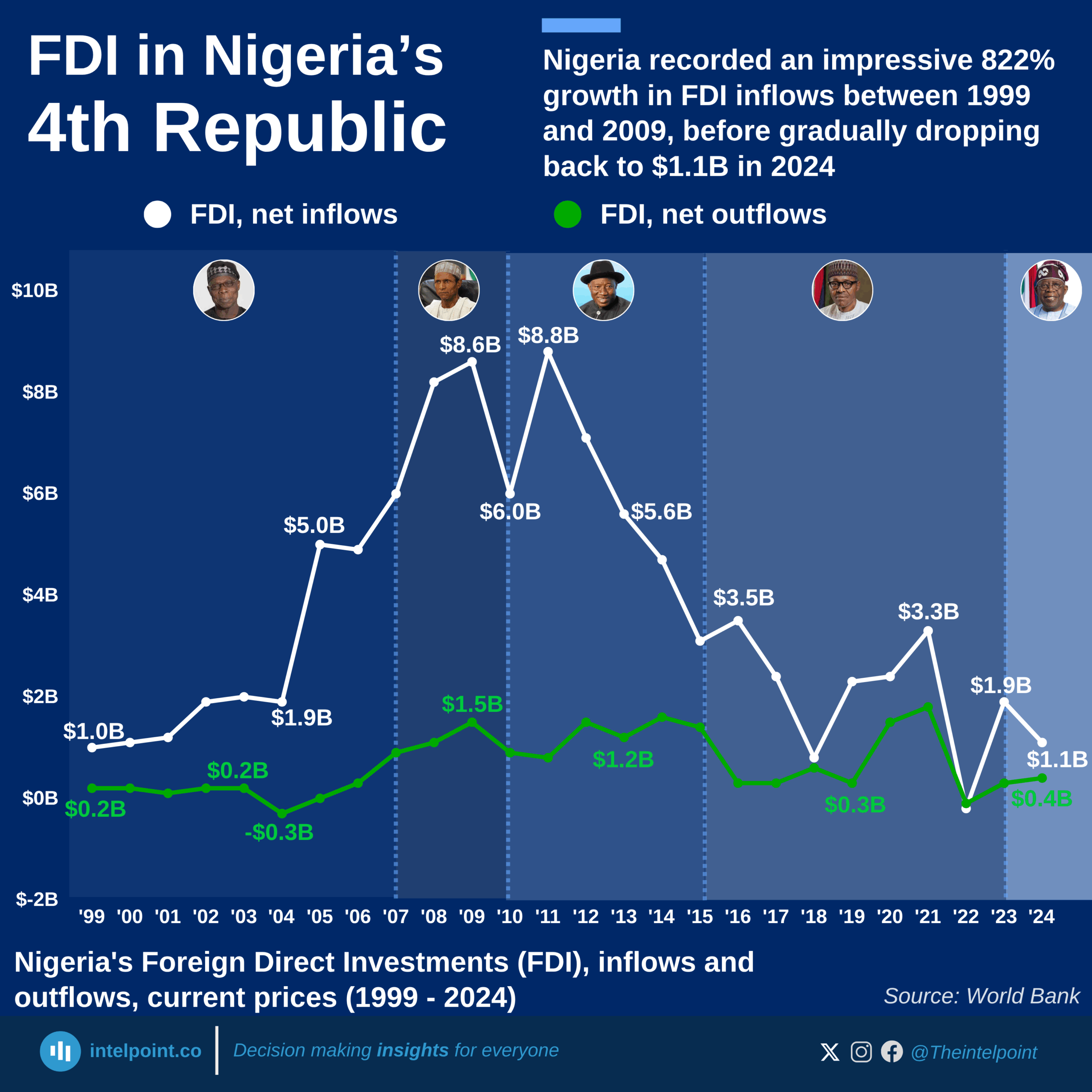
Nigeria recorded an impressive 822% growth in FDI inflows between 1999 and 2009, before gradually dropping back to $1.1B in 2024

  • FDI inflows in Nigeria peaked at $8.8 billion in 2011, marking the highest point in the Fourth Republic.
  • From 2011 to 2024, FDI inflows dropped, settling at $1.1 billion in 2024.
  • The early Fourth Republic (1999–2011) showed growth in FDI inflows.
  • FDI outflows rose from $0.2 billion in 1999 to $1.5 billion in 2009, reflecting gradual international expansion by Nigerian investors.
  • From 2015 onward, both inflows and outflows showed significant volatility, with no clear recovery trend.

Foreign Direct Investment (FDI) in Nigeria’s Fourth Republic tells a clear story of early promise followed by a prolonged decline. Between 1999 and 2011, the country experienced a strong upward trend in FDI inflows, peaking at $8.8 billion in 2011. This period reflected growing investor confidence, driven by economic reforms, liberalisation policies, and a favourable global commodities market. However, after the 2011 peak, FDI inflows began to fall steadily, dropping to just $1.1 billion in 2024, a level similar to the early days of the Fourth Republic.
Source:

World Bank

Period:

1999 - 2024
HTML code to embed chart
Want a bespoke report?
Reach out
Tags
Related Insights

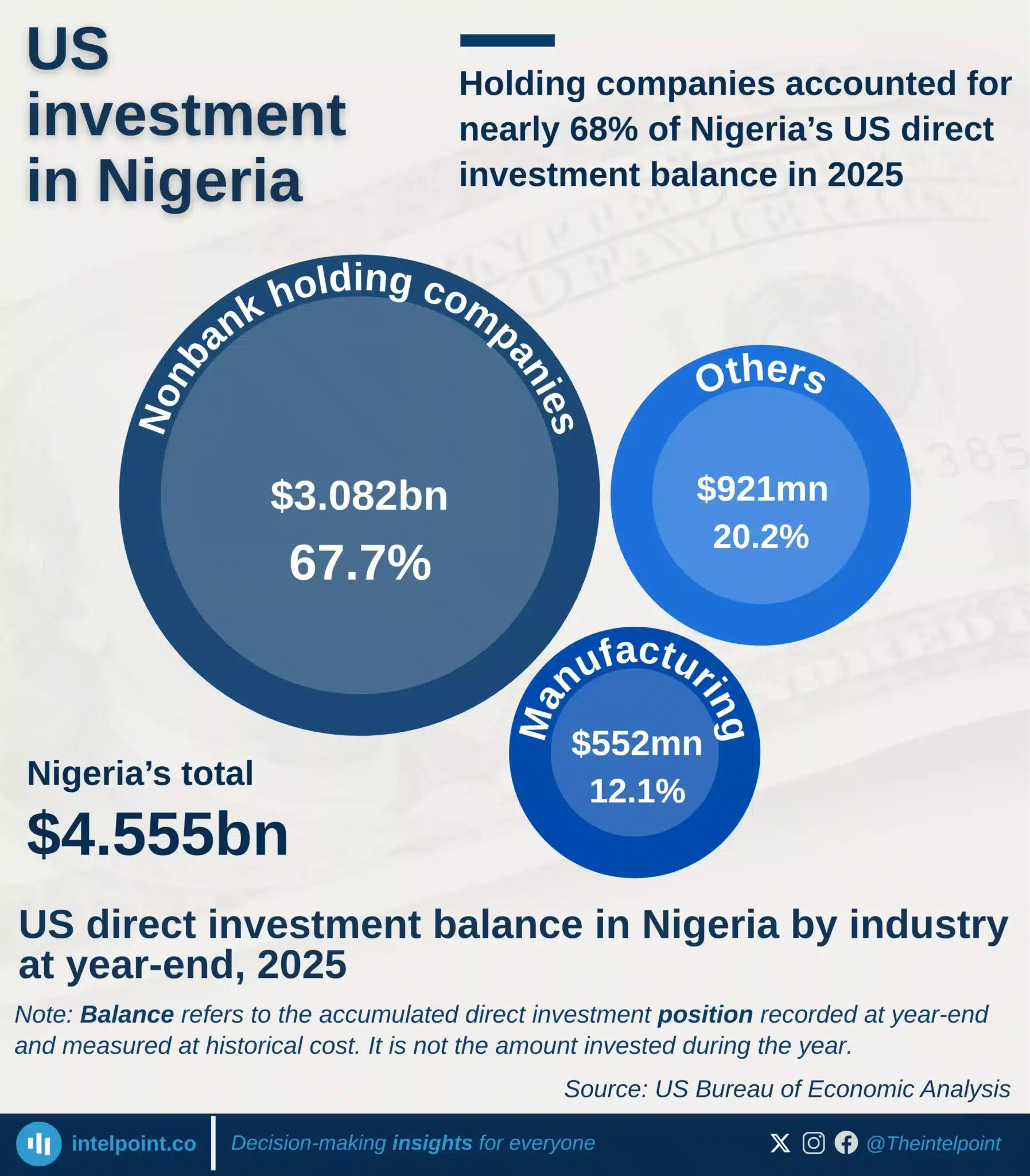
Holding companies accounted for nearly 68% of Nigeria’s US direct investment balance in 2025
  • Nigeria held Africa’s fourth-largest US direct investment balance in 2025, at $4.56 billion.
  • The balance fell by $1.98 billion from $6.54 billion in 2024, a decline of 30.3%.
  • Nonbank holding companies accounted for $3.08 billion, or 67.7% of Nigeria’s total balance.
  • Manufacturing represented $552 million, or 12.1%, while other industries accounted for $921 million.
  • Holding-company assets may ultimately be deployed in other sectors, so the classification does not show their final use.

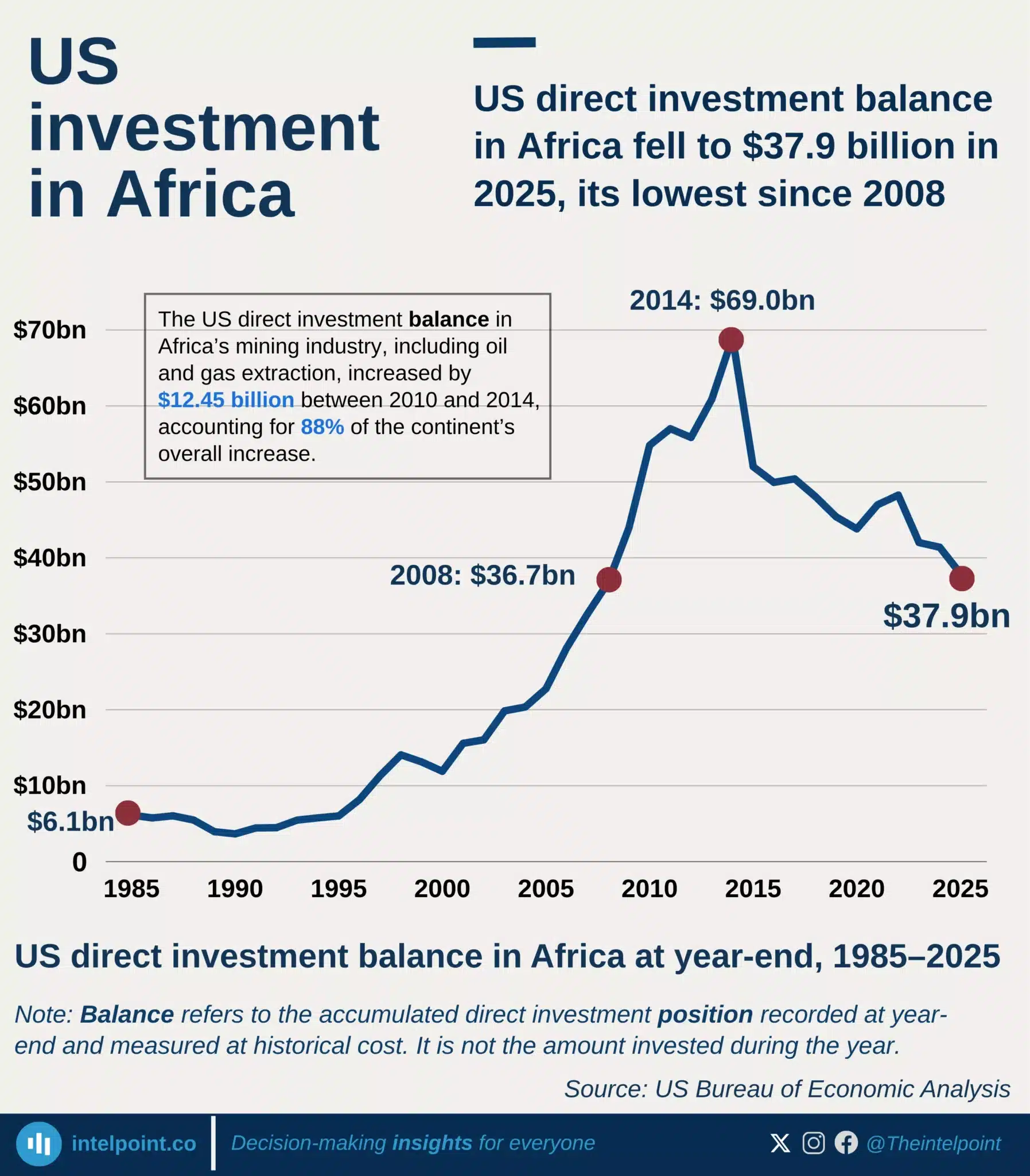
US direct investment balance in Africa fell to $37.9 billion in 2025, its lowest since 2008
  • US direct investment in Africa peaked at $69 billion in 2014 after expanding rapidly from the mid-2000s.
  • By 2025, the balance had fallen 45.1% from its peak to $37.9 billion, its lowest since 2008.
  • Mining drove the cycle, accounting for 88% of the 2010–2014 increase and 97% of the subsequent decline.
  • Africa’s share of the global US direct investment balance remained below 3% throughout 1985–2025.
  • The post-2014 decline was interrupted by brief recoveries in 2017 and 2021–2022.

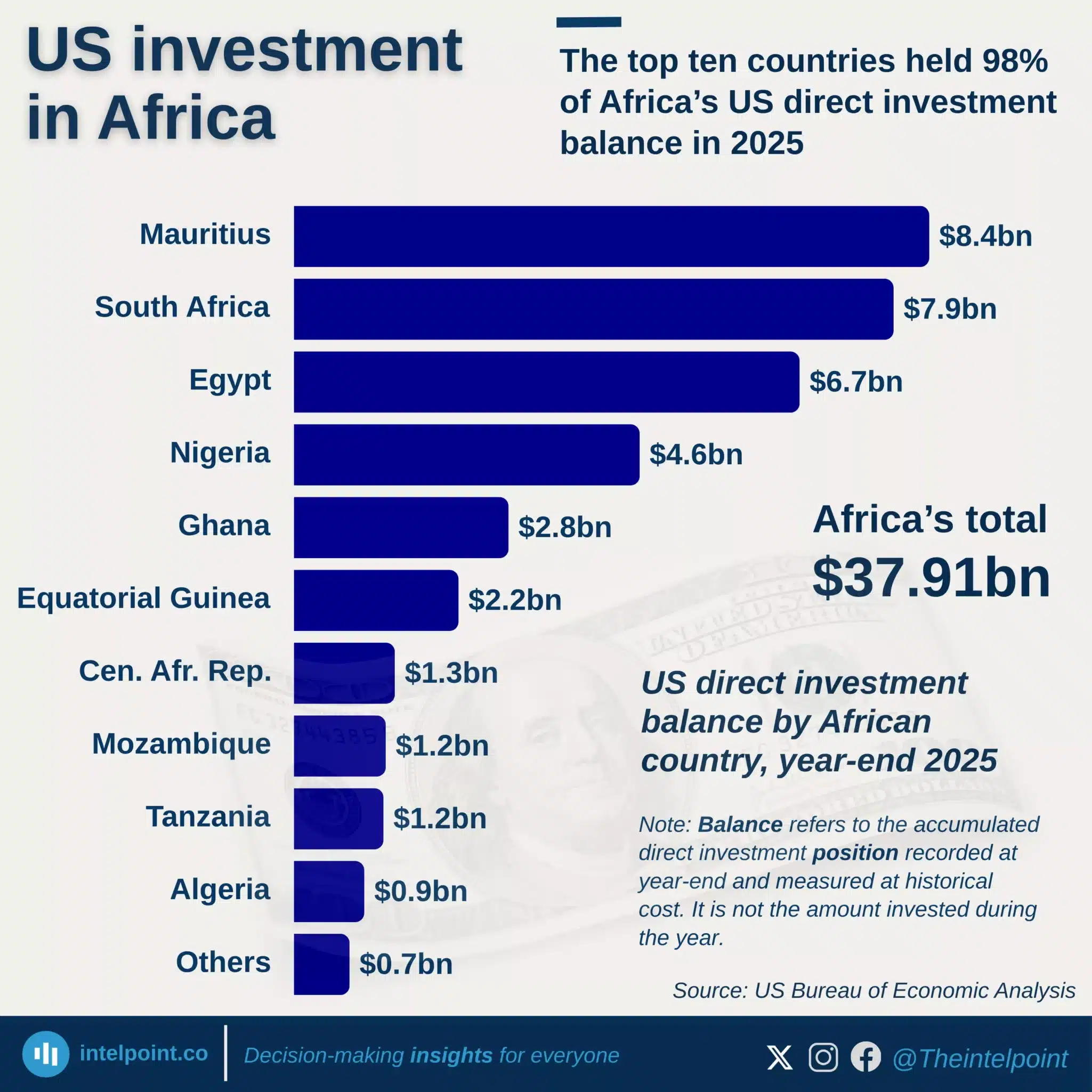
The top ten countries held 98% of Africa’s US direct investment balance in 2025
  • Mauritius held Africa’s largest US direct investment balance in 2025, at $8.4 billion.
  • South Africa followed with $7.9 billion, ahead of Egypt’s $6.7 billion and Nigeria’s $4.6 billion.
  • Africa’s total balance fell by 8.4% to $37.91 billion, its third consecutive annual decline.
  • The top ten countries held 98% of Africa’s total, leaving only $0.7 billion across the rest.
  • Manufacturing led South Africa’s balance, mining dominated Egypt’s, and holding companies accounted for most of Nigeria’s.

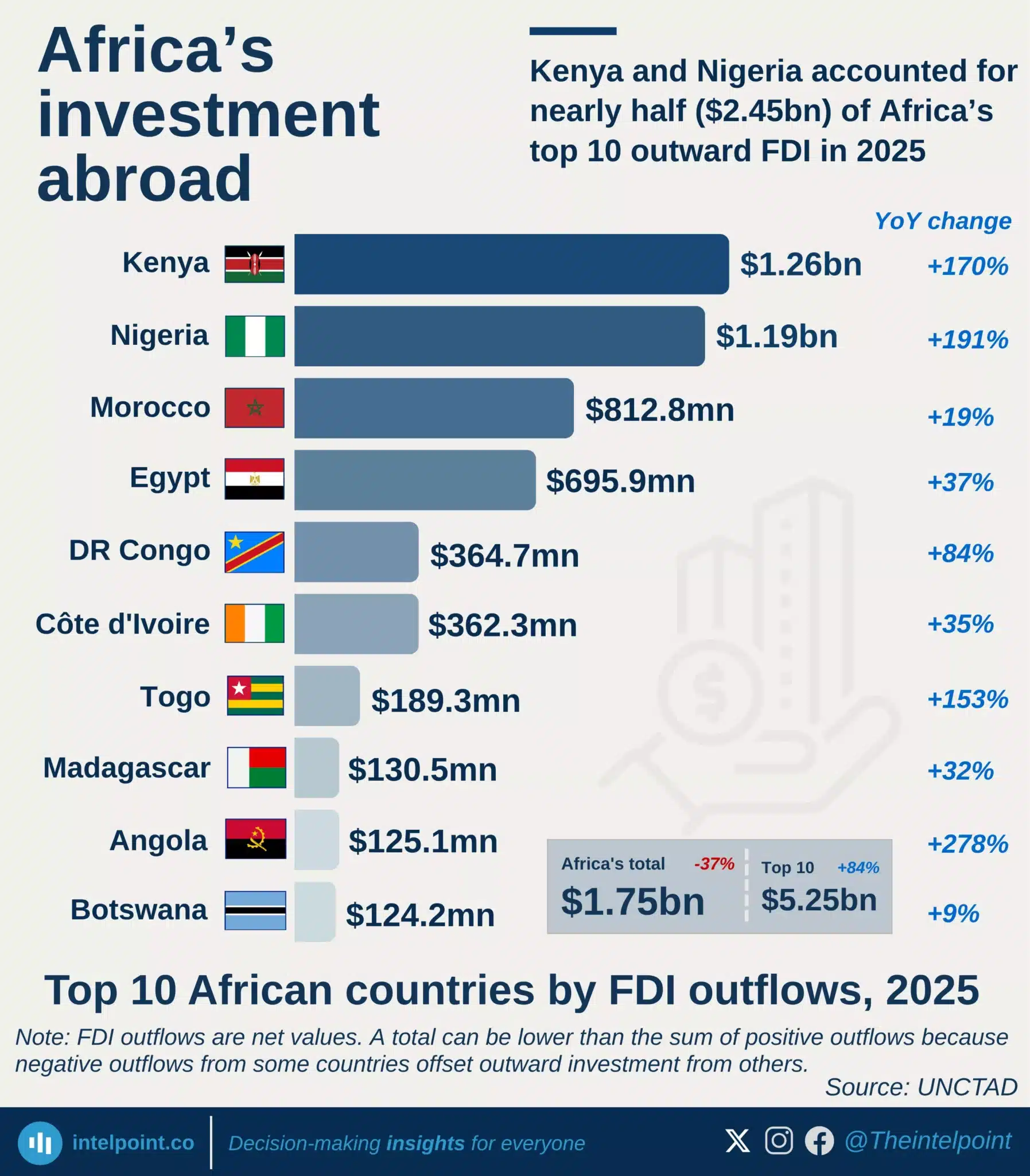
Kenya and Nigeria accounted for nearly half ($2.45bn) of Africa’s top 10 outward FDI in 2025
  • Kenya led Africa’s outward FDI in 2025, recording $1.26bn.
  • Nigeria followed closely with $1.19bn, after a 191% increase.
  • Together, Kenya and Nigeria accounted for $2.45bn of the top 10 total.
  • Morocco and Egypt completed the top four, with $812.8m and $695.9m.
  • Angola recorded the fastest growth among the top 10, rising 278%.
  • Africa’s total outflow was lower because negative outflows offset gains elsewhere.

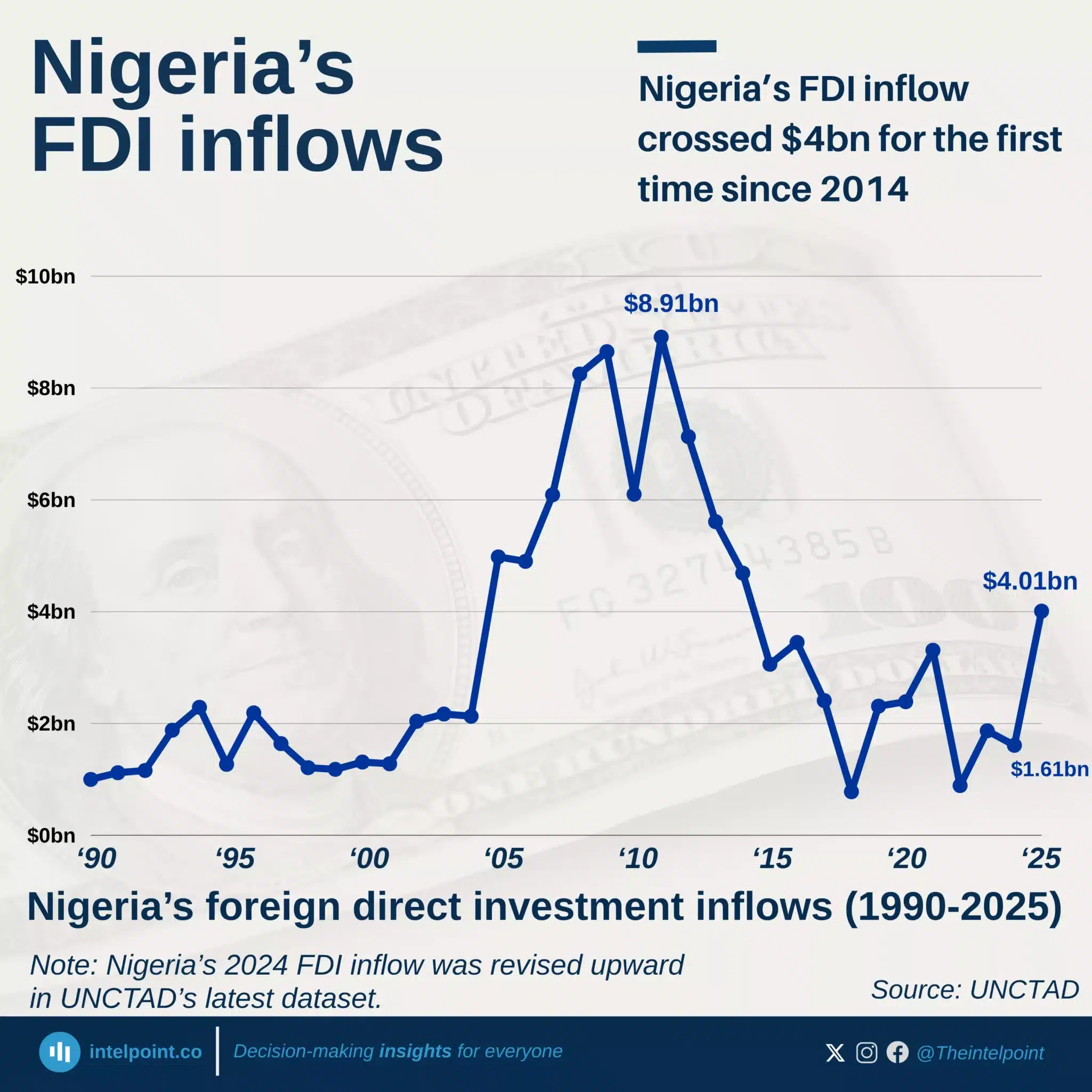
Nigeria’s FDI inflow crossed $4bn for the first time since 2014
  • Nigeria’s FDI inflows rose to $4.01 billion in 2025, the highest level since 2014.
  • The 2025 figure represents a 148% increase from the revised $1.61 billion recorded in 2024.
  • Despite the rebound, Nigeria remains far below its 2011 peak of $8.91 billion.
  • Nigeria’s strongest FDI period was 2005 to 2014, when inflows stayed above $4 billion every year.

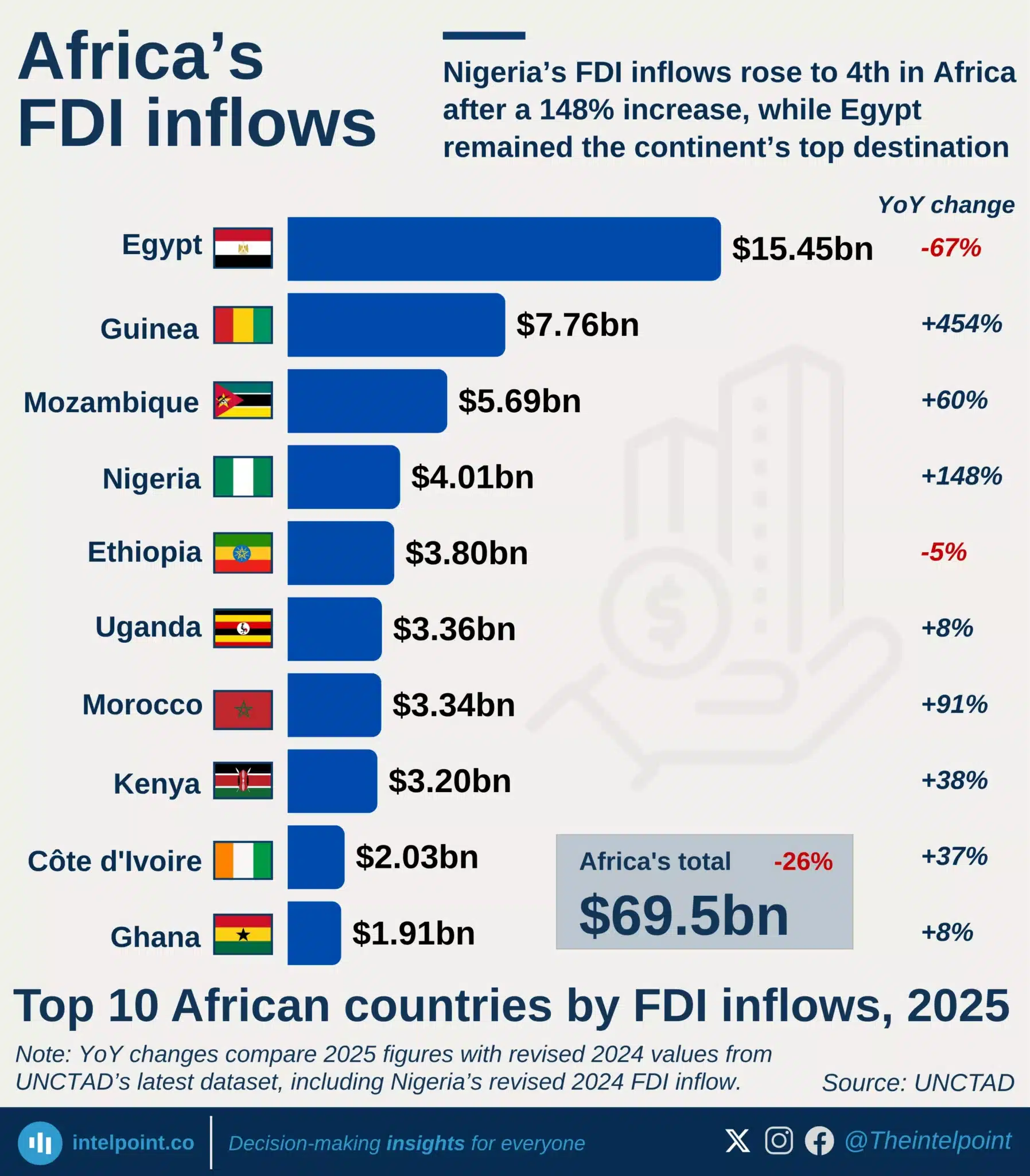
Nigeria’s FDI inflows rose to 4th in Africa after a 148% increase, while Egypt remained the continent’s top destination
Egypt remained Africa’s top FDI destination with $15.45bn. Nigeria ranked 4th after FDI inflows rose 148% to $4.01bn. Guinea had the biggest top-10 jump, rising 454% to $7.76bn. Africa’s top 10 accounted for 73% of total FDI inflows.

POPULAR TOPICS
SIGN UP TO OUR NEWSLETTER
Get periodic updates about the African startup space, access to our reports, among others.
Subscribe Here
Subscription Form

A product of Techpoint Africa. All rights reserved