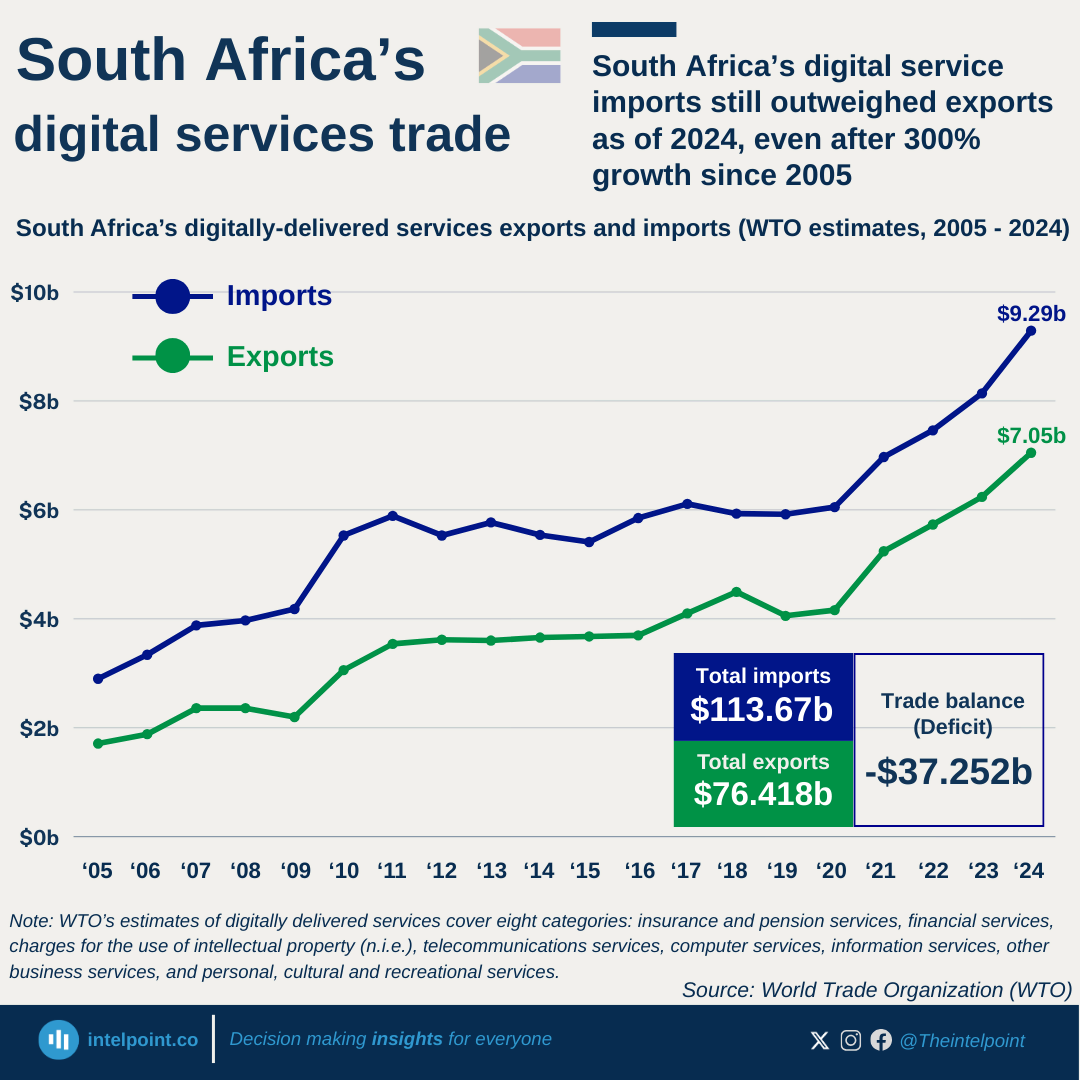
South Africa’s digital service imports still outweighed exports as of 2024, even after 300% growth since 2005

key takeaways:

  • South Africa’s digital service imports consistently overshadowed export earnings, despite exports growing by over 300% since 2005.
  • South Africa exported $76.418 billion in digital services between 2005 and 2024.
  • Imports during the same period reached $113.67 billion.
  • The result was a trade deficit of $37.252 billion in over 20 years.
  • Exports rose from just $1.71 billion in 2005 to $7.05 billion in 2024.

South Africa’s digital services trade between 2005 and 2024 reveals a consistent imbalance. Over this 20-year period, the country exported a total of $76.418 billion worth of digital services. However, imports were significantly higher, totaling $113.67 billion during the same time-frame. This gap created a trade deficit of $37.252 billion, highlighting the country’s dependence on foreign digital services.

In 2005, South Africa’s digital service exports were modest, at just $1.71 billion. By 2024, exports had grown substantially to $7.05 billion, reflecting a steady upward trajectory. Despite this growth, imports continued to outpace exports, limiting the benefits of export expansion.

On average, South Africa exported $3.8 billion annually in digital services across the two decades. By contrast, annual imports averaged around $5.68 billion, creating a persistent yearly gap. This imbalance points to structural challenges in the digital economy and service provision sector. The steady rise in exports shows that South Africa has developed competitive capabilities in certain digital niches. Yet the even faster growth in imports suggests strong domestic demand for foreign platforms and solutions. Encouraging investment in local platforms could reduce reliance on imports. At the same time, expanding export markets would help boost foreign exchange earnings.

Ultimately, South Africa’s digital services trade tells a story of growth overshadowed by imbalance.
Source:

World Trade Organization

Period:

2005-2024
HTML code to embed chart
Want a bespoke report?
Reach out
Tags
Related Insights

The Nigerian Army commands over half of Nigeria’s proposed 2026 defence budget, more than every other force combined
  • The Army has been allocated ₦1.50tn, more than half of the top-ten defence allocations, making it the backbone of Nigeria’s security spending.
  • The Navy (₦443.9bn) and Air Force (₦407.2bn) come next, but together they are far behind the Army.
  • Institutions like the Defence Intelligence Agency, Training and Doctrine Command, and Defence Missions receive meaningful but much smaller funding, reinforcing their support-role status.
  • The Defence Space Administration (₦37.3bn) is on the table, but its small size shows Nigeria is only cautiously stepping into cyber- and space-based security.

Finance, budget, and economic planning ministries command half of Nigeria’s 2026 top allocations
  • The Federal Ministry of Finance dominates with ₦16.78 trillion, accounting for nearly ₦1 in every ₦3 spent among the top ministries.
  • Combined, the ministries of Finance and Budget & Economic Planning control more than 50% of the listed allocations, underscoring the government’s focus on fiscal strategy and economic agenda.
  • The Works and Defence sectors rank third and fourth, reflecting continuous prioritisation of infrastructure development and national security.
  • Education and Health, while critical, receive smaller shares, signalling potential pressure points in human capital development funding

Mauritius ranks 15th globally, securing the number-one spot in Africa on the economic freedom index
  • Mauritius is the continent’s strongest performer by a wide margin, leading with a score of 75, and ranking 15th globally.
  • Botswana and Cape Verde are the only other African countries with a score close to 70, placing them within the global top 40.
  • Most of Africa’s top 15 countries score between 56 and 60, indicating moderate levels of economic freedom.
  • Even Africa’s highest performers trail global leaders, showing persistent gaps in rule of law, regulatory efficiency, and open-market conditions.

Presidential air fleet budget falls 15% after 2024 peak
  • Allocation declined by ₦290 m from ₦6.16bn in 2025 to a proposed ₦5.87bn in 2026.
  • The change represents a 4.7% year-on-year reduction in funding.
  • Despite the decline, allocations remain broadly flat, with no major expansion in 2026.
  • The 2026 figure is still a proposal, and actual funding figures may change after legislative review.

97% of businesses in Kogi are aware of Nigeria's 2025 tax reform, while 99% in Abia are not
  • Kogi entrepreneurs have the highest tax policy awareness in Nigeria (96.8%) in 2025.
  • Abia has the lowest awareness nationwide at just 1.4%.
  • Fewer than one-third of Nigerian states have awareness levels above 60%.
  • Major economic hubs like Lagos and Rivers have awareness below 50%.
  • Northern states dominate the top awareness rankings more than southern states.
  • Several states cluster around the 40–50% range, indicating partial reach.
  • States with low awareness risk lower compliance and higher friction during enforcement.
  • The gap between the highest and lowest states exceeds 95 percentage points, showing extreme disparity.

10 Nigerian states and the FCT cut their external debt by a combined $227.19 million in H1 2025
  • Ten states and the FCT collectively reduced their external debt by $227.19 million in H1 2025.
  • Lagos, Edo, and Rivers accounted for most of the reductions, making up more than three-quarters of the total.
  • Several smaller states also trimmed their balances, but by relatively modest amounts.
  • These reductions significantly offset the increases recorded by 26 other states, helping keep nationwide net external debt growth low.

POPULAR TOPICS
SIGN UP TO OUR NEWSLETTER
Get periodic updates about the African startup space, access to our reports, among others.
Subscribe Here
Subscription Form

A product of Techpoint Africa. All rights reserved