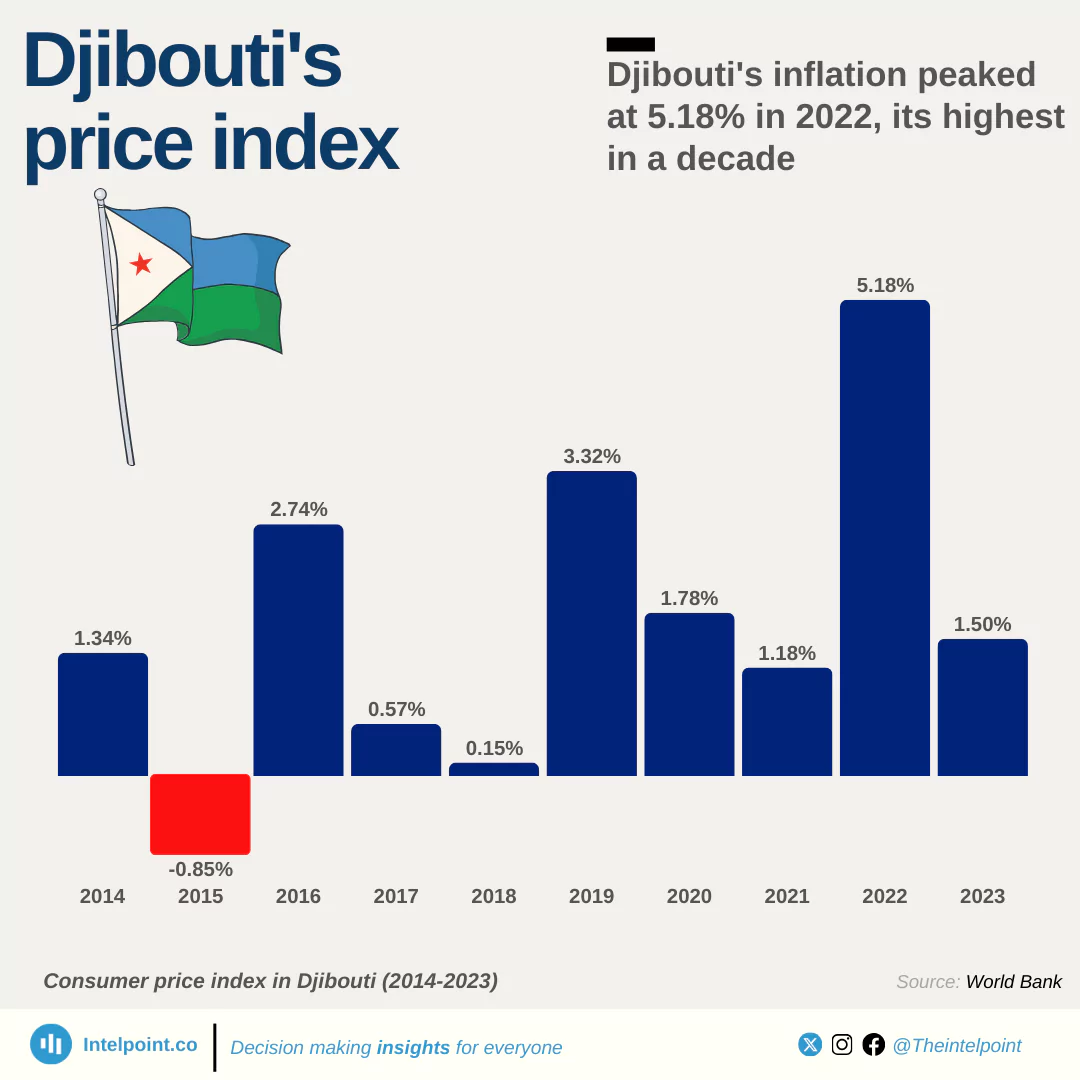
Djibouti's inflation peaked at 5.18% in 2022, its highest in a decade

  • Djibouti’s inflation reached a peak in 2022, with 5.18%, the highest in the past decade.
  • The lowest inflation rate occurred in 2015, with a negative value of -0.85%.
  • From 2014 to 2023, Djibouti experienced fluctuating inflation, with increases in 2016, 2019, and 2022.
  • Between 2022 and 2023, inflation decreased from 5.18% to 1.50%.
  • The year 2018 saw the lowest inflation among positive rates, with a modest 0.15%.
  • The overall trend shows periodic inflation spikes, particularly in 2016, 2019, and 2022, while other years maintained relatively stable or lower inflation.

From the World Bank data, Djibouti’s inflation rate has experienced obvious fluctuations over the past decade, with peaks and troughs. The highest inflation rate during this period occurred in 2022, reaching 5.18%. Conversely, 2015 saw the lowest inflation rate at -0.85%, highlighting a brief period of deflation. The years 2016, 2019, and 2022 were particularly notable for high inflation rates. Despite these fluctuations, other years, including 2014, 2017, 2018, and 2023, had relatively stable inflation, with modest increases or decreases. In 2023, the inflation rate notably dropped to 1.50%, a significant decrease from the 2022 peak.

In summary, the data illustrates that while Djibouti has faced periods of inflationary pressure, particularly in 2019 and 2022, the country has also seen years of lower inflation, contributing to an overall mixed but progressively stable inflation trend in recent years.
Source:

World Bank

Period:

2014-2023
HTML code to embed chart
Want a bespoke report?
Reach out
Tags
Related Insights

South Africa, Egypt and Morocco accounted for nearly 40% ($313b) of Africa’s merchandise imports in 2025
  • Africa imported merchandise worth $788.9 billion in 2025, representing about 3% of global merchandise imports.
  • South Africa was Africa’s largest merchandise importer, with imports valued at $128.1 billion.
  • Egypt ranked second at $97.5 billion, followed by Morocco at $87.4 billion.
  • The three largest importers accounted for $313 billion, or 39.7% of Africa’s total merchandise imports.
  • South Africa alone accounted for about 16.2% of the continental total.
  • The five largest importers, including Algeria and Nigeria, were responsible for $404.6 billion, or 51.3% of Africa’s imports.
  • Nigeria ranked fifth, with merchandise imports valued at $41.5 billion.

Africa has never sold more than 20% of its goods exports within the continent in three decades
  • Only 16.9% of Africa’s merchandise exports were sold to other African countries in 2024.
  • Africa had the second-lowest intra-continental export share, ahead only of Oceania’s 4.8%.
  • Europe recorded the highest share at 65.6%, followed by Asia at 58.4% and the Americas at 54.0%.
  • Europe’s intra-continental export share was nearly four times Africa’s.
  • Africa’s share increased from 12.1% in 1995 to 16.9% in 2024, a rise of 4.8 percentage points.
  • Despite this long-term improvement, Africa remained below its 2015 peak of 18.8%.
  • Africa has not crossed the 20% mark at any point in the three decades covered.

South Africa accounted for nearly $1 in every $6 Africa earned from merchandise exports in 2025
  • Africa’s merchandise exports reached $689.2 billion in 2025.
  • Exports grew by 9.7%, the fastest rate outside Asia.
  • Africa accounted for just 2.6% of global merchandise exports.
  • South Africa led with $116.4 billion, followed by Nigeria and Egypt.
  • The top 15 economies generated 79.3% of Africa’s exports.

Nigeria's trade surplus hit a record ₦21.0tn in 2025 and remained strong in Q1 2026
  • Nigeria recorded a ₦21.03 trillion trade surplus in 2025, the highest in the period shown.
  • The trade surplus remained strong at ₦7.55 trillion in Q1 2026.
  • The latest performance marks a sharp recovery from the deficits recorded in 2020 and 2021.
  • Nigeria’s trade balance moved from near zero in 2023 to large surpluses in 2024 and 2025.

Nigeria's non-oil exports grew faster than oil exports in 2024 and 2025, though oil remained dominant
  • In 2025, non-oil export growth (36%) was 6x higher than oil (6%).
  • In 2024, non-oil exports grew by 189% vs oil’s 108%.
  • Total exports still heavily depend on oil.
  • Export value rose from ₦36 trillion in 2023 to ₦85.1 trillion in 2025.

Nigeria imported 10x more from Asia than from Africa in 2025
  • Asia is Nigeria’s top import source in 2025.
  • The highest import value from Asia was recorded in Q1 at ₦8.7 trillion.
  • Imports from Europe surged to ₦8.6 trillion in Q2 but declined to ₦6.6 trillion by Q4.
  • Imports from America showed continuous growth, rising from ₦2.9 trillion in Q1 to ₦6.6 trillion in Q4.
  • Imports from Africa remained below ₦1 trillion across most quarters.

POPULAR TOPICS
SIGN UP TO OUR NEWSLETTER
Get periodic updates about the African startup space, access to our reports, among others.
Subscribe Here
Subscription Form

A product of Techpoint Africa. All rights reserved