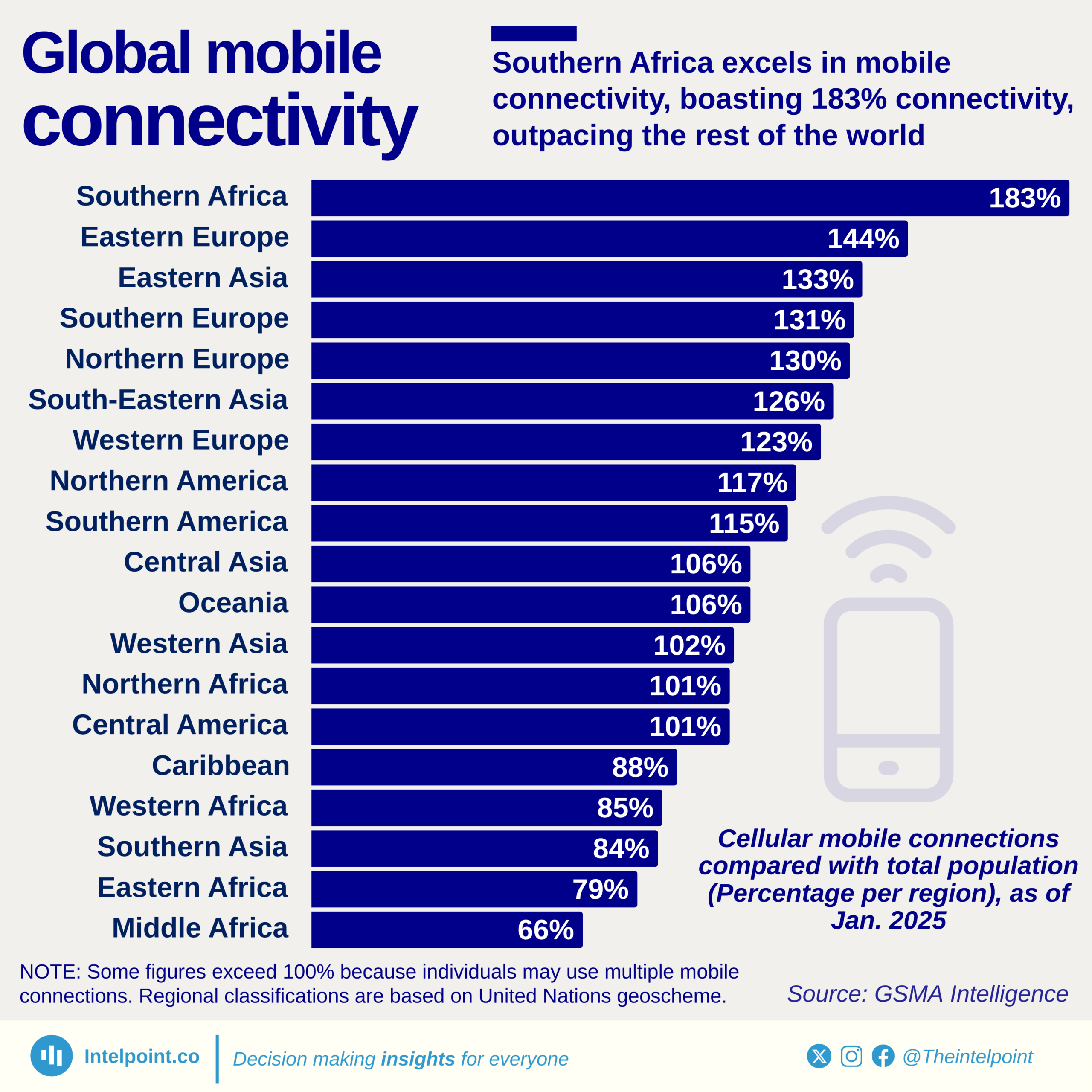
Southern Africa excels in mobile connectivity, boasting 183% connectivity, outpacing the rest of the world

Key takeaways:

  • Southern Africa is the global leader in mobile connectivity, with 183% mobile connections compared to its population, significantly ahead of all other regions.
  • The world’s most connected regions are outside North America and Western Europe, with Eastern Europe (144%), Eastern Asia (133%), and Southern Europe (131%) leading the charge after Southern Africa.
  • Africa is deeply divided in mobile adoption. While Southern Africa dominates, Eastern Africa (79%) and Middle Africa (66%) have a lower penetration.
  • Some regions have more mobile connections than people. The fact that multiple regions exceed 100% connectivity means that many individuals own multiple SIM cards, a trend driven by business needs, mobile money, and telecom competition.
  • Western Africa, at 85% connectivity, is doing better than Eastern Africa but still lags behind the global average, signaling potential for more growth in mobile adoption.

With an astonishing 183% connectivity rate, Southern Africa is the leader in global mobile connectivity, surpassing every other region. This means there are almost two mobile connections per person in Southern Africa, highlighting a massive penetration of mobile technology in the region. The closest contender, Eastern Europe, stands at 144%, followed by Eastern Asia (133%) and Southern Europe (131%).
While Northern Europe, South-Eastern Asia, and North America show strong mobile adoption, Africa remains a continent of two extremes. Eastern Africa (79%) and Middle Africa (66%) lag far behind Southern Africa, showing clear disparities in infrastructure, affordability, and mobile accessibility.
Source:

GSMA Intelligence

Period:

2025
HTML code to embed chart
Want a bespoke report?
Reach out
Tags
Related Insights

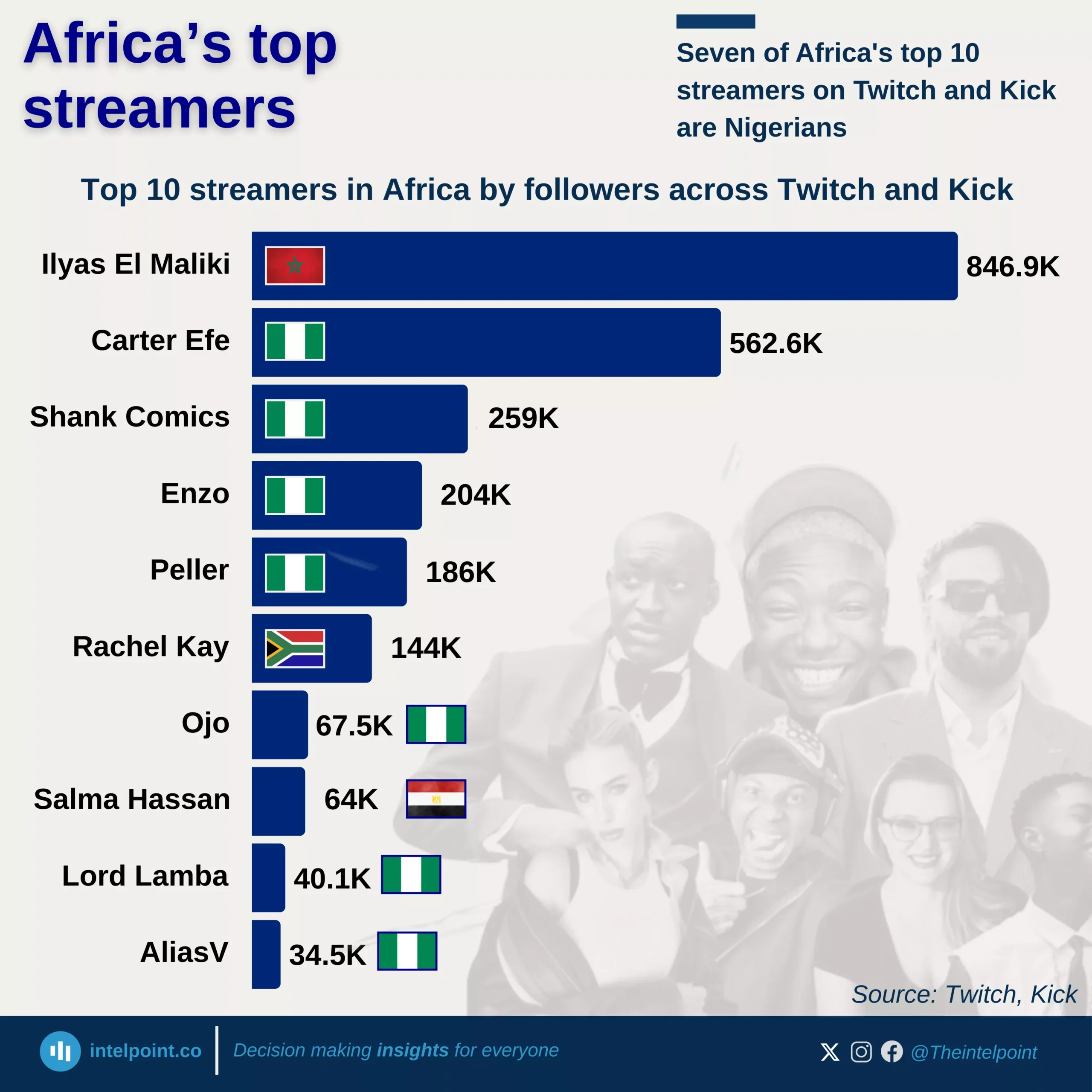
Seven of Africa's top 10 streamers on Twitch and Kick are Nigerians
  • Ilyas El Maliki is Africa’s most followed streamer, with 846,900 followers on Kick.
  • Nigeria dominates the top ten, contributing seven streamers to the list.
  • Nigeria’s top streamers have a combined 1.35 million followers, showing a strong concentration of influence.
  • Follower distribution drops sharply after the top two.
  • Streaming influence in Africa is country-clustered rather than evenly distributed across the continent.
  • Platforms such as Twitch and Kick are enabling African creators to compete globally.

Nathaniel Bassey's livestream crosses one million concurrent viewers, ranking among YouTube’s global top 10 in 2025
  • Nathaniel Bassey Main peaked at 1.02 million concurrent viewers, ranking 6th globally among YouTube’s most-watched livestreams in 2025.
  • Nigeria is one of the few countries to cross the one-million peak viewer mark, alongside major global entertainment creators.
  • Religious livestreams account for multiple top-ranking events, indicating strong real-time engagement beyond music and entertainment.
  • Peak viewership is tightly clustered at the top, with only about 700,000 viewers separating 1st and 10th place.

Pastor Jerry Eze places Nigeria in the global top three YouTube livestreams for 2025, with 105 million watch hours
  • Pastor Jerry Eze ranks 3rd globally, with 105 million hours watched, outperforming most entertainment and music livestream channels.
  • Faith-based livestreaming dominates the top tier, with religious creators accounting for four of the top ten.
  • Nigeria is the only African country represented in the global top ten, signalling a strong international reach.
  • Live spiritual content competes directly with relaxation and music streams, traditionally among YouTube’s most-watched formats.

Flutterwave’s UK arm quadruples turnover since 2021, hitting £6.6 million in 2024
  • Flutterwave UK’s turnover rose from £0.93M in 2021 to £6.61M in 2024, showing consistent expansion.
  • Growth cooled from 311% in 2022 to 21% in 2024, reflecting market maturity.
  • The UK unit’s performance is now tied to Flutterwave’s global surge, with over $31 billion in payments processed in 2024.
  • The focus is shifting from rapid scaling to sustainable growth, compliance, and strengthening cross-border infrastructure.

South Africa leads as Africa’s digitally delivered services exports hit $41.3 billion in 2024, less than 1 percent of the world total
  • Africa exported $41.3 billion in digital services in 2024, less than 1 percent of the world total.
  • South Africa was the continent’s top exporter with $7.05 billion.
  • Morocco ($6.74 billion) and Ghana ($5.18 billion) followed closely.
  • Egypt ($4.03 billion) and Mauritius ($3.53 billion) also ranked among the top five.
  • The top five countries together made up about two-thirds of Africa’s exports.

For every $1 Nigeria earned from exporting digital services between 2005 and 2024, it spent almost $10 on imports
  • Nigeria exported $10.81 billion in digital services between 2005 and 2024.
  • Imports during the same period reached $105.34 billion.
  • The result was a trade deficit of $94.53 billion over 20 years.
  • Exports rose from just $40 million in 2005 to $1.55 billion in 2024.
  • Imports were almost ten times larger than exports, showing a persistent imbalance.

POPULAR TOPICS
SIGN UP TO OUR NEWSLETTER
Get periodic updates about the African startup space, access to our reports, among others.
Subscribe Here
Subscription Form

A product of Techpoint Africa. All rights reserved