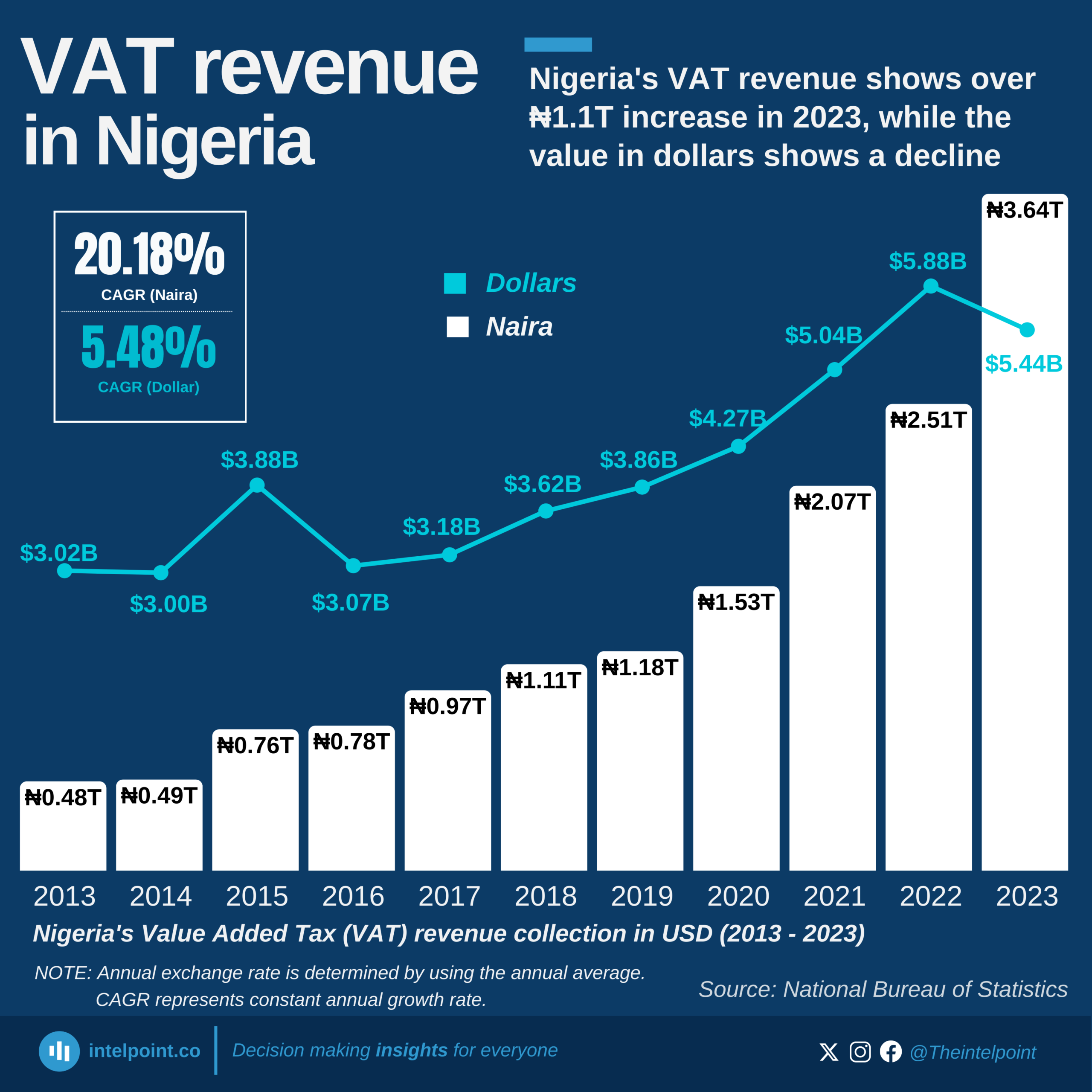
Nigeria's VAT revenue shows over ₦1.1T increase in 2023 while the value in dollars shows a decline

Key takeaways:

  • VAT revenue in naira has consistently grown over the years, hitting an all-time high of ₦3.64 trillion in 2023.
  • The dollar value of VAT revenue declined despite the increase in naira terms, dropping from $5.88 billion in 2022 to $5.44 billion in 2023.
  • Over the last decade, VAT revenue in naira has grown at an impressive CAGR of 20.18%, while its dollar value grew at a much lower 5.48%, showing the impact of currency devaluation.
  • 2023 saw one of the largest year-on-year increases in VAT revenue in naira, but the corresponding drop in dollar value indicates that exchange rate volatility are eroding real revenue gains.
  • Nigeria’s revenue collection efforts are improving, but the decline in dollar value highlights the need for economic stability and currency strength.
  • This trend reflects a broader issue in Nigeria’s economy - higher local earnings do not necessarily translate into increased global purchasing power.
  • With VAT being a major non-oil revenue source, policymakers must focus on stabilizing the exchange rate to maximize the real impact of revenue growth.

Nigeria’s VAT revenue surged to ₦3.64 trillion in 2023, reflecting over ₦1.1 trillion increase from the previous year. However, despite this impressive growth in local currency terms, the dollar value of VAT revenue actually declined, dropping from $5.88 billion in 2022 to $5.44 billion in 2023. This divergence highlights the impact of exchange rate fluctuations on Nigeria’s fiscal earnings.
A steady increase in VAT collection over the past decade signals improved revenue mobilization efforts, but the real purchasing power of these earnings is eroding in the face of currency depreciation. The contrast between the naira and dollar trends exposes the underlying economic reality, growth in nominal figures doesn’t always translate to real gains in global terms.
Source:

National Bureau of Statistics (NBS)

Period:

2013 - 2023
HTML code to embed chart
Want a bespoke report?
Reach out
Tags
Related Insights

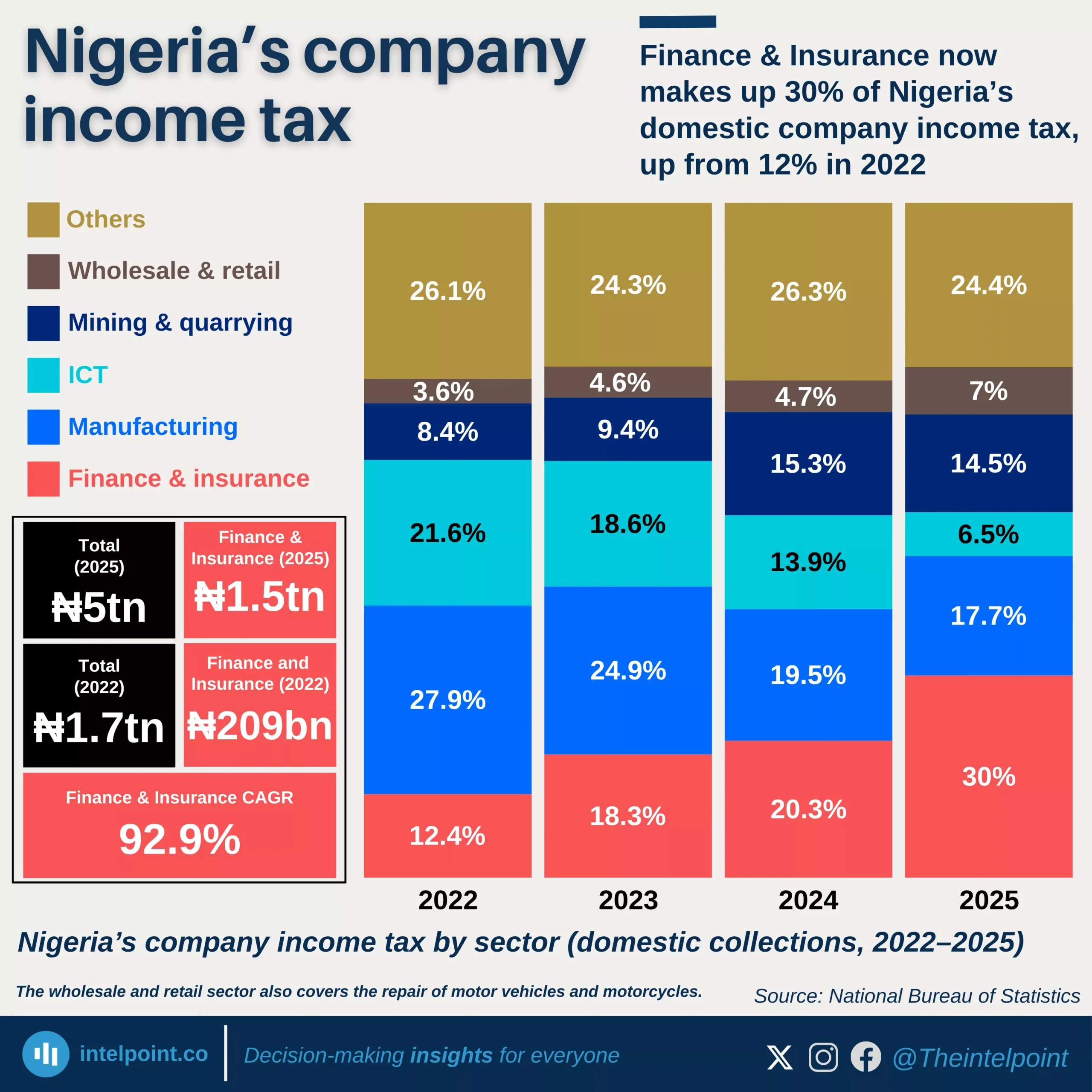
Finance & Insurance now makes up 30% of Nigeria’s domestic company income tax, up from 12% in 2022
  • Company income tax collections rose from ₦1.7tn in 2022 to ₦5.0tn in 2025.
  • Finance & Insurance more than doubled its share, from 12.4% to 30.0%.
  • Finance became the largest single sector in the tax mix by 2025.
  • Manufacturing remained important, but its share fell from 27.9% to 17.7%.
  • ICT saw one of the sharpest declines, from 21.6% to 6.5%.
  • Mining & quarrying gained weight, rising from 8.4% to 14.5%.
  • Wholesale & retail also increased, from 3.6% to 7.0%.
  • The tax base became less evenly distributed across sectors.

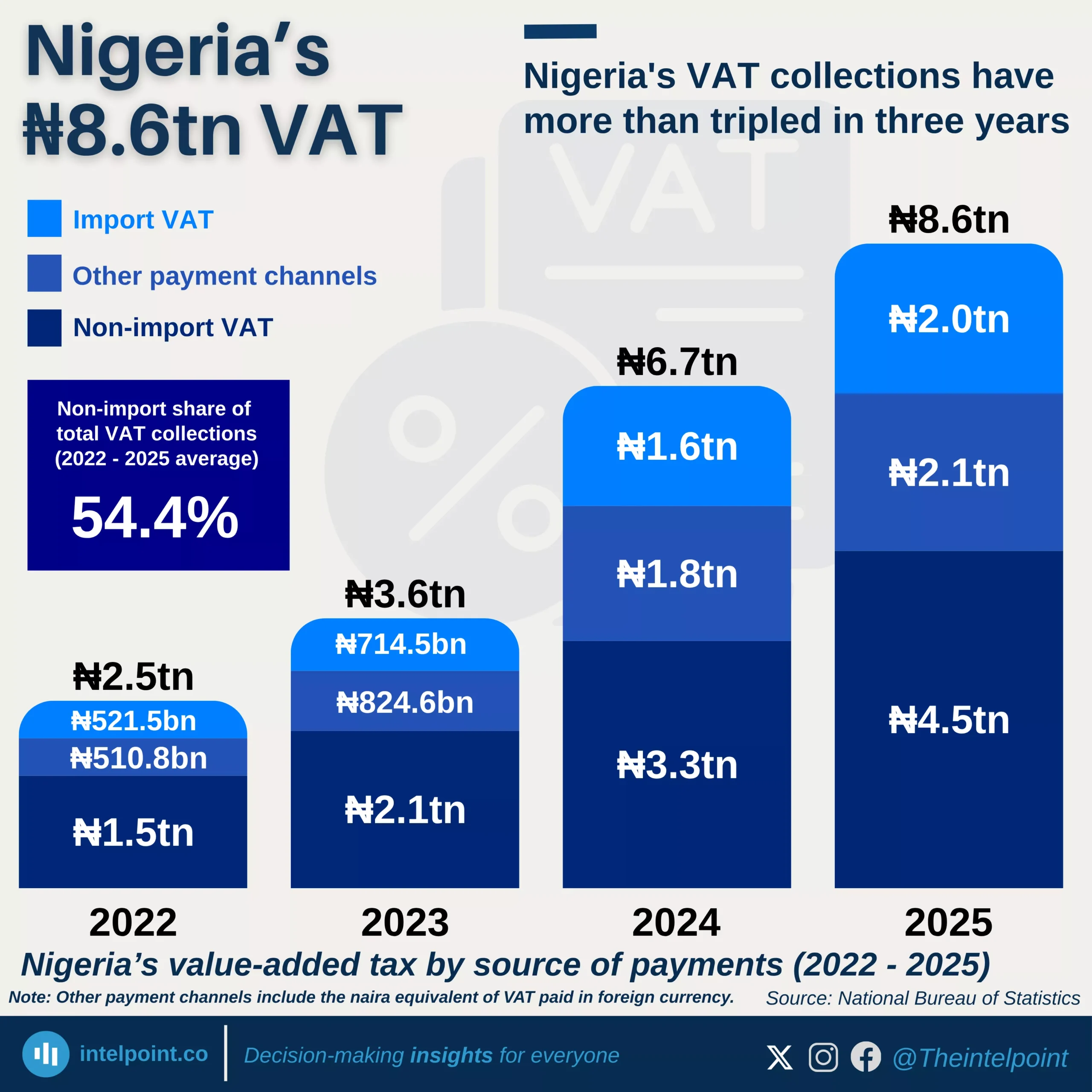
Nigeria's VAT collections have more than tripled in three years
  • Nigeria’s total VAT rose from ₦2.5tn in 2022 to ₦8.6tn in 2025.
  • VAT collections more than tripled in four years.
  • Local VAT remained the largest source of VAT throughout the period.
  • Local VAT increased from ₦1.5tn to ₦4.5tn.
  • Local VAT averaged 54.4% of total VAT between 2022 and 2025.
  • Import VAT also grew strongly, from ₦521.5bn to ₦2.0tn.
  • Other payment channels rose from ₦510.8bn to ₦2.1tn.
  • VAT growth is increasingly being driven by non-import activity.

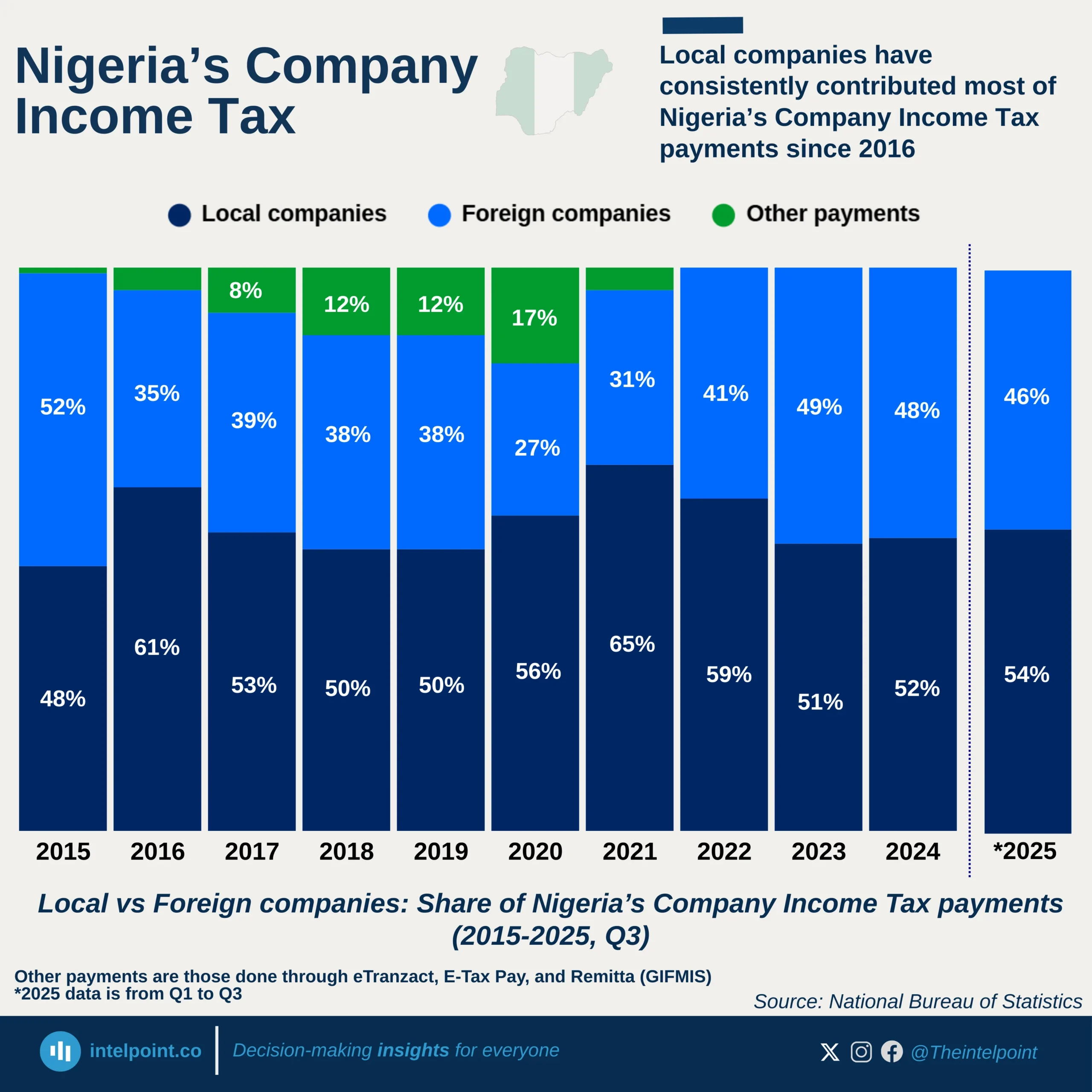
Local companies have consistently contributed most of Nigeria’s Company Income Tax payments since 2016
  • Local companies dominated CIT contributions in most years, accounting for over 50% of payments in 9 of 11 periods between 2015 and 2025 (Q1–Q3).
  • Foreign companies briefly closed the gap in 2023, contributing 49%, the closest they have come to matching local firms.
  • Local companies recorded their strongest share in 2021 at 65%, marking the widest gap between local and foreign contributors.
  • “Other payments” peaked during the pandemic, rising to 17% in 2020 before dropping to 0% from 2022 onward.

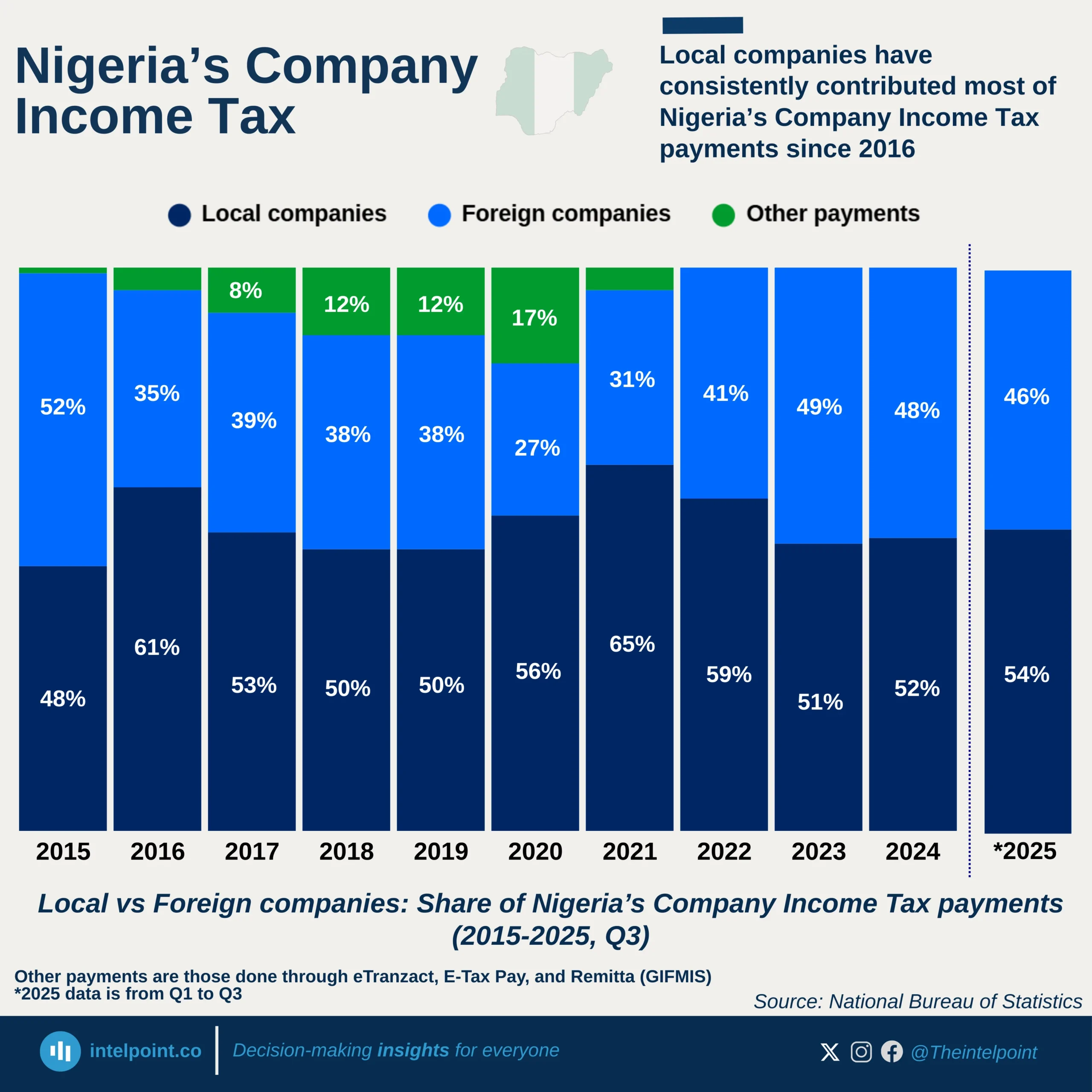
Local companies have consistently contributed most of Nigeria’s Company Income Tax payments since 2016
  • Local companies dominated CIT contributions in most years, accounting for over 50% of payments in 9 of 11 periods between 2015 and 2025 (Q1–Q3).
  • Foreign companies briefly closed the gap in 2023, contributing 49%, the closest they have come to matching local firms.p
  • Local companies recorded their strongest share in 2021 at 65%, marking the widest gap between local and foreign contributors.
  • “Other payments” peaked during the pandemic, rising to 17% in 2020 before dropping to 0% from 2022 onward.

97% of businesses in Kogi are aware of Nigeria's 2025 tax reform, while 99% in Abia are not
  • Kogi entrepreneurs have the highest tax policy awareness in Nigeria (96.8%) in 2025.
  • Abia has the lowest awareness nationwide at just 1.4%.
  • Fewer than one-third of Nigerian states have awareness levels above 60%.
  • Major economic hubs like Lagos and Rivers have awareness below 50%.
  • Northern states dominate the top awareness rankings more than southern states.
  • Several states cluster around the 40–50% range, indicating partial reach.
  • States with low awareness risk lower compliance and higher friction during enforcement.
  • The gap between the highest and lowest states exceeds 95 percentage points, showing extreme disparity.

Nigeria's non-oil tax revenue solidified its dominance over oil in FIRS collections, reaching a record of ₦15.9t in 2024, more than 2.7x the ₦5.8t from oil
  • FIRS recorded ₦15.9 trillion of non-oil tax, almost three times the ₦5.8 trillion recorded for oil tax.
  • Non-oil tax revenue made up 73.3% of the total revenue collected in 2023.
  • From 2012 down to 2024, non-oil tax revenue surpassed oil tax revenue most of the time.
  • Oil taxes are petroleum profit tax and company income (oil & gas) tax while non-profit tax includes company income (non-oil) tax, gas tax, capital gains, stamp duty, NCS import VAT, and non-import VAT.

POPULAR TOPICS
SIGN UP TO OUR NEWSLETTER
Get periodic updates about the African startup space, access to our reports, among others.
Subscribe Here
Subscription Form

A product of Techpoint Africa. All rights reserved