Top 10 Countries With The Most Number of U.S. Military Bases

Key Takeaways

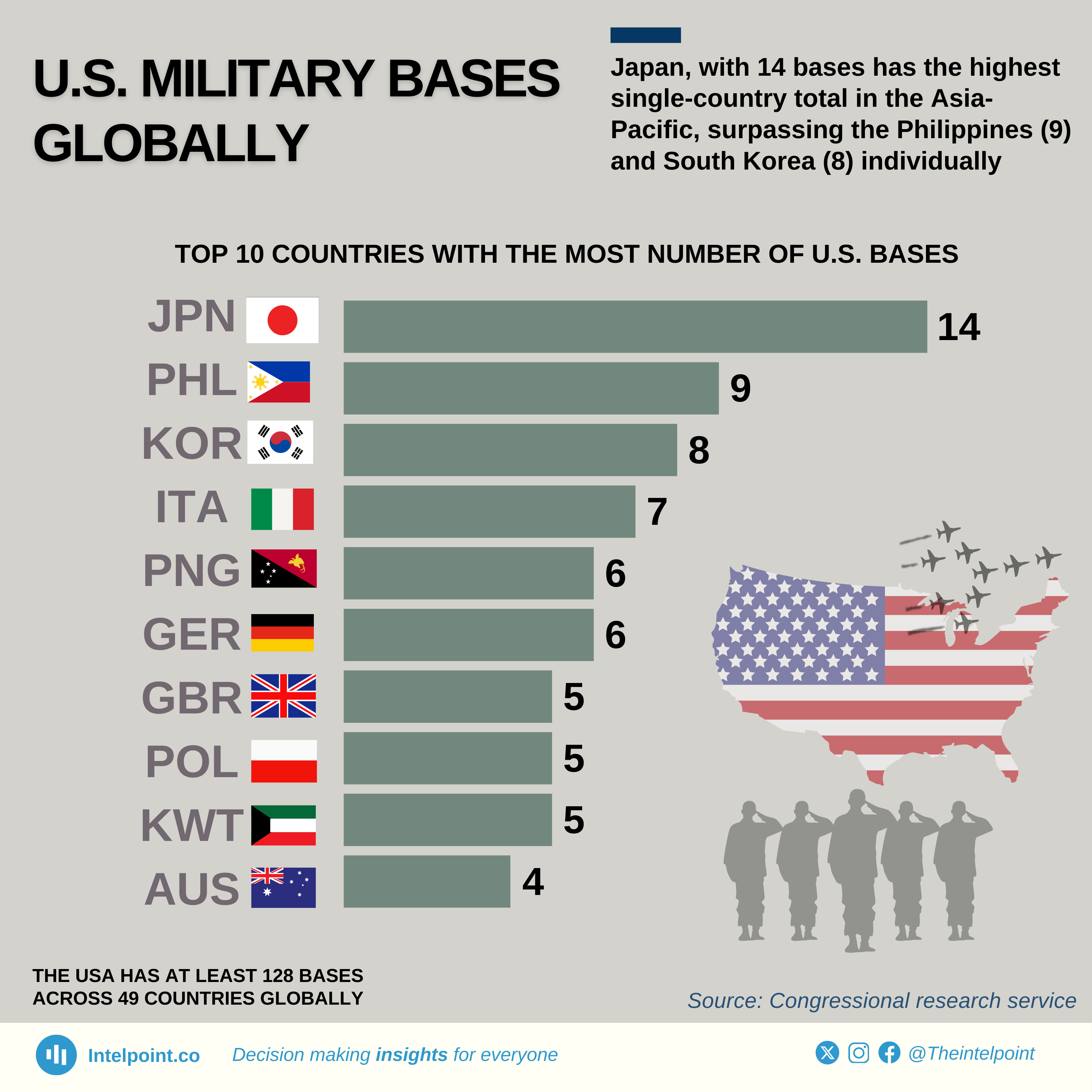
  • Japan leads with 14 bases. It hosts the most U.S. bases globally, exceeding individual counts in the Philippines (9) and South Korea (8).
  • Asia-Pacific Dominance: The region (Japan, Philippines, South Korea, Australia, and Papua New Guinea) accounts for 41 bases, nearly 1/3 of the global total.
  • The Asia-Pacific region hosts 41 U.S. bases, while Europe (Italy, Germany, Poland, UK) has 23. This indicates a growing strategic pivot towards the Pacific compared to traditional European deployments.
  •  Kuwait (5 bases) stands out as the primary hub for U.S. military operations in the Middle East, highlighting its role as a key staging ground for regional security.
  • The top 10 host countries account for 69 of the 128 total bases (over 53%), meaning nearly half of U.S. overseas bases are spread across the remaining 39 countries.

The U.S. maintains 128 bases across 49 countries, with Japan alone hosting 14 — the highest single-nation total. While Japan leads individually, the Philippines (9) and South Korea (8) collectively hold 17 bases in the Asia-Pacific, highlighting the region’s strategic priority.

Europe’s footprint spans Italy (7), Germany (6), and Poland (5), reflecting NATO’s eastern focus, while Kuwait (5) anchors Middle East operations. Emerging deployments in Papua New Guinea (6) highlight Pacific militarisation efforts, contrasting with legacy hubs like Germany.
Source:

Congressional research service

Period:

2024
HTML code to embed chart
Want a bespoke report?
Reach out
Tags
Related Insights

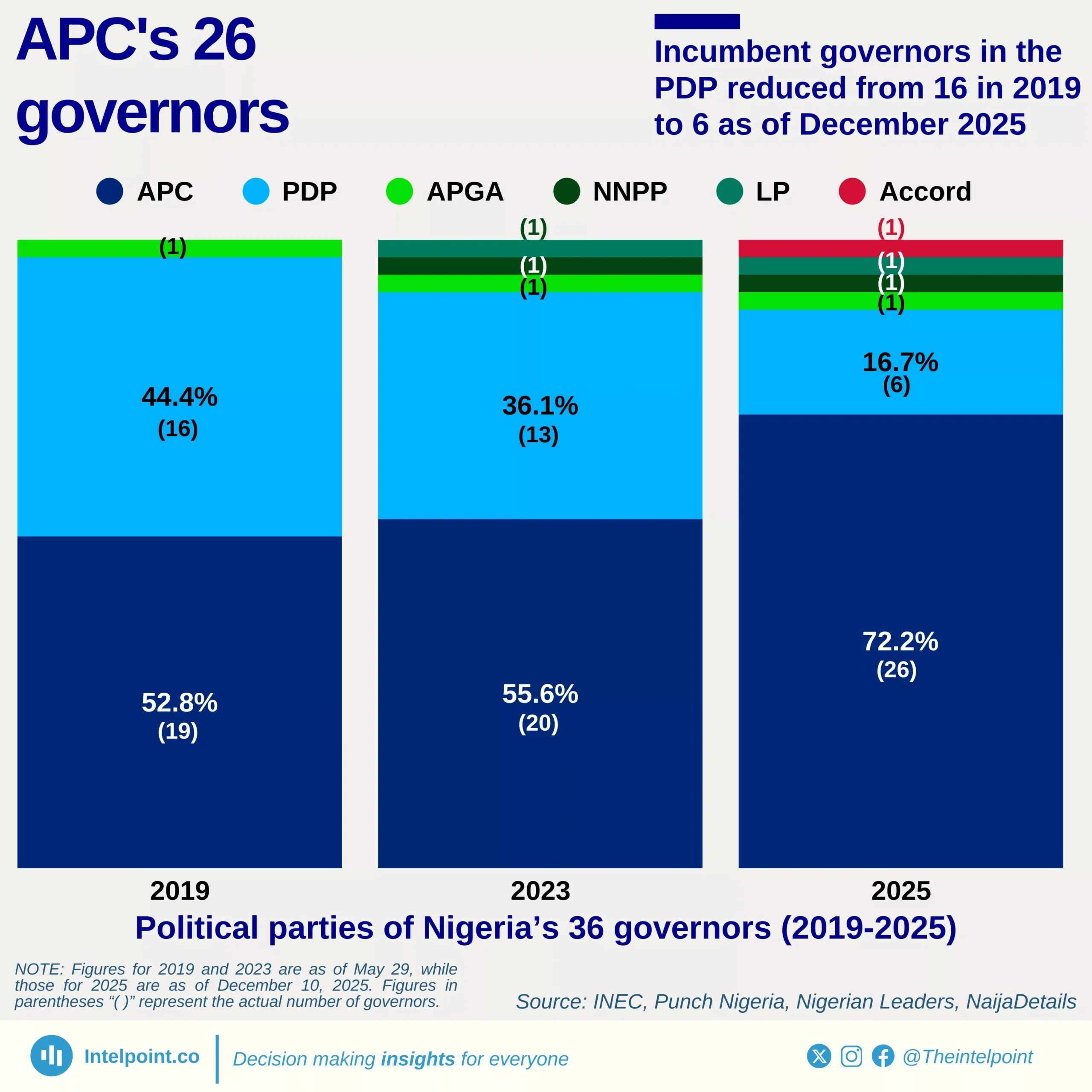
Incumbent governors in the PDP reduced from 16 in 2019 to 6 as of December 2025
  • APC increased its number of sitting governors from 19 in 2019 to 26 in 2025.
  • PDP saw a significant decline, dropping from 16 governors in 2019 to 6 by 2025.
  • APC’s share of governors rose from 52.8% in 2019 to 72.2% in 2025.
  • As of May 2023, after the 2023 general elections, 13 sitting governors were still members of the PDP, but by 2025, five of these governors had defected to the APC, one had defected to
  • Accord, and one lost an election in 2024 to the APC.
  • Smaller parties (APGA, NNPP, LP, and Accord) appeared intermittently, each holding a single governorship.
  • By 2025, Nigeria’s governorship landscape was the most one-sided in recent years, heavily dominated by the APC.

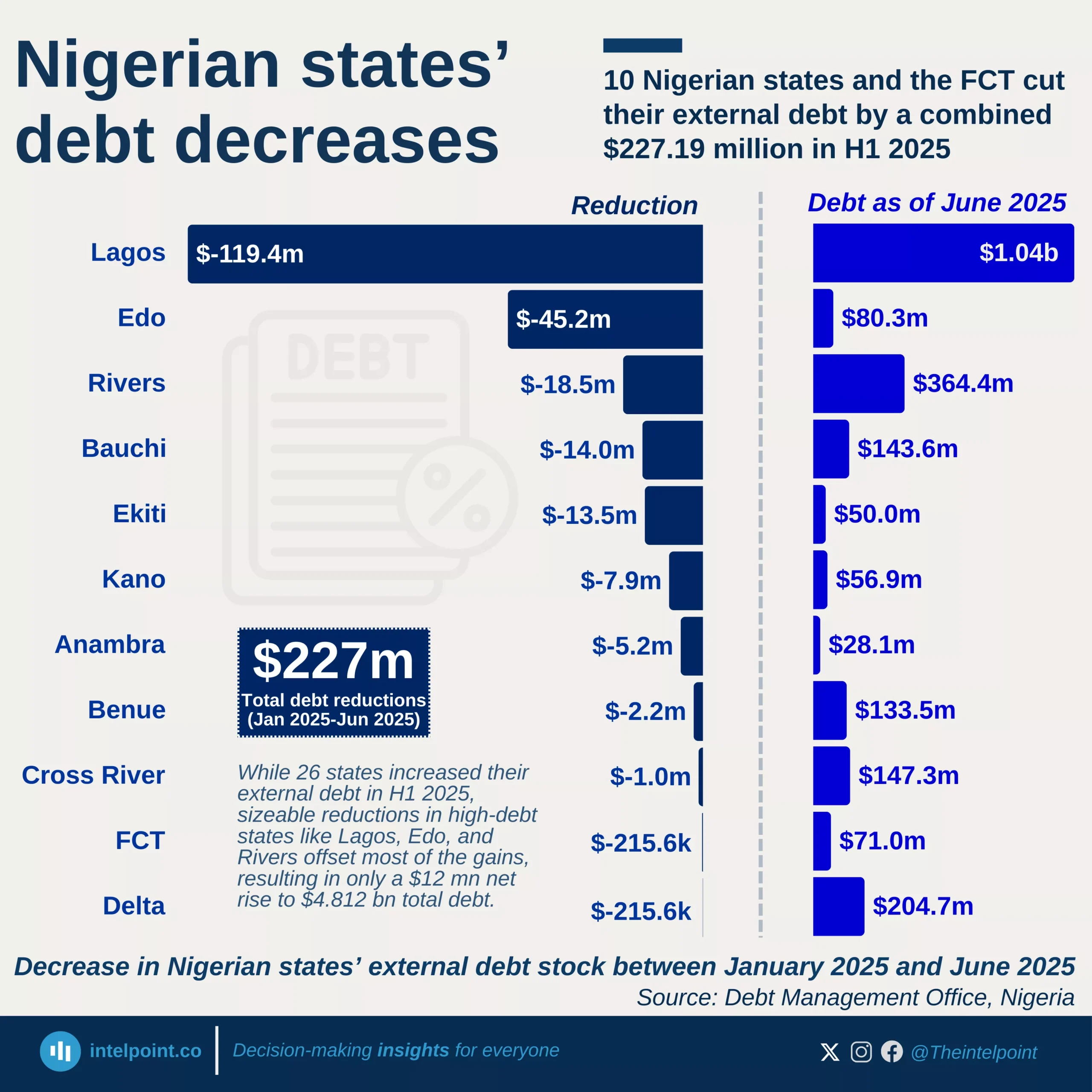
10 Nigerian states and the FCT cut their external debt by a combined $227.19 million in H1 2025
  • Ten states and the FCT collectively reduced their external debt by $227.19 million in H1 2025.
  • Lagos, Edo, and Rivers accounted for most of the reductions, making up more than three-quarters of the total.
  • Several smaller states also trimmed their balances, but by relatively modest amounts.
  • These reductions significantly offset the increases recorded by 26 other states, helping keep nationwide net external debt growth low.

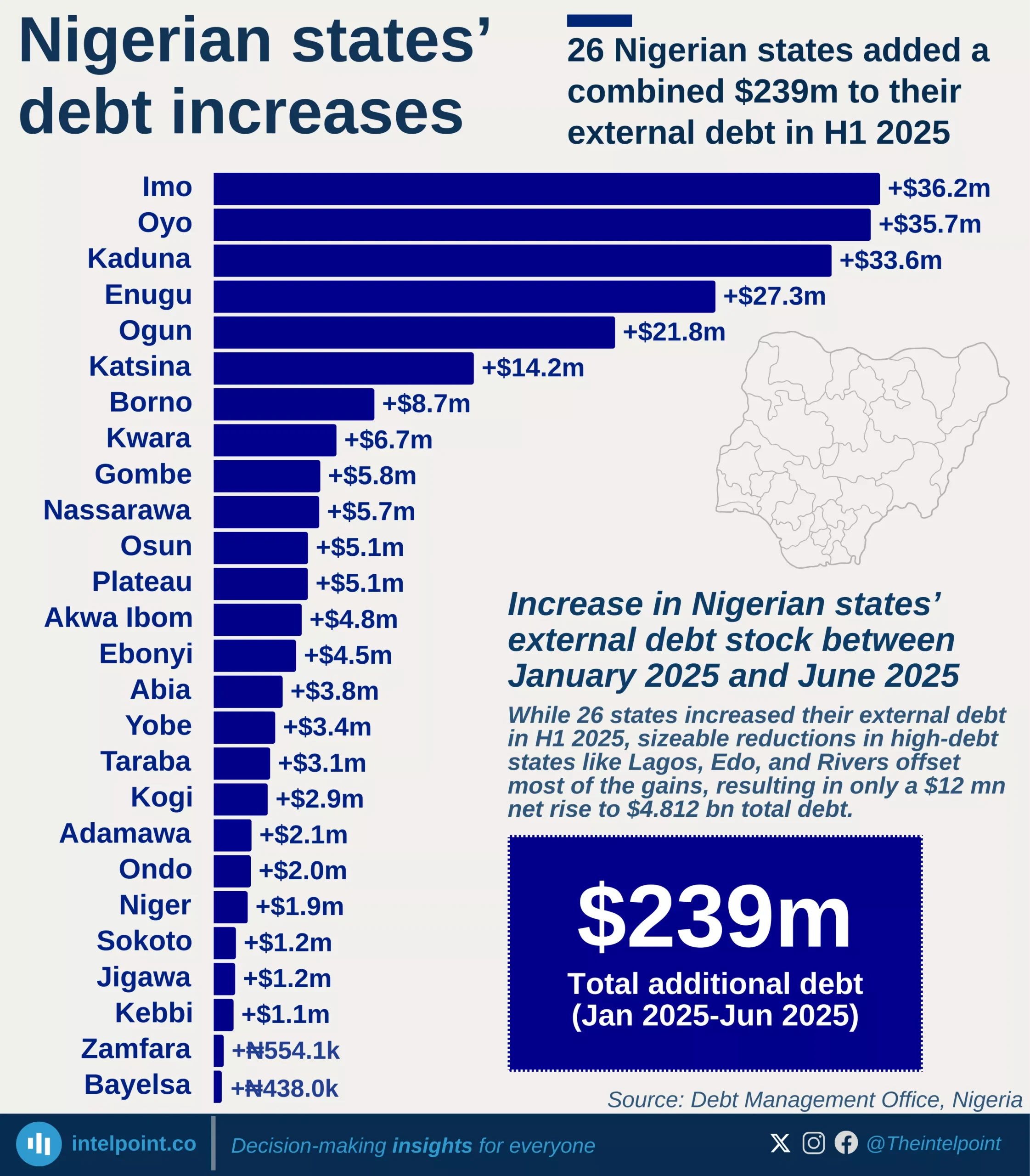
26 Nigerian states added a combined $239m to their external debt in H1 2025
  • 26 states increased their external debt by a combined $239 million in H1 2025.
  • Imo, Oyo, Kaduna, Enugu, and Ogun recorded the biggest increases.
  • 11 states, including the FCT, reduced their debt through higher repayments.
  • Lagos, Edo, Rivers, and Bauchi accounted for most of the $227 million in reductions.
  • Total state external debt rose only slightly, from $4.8 billion to $4.812 billion.

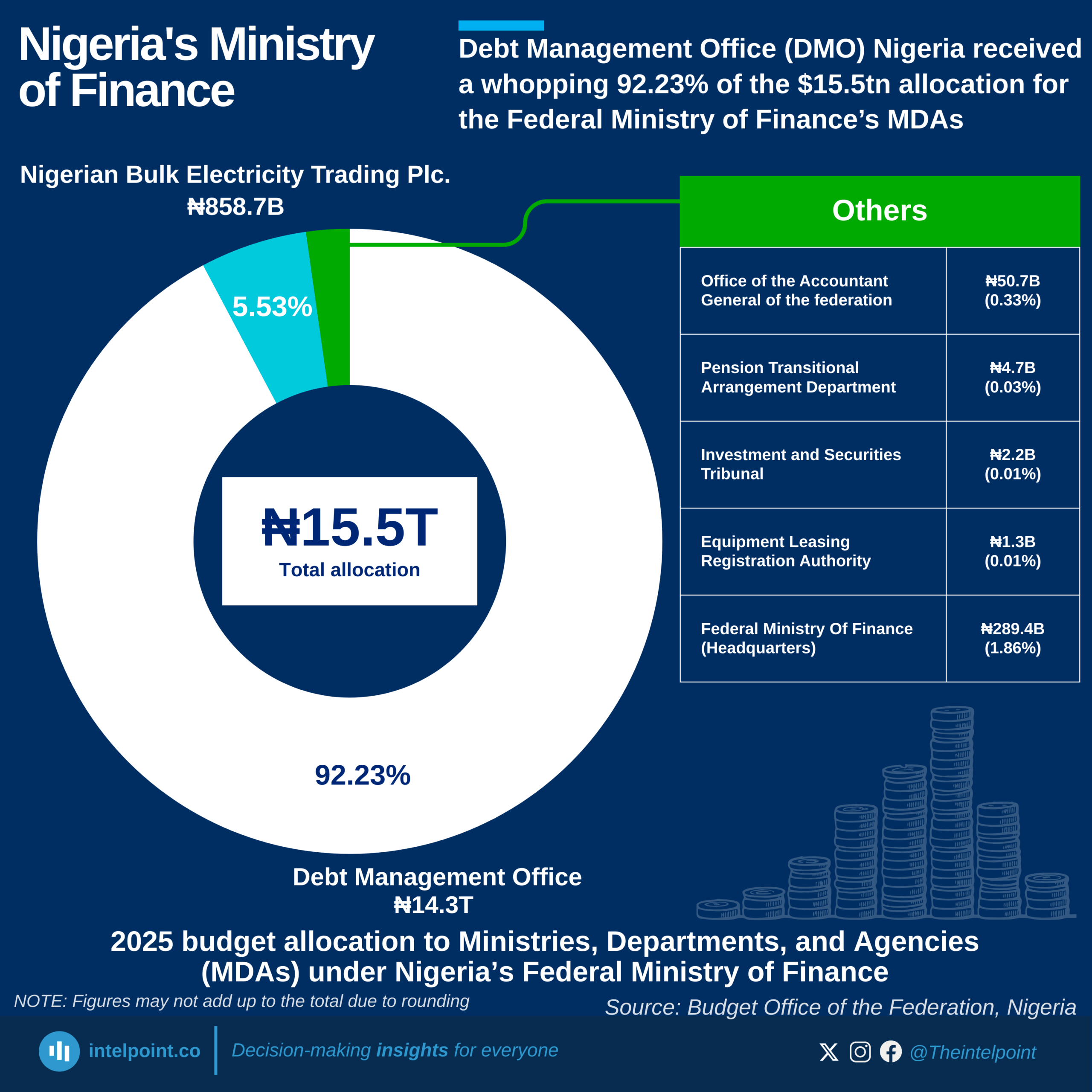
Debt Management Office (DMO) Nigeria received a whopping 92.23% of the $15.5tn allocation for the Federal Ministry of Finance’s MDAs
  • The Debt Management Office (DMO) Nigeria took the lion’s share, with ₦14.3 trillion (92.23%) of the Ministry of Finance's total allocation.
  • The Nigerian Bulk Electricity Trading Plc. received ₦858.7 billion (5.53%), making it the second-highest allocation.
  • The Federal Ministry of Finance (Headquarters) got ₦289.4 billion (1.86%).
  • The Office of the Accountant General of the Federation was allocated ₦50.7 billion (0.33%).
  • The figures reveal how debt servicing priorities overshadow operational and policy-related financial allocations.

From 45% to 2%: How Nigeria lost its global palm oil production share to Asia
  • Indonesia dominated with 46.8M tonnes in 2022, up from 145.7 ktonnes in 1961
  • Malaysia was the second-largest producer in 2022 with 18.5M tonnes
  • Global production has increased from under 2M tonnes (1961) to over 75M tonnes (2022)
  • Thailand, Colombia, and Guatemala have emerged as major producers in recent decades
  • Nigeria was historically significant, but has been overtaken by Asian producers

Over one-fourth of Asia’s forests were in legally established protected areas as of 2024
  • Asia leads globally with 26% of its forests in legally protected areas.
  • The global average stands at 20%, meaning that one-fifth of all forests are under some form of legal protection.
  • Africa and Europe are tied at 23%, both above the global average.
  • South America has only 17% of its forests protected, despite being home to the Amazon rainforest.

POPULAR TOPICS
SIGN UP TO OUR NEWSLETTER
Get periodic updates about the African startup space, access to our reports, among others.
Subscribe Here
Subscription Form

A product of Techpoint Africa. All rights reserved