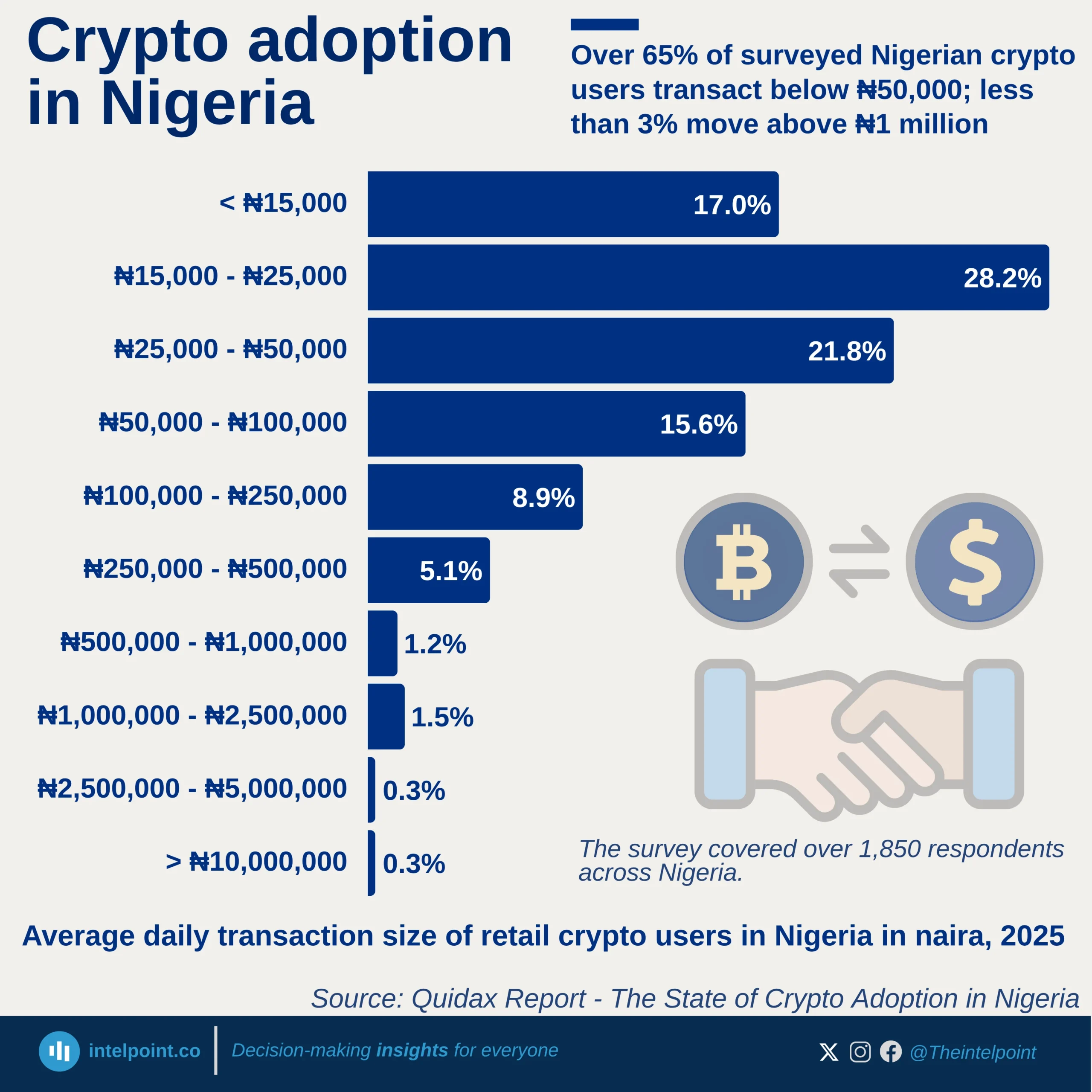
Over 65% of surveyed Nigerian crypto users transact below ₦50,000; less than 3% move above ₦1 million

Key Takeaways

  • Nearly two-thirds (67%) of all crypto transactions in Nigeria are below ₦50,000, reflecting widespread use among everyday retail users.
  • The ₦15,000–₦25,000 band (28.2%) is the single largest group, showing consistent, small-scale engagement rather than high-value speculation.
  • Around 25% of users transact between ₦50,000 and ₦250,000, suggesting a growing middle class of more confident, mid-level investors.
  • Less than 3% of users transact above ₦1 million, confirming that Nigeria’s crypto market remains primarily retail-driven, not institutional or high-net-worth.

Nigeria’s crypto economy beats to the rhythm of everyday users. According to the Quidax 2025 report, most retail participants engage in small, frequent transactions, typically under ₦50,000. This pattern highlights a market characterised by accessibility and grassroots participation rather than large-scale speculation. It reflects how Nigerians are integrating crypto into daily financial habits, topping up, saving, testing markets, and hedging modest sums, rather than making one-off big bets. These micro-transactions form the pulse of the country’s digital economy, illustrating crypto’s role as both a tool for financial inclusion and a gateway to investment literacy.

Source:

Quidax Report - The State of Crypto Adoption in Nigeria

Period:

2025
HTML code to embed chart
Want a bespoke report?
Reach out
Tags
Related Insights

Nigeria’s power grid is 69.9% powered by thermal plants
  • Thermal energy dominates Nigeria’s grid, supplying 69.9% of total power.
  • Hydro plants contribute 30.1%, making them the country’s second major source.
  • The heavy reliance on thermal generation shows Nigeria’s grid is still largely fossil-fuel driven.
  • Hydro remains a crucial but secondary source, supporting overall supply stability.

Nigeria's DisCos recorded ₦360bn revenue gap after collecting ₦1.12tn from ₦1.49tn billed in H1 2025
  • DisCos billed approximately ₦1.49 trillion but collected only ₦1.12 trillion in H1 2025.
  • Ikeja and Eko DisCos generated the highest revenues, collecting ₦206.22 billion and ₦210.59 billion, respectively.
  • Revenue collection gaps remain significant, with Jos, Kaduna, and Yola posting the weakest collection performances.
  • The wide gap between billings and actual collections suggests persistent challenges in customer payment compliance, metering, and distribution efficiency.

Nigeria has installed 3.65 million electricity metres since 2019; Ikeja DisCo leads with 823,000, and Aba Power at the bottom with 56,000
  • Approximately 3.65 million metres have been installed nationwide across all frameworks since 2019.
  • Ikeja DisCo leads by a wide margin with 823,000 installations, over twice the volume of most other DisCos.
  • Kaduna, Yola, and Aba Power recorded the lowest metre installations, each below 100,000.
  • The disparities in installation totals reveal uneven progress in achieving nationwide metering coverage.

More than 8 in 10 electricity customers of Ikeja and Eko DisCos are now metered
  • Ikeja (84.6%) and Eko (83.3%) lead Nigeria’s metering performance, keeping unmetered customers below 17%.
  • Eight out of the twelve DisCos have metering rates below 60%, showing a wide sector imbalance.
  • The worst-performing DisCos — Yola, Jos, Kaduna, and Kano — have over 65% unmetered customers.
  • Regional disparities are sharp: Lagos and Abuja outperform northern and south-eastern DisCos by large margins.

Stablecoins are the most frequently transacted asset for outbound payments among Nigerian users (38.3%), outpacing bitcoin (27.3%)
  • Stablecoins lead the market, accounting for 38.3% of all crypto sent, highlighting Nigerians’ preference for stability and dollar-backed assets.
  • Bitcoin ranks second at 27.3%, showing it remains a major channel for store-of-value transfers and remittances.
  • Altcoins like SOL, ADA, SHIB, and DOGE (15.4%) attract younger and experimental users but remain secondary to stable assets.
  • Ethereum (10.2%) and BNB (8.9%) maintain moderate transaction volumes, suggesting users favor low-fee and widely accepted tokens for transfers.

Over 40% of surveyed Nigerian crypto users are students
  • Students are the largest crypto-holding group (43.6%), underscoring the youthful nature of Nigeria’s crypto community and their early adoption of digital finance.
  • Entrepreneurs follow closely (25.7%), showing strong participation from self-employed Nigerians, traders, business owners, and hustlers who use crypto for investment and business flexibility.
  • Traditional employees make up 17.4%, indicating growing acceptance of crypto beyond informal or youth circles, even among salary earners.
  • Freelancers and gig workers (5.6%) also feature, reflecting crypto’s role in global online work and cross-border earnings. Unemployed and retired individuals remain a small minority, under 3.5% combined.

POPULAR TOPICS
SIGN UP TO OUR NEWSLETTER
Get periodic updates about the African startup space, access to our reports, among others.
Subscribe Here
Subscription Form

A product of Techpoint Africa. All rights reserved