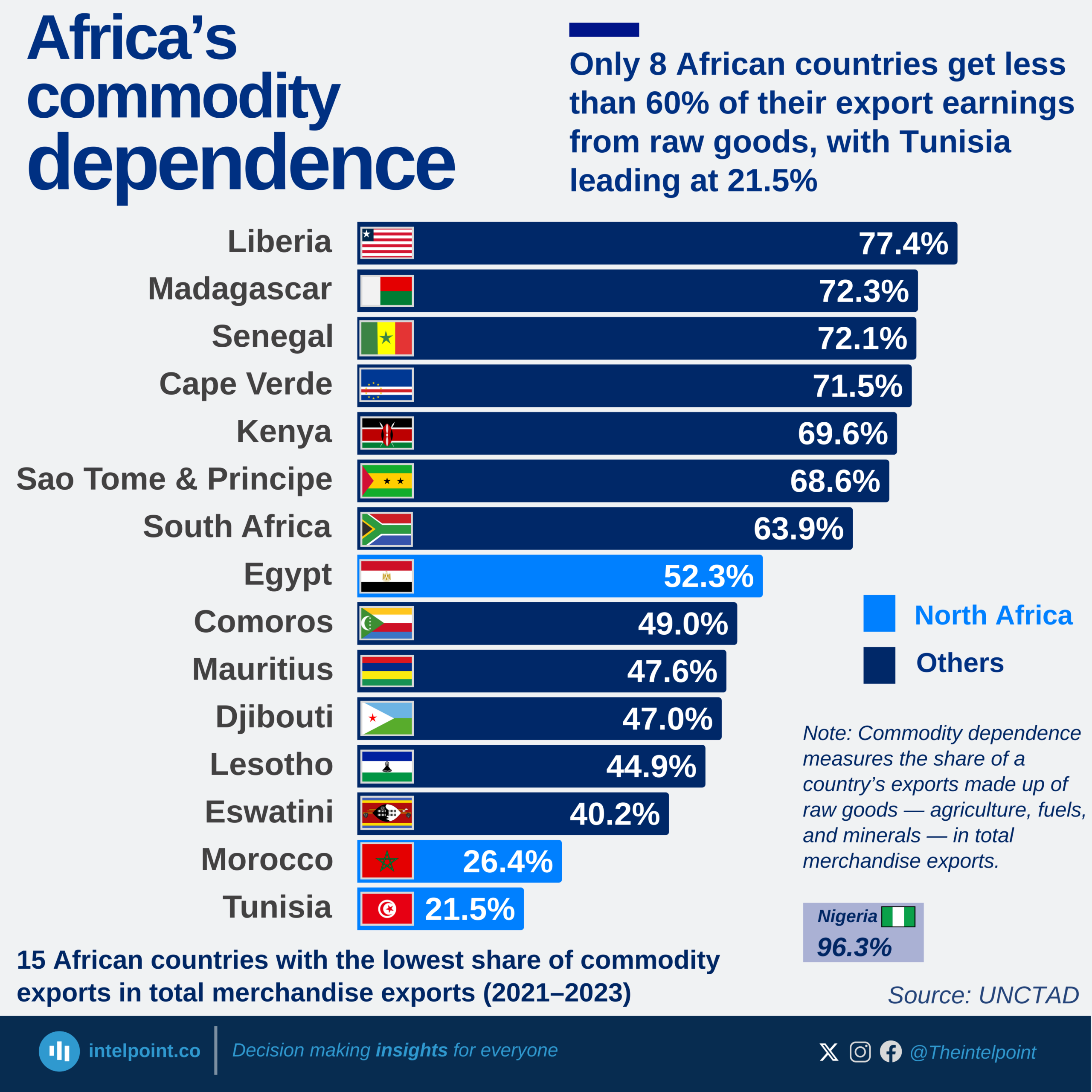
Only 8 African countries get less than 60% of their export earnings from raw goods, with Tunisia leading at 21.5%

  • Of the 54 African countries, 46 earn more than 60% of export revenues from raw goods.
  • Algeria, Morocco, Eswatini, Lesotho, Djibouti, Mauritius, Comoros, and Egypt stand out with less than 60%.
  • Algeria and Morocco are the least dependent, pointing to stronger industrial and trade sectors.
  • Lower dependence means greater economic stability, while high reliance exposes countries to volatile global commodity markets.

Across Africa, most economies remain heavily tied to raw goods — oil, minerals, and agricultural products — for the bulk of their export revenues. UNCTAD data for 2021–2023 shows that out of 54 countries, only eight managed to keep their dependence below 60%.

These eight are Tunisia, Morocco, Eswatini, Lesotho, Djibouti, Mauritius, Comoros, and Egypt. Their relatively low reliance reflects stronger export diversification, often in manufacturing, services, or re-exports. For instance, North African economies like Tunisia and Morocco benefit from industrial output and trade logistics, while Mauritius and Djibouti rely on services and re-export hubs.

Countries with less dependence on raw goods tend to be less vulnerable to global commodity price swings, giving them more stable revenue bases and resilience in downturns. For much of Africa, however, the dominance of commodities leaves economies exposed, underlining the urgent need for structural diversification.
Source:

UN Trade and Development (UNCTAD)

Period:

2021-2023
HTML code to embed chart
Want a bespoke report?
Reach out
Tags
Related Insights

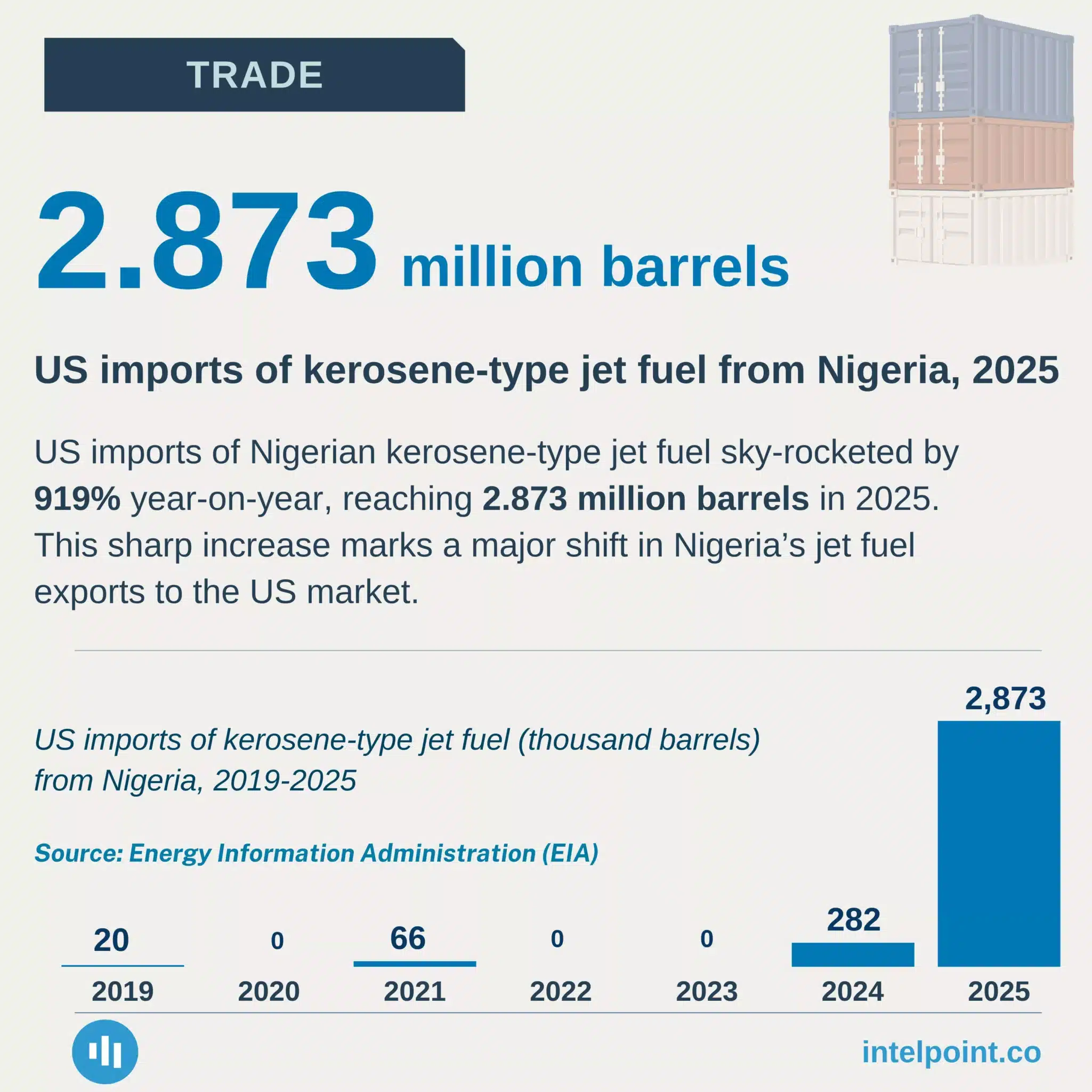
US imports of Nigerian kerosene-type jet fuel sky-rocketed by 919% year-on-year
  • Nigerian jet fuel exports to the U.S. jumped 10-fold to 2.87 million barrels in 2025.
  • Just 86,000 barrels were imported across the U.S. from Nigeria between 1993 and 2023.
  • The 2025 surge was concentrated in five months, amid East Coast refinery disruptions.
  • No Nigerian jet fuel imports were recorded through August 2026, suggesting the surge was temporary.

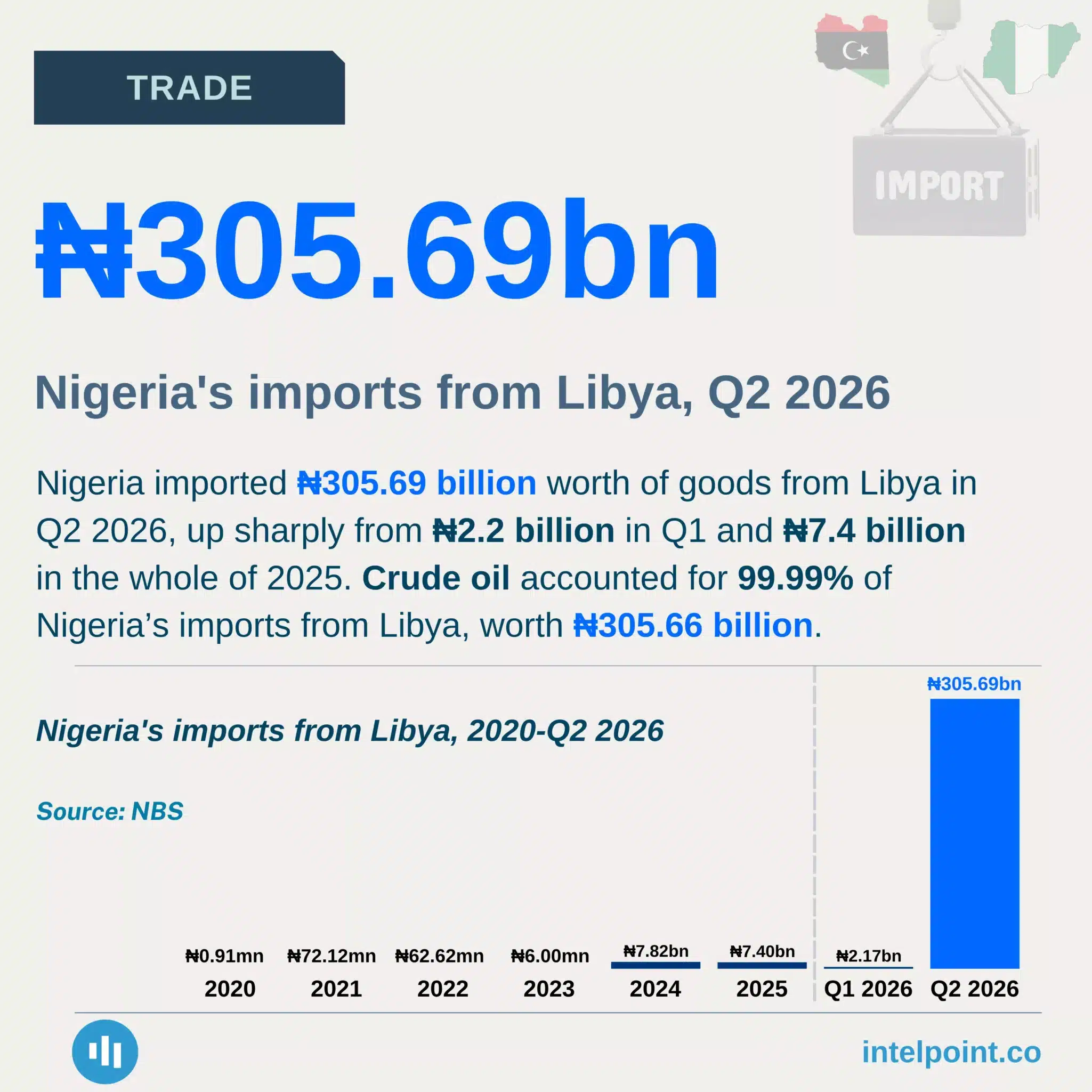
Nigeria bought ₦305.66 billion worth of crude oil from Libya in Q2 2026
  • Nigeria imported ₦305.69bn from Libya in Q2 2026, up from ₦2.17bn in Q1.
  • Crude oil accounted for 99.99% of Q2 imports, worth ₦305.66bn.
  • Libya’s Q2 exports to Nigeria surged from ₦7.4bn in 2025 to ₦305.69bn.
  • Libya became Nigeria’s ninth-largest import source, accounting for 2.12% of total imports in Q2.
  • Nigeria’s imports from Libya were previously dominated by much smaller values, with crude oil driving the sharp 2026 increase.

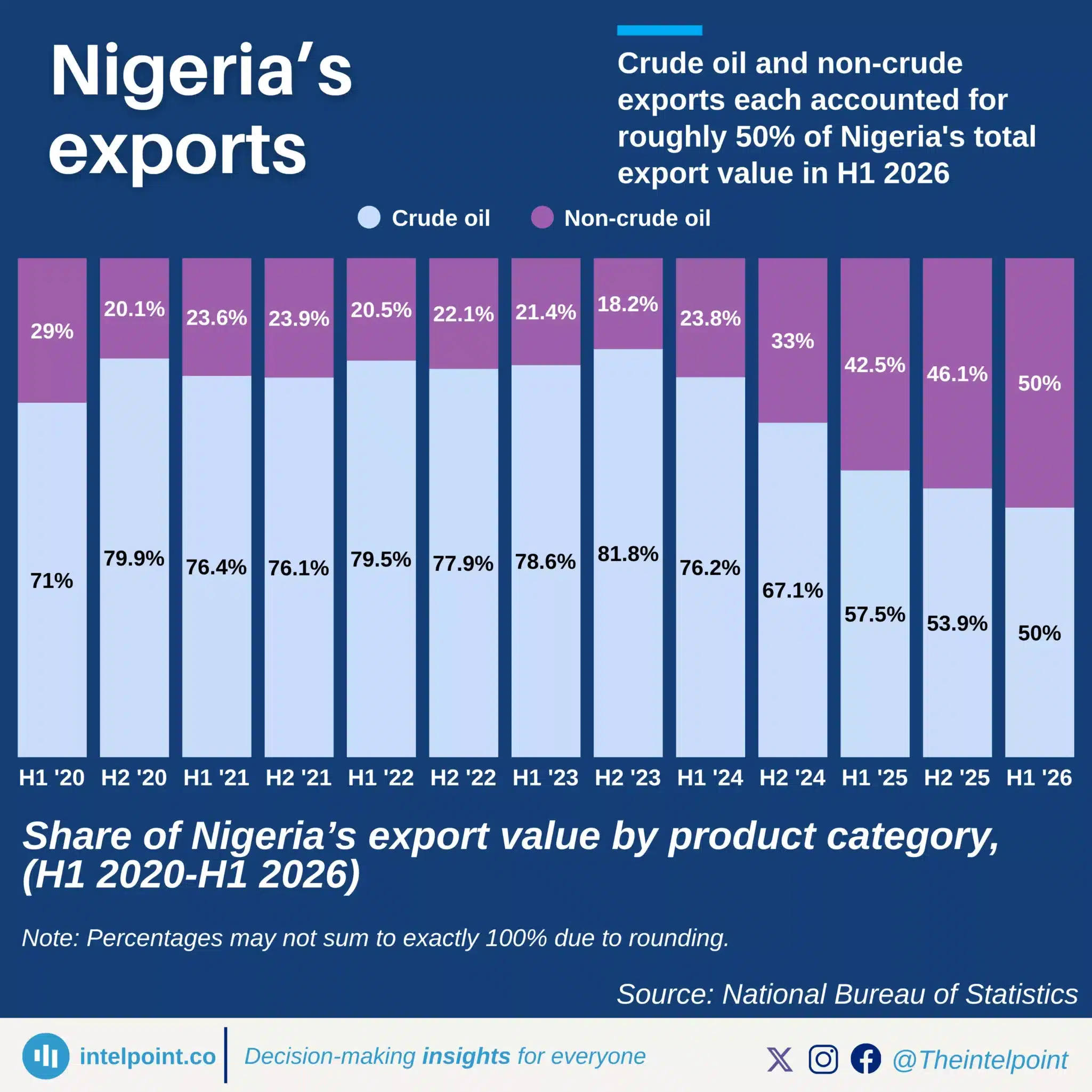
Crude oil and non-crude exports each accounted for roughly 50% of Nigeria's total export value in H1 2026
  • Nigeria’s crude and non-crude exports were nearly equal in H1 2026, at ₦24.1tn and ₦24tn, respectively.
  • Non-crude exports overtook crude in Q2 for the first time in at least six years, reaching ₦14.11tn.
  • Petroleum products and natural gas dominate non-crude exports, while non-oil exports accounted for just 13.8% of Q2 exports.
  • Nigeria’s export mix is shifting, but remains heavily dependent on hydrocarbons.

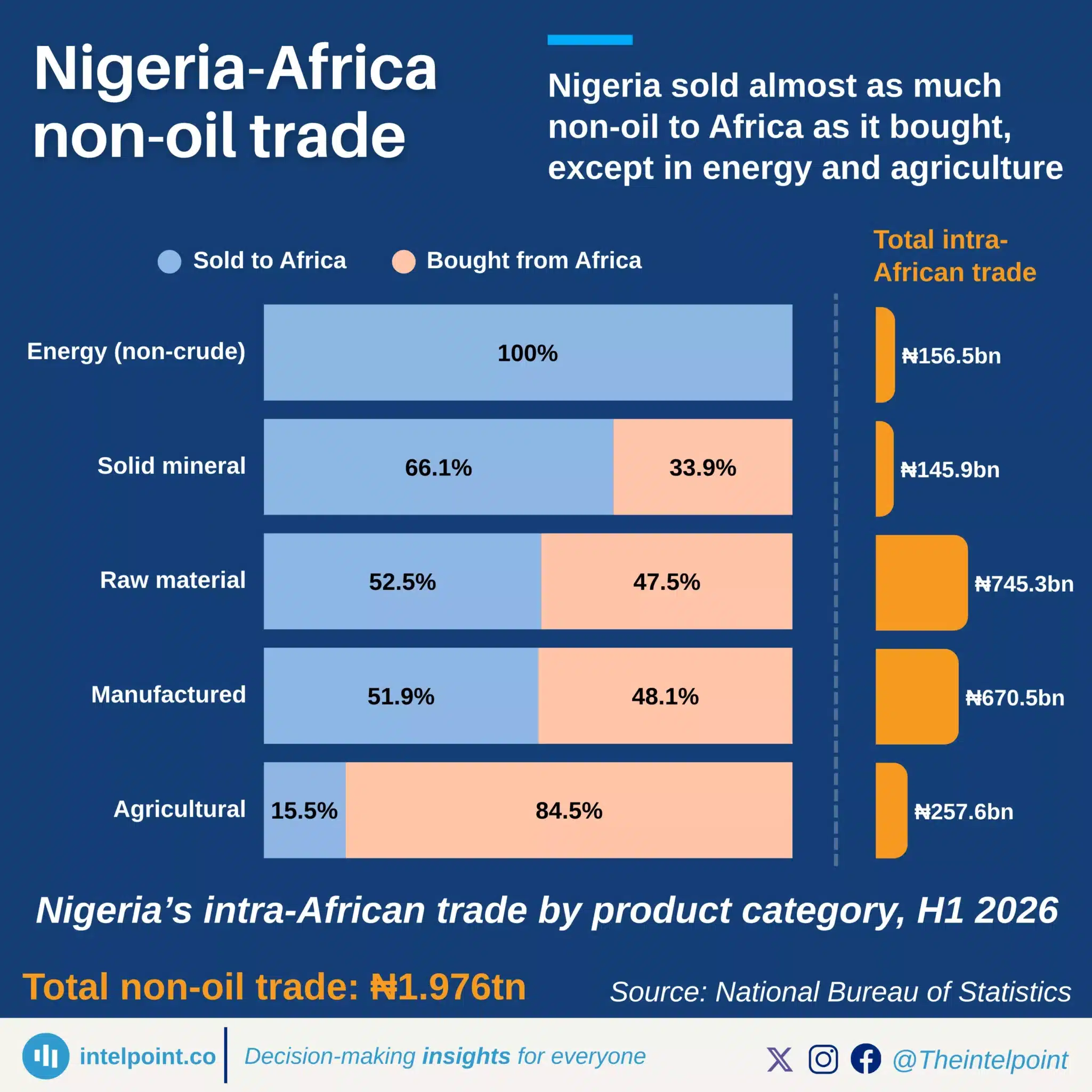
Nigeria sold almost as much non-oil to Africa as it bought, except in energy and agriculture
  • Nigeria’s non-oil trade with Africa was nearly balanced, with an ₦88bn surplus on almost ₦2tn of trade in H1 2026.
  • Energy trade was entirely export-led, with Nigeria selling ₦156.5bn and recording no imports.
  • Solid minerals also leaned towards exports, with sales making up 66.1% of category trade.
  • Agriculture ran a large deficit, as imports accounted for 84.5% of trade and exceeded exports by ₦178bn.
  • Nigeria’s agricultural trade deficit widened sharply, from ₦59bn in Q1 to ₦119bn in Q2.

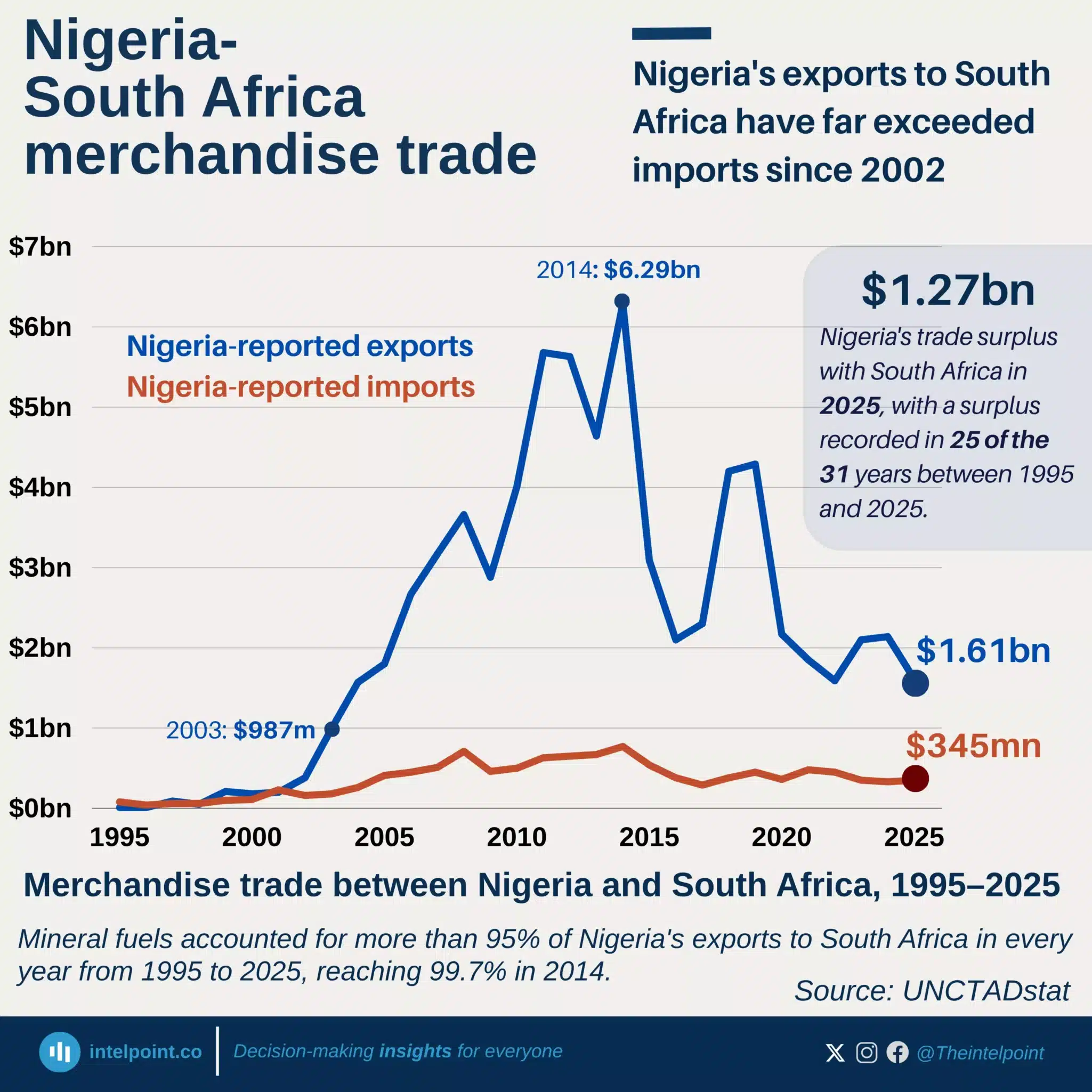
Nigeria's exports to South Africa have far exceeded imports since 2002
  • Nigeria has exported more to South Africa than it has imported every year since 2002.
  • Exports peaked at $6.29 billion in 2014, driven almost entirely by mineral fuels.
  • Imports from South Africa have remained below $1 billion annually.
  • Nigeria recorded a $1.27 billion trade surplus with South Africa in 2025.
  • Mineral fuels made up over 95% of Nigeria's exports throughout 1995-2025.

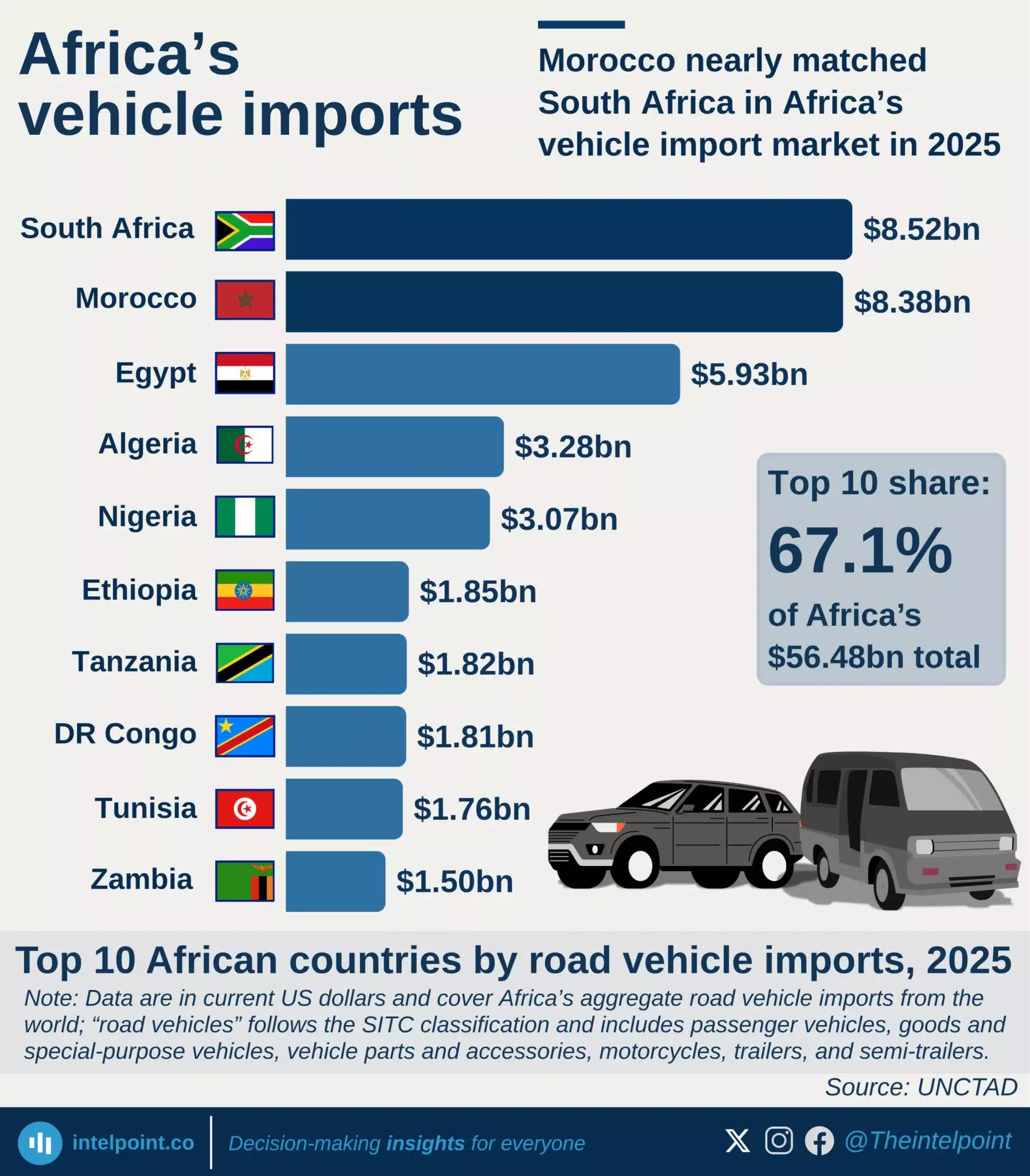
Morocco nearly matched South Africa in Africa’s vehicle import market in 2025
  • South Africa led with $8.52 billion, only $140 million ahead of Morocco.
  • Morocco’s imports have grown steadily, while South Africa’s 2025 figure was a recovery toward its 2012 peak.
  • Egypt ranked third, followed by Algeria and Nigeria.
  • The top 10 markets accounted for 67.1% of Africa’s $56.48 billion total.
  • Road vehicle imports include vehicles, parts, motorcycles, trailers, and semi-trailers.

POPULAR TOPICS
SIGN UP TO OUR NEWSLETTER
Get periodic updates about the African startup space, access to our reports, among others.
Subscribe Here
Subscription Form

A product of Techpoint Africa. All rights reserved