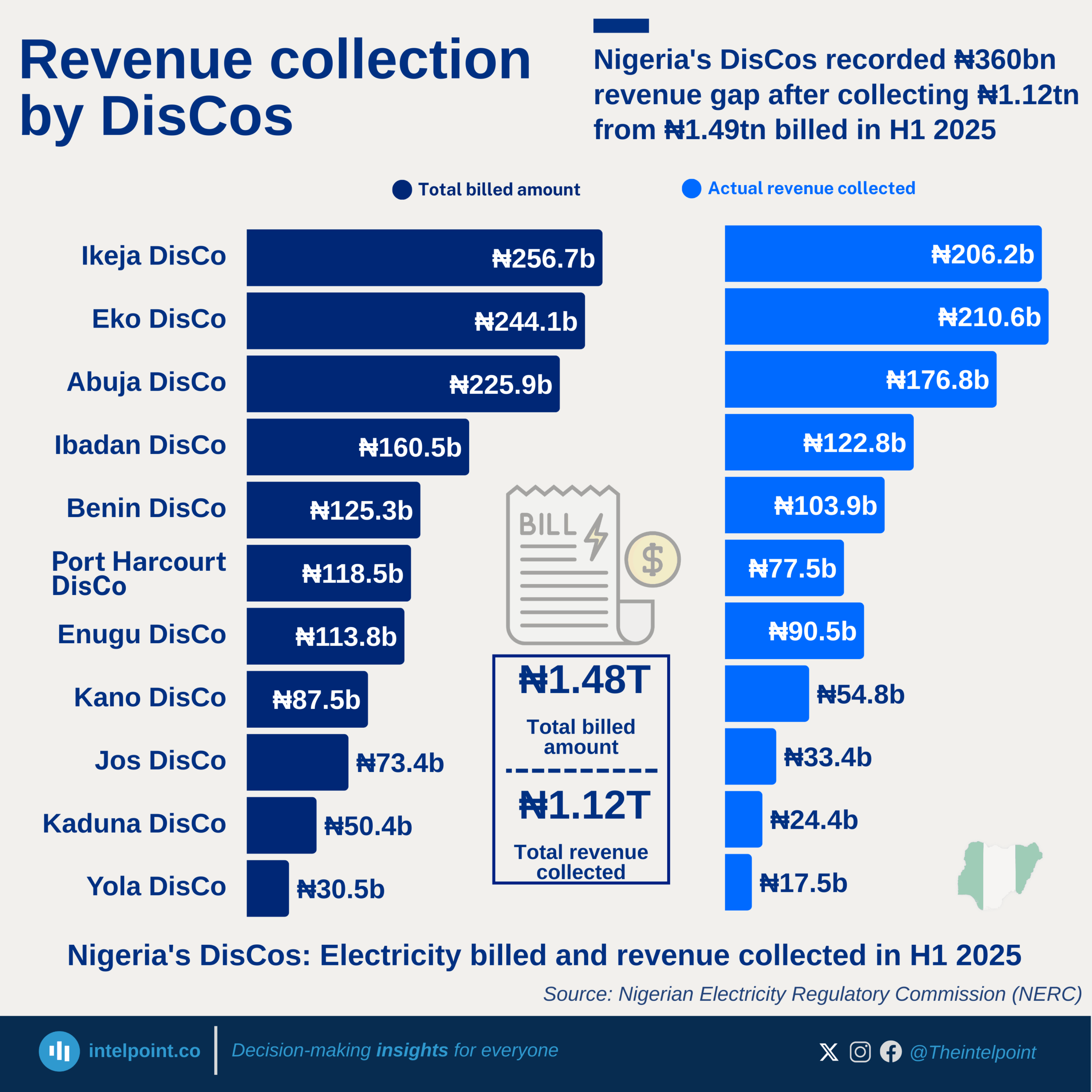
Nigeria's DisCos recorded ₦360bn revenue gap after collecting ₦1.12tn from ₦1.49tn billed in H1 2025

Key Takeaways

  • DisCos billed approximately ₦1.49 trillion but collected only ₦1.12 trillion in H1 2025.
  • Ikeja and Eko DisCos generated the highest revenues, collecting ₦206.22 billion and ₦210.59 billion, respectively.
  • Revenue collection gaps remain significant, with Jos, Kaduna, and Yola posting the weakest collection performances.
  • The wide gap between billings and actual collections suggests persistent challenges in customer payment compliance, metering, and distribution efficiency.

Data from the Nigerian Electricity Regulatory Commission (NERC) shows that in H1 2025, Nigeria’s DisCos billed customers approximately ₦1.49 trillion but recovered ₦1.12 trillion, leaving a sizable ₦360 billion gap.

This indicates ongoing revenue leakages driven by low collection efficiency, weak metering coverage, and customer underpayment. While some DisCos maintain relatively strong performance, revenue recovery remains uneven across the sector.

Ikeja and Eko remain the strongest performers, each collecting over ₦200 billion in the first half of the year. Abuja and Ibadan follow, though with significantly lower collection totals. At the lower end, Jos, Kaduna, and Yola collected far below their billed amounts, reflecting deeper structural issues.
Source:

Nigeria Electricity Regulatory Commission (NERC)

Period:

H1 2025
HTML code to embed chart
Want a bespoke report?
Reach out
Tags
Related Insights

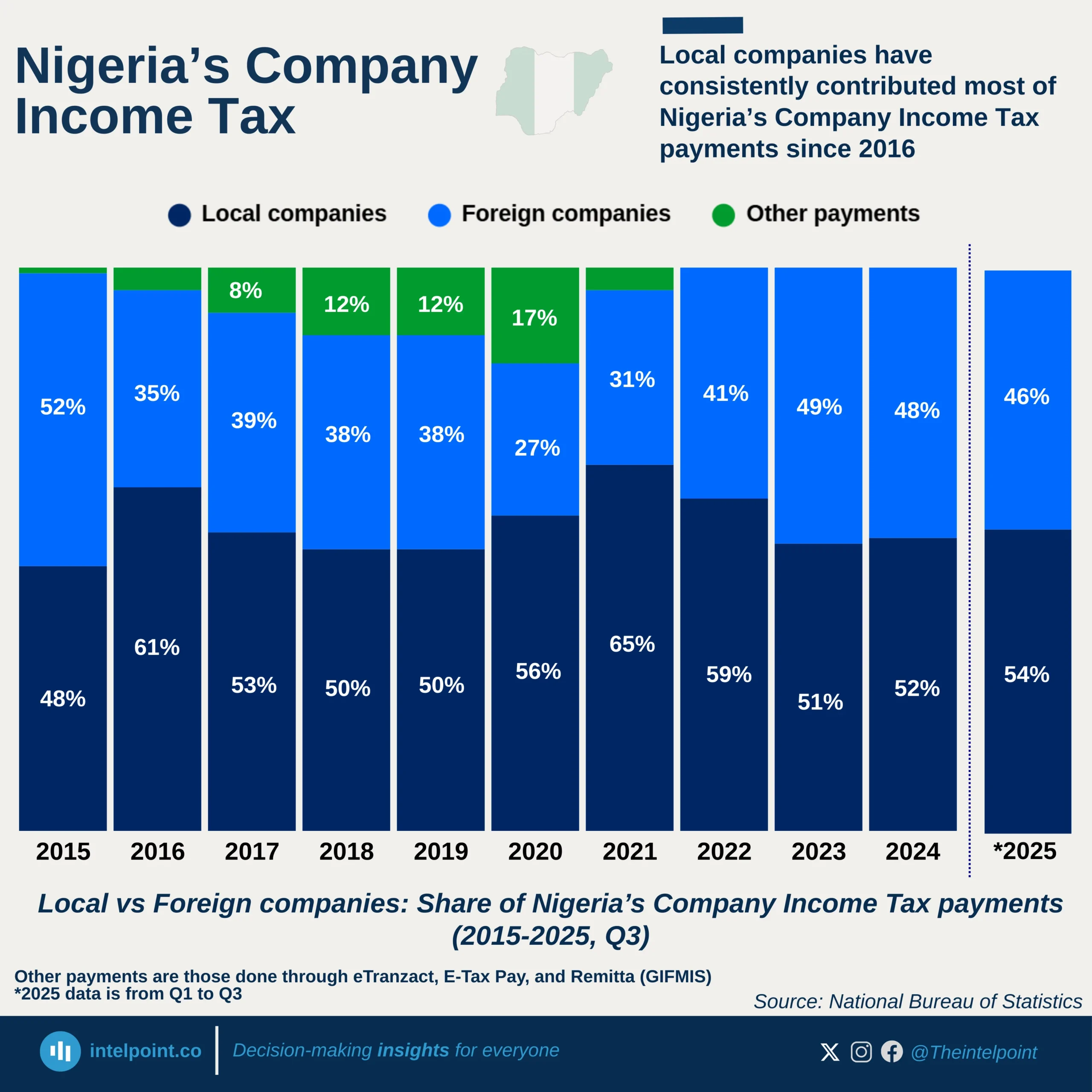
Local companies have consistently contributed most of Nigeria’s Company Income Tax payments since 2016
  • Local companies dominated CIT contributions in most years, accounting for over 50% of payments in 9 of 11 periods between 2015 and 2025 (Q1–Q3).
  • Foreign companies briefly closed the gap in 2023, contributing 49%, the closest they have come to matching local firms.p
  • Local companies recorded their strongest share in 2021 at 65%, marking the widest gap between local and foreign contributors.
  • “Other payments” peaked during the pandemic, rising to 17% in 2020 before dropping to 0% from 2022 onward.

Silverbird Ikeja led the region with ₦1.1bn in ticket sales and the most cinema admissions in 2025
  • Ogun has become Nigeria’s second-largest industrial centre, with major clusters in Ota, Sagamu, and Ifo.
  • Limestone mining triggered a boom in cement production and heavy industry.
  • Infrastructure-Enabled Expansion: strategic projects such as the Oyan Dam and the Agro-Cargo Airport supported industrial and demographic growth.
  • Rapid population growth, particularly from Lagos spillover, fuelled labour supply and urban development.

Silverbird Ikeja led the region with ₦1.1bn in ticket sales and the most cinema admissions in 2025
  • Nigeria has nine of the top ten highest-grossing cinemas in Anglophone West Africa.
  • Lagos hosts six of the top ten cinemas and leads the region in both revenue and admissions.
  • Silverbird Ikeja recorded the highest revenue (₦1.1 billion) and the highest admissions (217,000).
  • Cinema chains control all top ten positions, showing strong brand dominance across the region.

The South West hosts over a quarter of Nigeria’s universities, with Ogun as the core hub
  • The South West hosts 82 of Nigeria’s 309 universities (27%), the largest share nationwide.
  • Ogun State alone accounts for 24 universities, nearly one in every three institutions in the South West.
  • The South West has 18 more universities than North Central (64), the second-highest zone.
  • The gap between the highest zone (82) and the lowest zone (21) is 61 universities, underscoring the regional imbalance.

The Nigeria Football Federation (NFF) is to receive 1.1% of the 2026 sports budget
  • The NFF’s allocation of ₦2.31 billion is under 1.1% of the total sports budget.
  • The National Sports Commission HQ gets the most, with ₦203.6 billion, over 96% of the total.
  • The National Institute for Sports is to receive ₦4.12 billion, highlighting minimal federal investment in sports development.
  • Budget heavily favours administration over football development and grassroots programs.

Lagos had one licensed cinema for every 337,000 people in 2025
  • Lagos alone hosts 51 licensed cinemas, accounting for over half of all exhibition premises in the dataset.
  • The next three states—Ogun, FCT, and Rivers—combined have just 30 cinemas.
  • Only five states have five or more licensed cinemas, highlighting strong geographic concentration.
  • Several large states have two cinemas or fewer, pointing to limited formal exhibition infrastructure outside key urban hubs.

POPULAR TOPICS
SIGN UP TO OUR NEWSLETTER
Get periodic updates about the African startup space, access to our reports, among others.
Subscribe Here
Subscription Form

A product of Techpoint Africa. All rights reserved