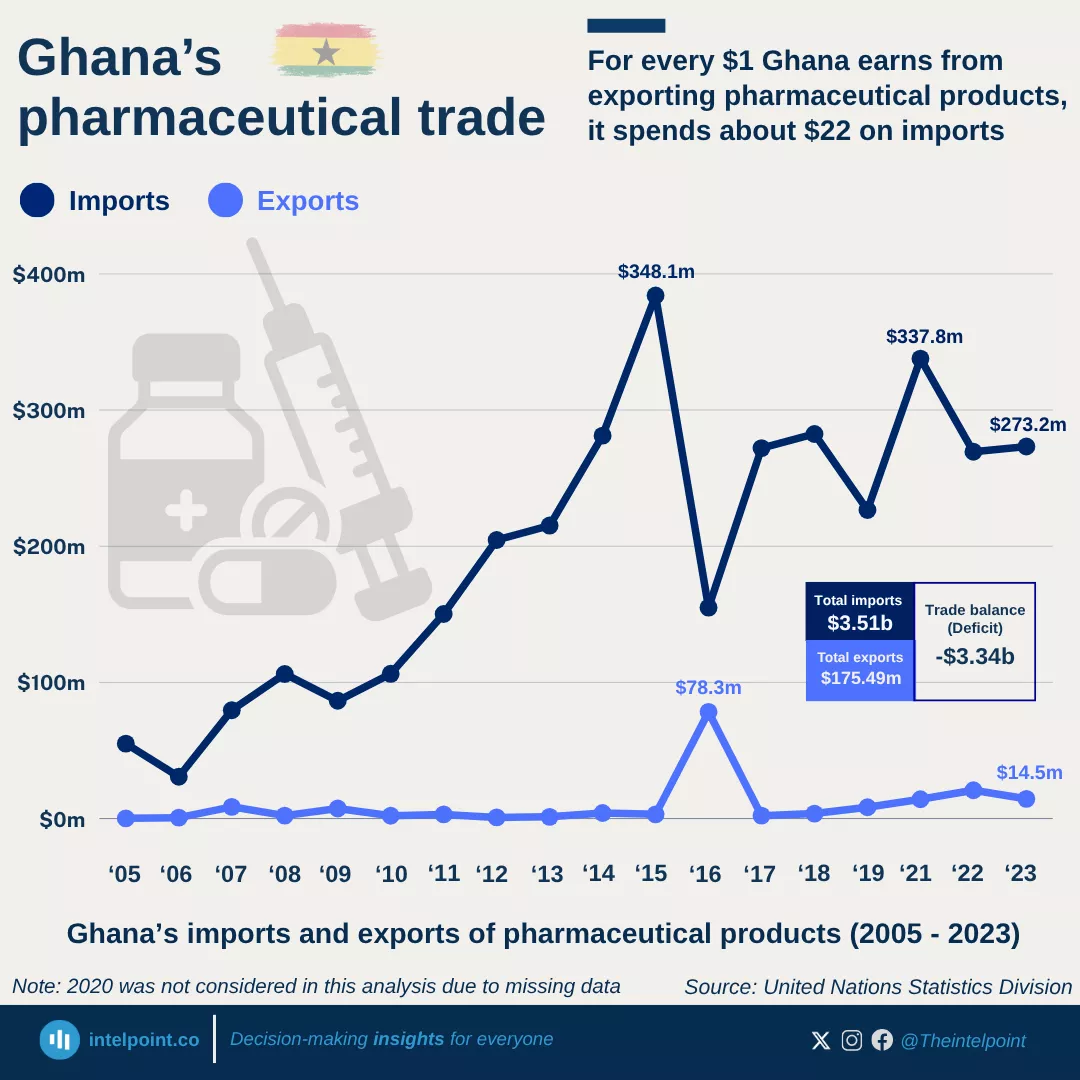
For every $1 Ghana earns from exporting pharmaceutical products, it spends about $22 on imports

Key takeaways:

  • For every $1 Ghana earns from pharmaceutical exports, it spends about $22 on imports, underscoring the country’s overwhelming dependence on foreign pharmaceutical products.
  • Ghana is a net importer of medicine and has been for nearly two decades.
  • By 2015, Ghana’s pharmaceutical imports reached its peak with $348.12m while exports were $3.10m, meaning imports were nearly 100 times larger.
  • In 2016, Ghana recorded its highest-ever export performance at $78.33 million, but even then, imports stood at $154.96m, almost two times higher.

Ghana has remained a net importer of pharmaceuticals for nearly two decades. Between 2005 and 2023, imports consistently outweighed exports by a wide margin. In 2005, Ghana imported $55.03 million worth of pharmaceuticals but exported only $191,000. A similar pattern followed in 2006 ($30.72m vs. $668,000) and 2007 ($79.59m vs. $8.63m).

From 2009 to 2014, import bills rose steadily, peaking at $348.12 million in 2015 against just $3.10 million in exports. The lone exception came in 2016, when exports reached a record $78.33 million — yet imports were still almost double at $154.96 million.

Overall, for every $1 Ghana earns from pharmaceutical exports, it spends about $22 on imports, underscoring its enduring dependence on foreign pharmaceutical supplies despite modest export gains.
Source:

United Nations Statistics Division

Period:

2005 - 2023
HTML code to embed chart
Want a bespoke report?
Reach out
Tags
Related Insights

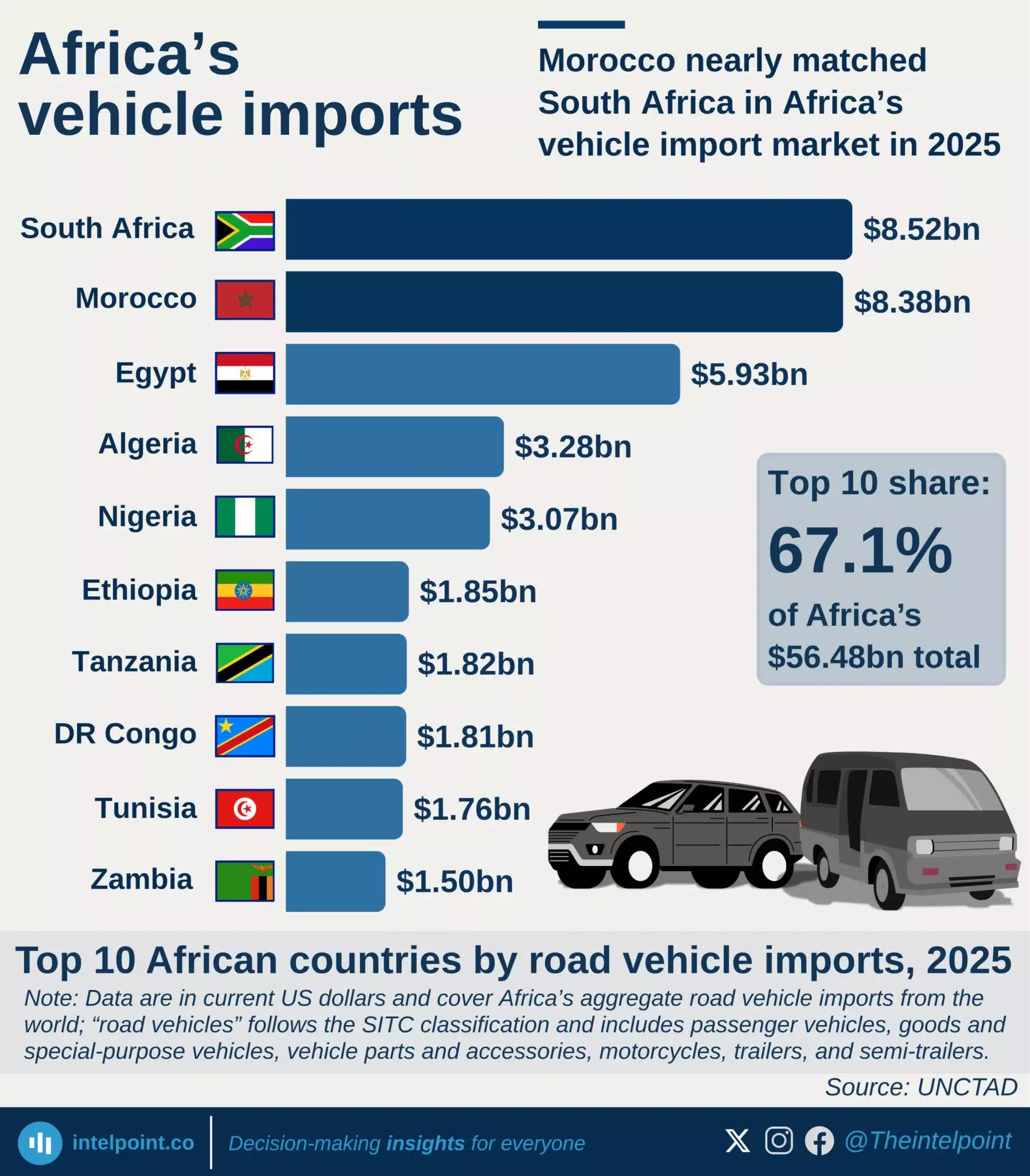
South Africa, Egypt and Morocco accounted for nearly 40% ($313b) of Africa’s merchandise imports in 2025
  • Africa imported merchandise worth $788.9 billion in 2025, representing about 3% of global merchandise imports.
  • South Africa was Africa’s largest merchandise importer, with imports valued at $128.1 billion.
  • Egypt ranked second at $97.5 billion, followed by Morocco at $87.4 billion.
  • The three largest importers accounted for $313 billion, or 39.7% of Africa’s total merchandise imports.
  • South Africa alone accounted for about 16.2% of the continental total.
  • The five largest importers, including Algeria and Nigeria, were responsible for $404.6 billion, or 51.3% of Africa’s imports.
  • Nigeria ranked fifth, with merchandise imports valued at $41.5 billion.

Africa has never sold more than 20% of its goods exports within the continent in three decades
  • Only 16.9% of Africa’s merchandise exports were sold to other African countries in 2024.
  • Africa had the second-lowest intra-continental export share, ahead only of Oceania’s 4.8%.
  • Europe recorded the highest share at 65.6%, followed by Asia at 58.4% and the Americas at 54.0%.
  • Europe’s intra-continental export share was nearly four times Africa’s.
  • Africa’s share increased from 12.1% in 1995 to 16.9% in 2024, a rise of 4.8 percentage points.
  • Despite this long-term improvement, Africa remained below its 2015 peak of 18.8%.
  • Africa has not crossed the 20% mark at any point in the three decades covered.

South Africa accounted for nearly $1 in every $6 Africa earned from merchandise exports in 2025
  • Africa’s merchandise exports reached $689.2 billion in 2025.
  • Exports grew by 9.7%, the fastest rate outside Asia.
  • Africa accounted for just 2.6% of global merchandise exports.
  • South Africa led with $116.4 billion, followed by Nigeria and Egypt.
  • The top 15 economies generated 79.3% of Africa’s exports.

Nigeria's trade surplus hit a record ₦21.0tn in 2025 and remained strong in Q1 2026
  • Nigeria recorded a ₦21.03 trillion trade surplus in 2025, the highest in the period shown.
  • The trade surplus remained strong at ₦7.55 trillion in Q1 2026.
  • The latest performance marks a sharp recovery from the deficits recorded in 2020 and 2021.
  • Nigeria’s trade balance moved from near zero in 2023 to large surpluses in 2024 and 2025.

Nigeria's non-oil exports grew faster than oil exports in 2024 and 2025, though oil remained dominant
  • In 2025, non-oil export growth (36%) was 6x higher than oil (6%).
  • In 2024, non-oil exports grew by 189% vs oil’s 108%.
  • Total exports still heavily depend on oil.
  • Export value rose from ₦36 trillion in 2023 to ₦85.1 trillion in 2025.

Nigeria imported 10x more from Asia than from Africa in 2025
  • Asia is Nigeria’s top import source in 2025.
  • The highest import value from Asia was recorded in Q1 at ₦8.7 trillion.
  • Imports from Europe surged to ₦8.6 trillion in Q2 but declined to ₦6.6 trillion by Q4.
  • Imports from America showed continuous growth, rising from ₦2.9 trillion in Q1 to ₦6.6 trillion in Q4.
  • Imports from Africa remained below ₦1 trillion across most quarters.

POPULAR TOPICS
SIGN UP TO OUR NEWSLETTER
Get periodic updates about the African startup space, access to our reports, among others.
Subscribe Here
Subscription Form

A product of Techpoint Africa. All rights reserved