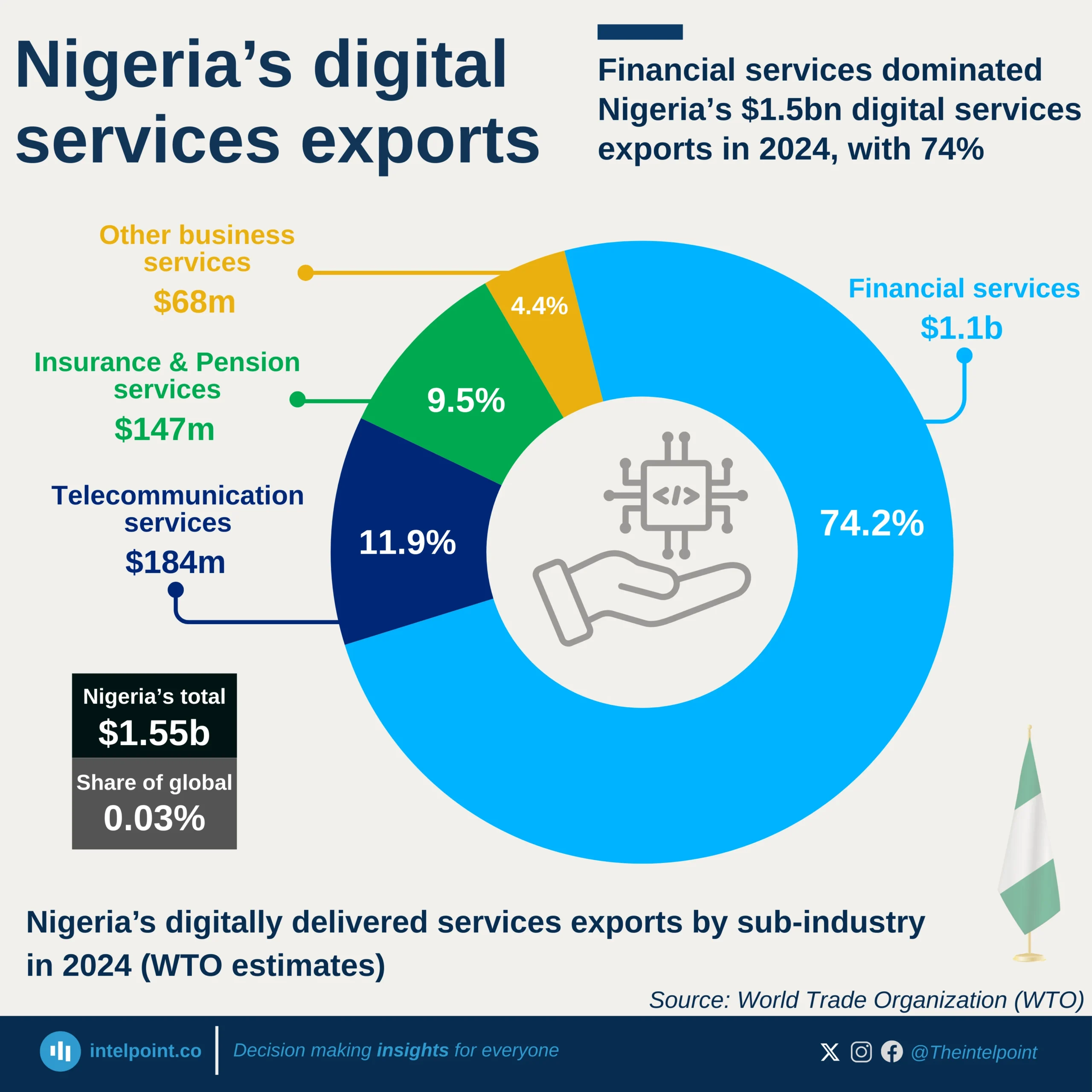
Financial services dominated Nigeria’s $1.5bn digital services exports in 2024

Key Takeaways

  • Financial services dominate Nigeria’s digitally delivered exports, contributing $1.15bn (over 74%).
  • Telecommunications ($184m) and insurance & pension services ($147m) follow, though far smaller.
  • Computer, information, and IP services registered almost no exports, highlighting untapped digital potential.
  • Nigeria’s digital exports remain highly concentrated in finance, leaving other sub-sectors underdeveloped.

According to WTO estimates, Nigeria exported about $1.5bn worth of digital services in 2024, with financial services accounting for the lion’s share. At $1.15bn, finance alone contributed more than three-quarters of the total. Telecommunications ($184m) and insurance & pension services ($147m) provided additional value, while other business services added $68m.

In contrast, Nigeria recorded negligible exports in computer, information, intellectual property, and cultural services, despite their global growth. This imbalance shows the economy’s reliance on finance-led digital trade, while also revealing the untapped potential of Nigeria’s wider digital services sector. Diversifying into ICT-driven exports could unlock far greater earnings in the years ahead.
Source:

World Trade Organization (WTO)

Period:

2024
HTML code to embed chart
Want a bespoke report?
Reach out
Tags
Related Insights

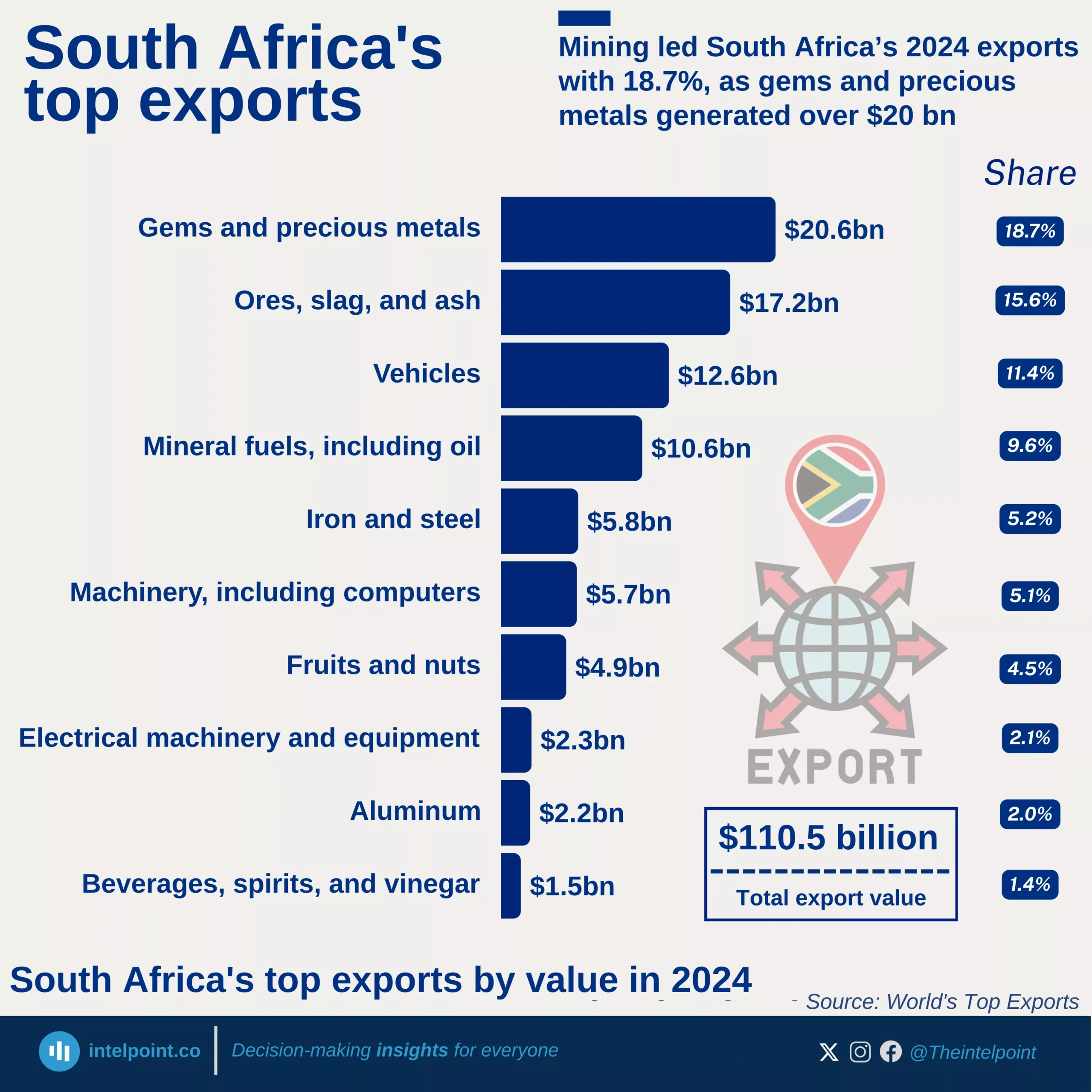
Mining led South Africa’s 2024 exports with 18.7%, as gems and precious metals generated over $20 bn
  • Gems and precious metals were the largest single export category, contributing $20.6 billion.
  • Ores and industrial minerals followed closely with $17.2 billion, showing the country’s reliance on mining.
  • Vehicles and machinery were significant non-mineral exports, with a combined $18.3 billion.
  • Agricultural and light industry products like fruits, nuts, and beverages contributed modestly, strengthening mining and manufacturing’s position as the core export drivers.

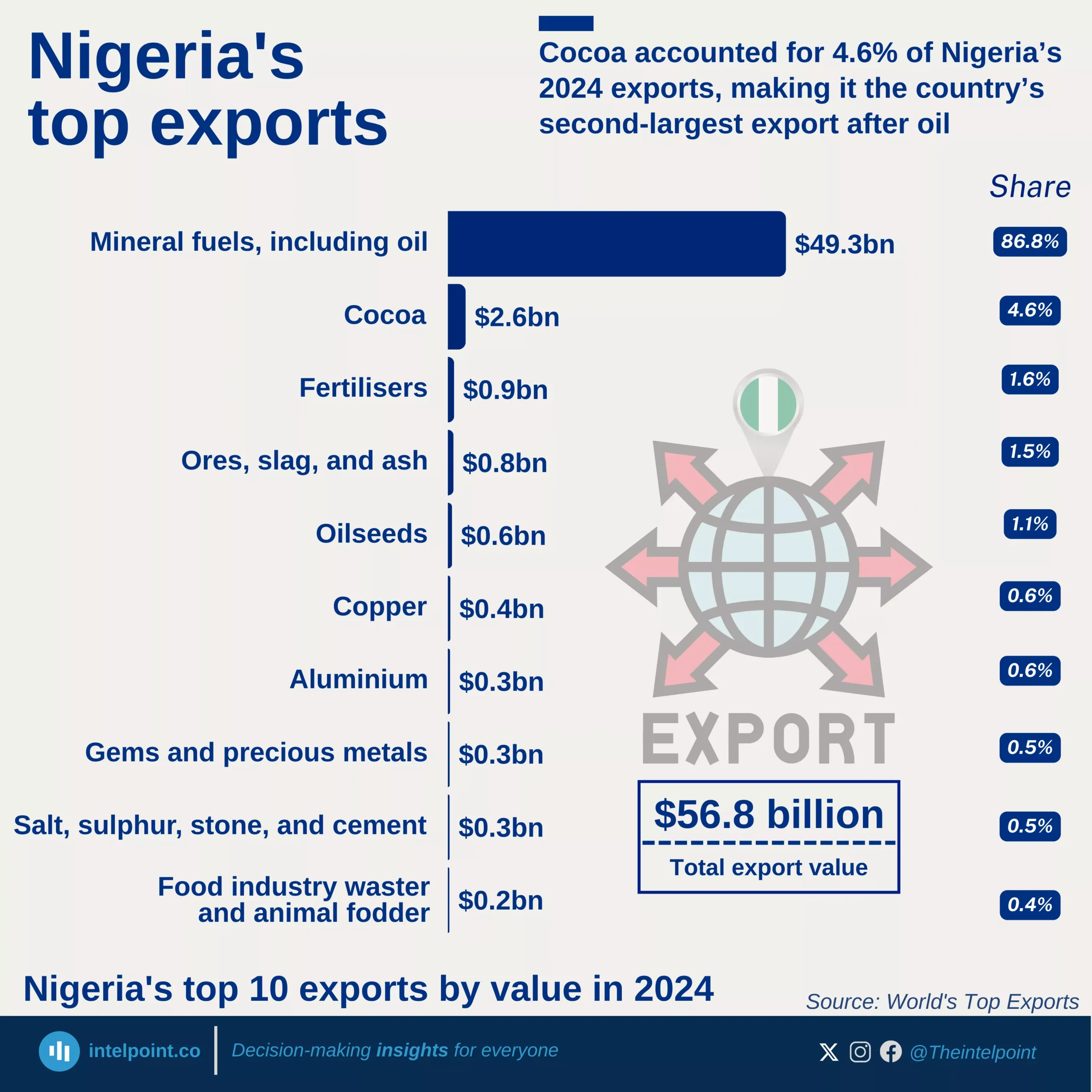
Cocoa accounted for 4.6% of Nigeria’s 2024 exports, making it the country’s second-largest export after oil
  • Mineral fuels (including crude oil) accounted for $49.3 billion, or 86.8% of total exports in 2024.
  • Non-oil exports remained marginal, with the second-largest item, cocoa, contributing only 4.6%.
  • Fertilisers, ores, slag, ash, and oilseeds collectively made up less than 5%, indicating limited diversification.
  • All other export categories each contributed 1% or less, underscoring Nigeria’s narrow export base.

Nigeria's energy goods imports have stayed low and stable for 7 years, while exports increased from ₦37B to ₦263B
  • Nigeria’s energy goods exports rose from ₦37.3B in 2017 to ₦262.9B in 2024, before falling to ₦154.2B in H1 2025.
  • Imports remained consistently low, ranging from ₦24.2M to ₦353.1M throughout the period.
  • Export growth outpaced imports, showing a widening trade surplus in energy goods.
  • The 2024 spike in exports represents the highest export value within the nine-year window.
  • Energy imports stayed below ₦400M yearly, indicating low dependency on foreign energy goods.

Nigeria's agricultural imports' share has been dropping, from 83.9% (2017) to a low of 42.9% (H1 2025)
  • Agricultural imports fell from 83.9% in 2017 to 42.9% in H1 2025, indicating a significant decline in import dependency.
  • Agricultural exports grew from 16.1% in 2017 to 54.0% in 2024, surpassing imports for the first time since 2017.
  • Total agricultural trade increased from ₦1.1 trillion in 2017 to ₦8.2 trillion in 2024.
  • Between 2022 and 2024, the import share dropped significantly from 75.7% to 46.0%.

Crude oil imports in Nigeria emerged in H1 2025 (the first since 2017), capturing a 10.2% share of the total crude oil trade
  • Crude oil imports into Nigeria in H1 2025 marked the first occurrence since 2017.
  • Crude oil imports accounted for 10.2% of total crude oil trade.
  • From 2017 to 2024, exports made up 100% of crude oil trade annually.
  • Total crude oil trade peaked at ₦55.3 trillion in 2024.
  • The emergence of crude oil imports can be linked to domestic refinery operations, especially the Dangote Refinery.

Nigeria's manufactured goods trade is overwhelmingly import-dependent, with imports consistently exceeding 85% since 2017
  • Imports have consistently exceeded 85% of Nigeria's manufactured goods trade since 2017.
  • In H1 2025, imports accounted for 93.3% of the total ₦16.5 trillion trade.
  • Nigeria’s export share in the manufactured goods trade was only 6.7% in H1 2025.
  • The highest export share in the past eight years was 14.8% in 2019.
  • Total manufactured goods trade grew from ₦4.9 trillion in 2017 to ₦29.1 trillion in 2024.

POPULAR TOPICS
SIGN UP TO OUR NEWSLETTER
Get periodic updates about the African startup space, access to our reports, among others.
Subscribe Here
Subscription Form

A product of Techpoint Africa. All rights reserved