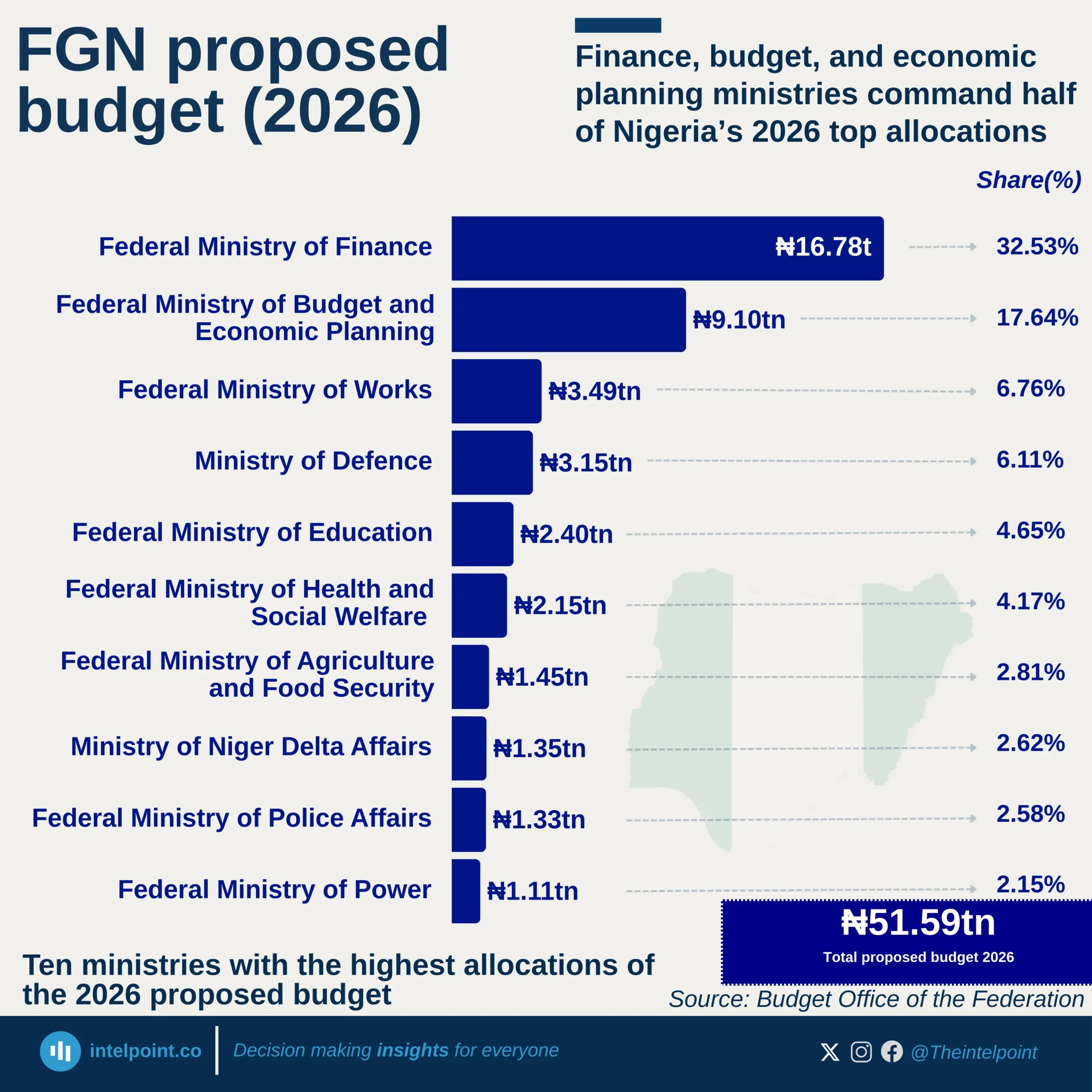
Finance, budget, and economic planning ministries command half of Nigeria’s 2026 top allocations

Key Takeaways

  • The Federal Ministry of Finance dominates with ₦16.78 trillion, accounting for nearly ₦1 in every ₦3 spent among the top ministries.
  • Combined, the ministries of Finance and Budget & Economic Planning control more than 50% of the listed allocations, underscoring the government’s focus on fiscal strategy and economic agenda.
  • The Works and Defence sectors rank third and fourth, reflecting continuous prioritisation of infrastructure development and national security.
  • Education and Health, while critical, receive smaller shares, signalling potential pressure points in human capital development funding

Nigeria’s proposed 2026 budget tells a clear story of where power lies: money. With ₦16.78 trillion flowing into the Ministry of Finance and ₦9.1 trillion into Budget and Economic Planning, over half of the top-ten allocations is concentrated in the two institutions that control how funds are raised, managed, and distributed. This means the government is betting first on economic steering rather than service delivery, locking in debt management, fiscal control, and planning before roads, classrooms, or hospitals.

Infrastructure and security follow, with Works (₦3.49 trillion) and Defence (₦3.15 trillion) signalling that stability and physical development remain strategic pillars.

Moving down the list to Education (₦2.4 trillion), Health (₦2.15 trillion), and Agriculture (₦1.45 trillion), the contrast is striking: the sectors that directly shape human capital and food security receive barely a fraction of what financial management does. In essence, the 2026 budget is structured like a command centre, heavily funding the system that controls the economy first, then allocating what remains to the sectors that touch everyday Nigerian life.
Source:

Budget Office of the Federation

Period:

2026
HTML code to embed chart
Want a bespoke report?
Reach out
Tags
Related Insights

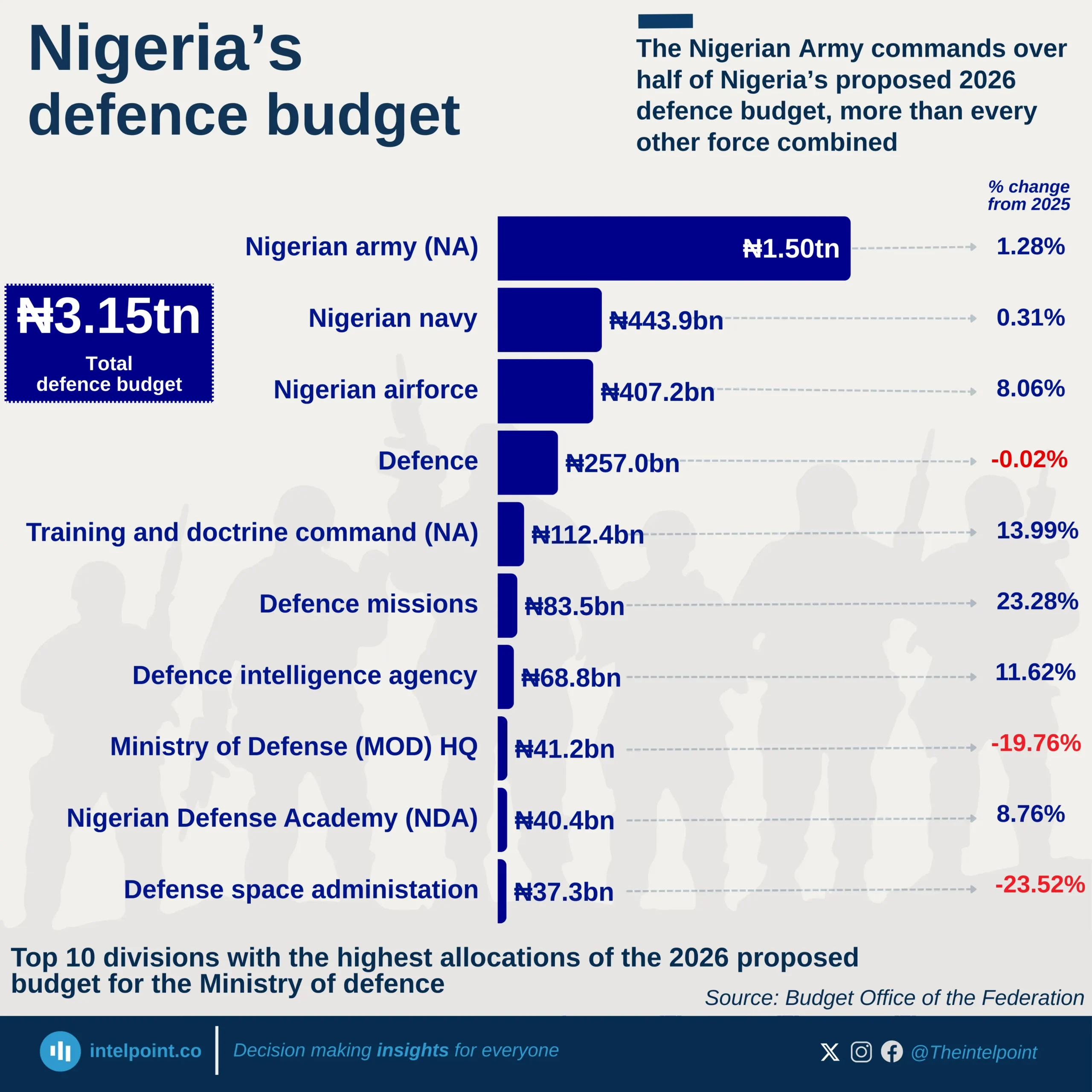
The Nigerian Army commands over half of Nigeria’s proposed 2026 defence budget, more than every other force combined
  • The Army has been allocated ₦1.50tn, more than half of the top-ten defence allocations, making it the backbone of Nigeria’s security spending.
  • The Navy (₦443.9bn) and Air Force (₦407.2bn) come next, but together they are far behind the Army.
  • Institutions like the Defence Intelligence Agency, Training and Doctrine Command, and Defence Missions receive meaningful but much smaller funding, reinforcing their support-role status.
  • The Defence Space Administration (₦37.3bn) is on the table, but its small size shows Nigeria is only cautiously stepping into cyber- and space-based security.

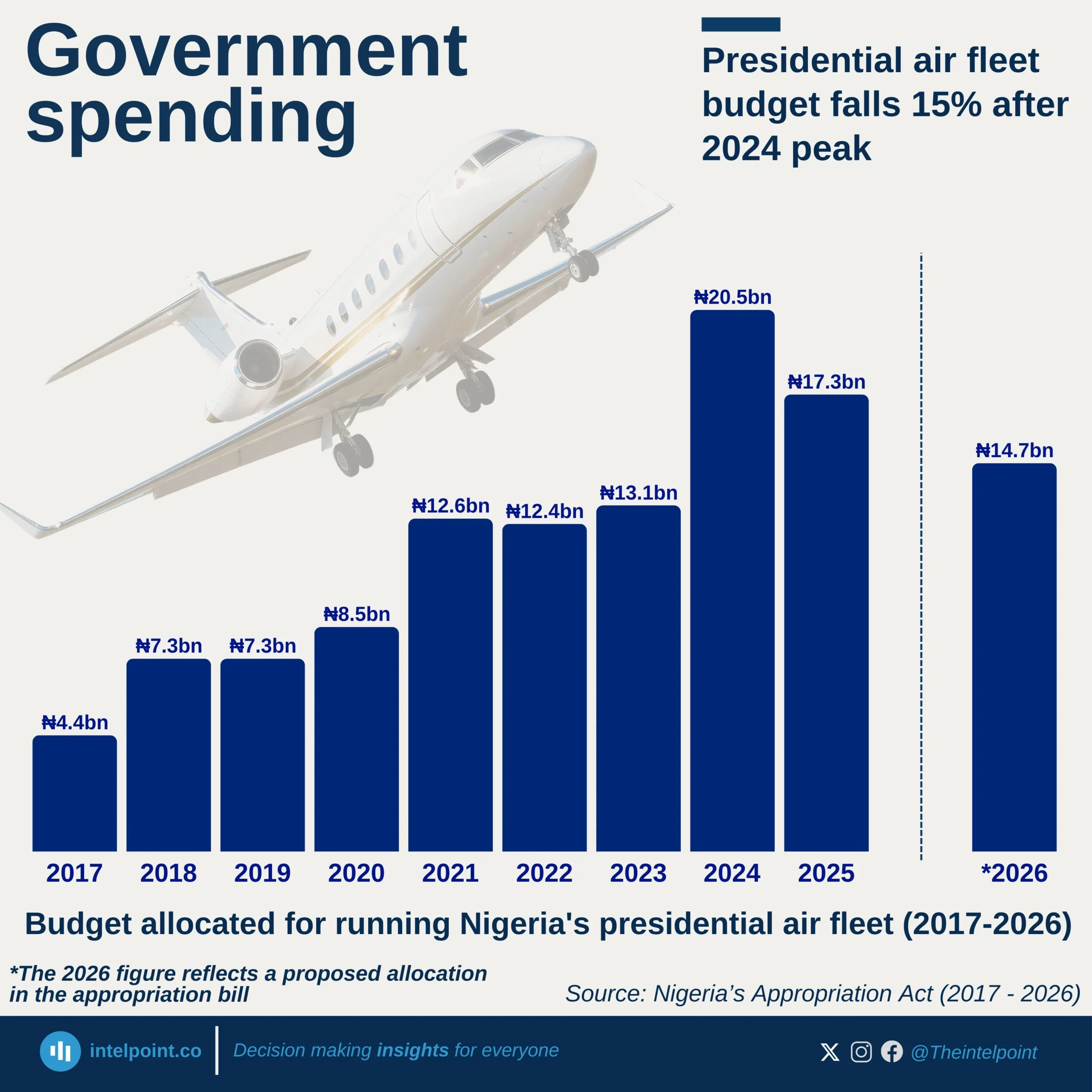
Presidential air fleet budget falls 15% after 2024 peak
  • Allocation declined by ₦290 m from ₦6.16bn in 2025 to a proposed ₦5.87bn in 2026.
  • The change represents a 4.7% year-on-year reduction in funding.
  • Despite the decline, allocations remain broadly flat, with no major expansion in 2026.
  • The 2026 figure is still a proposal, and actual funding figures may change after legislative review.

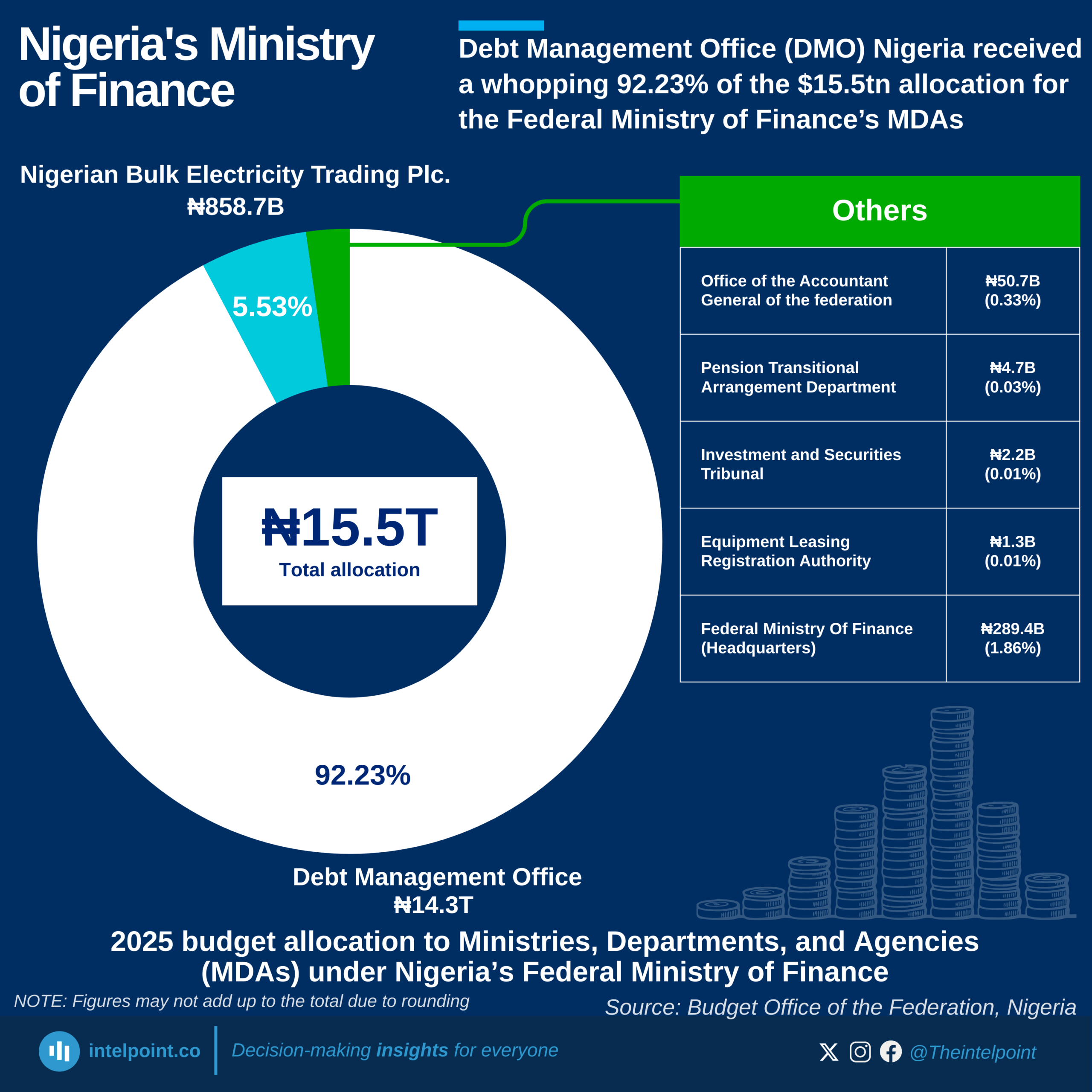
Debt Management Office (DMO) Nigeria received a whopping 92.23% of the $15.5tn allocation for the Federal Ministry of Finance’s MDAs
  • The Debt Management Office (DMO) Nigeria took the lion’s share, with ₦14.3 trillion (92.23%) of the Ministry of Finance's total allocation.
  • The Nigerian Bulk Electricity Trading Plc. received ₦858.7 billion (5.53%), making it the second-highest allocation.
  • The Federal Ministry of Finance (Headquarters) got ₦289.4 billion (1.86%).
  • The Office of the Accountant General of the Federation was allocated ₦50.7 billion (0.33%).
  • The figures reveal how debt servicing priorities overshadow operational and policy-related financial allocations.

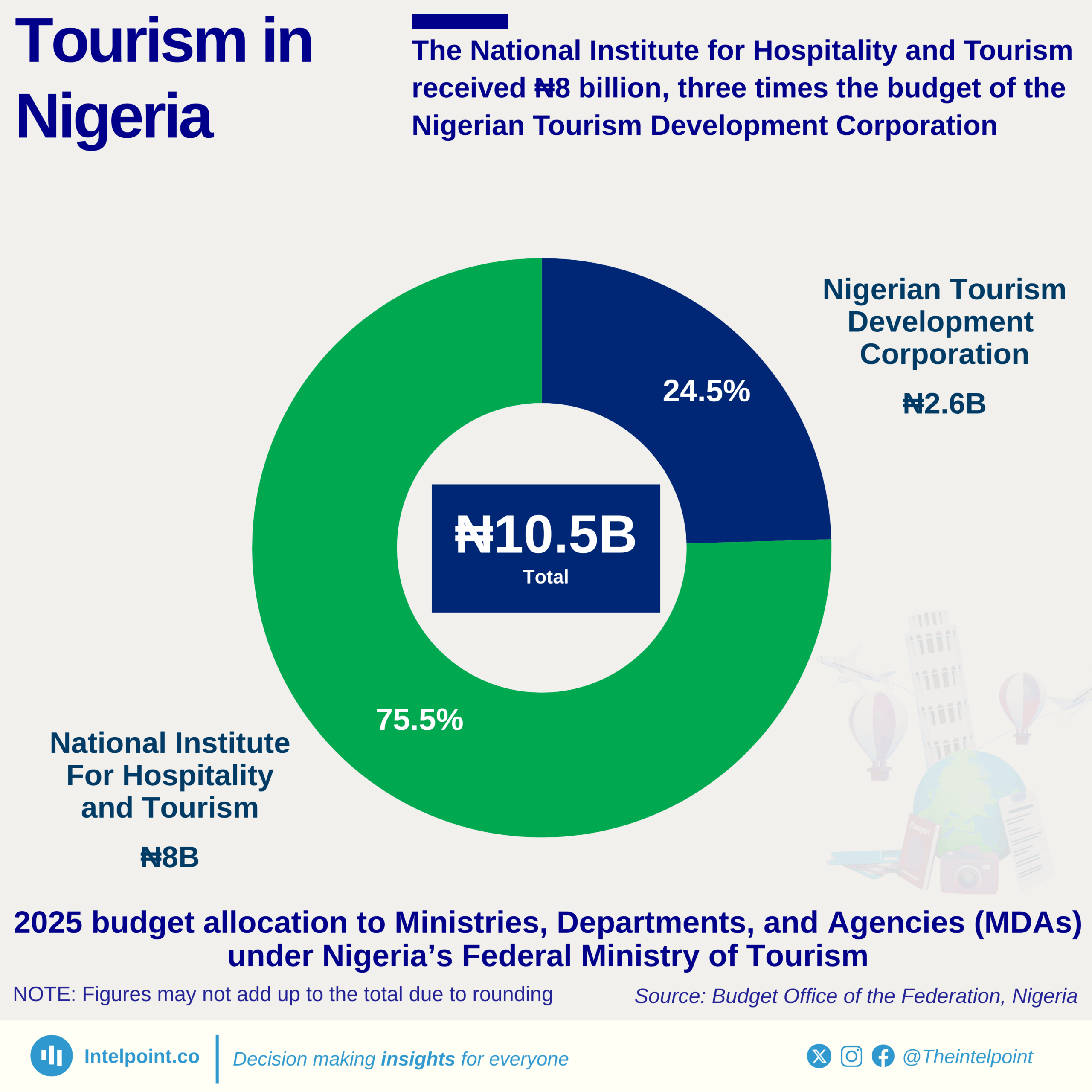
The National Institute for Hospitality and Tourism received ₦8 billion, three times the budget of the Nigerian Tourism Development Corporation
  • The Ministry of Art, Culture, Tourism and the Creative Economy allocated a total of ₦10.5 billion to its MDAs for the 2025 fiscal year.
  • The National Institute for Hospitality and Tourism (NIHOTOUR) received ₦8 billion, the largest allocation.
  • NIHOTOUR's allocation accounts for 75.5% of the ministry’s total budget for 2025.
  • The Nigerian Tourism Development Corporation received ₦2.6 billion, representing 24.5% of the total allocation.
  • NIHOTOUR’s budget is more than three times the allocation given to NTDC.

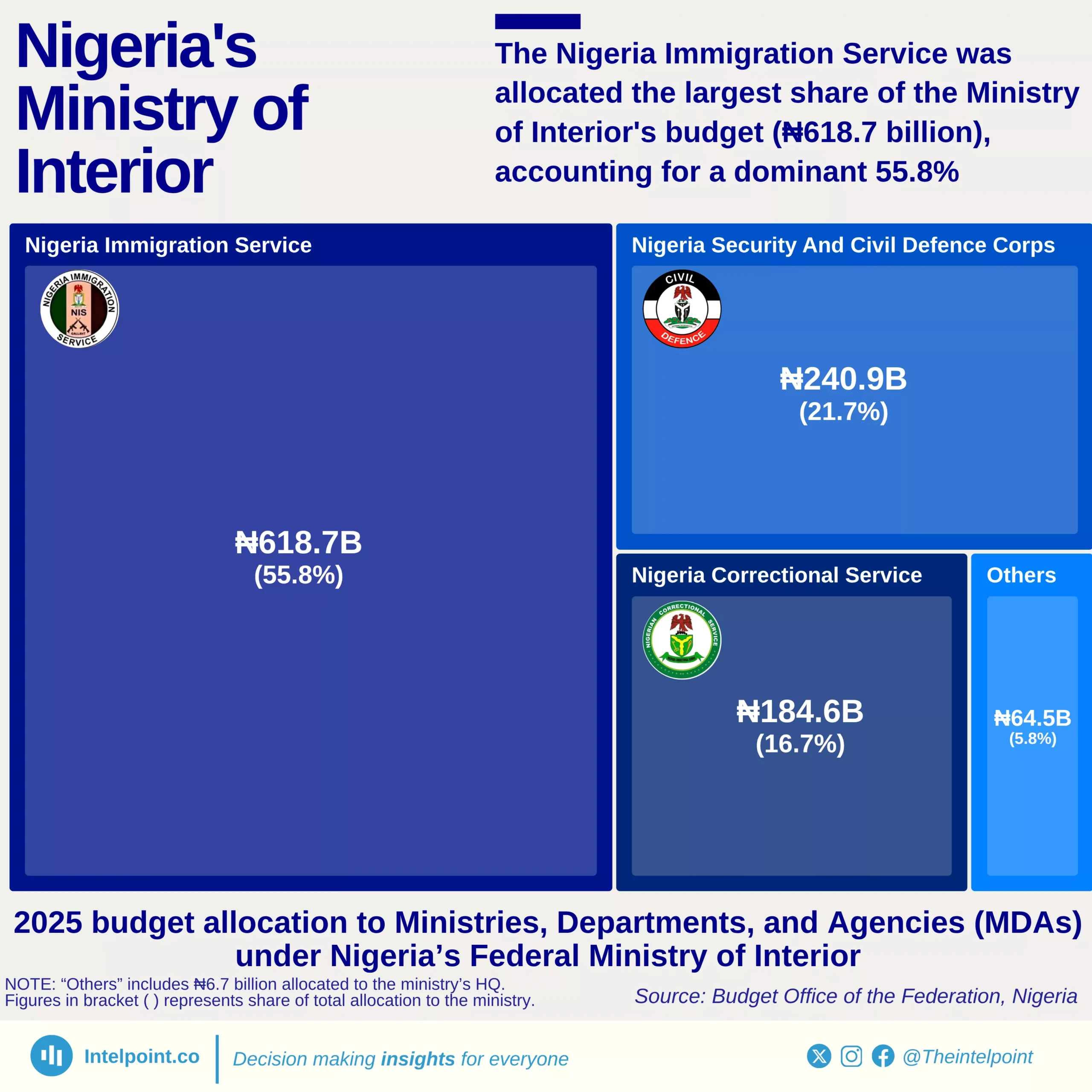
The Nigeria Immigration Service was allocated the largest share of the Ministry of Interior's budget (₦618.7 billion), accounting for a dominant 55.8%
  • The Nigeria Immigration Service received the highest share — ₦618.7 billion (55.8%) — of the Interior Ministry’s 2025 budget.
  • This allocation emphasises border security and migration management as national priorities.
  • The NSCDC follows with ₦240.9 billion (21.7%), highlighting the government’s focus on civil protection and internal security.
  • The Nigeria Correctional Service received ₦184.6 billion (16.7%).
  • Other agencies, including the ministry headquarters, received ₦64.5 billion (5.8%).

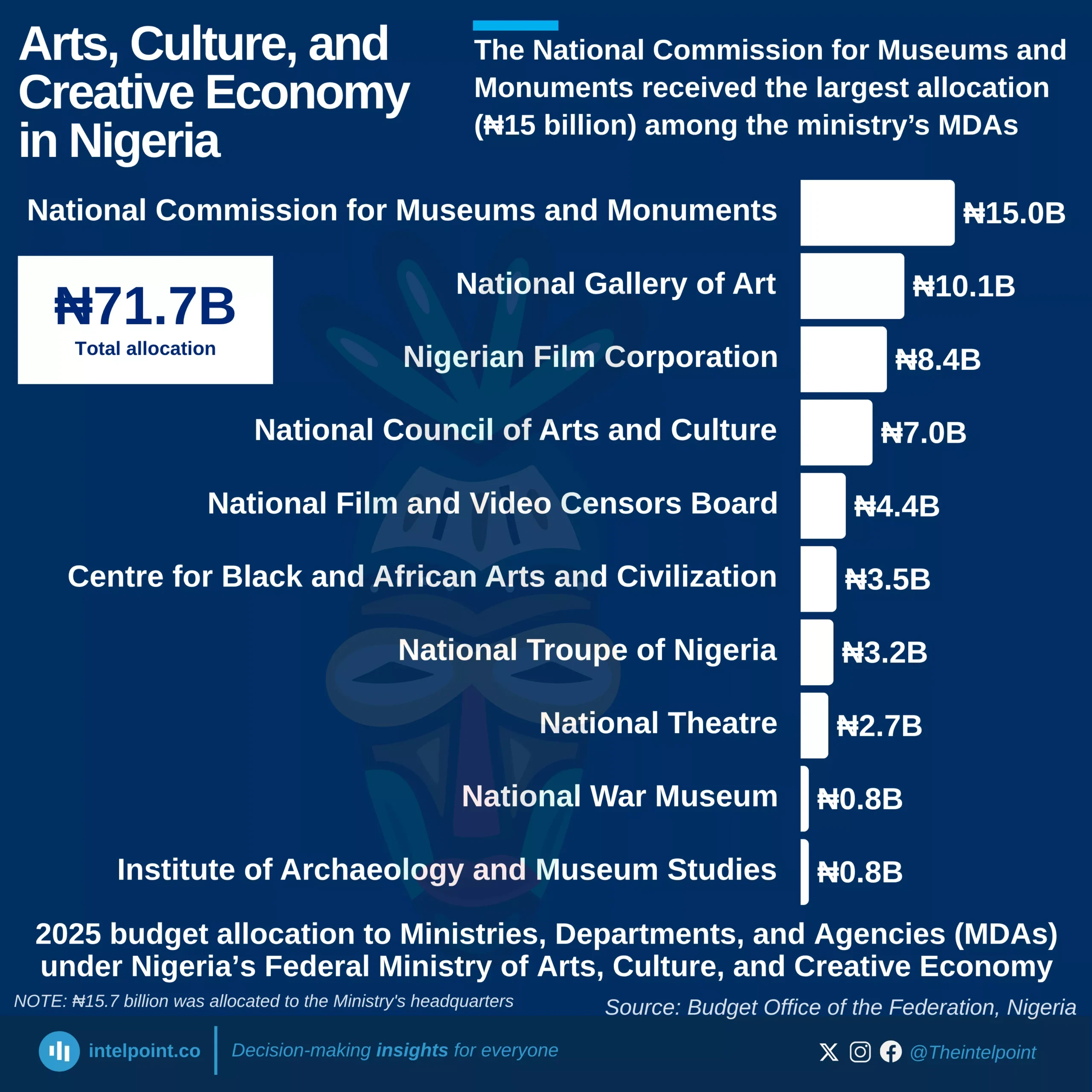
The National Commission for Museums and Monuments received the largest allocation (₦15 billion) among the ministry’s MDAs
  • The Federal Ministry of Arts, Culture, and Creative Economy received a total of ₦71.7 billion in the 2025 budget.
  • The National Commission for Museums and Monuments got the highest allocation of ₦15 billion.
  • Visual and film industries received notable funding of ₦10.1 billion for the National Gallery of Art and ₦8.4 billion for the Nigerian Film Corporation.
  • The National Council of Arts and Culture was allocated ₦7 billion.
  • The National Film and Video Censors Board received ₦4.4 billion, emphasising regulation and content oversight.
  • Institutions like the Centre for Black and African Arts and Civilisation, which promotes African identity, received ₦3.5 billion.

POPULAR TOPICS
SIGN UP TO OUR NEWSLETTER
Get periodic updates about the African startup space, access to our reports, among others.
Subscribe Here
Subscription Form

A product of Techpoint Africa. All rights reserved