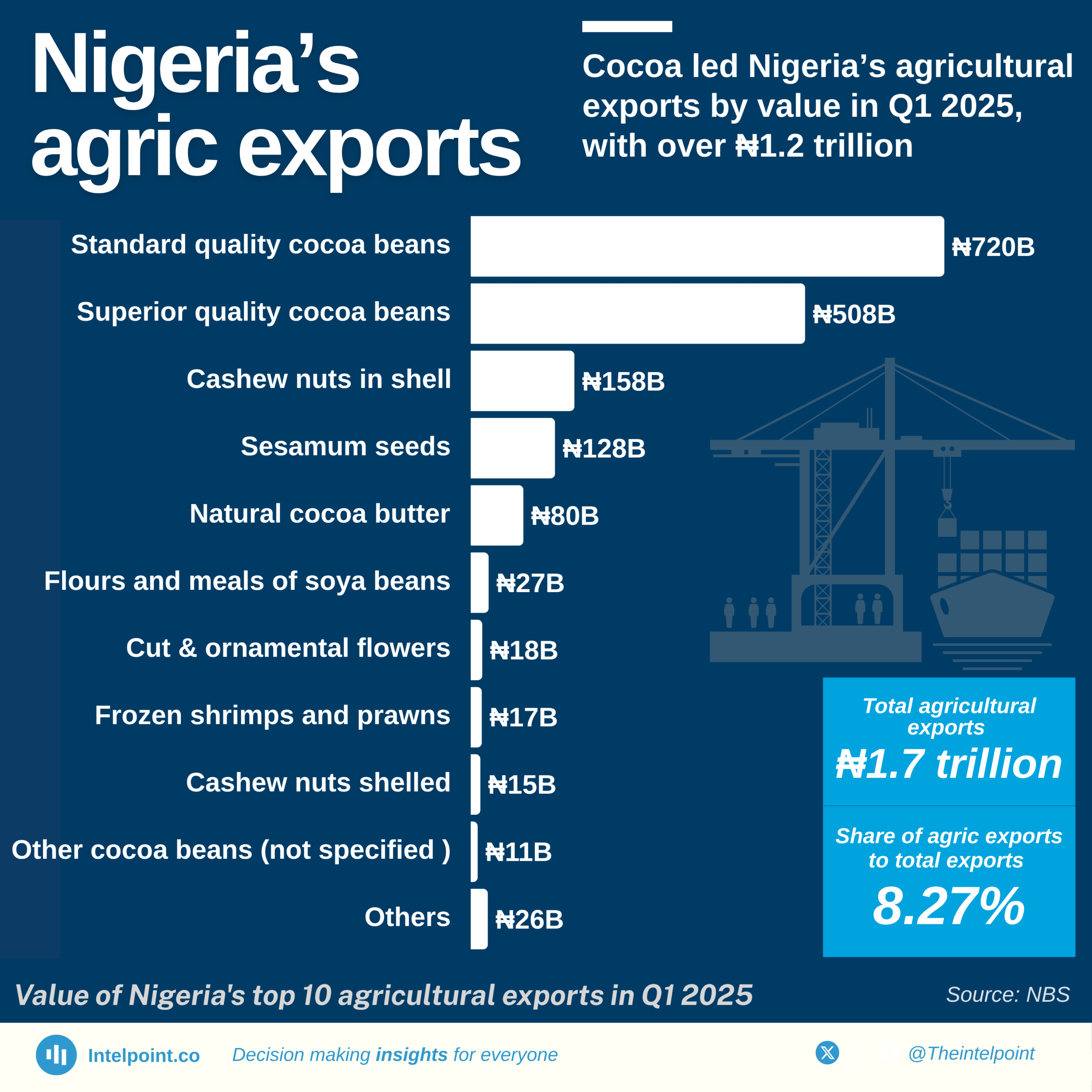
Cocoa led Nigeria’s agricultural exports by value in Q1 2025, with over ₦1.2B

  • The value of agricultural goods exported in Q1 2025 rose to ₦1.70 trillion, up 64.65% year-on-year and 10.63% quarter-on-quarter, highlighting continued growth in the sector.
  • Standard and superior cocoa beans led the chart, contributing a combined ₦1.23 trillion, with major buyers being The Netherlands (₦344.17B) and Belgium (₦203.17B).
  • Cashew nuts in shell earned ₦157.63B, mostly exported to India (₦87.56B) and Vietnam (₦69.74B), while sesamum seeds brought in ₦128.18B.
  • Soya bean flours and ornamental flowers fetched ₦27B and ₦18B respectively, showing Nigeria's export mix is broadening.

Nigeria's agricultural exports soared to ₦1.7 trillion (approximately $1.079 billion) in the first quarter of 2025, marking a significant 64.65% increase from Q1 2024. This impressive growth was largely driven by cocoa exports, which brought in over ₦1.2 trillion, primarily from standard and superior quality beans shipped to the Netherlands and Belgium.

Other strong performers included cashew nuts (₦158 billion) and sesamum seeds (₦128 billion). There was also notable growth in semi-processed goods like natural cocoa butter and soya flour. Additionally, non-traditional exports such as cut and ornamental flowers, along with frozen shrimps and prawns, showed increasing diversification, contributing to an expanding export base beyond a few core commodities.

This strong performance in Q1 2025 highlights Nigeria's growing momentum in the global agricultural market, signalling improved market penetration and a critical step toward economic diversification.
Source:

National Bureau of Statistics

Period:

Q1 2025
HTML code to embed chart
Want a bespoke report?
Reach out
Tags
Related Insights

South Africa accounted for nearly $1 in every $6 Africa earned from merchandise exports in 2025
  • Africa’s merchandise exports reached $689.2 billion in 2025.
  • Exports grew by 9.7%, the fastest rate outside Asia.
  • Africa accounted for just 2.6% of global merchandise exports.
  • South Africa led with $116.4 billion, followed by Nigeria and Egypt.
  • The top 15 economies generated 79.3% of Africa’s exports.

Nigeria's trade surplus hit a record ₦21.0tn in 2025 and remained strong in Q1 2026
  • Nigeria recorded a ₦21.03 trillion trade surplus in 2025, the highest in the period shown.
  • The trade surplus remained strong at ₦7.55 trillion in Q1 2026.
  • The latest performance marks a sharp recovery from the deficits recorded in 2020 and 2021.
  • Nigeria’s trade balance moved from near zero in 2023 to large surpluses in 2024 and 2025.

Nigeria's non-oil exports grew faster than oil exports in 2024 and 2025, though oil remained dominant
  • In 2025, non-oil export growth (36%) was 6x higher than oil (6%).
  • In 2024, non-oil exports grew by 189% vs oil’s 108%.
  • Total exports still heavily depend on oil.
  • Export value rose from ₦36 trillion in 2023 to ₦85.1 trillion in 2025.

Nigeria imported 10x more from Asia than from Africa in 2025
  • Asia is Nigeria’s top import source in 2025.
  • The highest import value from Asia was recorded in Q1 at ₦8.7 trillion.
  • Imports from Europe surged to ₦8.6 trillion in Q2 but declined to ₦6.6 trillion by Q4.
  • Imports from America showed continuous growth, rising from ₦2.9 trillion in Q1 to ₦6.6 trillion in Q4.
  • Imports from Africa remained below ₦1 trillion across most quarters.

China’s exports to Nigeria increased by 40% in 2025
  • China’s exports to Nigeria increased by 40.4%,
  • China's exports moved from ₦ 14.1 trillion in 2024 to ₦ 19.8 trillion in 2025.
  • Growth was consistent across all four quarters.
  • Quarter 2 saw the highest growth at 80%, jumping from ₦3.0tn to ₦5.4tn.
  • Quarter 4 recorded a modest 4.3% rise.

Nigeria’s export mix stayed oil-heavy in 2025, with crude oil above 75% in all quarters
  • Crude oil dominated Nigeria’s exports in all quarters of 2025
  • Q1 recorded the highest oil dependency at 81.5%.
  • Non-oil exports peaked in Q2 at 24.2%, representing the strongest diversification point in 2025.
  • The oil share dropped to its lowest in Q2 (75.8%), but still remained dominant.

POPULAR TOPICS
SIGN UP TO OUR NEWSLETTER
Get periodic updates about the African startup space, access to our reports, among others.
Subscribe Here
Subscription Form

A product of Techpoint Africa. All rights reserved