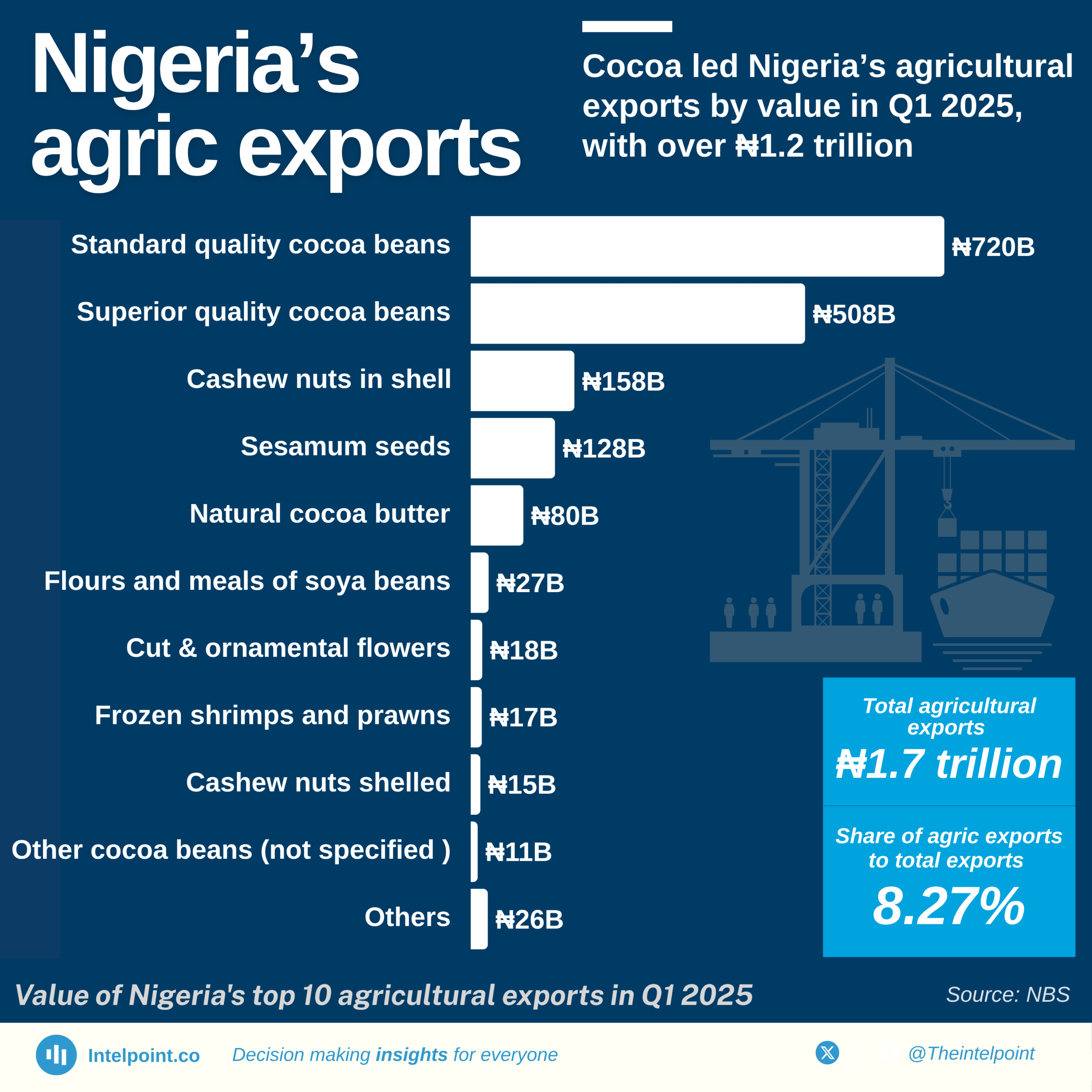
Cocoa led Nigeria’s agricultural exports by value in Q1 2025, with over ₦1.2B

  • The value of agricultural goods exported in Q1 2025 rose to ₦1.70 trillion, up 64.65% year-on-year and 10.63% quarter-on-quarter, highlighting continued growth in the sector.
  • Standard and superior cocoa beans led the chart, contributing a combined ₦1.23 trillion, with major buyers being The Netherlands (₦344.17B) and Belgium (₦203.17B).
  • Cashew nuts in shell earned ₦157.63B, mostly exported to India (₦87.56B) and Vietnam (₦69.74B), while sesamum seeds brought in ₦128.18B.
  • Soya bean flours and ornamental flowers fetched ₦27B and ₦18B respectively, showing Nigeria's export mix is broadening.

Nigeria's agricultural exports soared to ₦1.7 trillion (approximately $1.079 billion) in the first quarter of 2025, marking a significant 64.65% increase from Q1 2024. This impressive growth was largely driven by cocoa exports, which brought in over ₦1.2 trillion, primarily from standard and superior quality beans shipped to the Netherlands and Belgium.

Other strong performers included cashew nuts (₦158 billion) and sesamum seeds (₦128 billion). There was also notable growth in semi-processed goods like natural cocoa butter and soya flour. Additionally, non-traditional exports such as cut and ornamental flowers, along with frozen shrimps and prawns, showed increasing diversification, contributing to an expanding export base beyond a few core commodities.

This strong performance in Q1 2025 highlights Nigeria's growing momentum in the global agricultural market, signalling improved market penetration and a critical step toward economic diversification.
Source:

National Bureau of Statistics

Period:

Q1 2025
HTML code to embed chart
Want a bespoke report?
Reach out
Tags
Related Insights

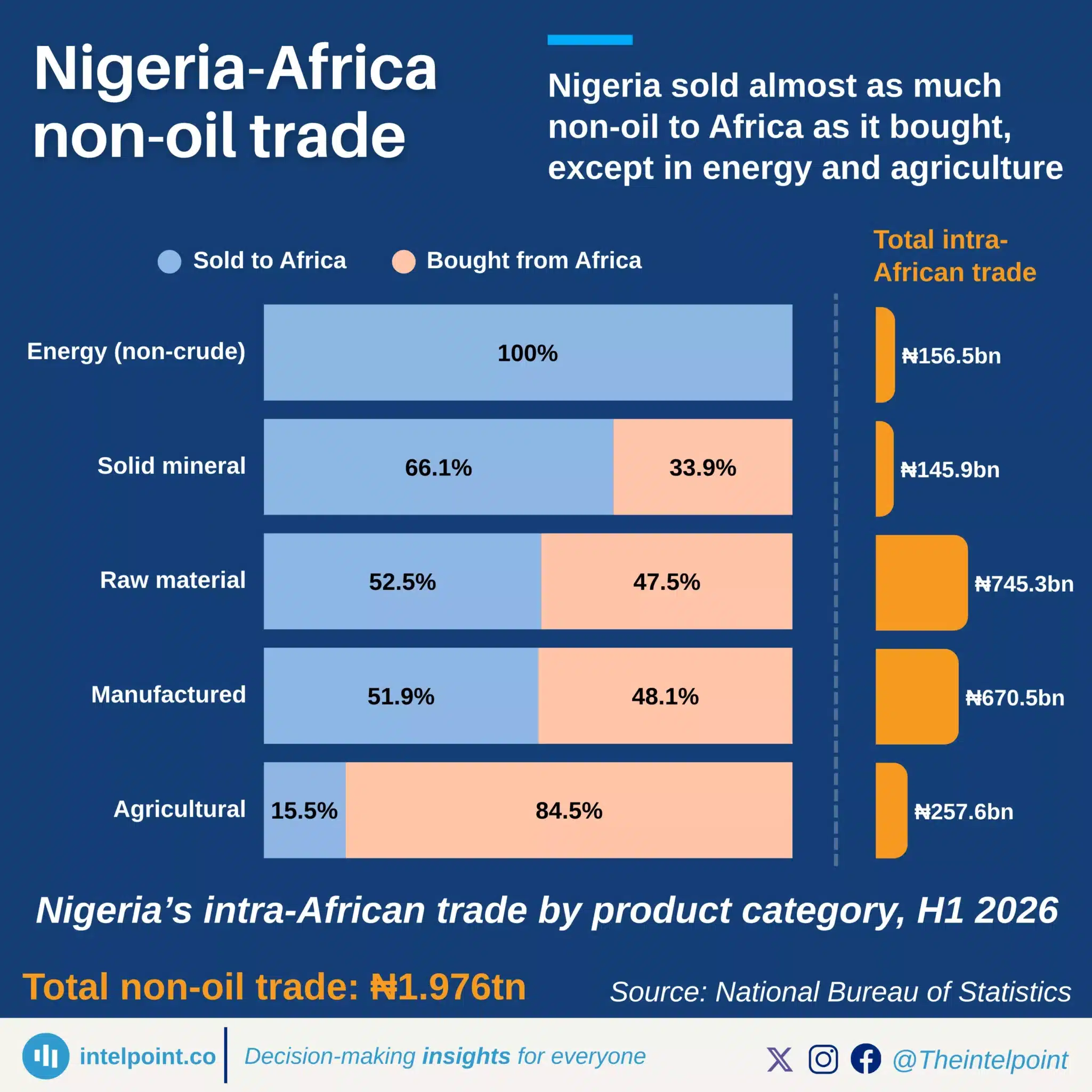
Nigeria sold almost as much non-oil to Africa as it bought, except in energy and agriculture
  • Nigeria’s non-oil trade with Africa was nearly balanced, with an ₦88bn surplus on almost ₦2tn of trade in H1 2026.
  • Energy trade was entirely export-led, with Nigeria selling ₦156.5bn and recording no imports.
  • Solid minerals also leaned towards exports, with sales making up 66.1% of category trade.
  • Agriculture ran a large deficit, as imports accounted for 84.5% of trade and exceeded exports by ₦178bn.
  • Nigeria’s agricultural trade deficit widened sharply, from ₦59bn in Q1 to ₦119bn in Q2.

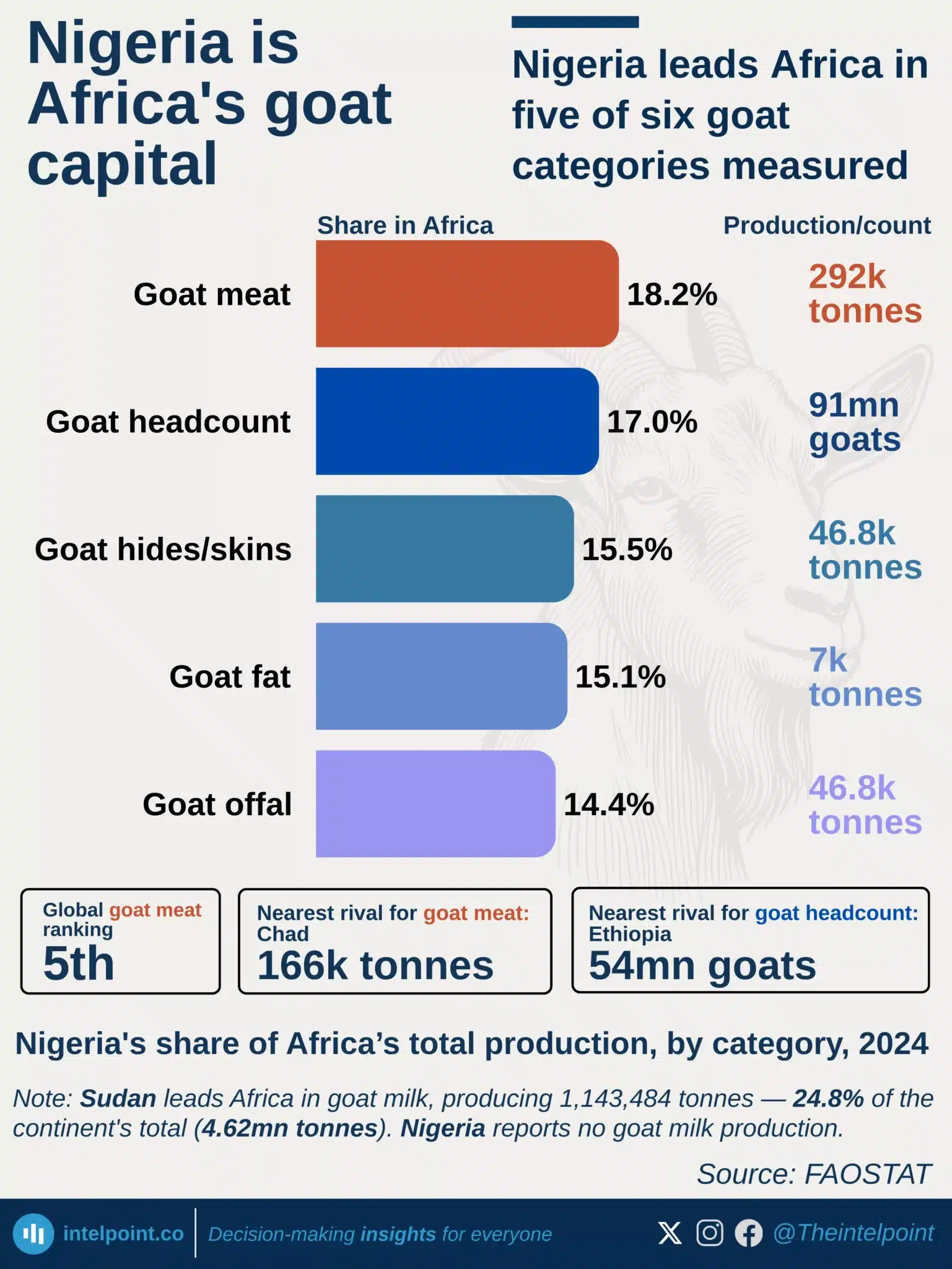
Nigeria leads Africa in five of six goat categories measured
  • Nigeria leads Africa in five of six goat categories, but its largest share is just 18.2% of continental production.
  • Nigeria has 91 million goats, 17.0% of Africa’s total, nearly twice Ethiopia’s 54 million.
  • Nigeria produced 292,000 tonnes of goat meat, making it Africa’s largest producer but only the world’s 5th largest.
  • Chad produced 166,000 tonnes of goat meat, making it Nigeria’s closest African rival.
  • Goat milk is the exception: FAOSTAT records no Nigerian production, while Sudan accounts for 24.8% of Africa’s total.

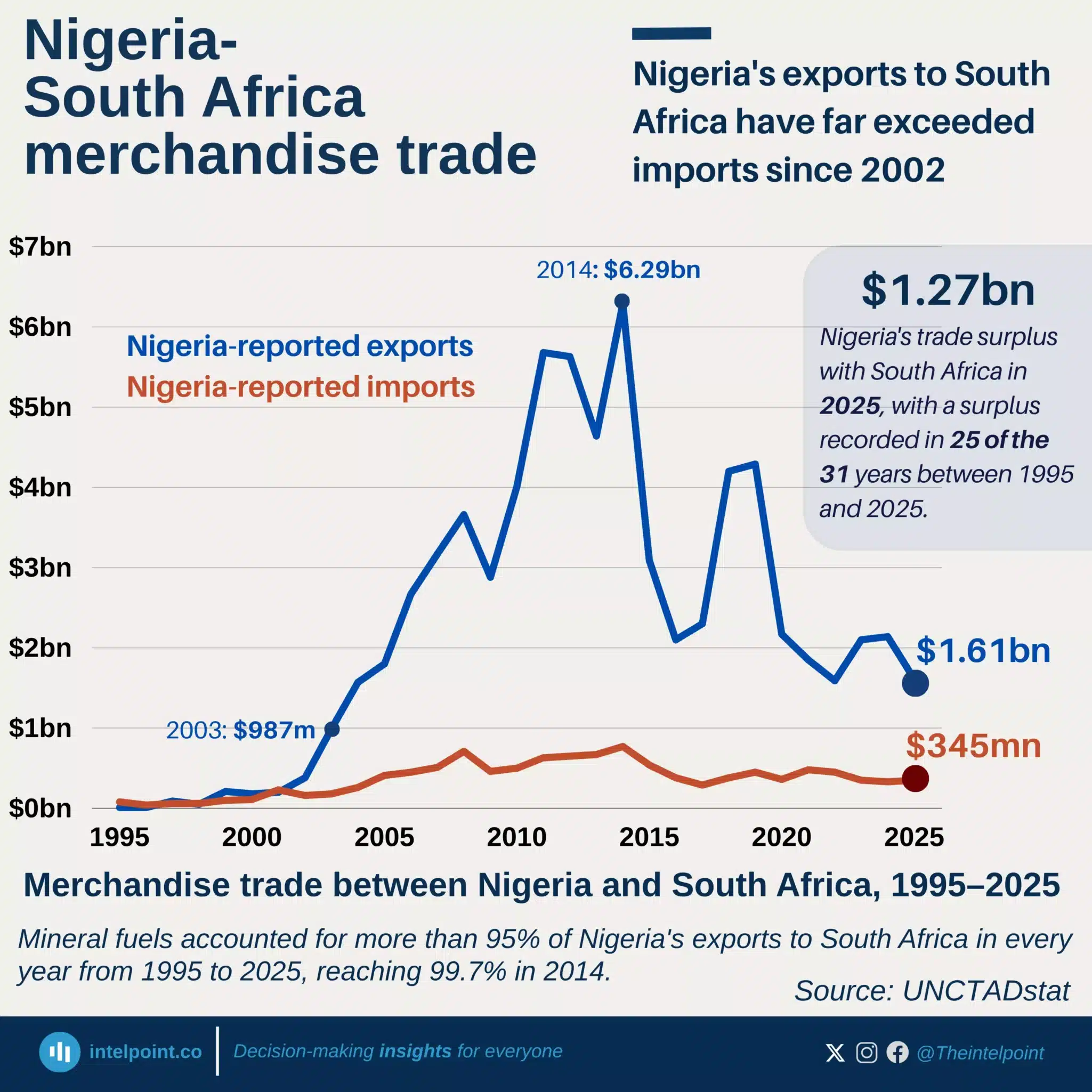
Nigeria's exports to South Africa have far exceeded imports since 2002
  • Nigeria has exported more to South Africa than it has imported every year since 2002.
  • Exports peaked at $6.29 billion in 2014, driven almost entirely by mineral fuels.
  • Imports from South Africa have remained below $1 billion annually.
  • Nigeria recorded a $1.27 billion trade surplus with South Africa in 2025.
  • Mineral fuels made up over 95% of Nigeria's exports throughout 1995-2025.

Morocco nearly matched South Africa in Africa’s vehicle import market in 2025
  • South Africa led with $8.52 billion, only $140 million ahead of Morocco.
  • Morocco’s imports have grown steadily, while South Africa’s 2025 figure was a recovery toward its 2012 peak.
  • Egypt ranked third, followed by Algeria and Nigeria.
  • The top 10 markets accounted for 67.1% of Africa’s $56.48 billion total.
  • Road vehicle imports include vehicles, parts, motorcycles, trailers, and semi-trailers.

Africa’s merchandise exports to China in 2025
  • Africa exported a record $86.2bn worth of goods to China in 2025.
  • China received about 12.5% of Africa’s total merchandise exports.
  • Annual exports remained below $10bn until 2004, before accelerating sharply.
  • Export values have remained relatively high since 2021 despite earlier downturns.
  • The trade relationship remains heavily commodity-led, with limited manufactured exports.

Africa’s export map changed, but only three economies escaped heavy reliance on one buyer
  • Only 3 of 52 African economies met the export-market diversification test in 2025.
  • Nigeria recorded the largest and most sustained shift, with its top-buyer share falling from 43.1% to 9.9%.
  • Madagascar’s top-market share dropped from 40.0% to 14.9% and has remained below 20% since 2021.
  • Libya narrowly qualified at 19.5%, after remaining above the threshold in 2024.
  • The test measures reduced dependence on one export destination, not greater product diversification.

POPULAR TOPICS
SIGN UP TO OUR NEWSLETTER
Get periodic updates about the African startup space, access to our reports, among others.
Subscribe Here
Subscription Form

A product of Techpoint Africa. All rights reserved