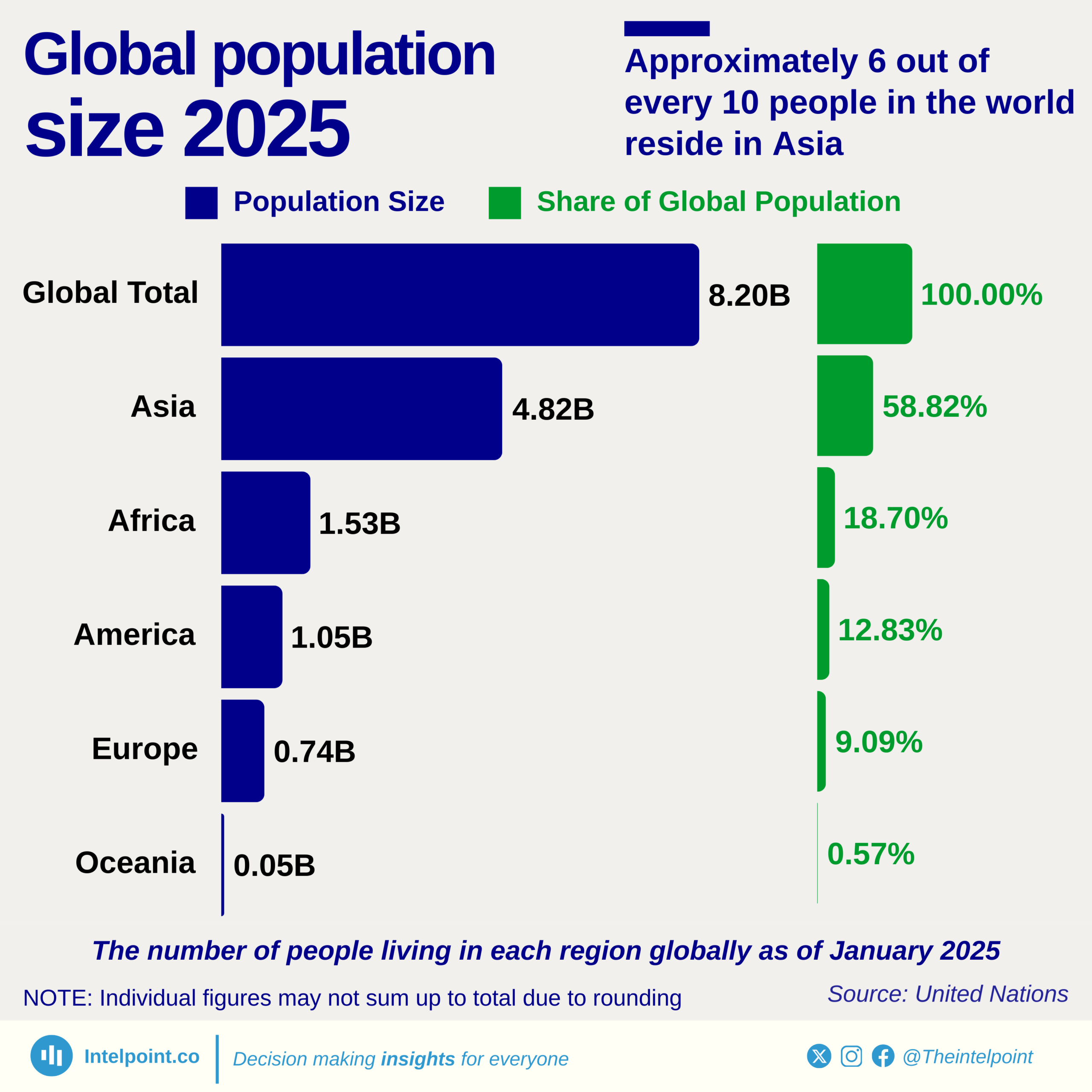
Approximately 6 out of every 10 people in the world reside in Asia

Key takeaways:

  • Asia remains the world's population giant, housing nearly 59% of the global population.
  • Africa’s population boom is accelerating, contributing 18.7% of the world’s people.
  • Europe is shrinking in global demographic weight, making up only 9.09% of the world’s people.
  • Oceania remains sparsely populated, with just 0.57% of the global population.
  • Demographic trends will shape economic power, as nations with younger populations could become economic engines if properly harnessed.
  • Urbanisation and resource allocation will become critical, especially in Asia and Africa, where rising populations will put pressure on housing, food, and infrastructure.

The world’s population is estimated to be 8.2 billion as of January 2025, with Asia dominating. With 4.82 billion people, Asia alone accounts for nearly 6 out of every 10 people on Earth, emphasising its overwhelming share of humanity. Africa, though significantly smaller in numbers (1.53 billion people), is experiencing rapid growth, positioning it as the next major demographic powerhouse.
Source:

United Nations

Period:

2025
HTML code to embed chart
Want a bespoke report?
Reach out
Tags
Related Insights

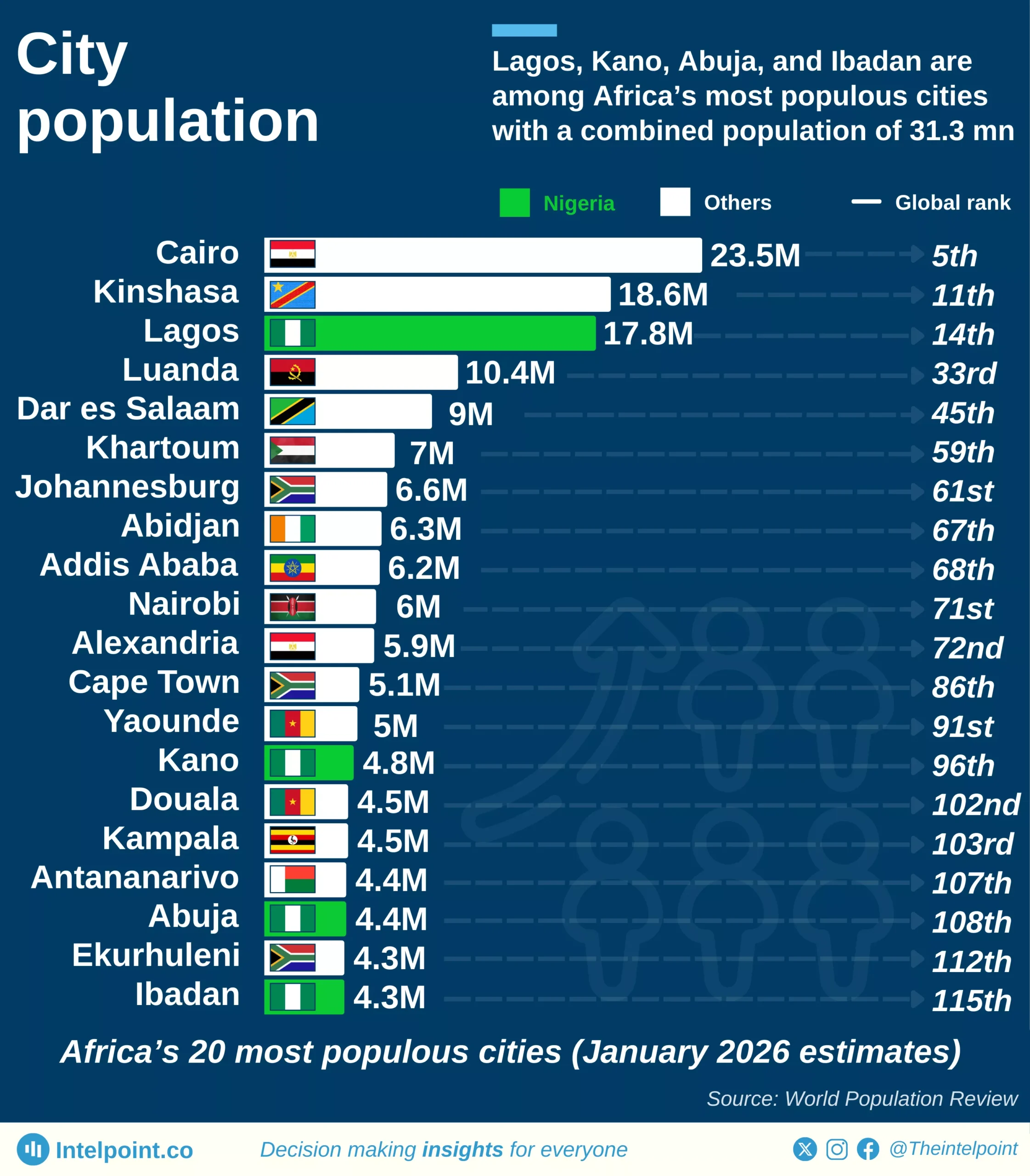
Lagos, Kano, Abuja, and Ibadan are among Africa’s most populous cities with a combined population of 31.3 mn
  • Lagos is Africa’s third-largest city and ranks 14th globally.
  • Cairo remains Africa’s largest city, with over 23 million people, keeping Egypt at the centre of the continent’s urban network.
  • Kinshasa’s position shows Central Africa’s rising urban influence.
  • There is a steep population gap after the top three cities.

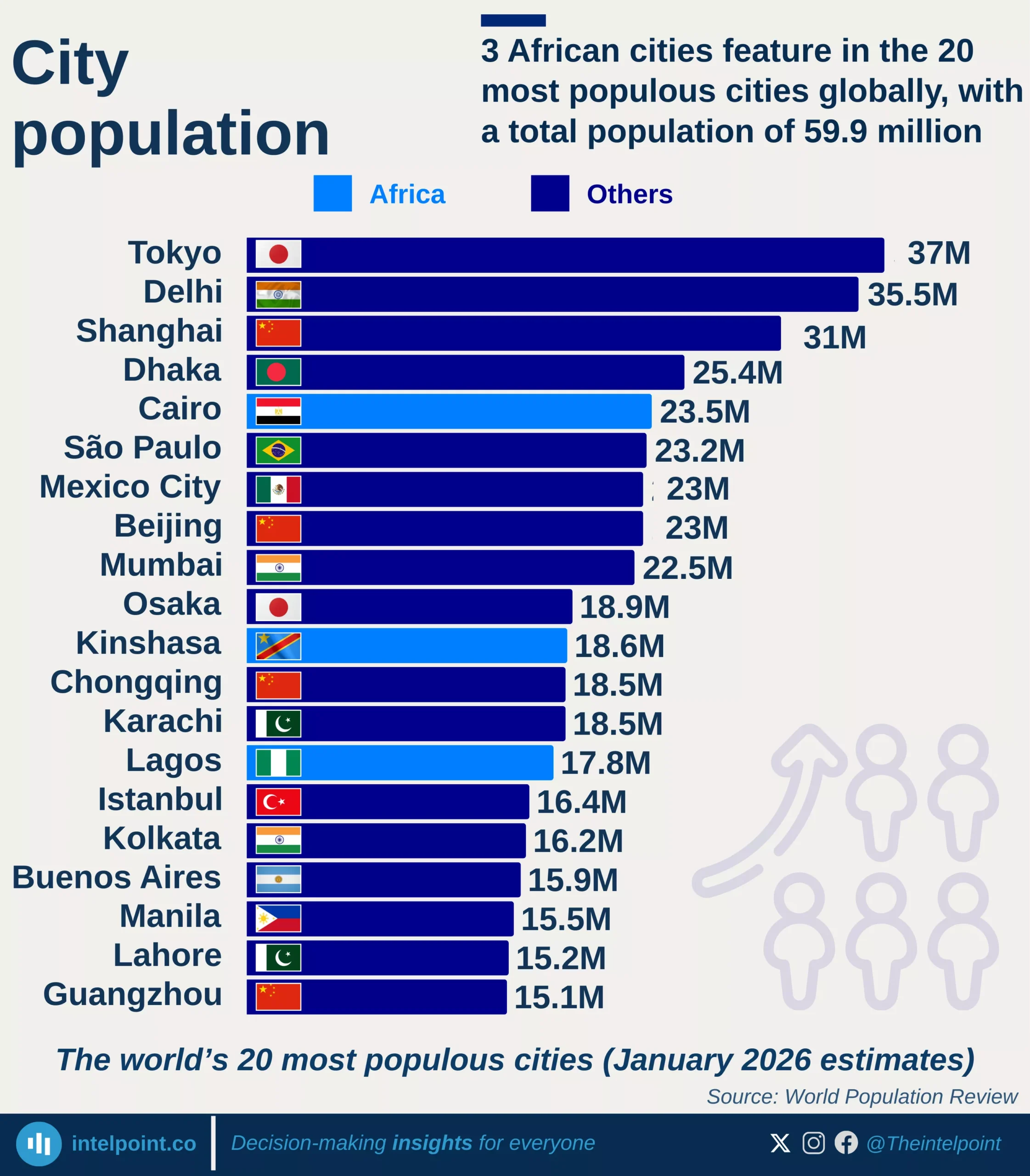
3 African cities feature in the 20 most populous cities globally, with a total population of 59.9 million
  • Together, the top three cities — Tokyo, Delhi, and Shanghai — have more than 100 million residents.
  • Asia dominates the ranking, with most of the top ten cities located on the continent.
  • Only three African cities — Cairo, Kinshasa, and Lagos — appear in the top 20.
  • Africa’s three mega-cities together account for nearly 60 million people, showing concentrated urban growth.
  • Urban population growth is driven by migration toward economic and commercial hubs.

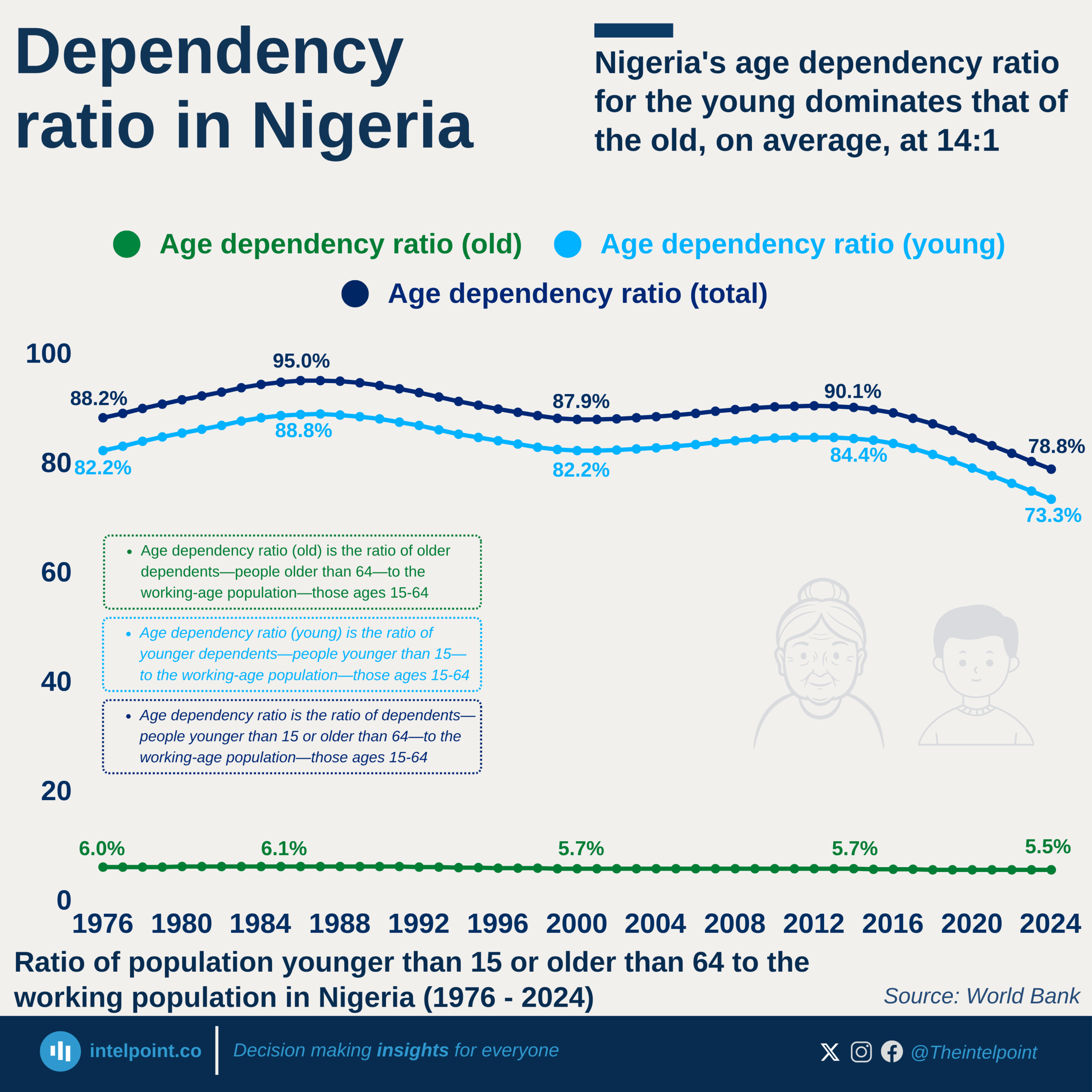
Nigeria's age dependency ratio for the young dominates that of the old, on average, at 14:1
  • The young-to-old dependency ratio stands at 14:1, showing that youth dependency overwhelmingly drives the total ratio.
  • The total dependency ratio declined from 88.2% in 1976 to 78.8% in 2024, showing slow but steady improvement.
  • The youth dependency ratio has dropped from 82.2% to 73.3% over the same period.
  • The old-age dependency ratio remained almost flat, averaging around 5–6% for nearly 50 years.
  • The highest total dependency ratio was 95.0% in 1988.
  • The ratio’s slight downward trend after 2012 reflects a growing working-age population entering the labour market.

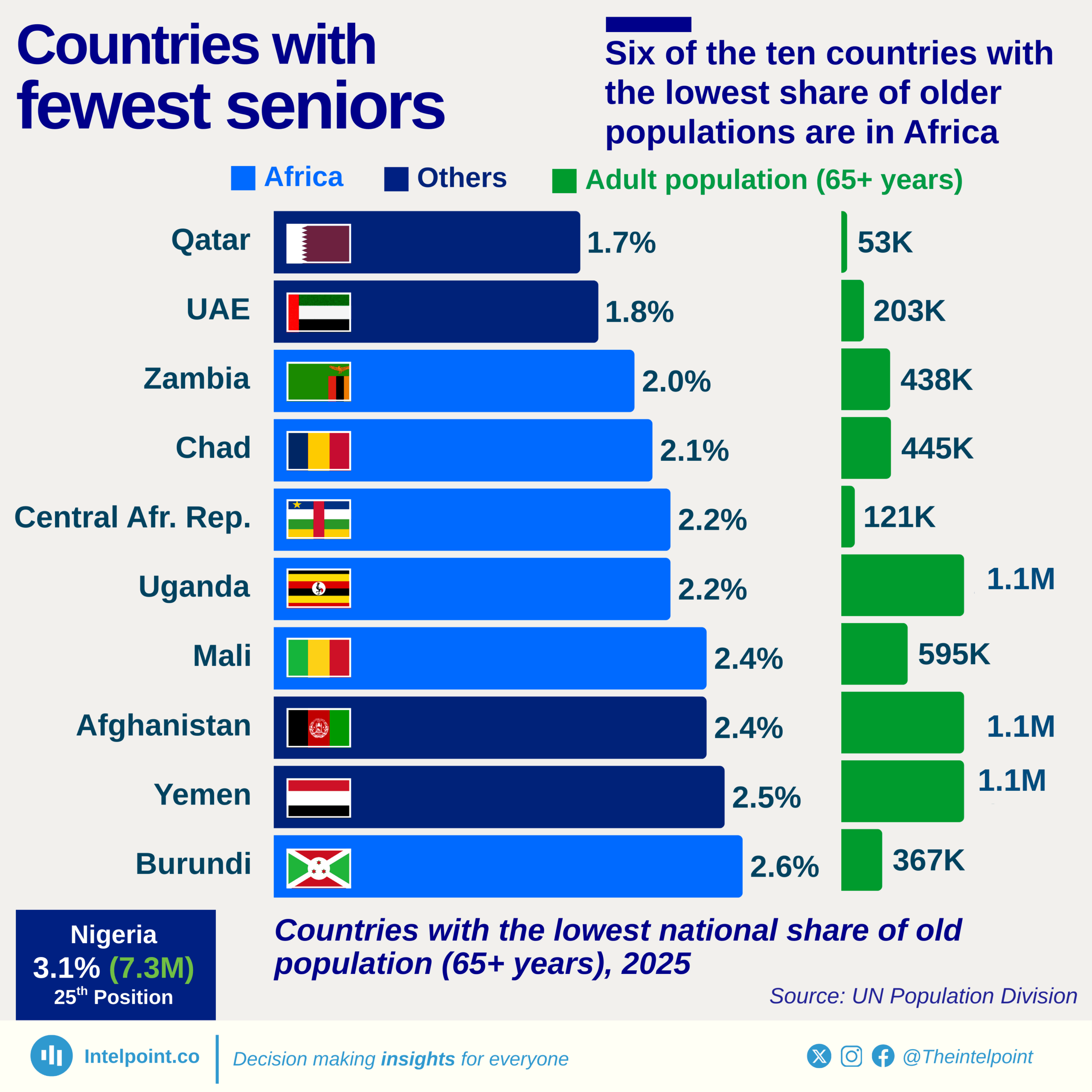
Six of the ten countries with the lowest share of older populations are in Africa
  • Qatar has the lowest share of seniors, with only 1.7% of its population aged 65+.
  • The UAE follows closely at 1.8%.
  • Zambia has 2.0% of its population aged 65 and above, totalling about 438,000 people.
  • Uganda, Chad, and the Central African Republic each have a senior population of around 2.1–2.2%, with totals exceeding 1 million seniors.
  • Qatar also has the smallest absolute number of seniors on the list—just 53,000 people.
  • Nigeria has 7.3 million seniors that represent only 3.1% of its population, ranking 25th worldwide.

At 38 years, Mauritius has the oldest median age among African countries
  • Mauritius, with a median age of 38 years, has the oldest population in Africa.
  • The Central African Republic has the youngest population, with a median age of 14 years.
  • Nigeria’s median age of 18 years reflects the dominance of youth in its population.
  • Older populations tend to signal lower fertility rates.
  • Younger populations highlight higher fertility rates and greater demand for education and jobs.

Over the last 76 years, Africa's population has increased from being less than half (228M) that of Europe to doubling Europe (1.6B)
  • Africa’s population grew by 580.4%, from 228M in 1950 to 1.6B in 2025, making it the fastest-growing continent.
  • Asia remains the most populated continent, reaching 4.8B people in 2025, up from 1.4B in 1950.
  • Europe’s growth has been the slowest, at just 35.6%, rising from 549M to 744M.
  • Latin America & the Caribbean grew by 298%, from 168M to 668M.
  • North America more than doubled its population, growing by 130.7% from 168M to 388M.
  • Oceania saw a 270% increase, though it remains the least populated continent at 47M people.
  • Africa’s population is now more than double Europe’s, a major demographic shift compared to 1950.

POPULAR TOPICS
SIGN UP TO OUR NEWSLETTER
Get periodic updates about the African startup space, access to our reports, among others.
Subscribe Here
Subscription Form

A product of Techpoint Africa. All rights reserved