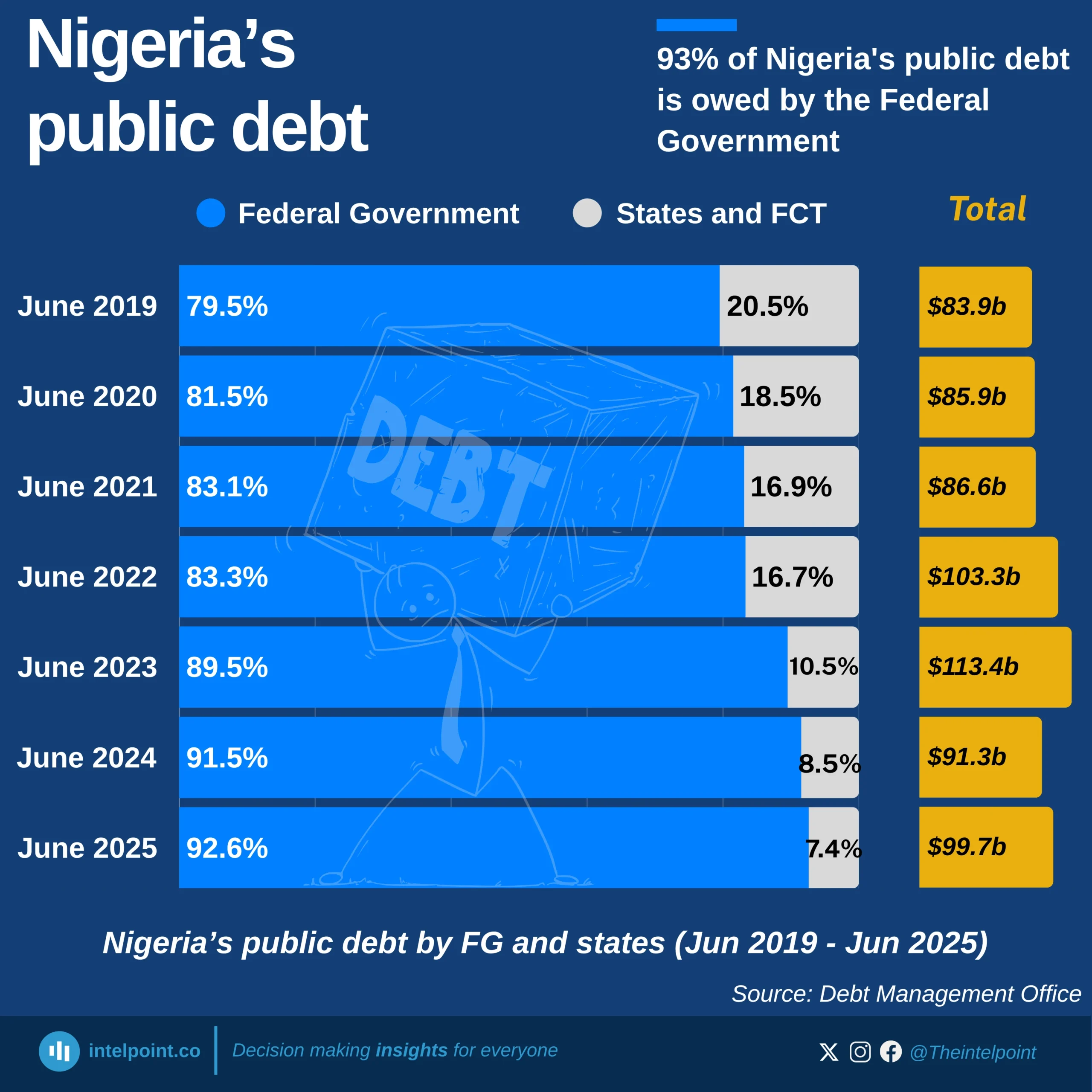
93% of Nigeria's public debt is owed by the Federal Government

Key Takeaways

  • The Federal Government’s share of total public debt rose from 79.5% in 2019 to 92.6% in 2025.
  • States’ share has more than halved, from 20.5% to 7.4% in six years.
  • Total public debt grew from $83.9 billion to $99.7 billion, peaking at $113.4 billion in 2023.
  • Nigeria’s debt burden is increasingly concentrated at the centre, amplifying federal repayment risks and reducing fiscal independence for states.

Over the last six years, Nigeria’s debt story has become more centralised. In 2019, the Federal Government owed roughly four-fifths of the country’s total debt, but by mid-2025, it owed more than nine-tenths. While total public debt climbed from $83.9 billion to $99.7 billion, state governments’ share shrank drastically.

This shift means borrowing power and pressure now sits firmly in the FCT. The states, once active borrowers for infrastructure and development, are now mostly dependent on federal allocations rather than credit markets. As a result, debt servicing decisions, interest risks, and repayment pressures are increasingly tied to the federal purse.

In short, Nigeria’s debt may be national but the burden is mostly federal.
Source:

Debt Management Office

Period:

June 2019 - June 2025
HTML code to embed chart
Want a bespoke report?
Reach out
Tags
Related Insights

The Nigeria Football Federation (NFF) is to receive 1.1% of the 2026 sports budget
  • The NFF’s allocation of ₦2.31 billion is under 1.1% of the total sports budget.
  • The National Sports Commission HQ gets the most, with ₦203.6 billion, over 96% of the total.
  • The National Institute for Sports is to receive ₦4.12 billion, highlighting minimal federal investment in sports development.
  • Budget heavily favours administration over football development and grassroots programs.

Lagos had one licensed cinema for every 337,000 people in 2025
  • Lagos alone hosts 51 licensed cinemas, accounting for over half of all exhibition premises in the dataset.
  • The next three states—Ogun, FCT, and Rivers—combined have just 30 cinemas.
  • Only five states have five or more licensed cinemas, highlighting strong geographic concentration.
  • Several large states have two cinemas or fewer, pointing to limited formal exhibition infrastructure outside key urban hubs.

Nigeria beats Egypt to win AFCON bronze medal, extending its record to nine third-place finishes
  • Nigeria extends its AFCON bronze medal wins to nine, the highest in men’s AFCON history, with another podium finish.
  • The win over Egypt highlights Nigeria’s resilience, turning late-stage setbacks into tangible success.
  • Bronze medals remain rare for most nations, with the majority appearing only once or twice in AFCON history.

10 Nigerian states and the FCT cut their external debt by a combined $227.19 million in H1 2025
  • Ten states and the FCT collectively reduced their external debt by $227.19 million in H1 2025.
  • Lagos, Edo, and Rivers accounted for most of the reductions, making up more than three-quarters of the total.
  • Several smaller states also trimmed their balances, but by relatively modest amounts.
  • These reductions significantly offset the increases recorded by 26 other states, helping keep nationwide net external debt growth low.

26 Nigerian states added a combined $239m to their external debt in H1 2025
  • 26 states increased their external debt by a combined $239 million in H1 2025.
  • Imo, Oyo, Kaduna, Enugu, and Ogun recorded the biggest increases.
  • 11 states, including the FCT, reduced their debt through higher repayments.
  • Lagos, Edo, Rivers, and Bauchi accounted for most of the $227 million in reductions.
  • Total state external debt rose only slightly, from $4.8 billion to $4.812 billion.

Nigeria’s power grid is 69.9% powered by thermal plants
  • Thermal energy dominates Nigeria’s grid, supplying 69.9% of total power.
  • Hydro plants contribute 30.1%, making them the country’s second major source.
  • The heavy reliance on thermal generation shows Nigeria’s grid is still largely fossil-fuel driven.
  • Hydro remains a crucial but secondary source, supporting overall supply stability.

POPULAR TOPICS
SIGN UP TO OUR NEWSLETTER
Get periodic updates about the African startup space, access to our reports, among others.
Subscribe Here
Subscription Form

A product of Techpoint Africa. All rights reserved