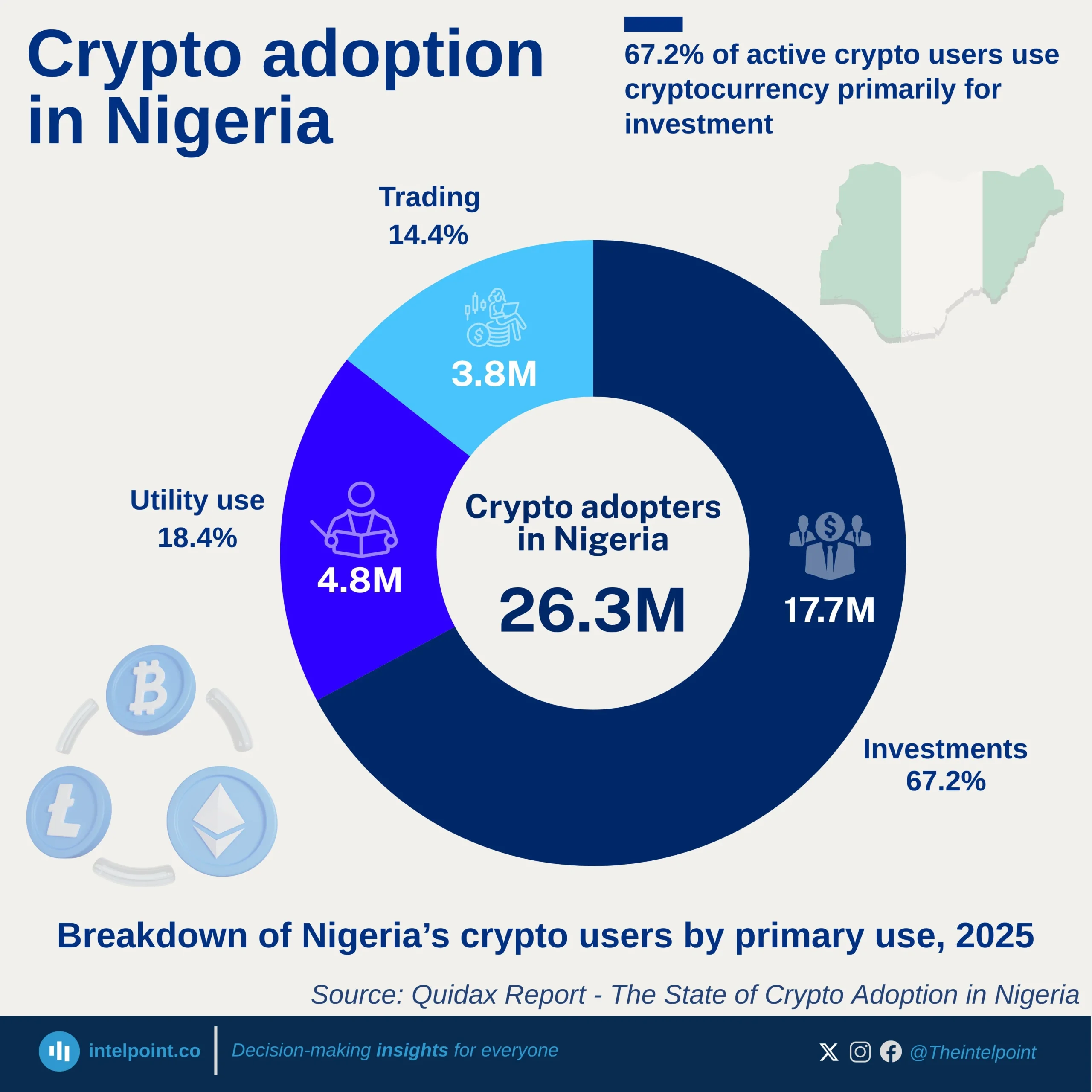
67.2% of active crypto users use cryptocurrency primarily for investment

Key Takeaways

  • A majority (67.2%) of Nigerian crypto users (17.7 million people) use digital assets mainly for investment and long-term financial growth.
  • Overall, 26.34 million Nigerians—over one in eight adults—actively use or hold cryptocurrency, giving the country the highest adoption rate globally.
  • About 18.4% (4.8 million) use crypto for everyday needs such as remittances, payments, and inflation protection.
  • 14.4% (3.8 million) identify as active traders, providing liquidity and earning income through market participation.

According to Quidax’s 2025: State of crypto adoption in Nigeria report, cryptocurrency in Nigeria has matured into a mainstream investment vehicle rather than a speculative fad. With 26.34 million active users, the majority engage in investment, viewing crypto as a path to long-term financial stability and diversification beyond traditional banking. Meanwhile, utility use focuses on practical applications such as payments, remittances, and inflation protection, while trading continues to sustain market activity through regular buying and selling. This balance of investment confidence, practical utility, and active trading cements Nigeria’s position as a global leader in digital asset engagement.

Source:

Quidax Report - The State of Crypto Adoption in Nigeria

Period:

2025
HTML code to embed chart
Want a bespoke report?
Reach out
Tags
Related Insights

Nigeria’s power grid is 69.9% powered by thermal plants
  • Thermal energy dominates Nigeria’s grid, supplying 69.9% of total power.
  • Hydro plants contribute 30.1%, making them the country’s second major source.
  • The heavy reliance on thermal generation shows Nigeria’s grid is still largely fossil-fuel driven.
  • Hydro remains a crucial but secondary source, supporting overall supply stability.

Nigeria's DisCos recorded ₦360bn revenue gap after collecting ₦1.12tn from ₦1.49tn billed in H1 2025
  • DisCos billed approximately ₦1.49 trillion but collected only ₦1.12 trillion in H1 2025.
  • Ikeja and Eko DisCos generated the highest revenues, collecting ₦206.22 billion and ₦210.59 billion, respectively.
  • Revenue collection gaps remain significant, with Jos, Kaduna, and Yola posting the weakest collection performances.
  • The wide gap between billings and actual collections suggests persistent challenges in customer payment compliance, metering, and distribution efficiency.

Nigeria has installed 3.65 million electricity metres since 2019; Ikeja DisCo leads with 823,000, and Aba Power at the bottom with 56,000
  • Approximately 3.65 million metres have been installed nationwide across all frameworks since 2019.
  • Ikeja DisCo leads by a wide margin with 823,000 installations, over twice the volume of most other DisCos.
  • Kaduna, Yola, and Aba Power recorded the lowest metre installations, each below 100,000.
  • The disparities in installation totals reveal uneven progress in achieving nationwide metering coverage.

More than 8 in 10 electricity customers of Ikeja and Eko DisCos are now metered
  • Ikeja (84.6%) and Eko (83.3%) lead Nigeria’s metering performance, keeping unmetered customers below 17%.
  • Eight out of the twelve DisCos have metering rates below 60%, showing a wide sector imbalance.
  • The worst-performing DisCos — Yola, Jos, Kaduna, and Kano — have over 65% unmetered customers.
  • Regional disparities are sharp: Lagos and Abuja outperform northern and south-eastern DisCos by large margins.

Stablecoins are the most frequently transacted asset for outbound payments among Nigerian users (38.3%), outpacing bitcoin (27.3%)
  • Stablecoins lead the market, accounting for 38.3% of all crypto sent, highlighting Nigerians’ preference for stability and dollar-backed assets.
  • Bitcoin ranks second at 27.3%, showing it remains a major channel for store-of-value transfers and remittances.
  • Altcoins like SOL, ADA, SHIB, and DOGE (15.4%) attract younger and experimental users but remain secondary to stable assets.
  • Ethereum (10.2%) and BNB (8.9%) maintain moderate transaction volumes, suggesting users favor low-fee and widely accepted tokens for transfers.

Over 40% of surveyed Nigerian crypto users are students
  • Students are the largest crypto-holding group (43.6%), underscoring the youthful nature of Nigeria’s crypto community and their early adoption of digital finance.
  • Entrepreneurs follow closely (25.7%), showing strong participation from self-employed Nigerians, traders, business owners, and hustlers who use crypto for investment and business flexibility.
  • Traditional employees make up 17.4%, indicating growing acceptance of crypto beyond informal or youth circles, even among salary earners.
  • Freelancers and gig workers (5.6%) also feature, reflecting crypto’s role in global online work and cross-border earnings. Unemployed and retired individuals remain a small minority, under 3.5% combined.

POPULAR TOPICS
SIGN UP TO OUR NEWSLETTER
Get periodic updates about the African startup space, access to our reports, among others.
Subscribe Here
Subscription Form

A product of Techpoint Africa. All rights reserved