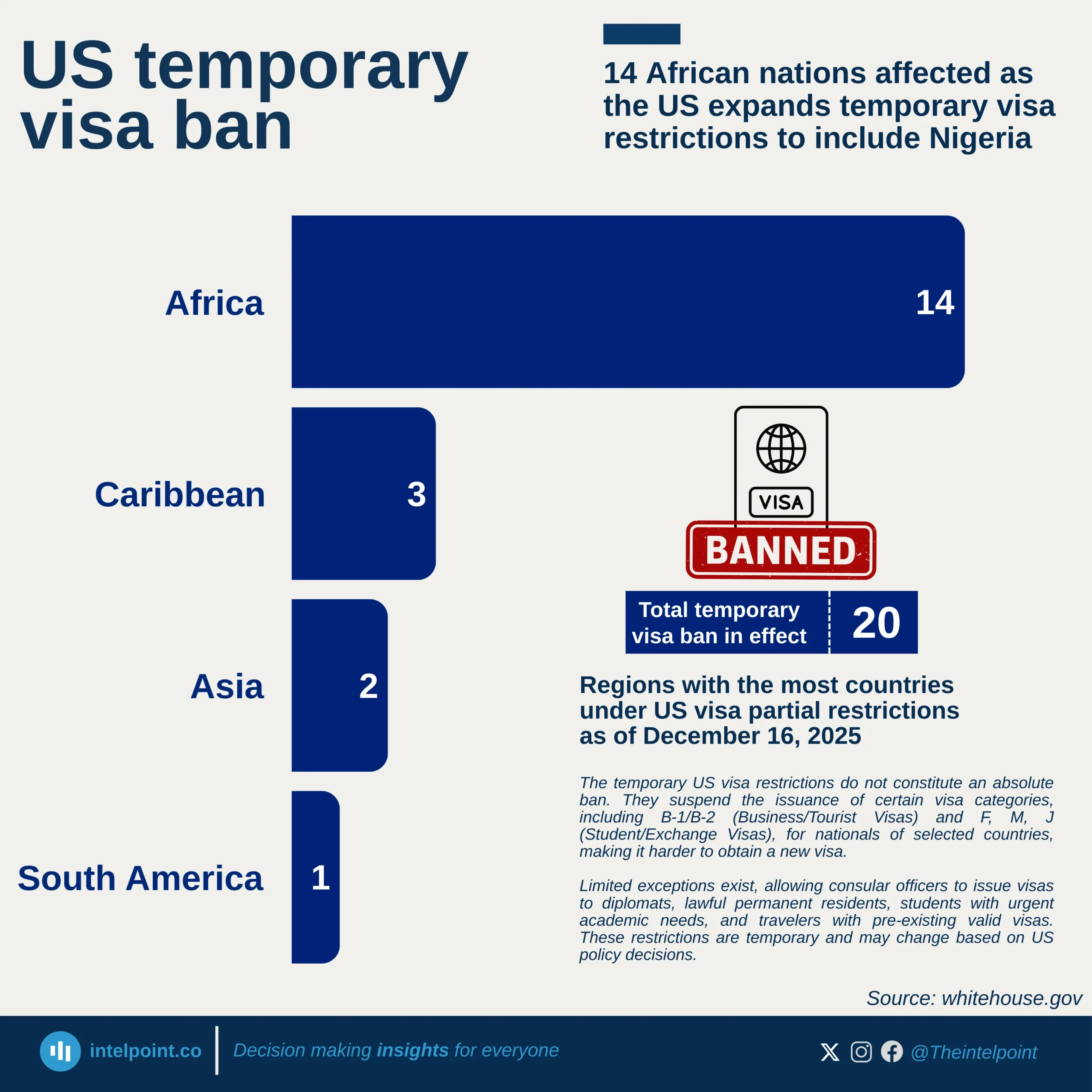
14 African nations affected as the US expands temporary visa restrictions to include Nigeria

Key Takeaways

  • Africa is the hardest-hit region, with 14 countries under partial visa restrictions, including Nigeria, limiting travel for business, tourism, and study.
  • Temporary bans target B‑1/B‑2 visas for business and tourism, and may also affect F‑1 student, M‑1 vocational, and J exchange visitor visas, impacting students, trainees, and cultural exchange participants.
  • Other affected regions include the Caribbean, Asia, and South America, showing the temporary restrictions span multiple continents.
  • Exemptions exist for lawful permanent residents, diplomats, and travellers with valid pre-existing visas, so not all citizens from these countries are blocked from entering the US.

As of December 2025, the US imposed temporary restrictions on B‑1/B‑2 Business and Tourist Visas, F‑1 Student Visas, M‑1 Vocational Student Visas, and J Exchange Visitor Visas for 20 countries, making it harder for nationals to obtain new visas. The restrictions do not constitute an absolute ban; those holding valid visas, lawful permanent residents, diplomats, and other travellers under narrow exemptions may still enter the US.

The affected African countries are Angola, Benin, Burundi, Côte d’Ivoire, Gabon, Gambia, Malawi, Mauritania, Nigeria, Senegal, Tanzania, Togo, Zambia, and Zimbabwe. In the Caribbean, Antigua and Barbuda, Dominica, and Cuba are affected. Asian countries under temporary restrictions include Turkmenistan and Tonga, while South America is represented by Venezuela.

The temporary ban primarily suspends the new issuance of these visas, affecting business travellers, tourists, students, and exchange visitors. Africa is the most impacted region, highlighting the continued focus of US policy on selective travel restrictions while still allowing exceptions under specific circumstances.
Source:

whitehouse.gov

Period:

December 16, 2025
HTML code to embed chart
Want a bespoke report?
Reach out
Tags
Related Insights

14 African nations affected as the US expands temporary visa restrictions to include Nigeria
  • Africa is the hardest-hit region, with 14 countries under partial visa restrictions, including Nigeria, limiting travel for business, tourism, and study.
  • Temporary bans target B‑1/B‑2 visas for business and tourism, and may also affect F‑1 student, M‑1 vocational, and J exchange visitor visas, impacting students, trainees, and cultural exchange participants.
  • Other affected regions include the Caribbean, Asia, and South America, showing the temporary restrictions span multiple continents.
  • Exemptions exist for lawful permanent residents, diplomats, and travellers with valid pre-existing visas, so not all citizens from these countries are blocked from entering the US.
 

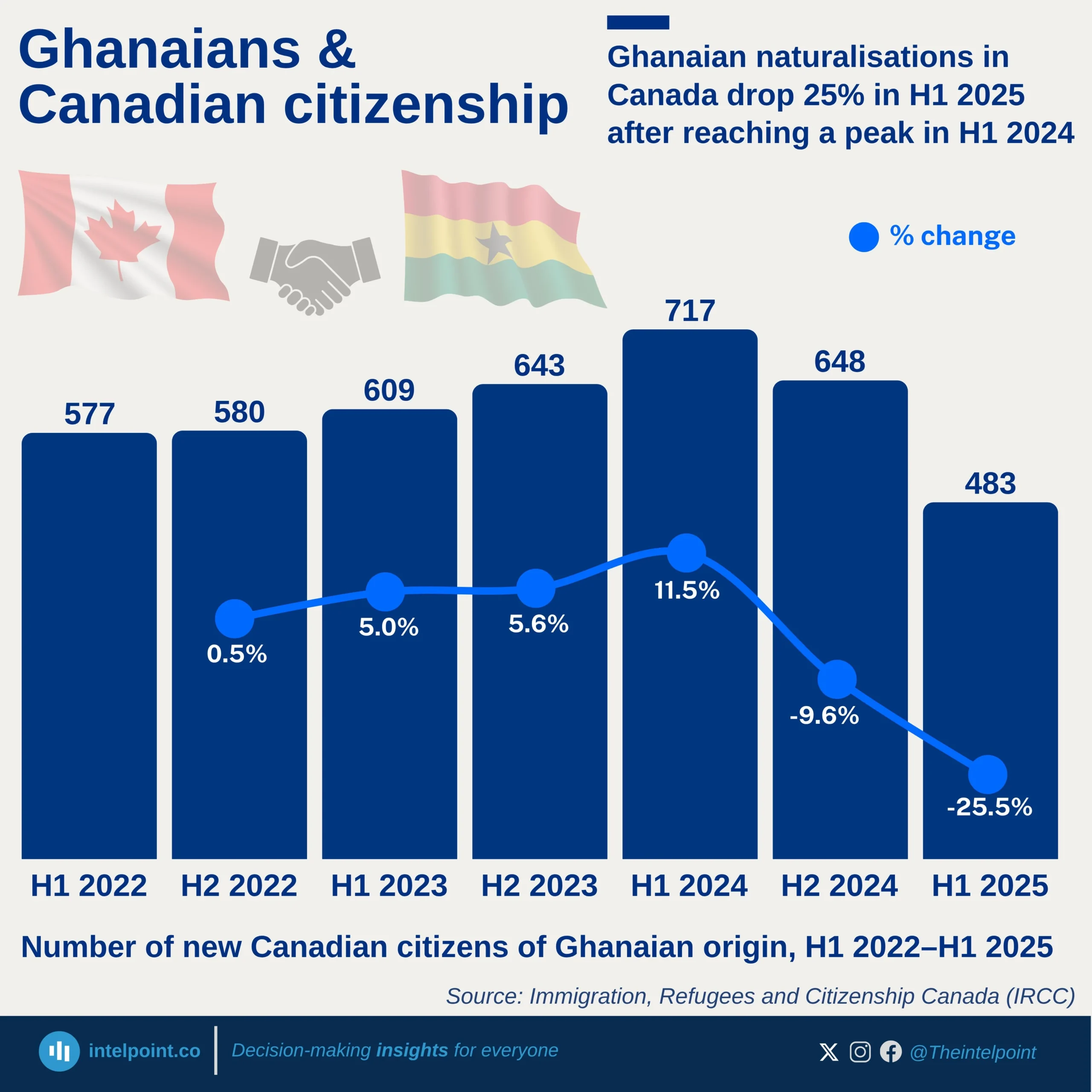
Ghanaian naturalisations in Canada drop 25% in H1 2025 after reaching a peak in H1 2024
  • Naturalisations rose consistently from 577 in H1 2022 to 717 in H1 2024, marking a 24% rise over two years.
  • The 11.5% increase recorded that period was the strongest half-year growth across the timeline.
  • Numbers fell 25.5% in H1 2025, the steepest half-on-half drop since tracking began.
  • Despite the recent fall, total naturalisations remain above early 2022 levels, signalling sustained long-term growth.

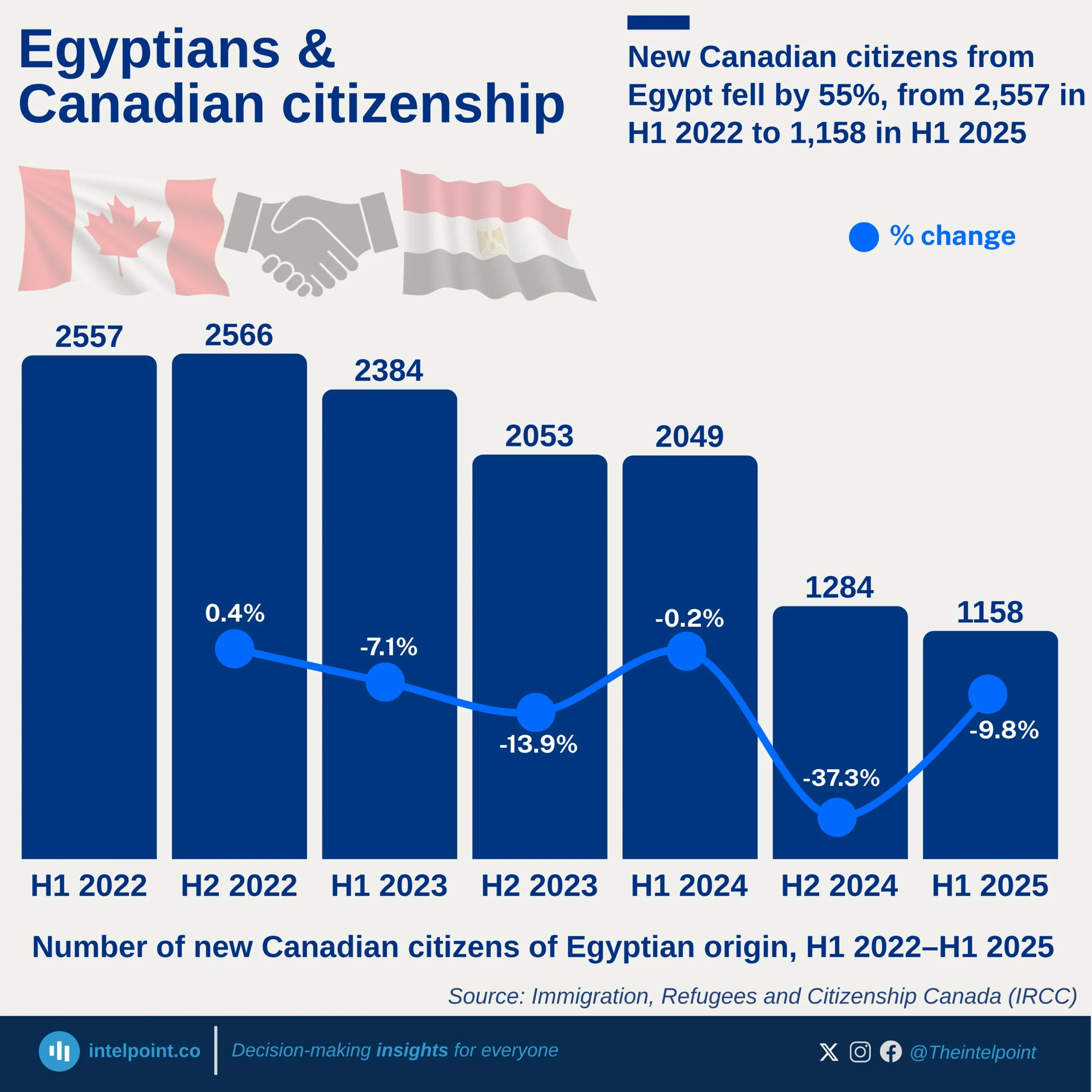
New Canadian citizens from Egypt fell by 55%, from 2,557 in H1 2022 to 1,158 in H1 2025
  • The number of new Canadian citizens born in Egypt fell 9.8% in H1 2025, reaching 1,158, down from 1,284 in late 2024.
  • The steepest half-on-half fall came in H2 2024 (-37.3%), signalling the start of a more sustained slowdown.
  • Compared with the 2022 peak of 2,566, current levels are down 55%, marking a continuous decline since mid-2022.
  • Despite the multi-year decline, the smaller 9.8% decrease in H1 2025 suggests the rate of decline may be easing.

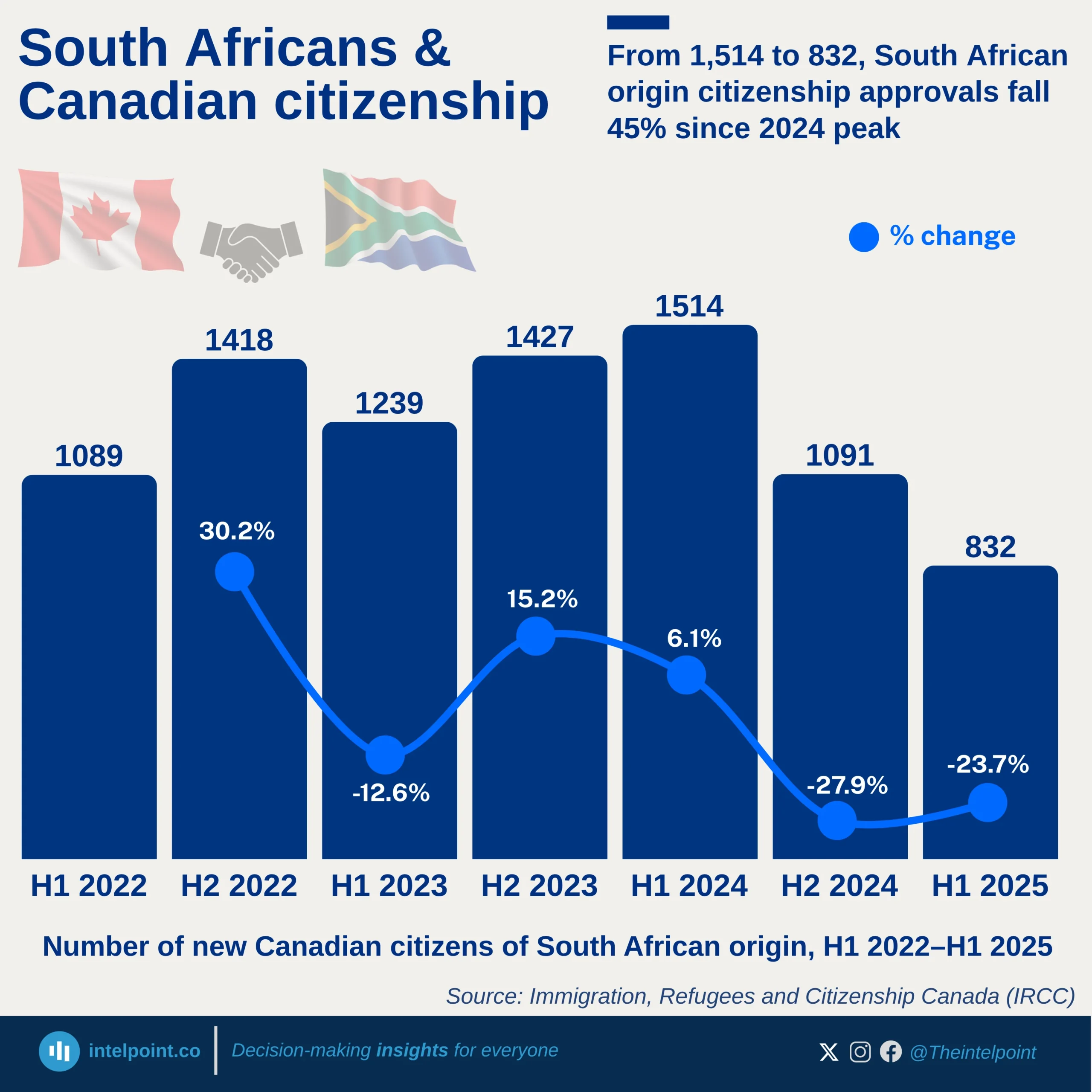
From 1,514 to 832, South African origin citizenship approvals fall 45% since 2024 peak
  • H1 2025 recorded 832 new Canadian citizens of South African origin, down 23.7% from H2 2024 (1,091).
  • The first half of 2024 marked the highest level of approvals (1,514) in the past four years.
  • H1 2025 is 24% below H1 2022’s 1,089, the second lowest number in the period.
  • The data shows average half-on-half change of ±19%, reflecting strong fluctuations in migration and processing patterns.

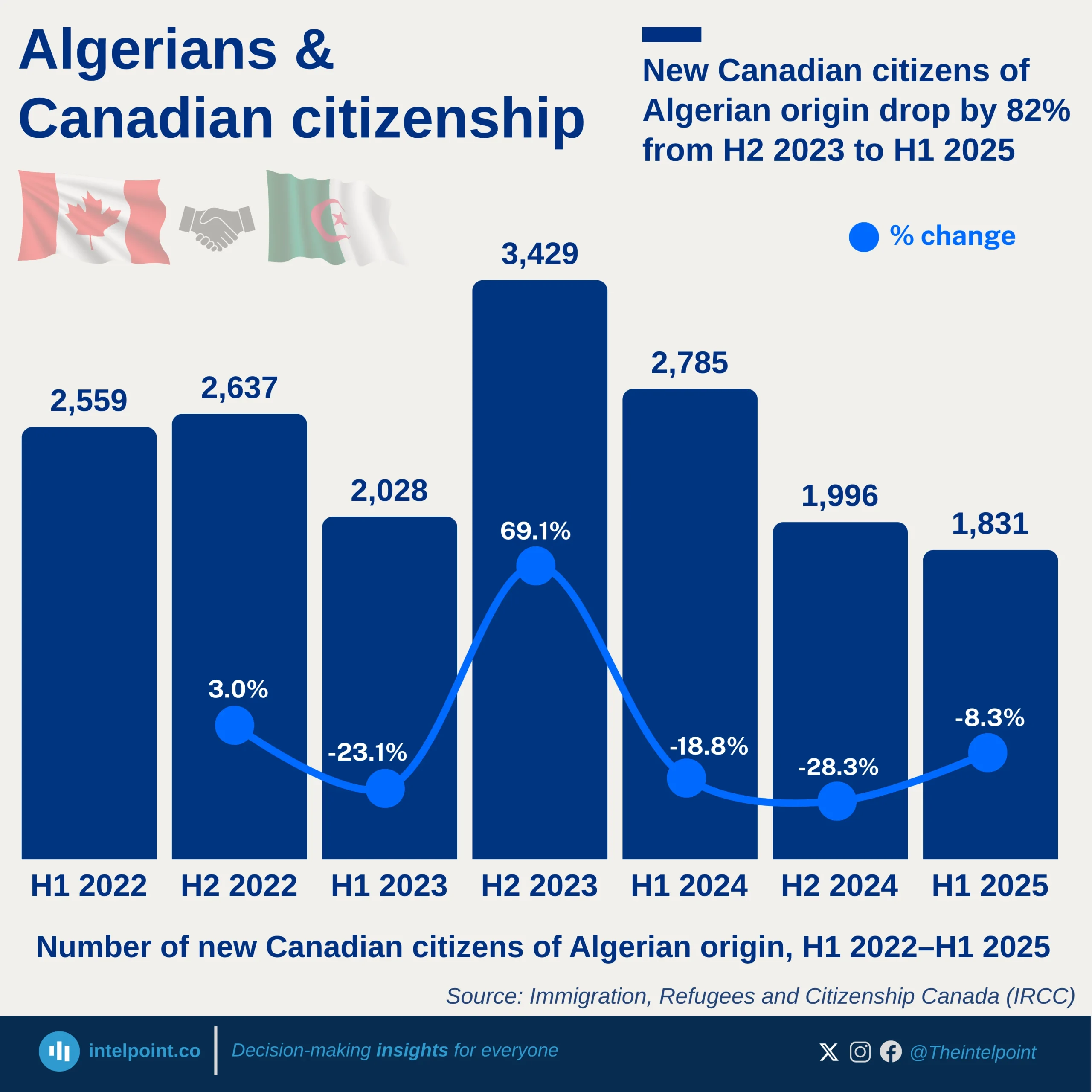
New Canadian citizens of Algerian origin drop by 82% from H2 2023 to H1 2025
  • Algeria’s naturalisation figures in Canada showed major volatility, swinging between sharp increases and declines across half-year periods.
  • The number of new citizens peaked at 3,429 in H2 2023, representing a 69.1% surge from the preceding half year.
  • Following the 2023 peak, figures fell by 18.8% in H1 2024 and another 8.3% in H1 2025, showing a sustained downward correction.
  • Between H1 2022 (2,559) and H1 2025 (1,831), naturalisations dropped by roughly 28%, suggesting reduced inflow or slower application approvals among Algerian residents.

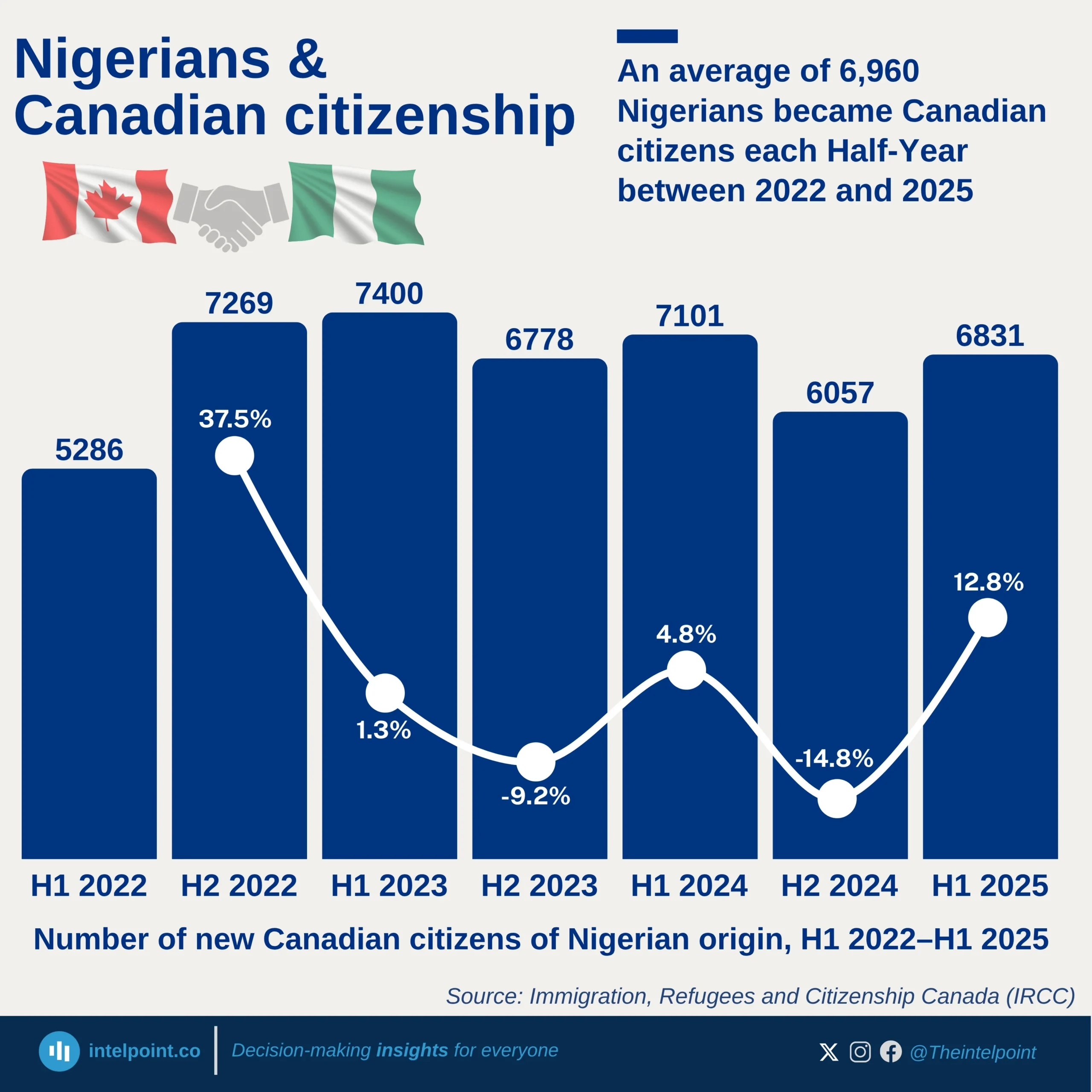
An average of 6,960 Nigerians became Canadian citizens each Half-Year between 2022 and 2025
  • Nigerian naturalisations in Canada rose from 5,286 in H1 2022 to 6,831 in H1 2025, a 29% increase overall.
  • H1 2023 marked the highest level with 7,400 new citizens.
  • Numbers declined through 2024, bottoming at 6,057 in H2.
  • The rebound in H1 2025 signals sustained interest in Canadian citizenship among Nigerians.

POPULAR TOPICS
SIGN UP TO OUR NEWSLETTER
Get periodic updates about the African startup space, access to our reports, among others.
Subscribe Here
Subscription Form

A product of Techpoint Africa. All rights reserved