Bite-sized Insights about
 
Providing you with data-based insights about things happening around you.
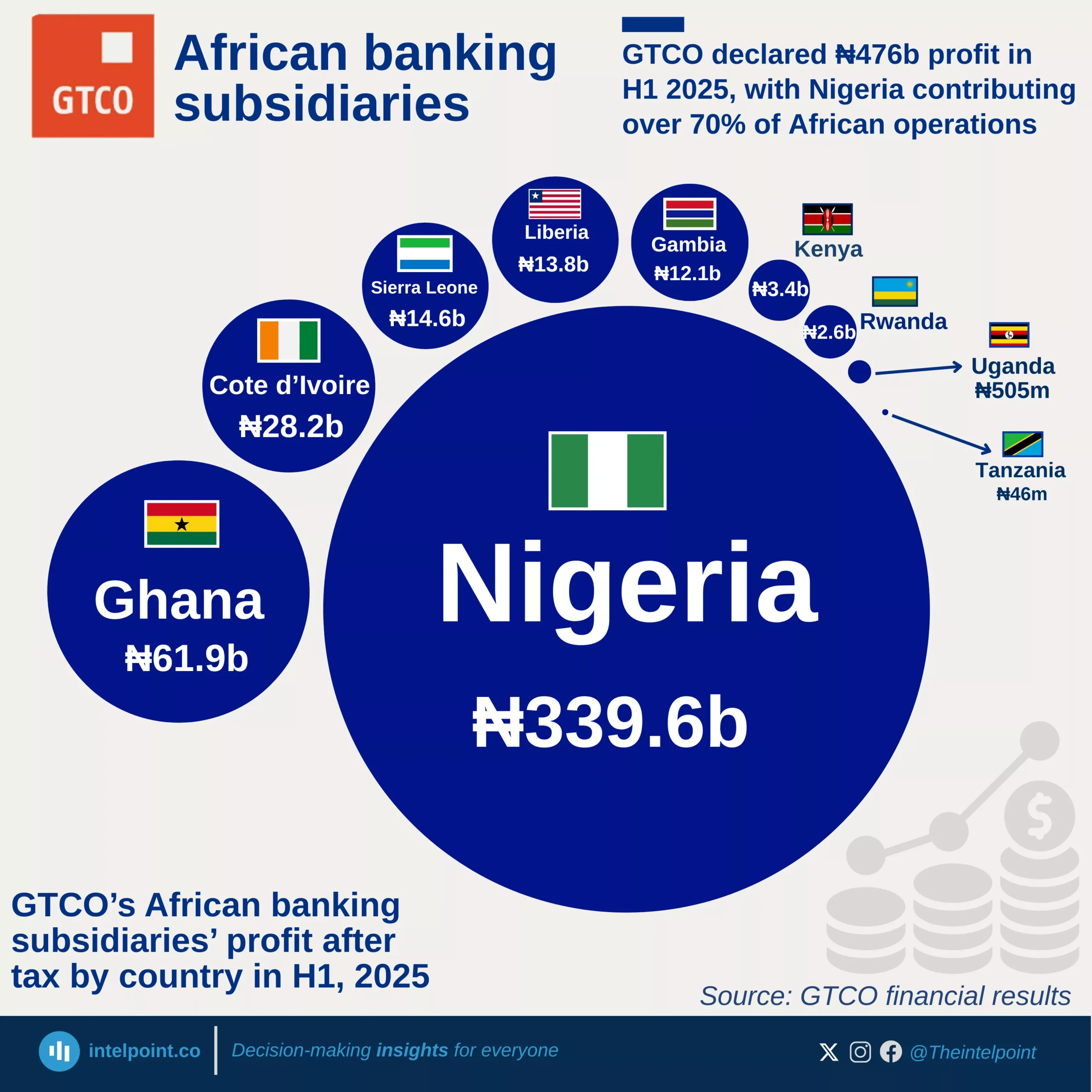
GTCO declared ₦476b profit in H1 2025, with Nigeria contributing over 70% of African operations
  • Nigeria dominates with ₦339.6b, contributing over 70% of GTCO’s total profit after tax in Africa.
  • Ghana (₦61.9b) and Côte d’Ivoire (₦28.2b) followed as the strongest non-Nigerian subsidiaries.
  • Tanzania (₦46m) and Uganda (₦505m) contributed negligible profits compared to peers.
  • GTCO subsidiaries across Africa collectively generated around ₦476b profit after tax in the first half of 2025.

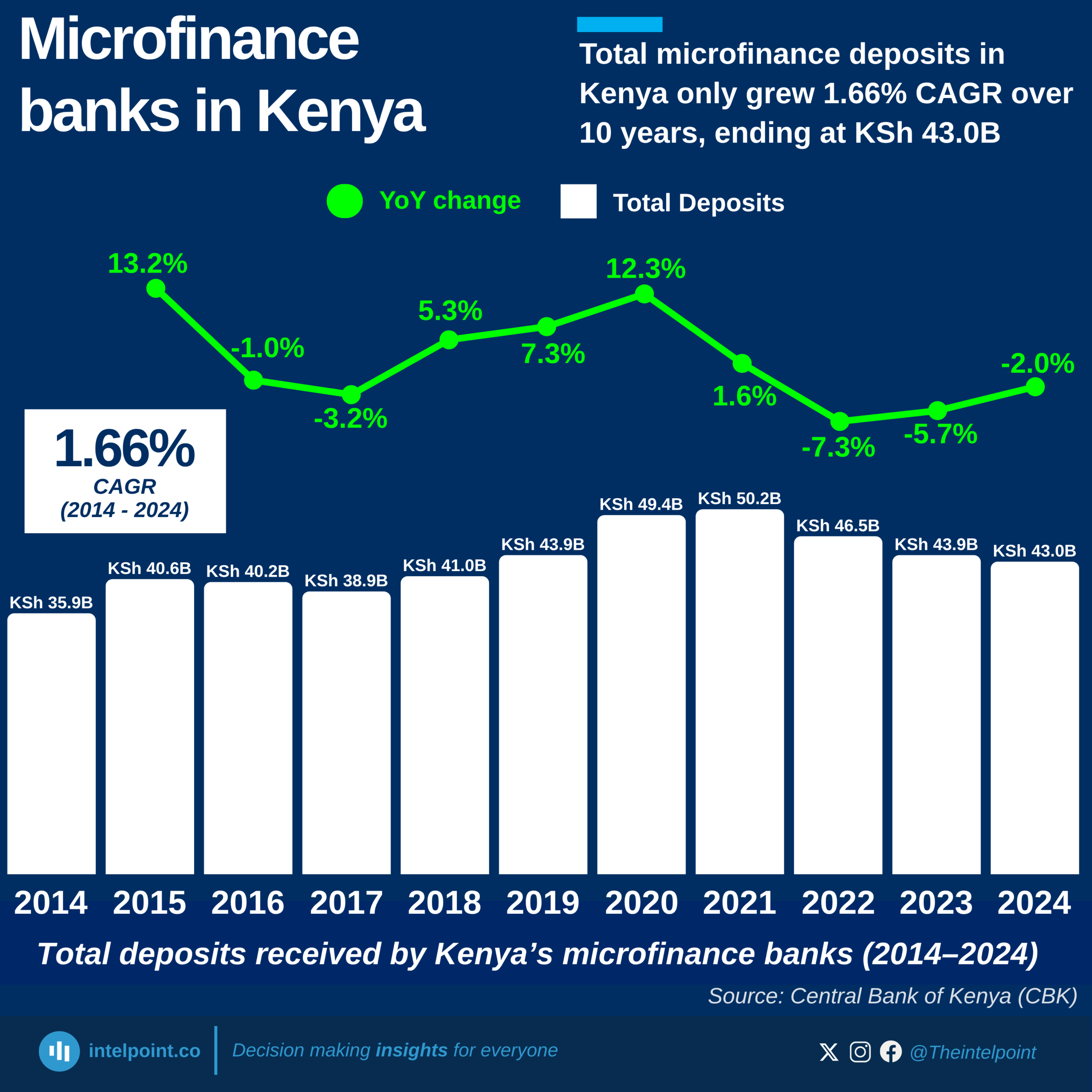
Total microfinance deposits in Kenya only grew 1.66% CAGR over 10 years, ending at KSh 43.0B
  • Microfinance deposits in Kenya grew at only 1.66% CAGR between 2014 and 2024.
  • The peak occurred in 2021 at KSh 50.2B, after which deposits began a steady decline.
  • 2015 (+13.2%) and 2020 (+12.3%) posted the strongest year-on-year growth rates.
  • The sector saw consecutive contractions from 2022 (-7.3%), 2023 (-5.7%), to 2024 (-2.0%).
  • Despite small rebounds in 2018 (+7.3%) and 2019 (+12.3%), the long-term trend is weak.

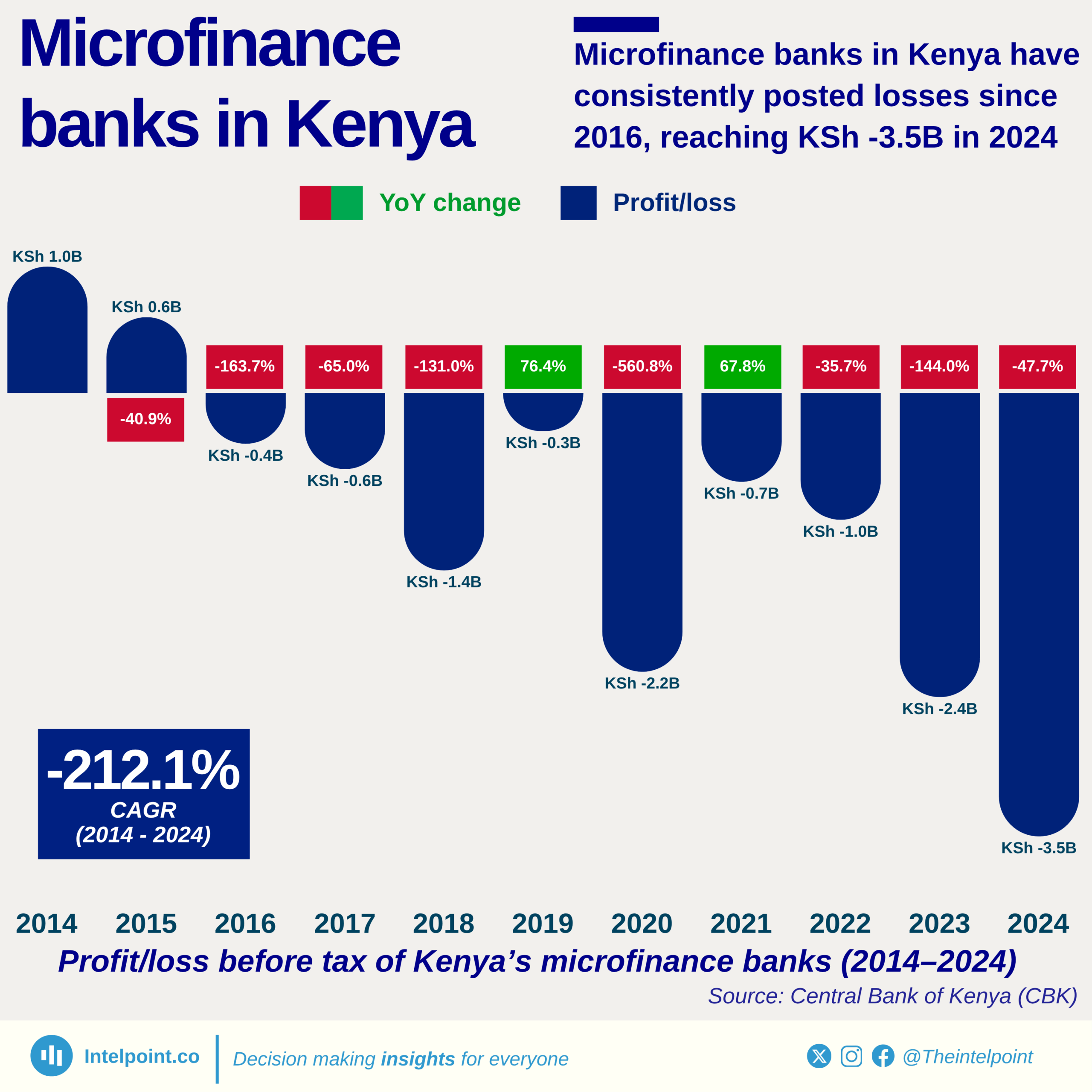
Microfinance banks in Kenya have consistently posted losses since 2016, reaching KSh -3.5B in 2024
  • Microfinance banks in Kenya recorded their last profit in 2015 (KSh 0.6B) before sliding into losses.
  • The sector’s losses deepened from KSh -0.4B in 2016 to KSh -3.5B in 2024.
  • The steepest single-year decline occurred in 2020, when losses increased by 560.8% to KSh -2.2B.
  • Even in recovery years like 2019 (KSh -0.3B) and 2021 (KSh -0.7B), the sector remained in losses.
  • Over the 10 years, profitability fell at a -212.1% CAGR, reflecting a structural collapse.
  • Since 2016, there has been no single year of profit, highlighting sustained weakness.
  • The worsening losses mirror other sector struggles, such as stagnant deposits, weak asset growth, and rising NPLs.

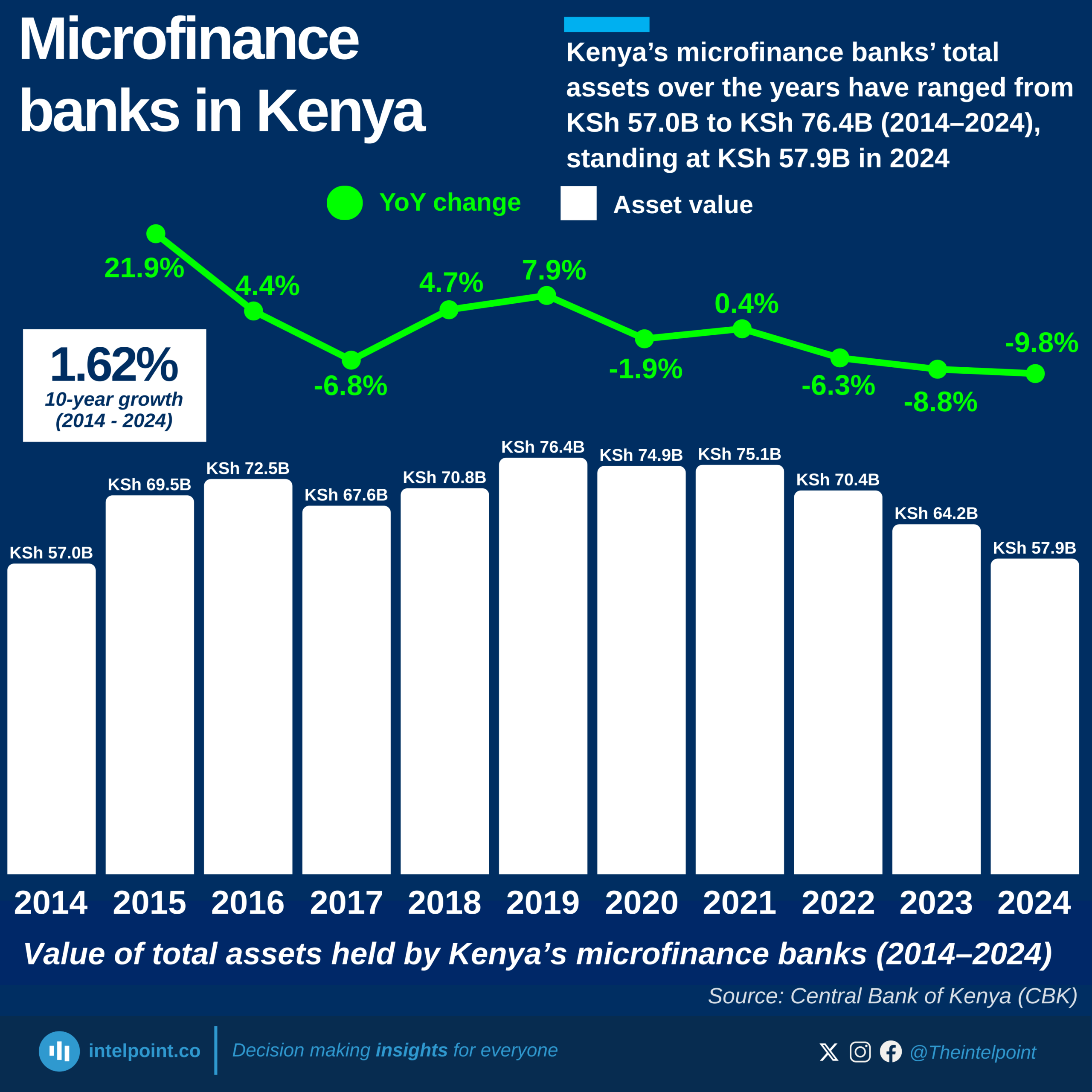
Kenya’s microfinance banks’ total assets over the years have ranged from KSh 57.0B to KSh 76.4B (2014–2024), standing at KSh 57.9B in 2024
  • Kenya’s microfinance assets grew by just 1.62% between 2014 and 2024.
  • The sector peaked in 2019 at KSh 76.4B, before entering a steady decline.
  • 2023 (-8.8%) and 2024 (-9.8%) posted the steepest year-on-year declines.
  • The sector recorded only two notable growth spikes: 2015 (+21.9%) and 2019 (+7.9%).
  • Overall, the trend from 2020 onward shows persistent contraction in asset value.

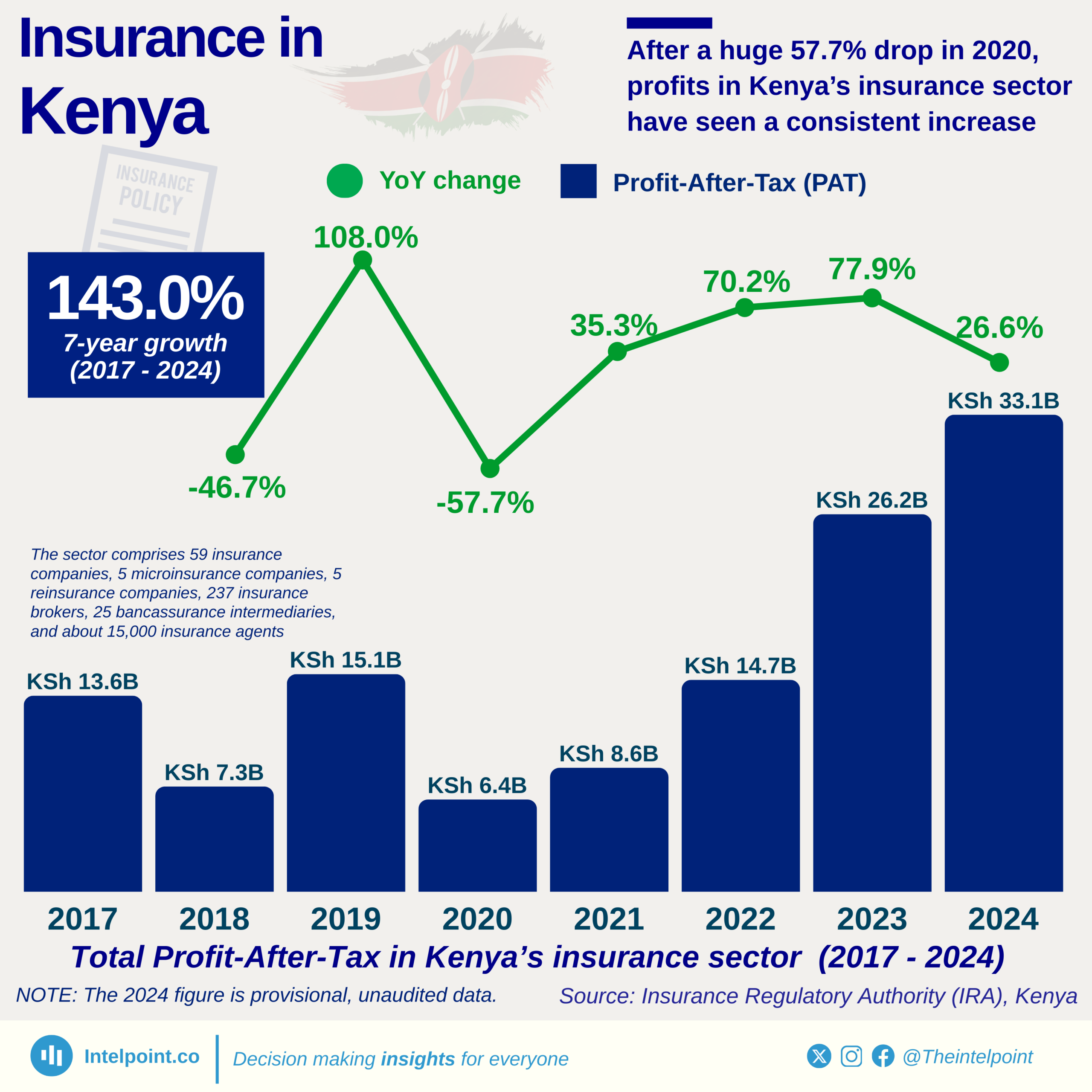
After a huge 57.7% drop in 2020, profits in Kenya’s insurance sector have seen a consistent increase
  • Kenya’s insurance sector PAT grew by 143% between 2017 and 2024.
  • The lowest point came in 2020, with profits dropping 57.7% to KSh 6.4B.
  • A sharp rebound followed, with profits rising steadily each year from 2021 to 2024.
  • The strongest yearly growth was in 2019, with a 108% surge in profits.
  • By 2024, PAT stood at KSh 33.1B, the highest in the seven-year period.
  • Profits more than quadrupled from 2020 (KSh 6.4B) to 2024 (KSh 33.1B).

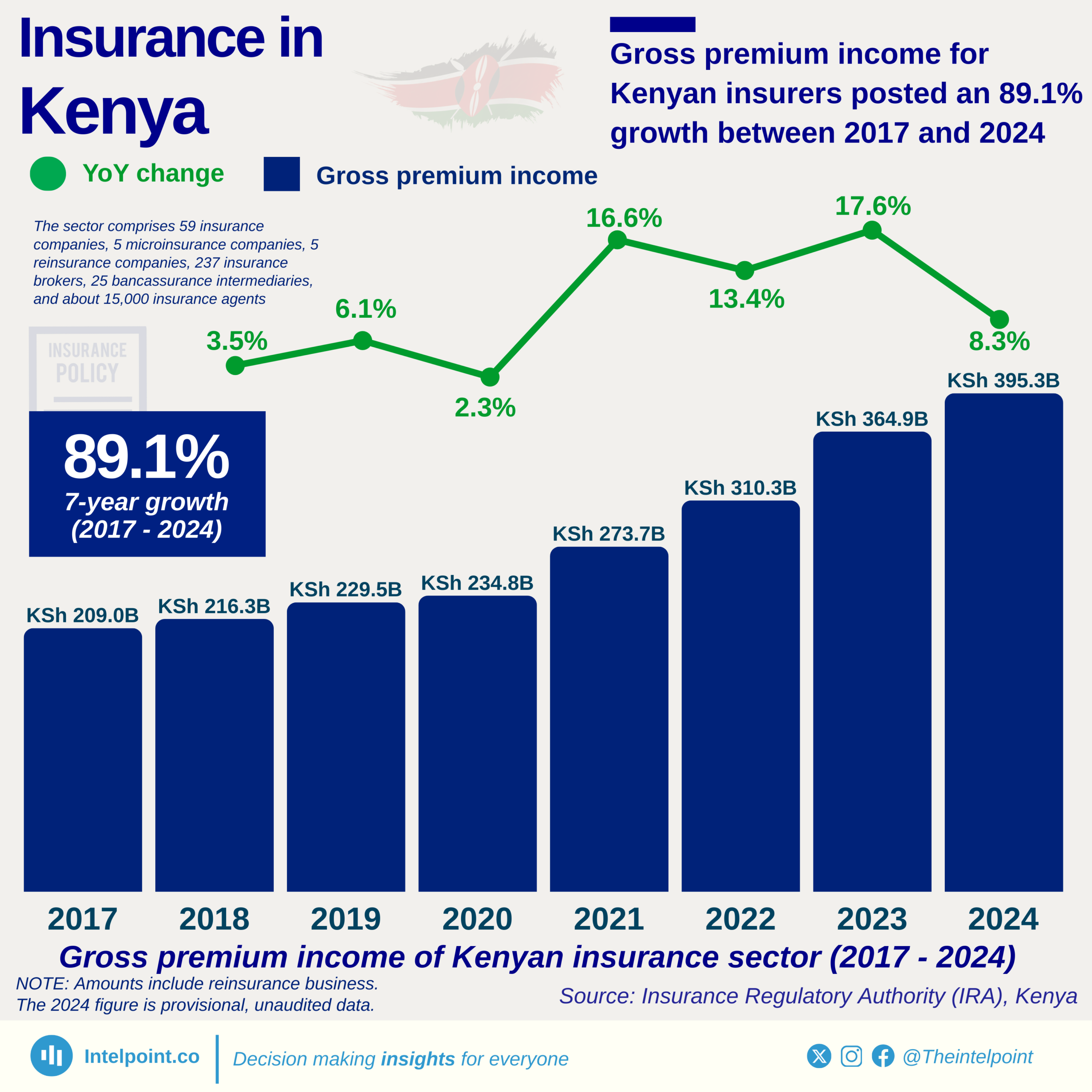
Gross premium income for Kenyan insurers posted an 89.1% growth between 2017 and 2024
  • Gross premium income in Kenya’s insurance sector grew by 89.1% between 2017 and 2024.
  • Premiums rose from KSh 209.0B in 2017 to KSh 395.3B in 2024.
  • The most substantial annual growth occurred in 2023 at 17.6%.
  • 2021 also recorded a significant rise of 16.6% growth.
  • The slowest growth was observed in 2020, at just 2.3%, likely reflecting the impact of the pandemic.
  • Despite fluctuations, the sector has maintained an upward growth trajectory across the 7 years.

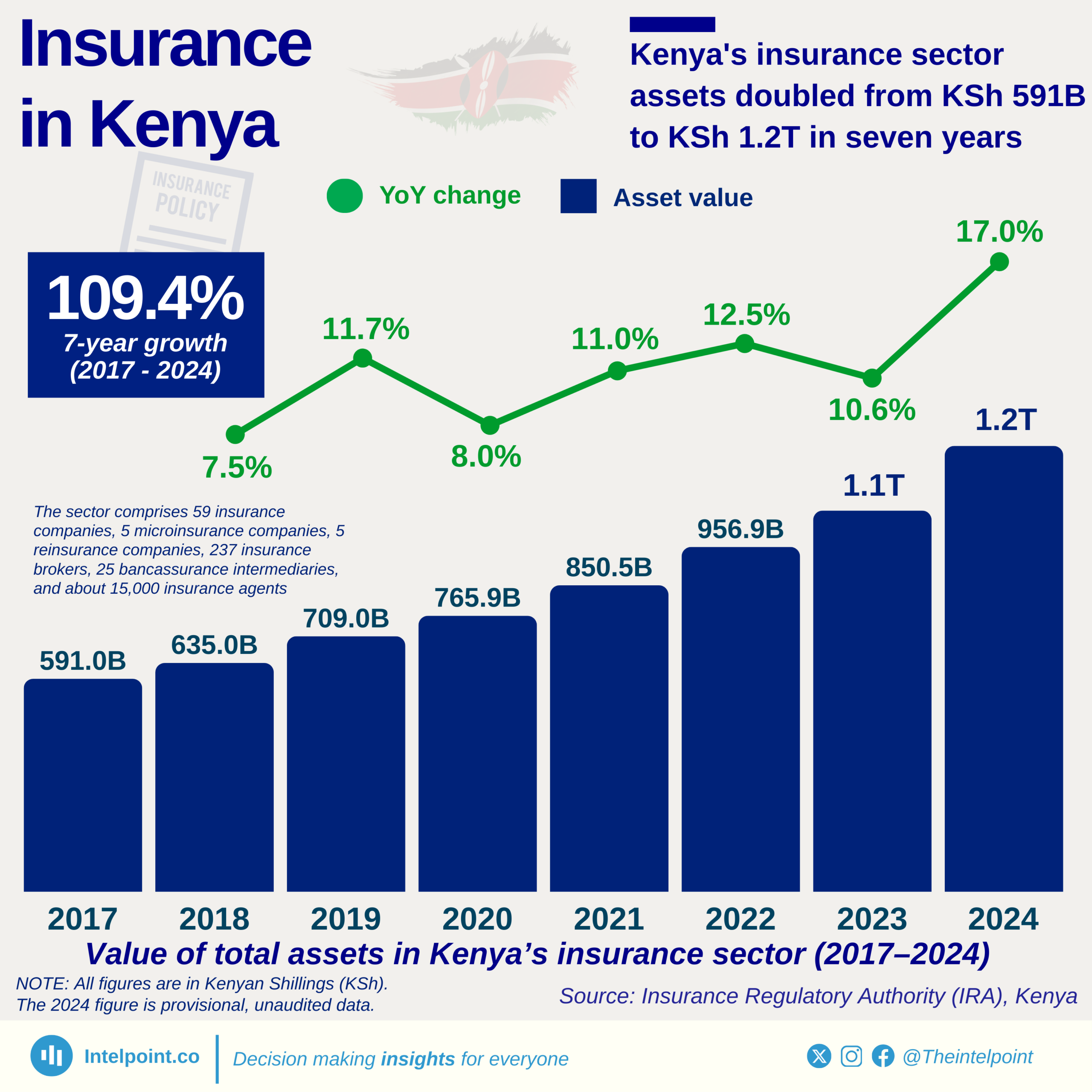
Kenya's insurance sector assets doubled from KSh 591B to KSh 1.2T in seven years
  • Kenya’s insurance assets more than doubled in seven years, from KSh 591B in 2017 to KSh 1.2T in 2024.
  • This represents a 109.4% growth over the period.
  • The sector recorded positive growth every single year, with no declines.
  • The most substantial growth occurred in 2024, at 17%.
  • Asset growth averaged between 7.5% and 12.5% annually until the surge in 2024.
  • 2023 marked the first time assets crossed the KSh 1 trillion mark.

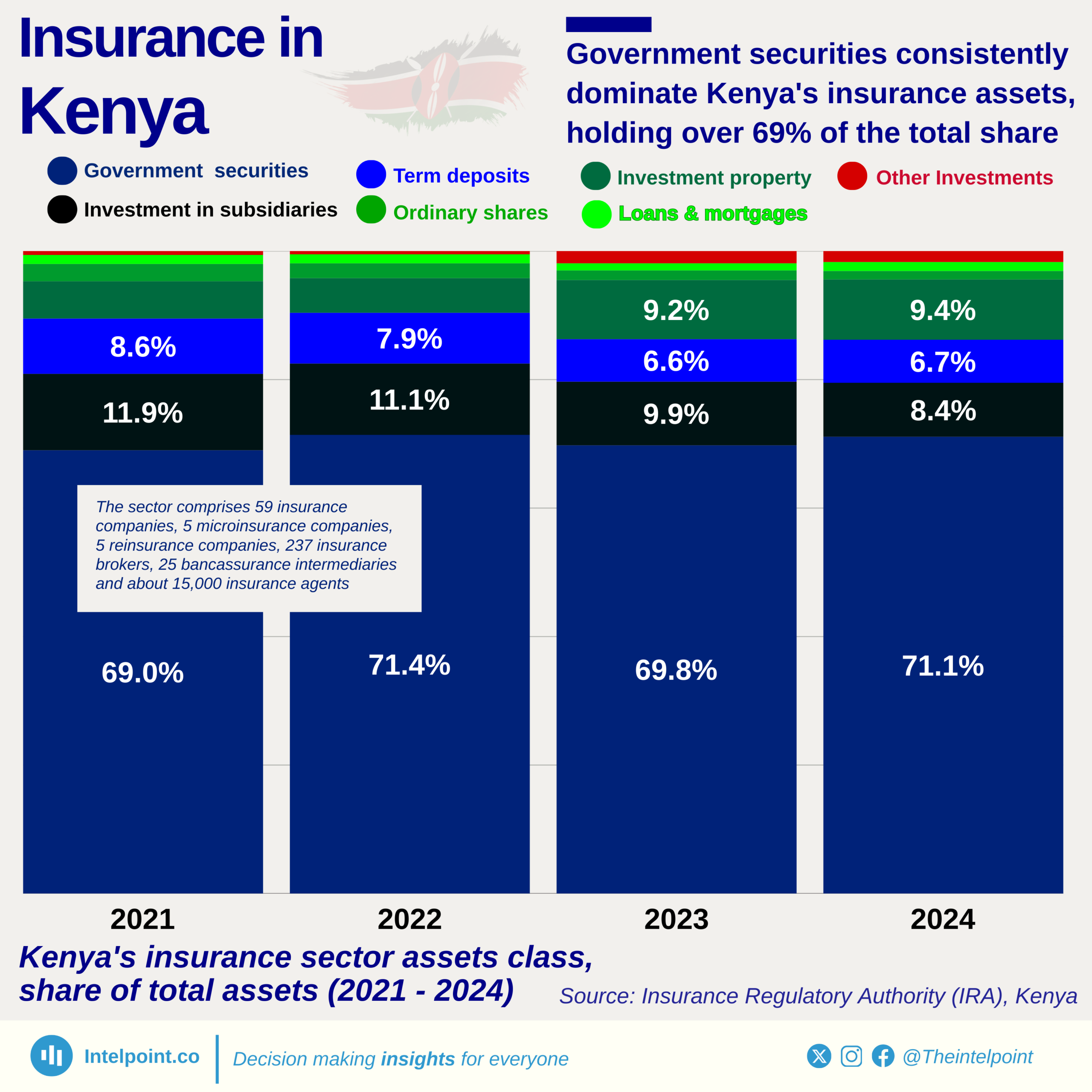
Government securities consistently dominate Kenya's insurance assets, holding over 69% of the total share
  • Government securities consistently dominate, holding between 69% and 71% of total insurance assets.
  • In 2022, government securities reached their peak share at 71.4%.
  • Investments in subsidiaries fell steadily from 11.9% in 2021 to 8.4% in 2024.
  • Ordinary shares and investment property grew slightly, reaching 9.4% and 9.2% respectively, in 2024 and 2023.
  • Term deposits declined from 8.6% in 2021 to around 6.7% in 2024.
  • The sector made gradual diversification moves but remained highly concentrated in government securities.
  • The consistent focus on low-risk assets highlights insurers’ preference for stability and capital preservation.

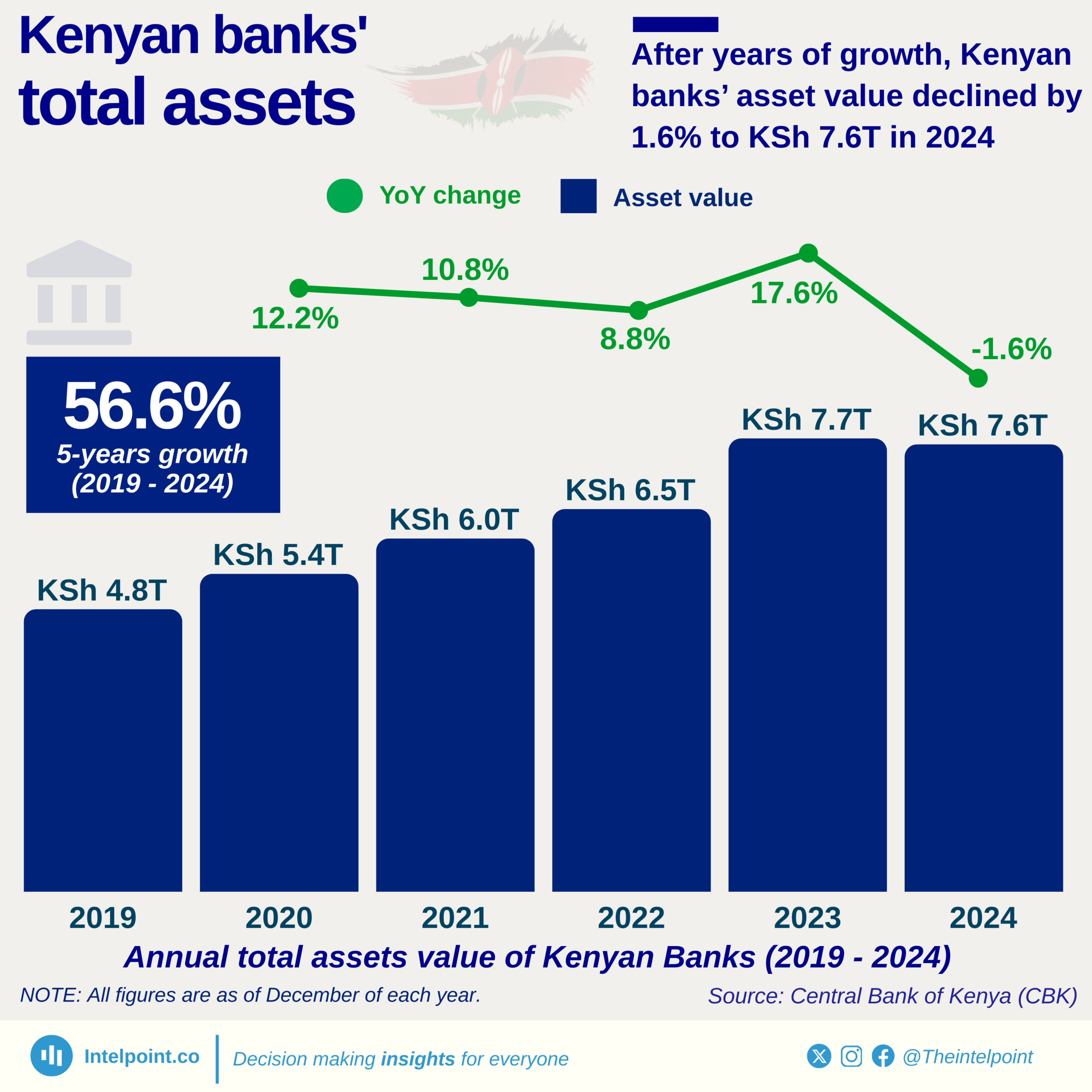
After years of growth, Kenyan banks’ asset value declined by 1.6% to KSh 7.6T in 2024
  • Kenyan banks’ total assets grew by 56.6% between 2019 and 2024.
  • In 2024, assets declined slightly by 1.6%, the first drop in five years.
  • The sector recorded consistent growth from 2019 to 2023 before dipping in 2024.
  • The highest growth came in 2023, when assets surged 17.6% to KSh 7.7T.
  • Assets rose from KSh 4.8T in 2019 to KSh 7.6T in 2024.
  • Despite the 2024 dip, banks added nearly KSh 3 trillion in assets over the five years.

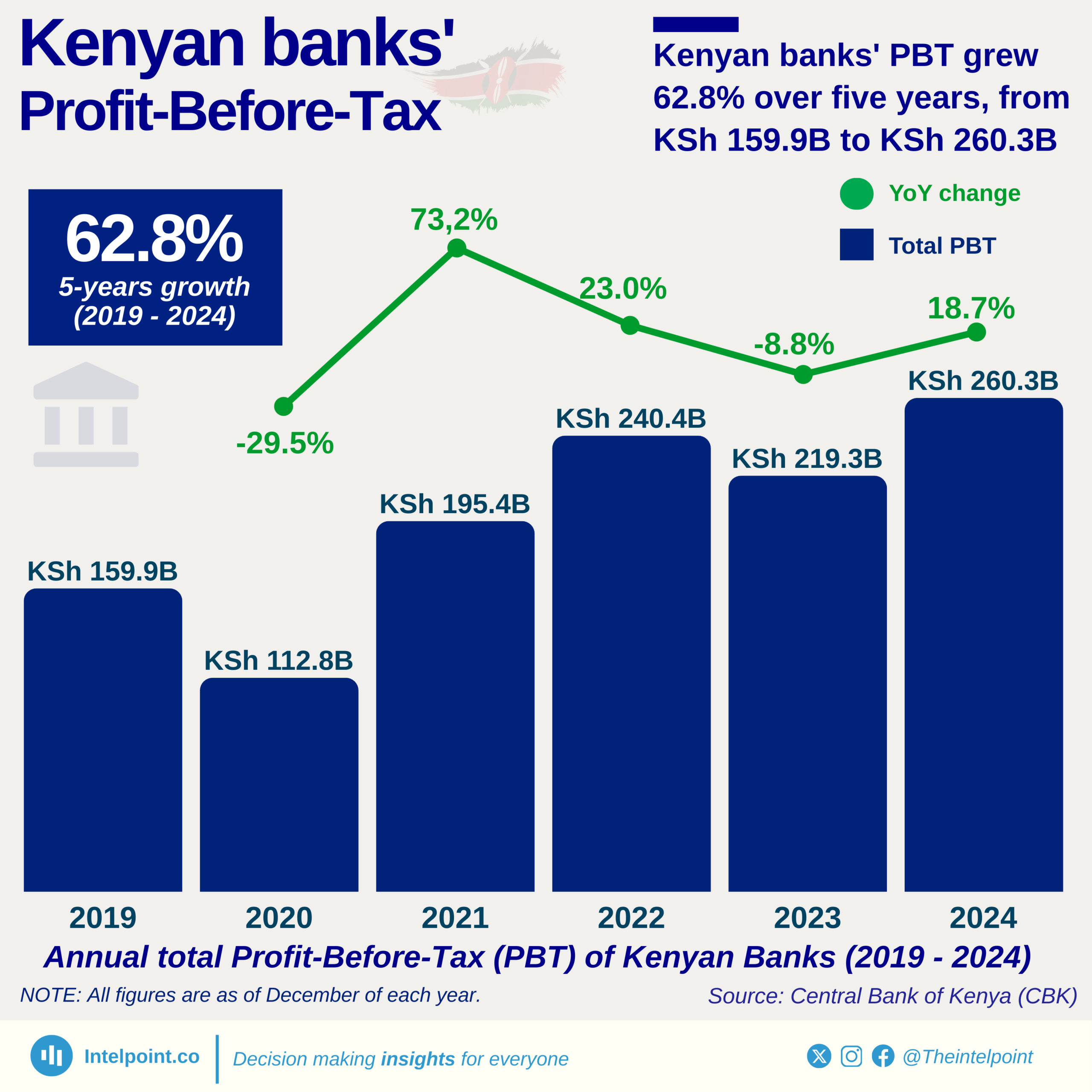
Kenyan banks' PBT grew 62.8% over five years, from KSh 159.9B to KSh 260.3B
  • Kenyan banks’ Profit-Before-Tax (PBT) grew by 62.8% between 2019 and 2024.
  • Total PBT rose from KSh 159.9B in 2019 to KSh 260.3B in 2024.
  • The lowest point was in 2020, when profits dropped to KSh 112.8B, a 29.5% decline.
  • Banks recorded their strongest recovery in 2021 with a 73.2% increase in PBT.

1 2 3 4 5 6 … 13

Can’t find what you’re looking for? Please fill the form below
Contact Form Demo
SIGN UP TO OUR NEWSLETTER
Get periodic updates about the African startup space, access to our reports, among others.
Subscribe Here
Subscription Form

A product of Techpoint Africa. All rights reserved