Bite-sized Insights about
 
Providing you with data-based insights about things happening around you.
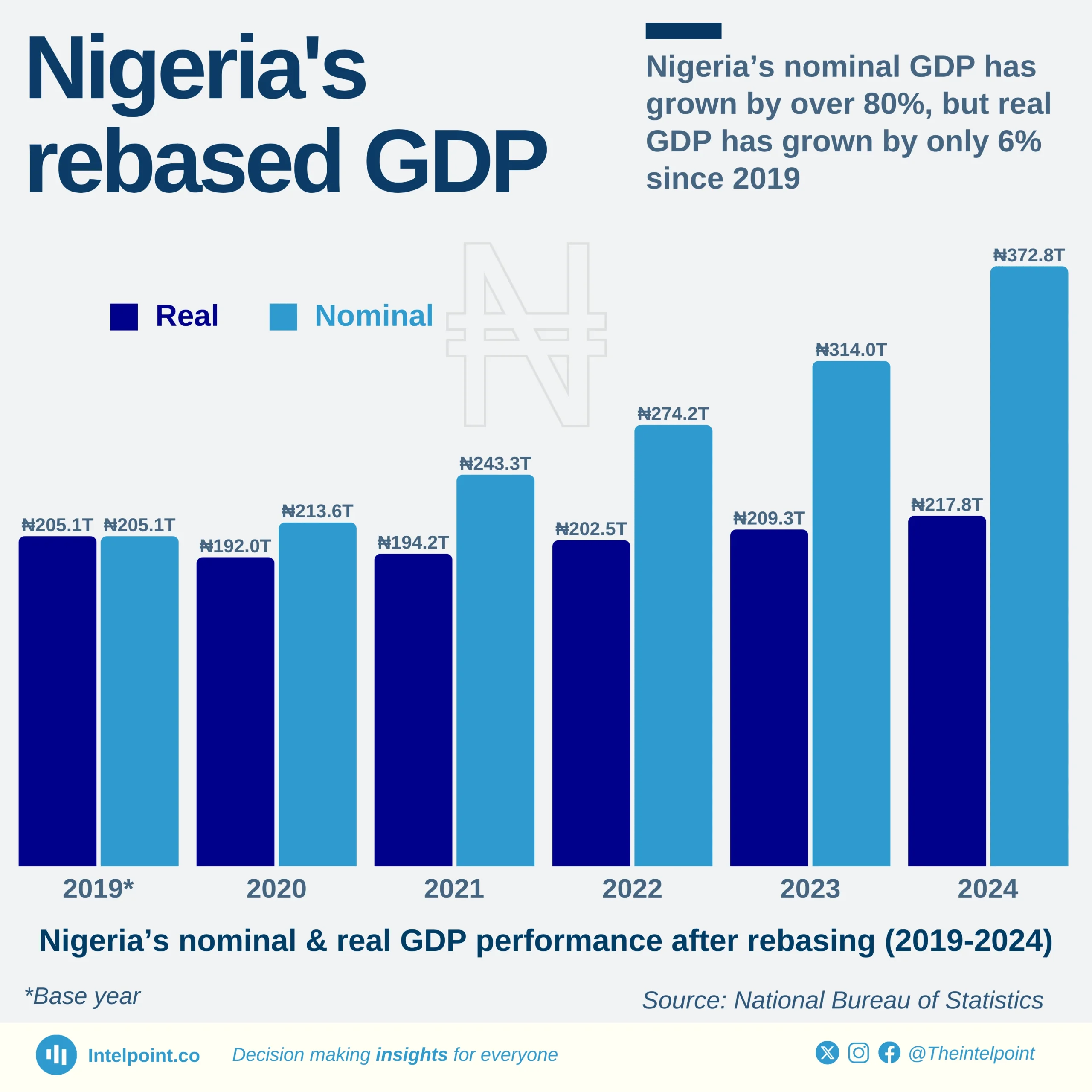
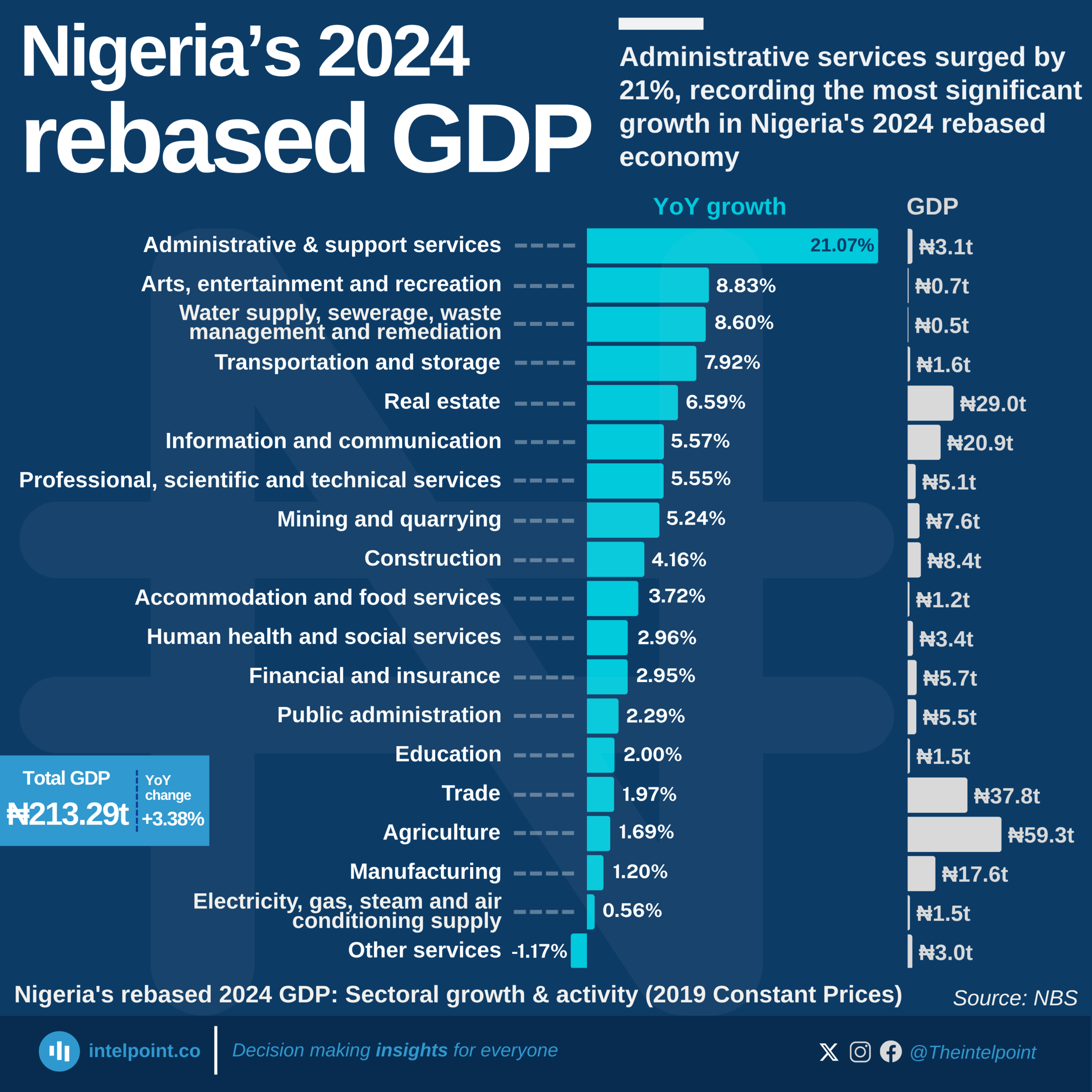
Nigeria’s 2024 GDP just got a $65 billion boost after the 2025 rebasing
  • The IMF’s new 2019 GDP base year added between $20 billion and $235 billion annually to Nigeria’s GDP from 1990–2025.
  • 2014 saw the biggest jump — an upward revision of $235.1 billion, raising GDP to $811.1 billion from $576.0 billion under the old base.
  • The rebased data consistently show 40–45% higher GDP values through the 2000s and 2010s, revealing a larger economy than earlier estimates.
  • The impact was strongest during Nigeria’s oil boom years (2007–2014), when rebasing captured fast-growing sectors like digital services, informal trade, and modular refining.

With new 2019 base year, Nigeria ranked among the world’s 20 largest economies in 1998, 2013, 2014, and 2015 — peaking at $811 billion
  • Nigeria’s GDP has been rebased to a 2019 base year, raising its nominal value by about 40.8%, according to the IMF’s October 2025 update.
  • The revision includes new data on digital, informal, and service sectors, giving a fuller picture of the economy.
  • Nigeria ranked among the world’s top 20 economies in 1998, 2013, 2014, and 2015, peaking in 2014 at $811 billion.
  • Despite later declines from currency depreciation and slower growth, the revision reaffirms Nigeria’s position as Africa’s largest economy.

Lagos’s domestic debt is 7.5% (₦72.6 billion) higher than the South South’s
  • The South-West recorded the highest domestic debt stock of approximately ₦1.43 trillion, largely powered by Lagos State’s ₦1.04 trillion debt.
  • The South-South ranks second with ₦968 billion, led by Rivers State’s ₦364.4 billion, reflecting major infrastructure and fiscal commitments.
  • The North-Central (₦520 billion) and North-East (₦450 billion) show moderate borrowing compared to their southern counterparts.
  • The North-West records the smallest combined debt stock at ₦223 billion, indicating a relatively conservative borrowing posture.

Enugu - South-East’s top domestic debtor - owes more than Imo, Abia, and Anambra combined
  • Enugu State holds the highest domestic debt in the South-East at ₦180.5 billion.
  • Imo ranks second with ₦97.9 billion, about 54% lower than Enugu’s figure.
  • At ₦15.8 billion, Ebonyi remains the least indebted in the region, maintaining a conservative borrowing stance.
  • Combined, the five South-East states (Enugu, Imo, Abia, Anambra, and Ebonyi) owe roughly ₦371 billion domestically as of Q2 2025.

Rivers State's domestic debt is 3.5% (₦12.4b) more than the combined debt of Delta and Cross River
  • Bayelsa holds the lowest debt with ₦65.9 billion.
  • Rivers’ ₦364.4 billion domestic debt is almost six times Bayelsa’s total, highlighting major fiscal disparities.
  • Delta (₦204.7 billion) and Cross River (₦147.3 billion) remain among the region’s more indebted states
  • Regional debt approaches ₦1 trillion: The six South-South states collectively hold an estimated ₦968 billion in domestic debt as of Q2 2025.

Jigawa recorded the lowest domestic debt in North-West Nigeria at ₦852 million in Q2 2025
  • The seven North-Western states collectively owed about ₦223.4 billion in domestic debt as of Q2 2025, according to DMO data.
  • Kano State ranked highest with ₦56.9 billion, accounting for roughly 25% of the zone’s total debt.
  • Jigawa remains the least indebted in the region and in the entire country, with only ₦852 million.
  • Moderate debt spread: While Kano, Zamfara, and Sokoto carried the largest debt loads, the remaining states maintained relatively conservative borrowing patterns.

Kogi and Nasarawa post lowest domestic debt in North Central Nigeria at ₦18.8 billion and ₦23.9 billion, respectively
  • The six North Central states collectively hold ₦449.4 billion in domestic debt as of Q2 2025, according to DMO data.
  • Kogi and Nasarawa lead in fiscal control with ₦18.8 billion and ₦23.9 billion, respectively
  • Both states record the lowest debt profiles in the region. Niger State’s ₦141.5 billion debt makes it the region’s most indebted, accounting for nearly one-third of the total.
  • The debt gap between Kogi (lowest) and Niger (highest) stands at over ₦123 billion, highlighting stark differences in fiscal management and borrowing capacity across the zone.

Lagos accounts for over 70% of South-West Nigeria’s domestic debt, hitting ₦1.04 trillion in mid-2025
  • Lagos dominates regional debt with a domestic debt stock of ₦1.04 trillion, over 70% of the South-West’s total subnational debt.
  • Lagos’s debt is six times larger than that of Ogun (₦162.9 billion), the region’s next most indebted state.
  • At ₦10.6 billion, Ondo maintains the lowest domestic debt profile in the region, reflecting relatively modest borrowing.
  • The combined domestic debt of the six South-West states (Lagos, Ogun, Oyo, Osun, Ekiti, and Ondo) stood at ₦1.43 trillion as of Q2 2025.

Nigeria’s public debt rises to $99.7 billion (₦152.4 trillion) as of June 2025
  • Nigeria’s public debt rose to $99.7 billion, up from $91.3 billion in June 2024, marking a return to growth after a dollar-value decline in 2024.
  • The debt in local currency climbed to ₦152.4 trillion, reflecting both borrowing and continued naira depreciation.
  • The increase underscores ongoing domestic financing challenges and vulnerability to exchange-rate fluctuations.
  • The growth in dollar terms points to renewed external borrowing as the government manages debt obligations post-2024 volatility.

Nigeria’s GDP growth peaked at 14.6% in 2002 after years of expansion, now averaging around 3.3% annually
  • From recession to recovery, Nigeria’s GDP growth journey reveals three decades of economic volatility and slow transformation.
  • Nigeria's economy grew by 14.6% in 2002, which is still the highest in the country's history.
  • The country entered a recession in 2016, with the economy shrinking by -1.6%.
  • Nigeria enjoyed a long period of strong growth between 2003 and 2010: The economy grew between 7% and 11%, powered by high oil prices and booming sectors like telecoms and banking.

1 2 3 4 5 6 14

Can’t find what you’re looking for? Please fill the form below
Contact Form Demo
SIGN UP TO OUR NEWSLETTER
Get periodic updates about the African startup space, access to our reports, among others.
Subscribe Here
Subscription Form

A product of Techpoint Africa. All rights reserved