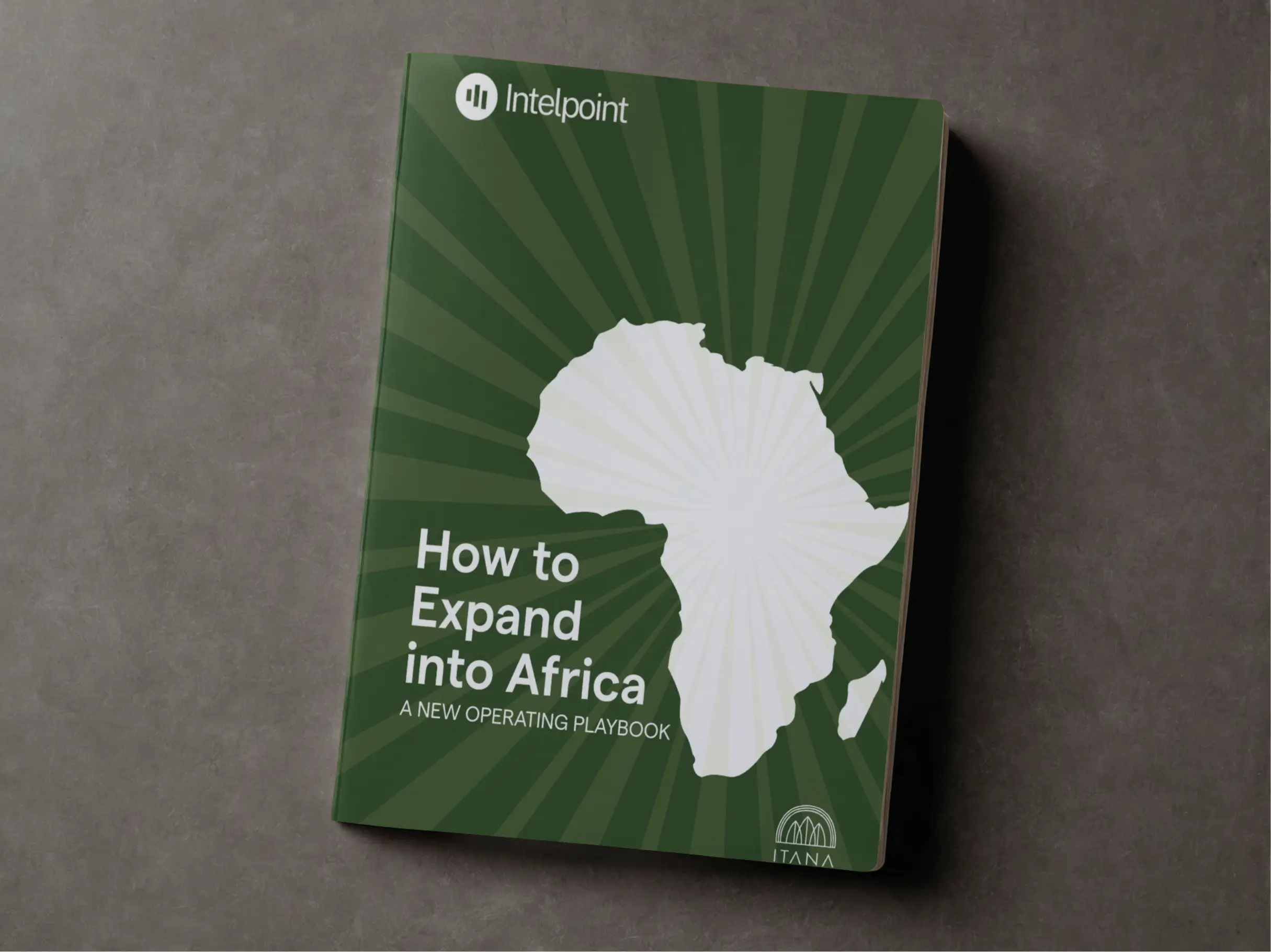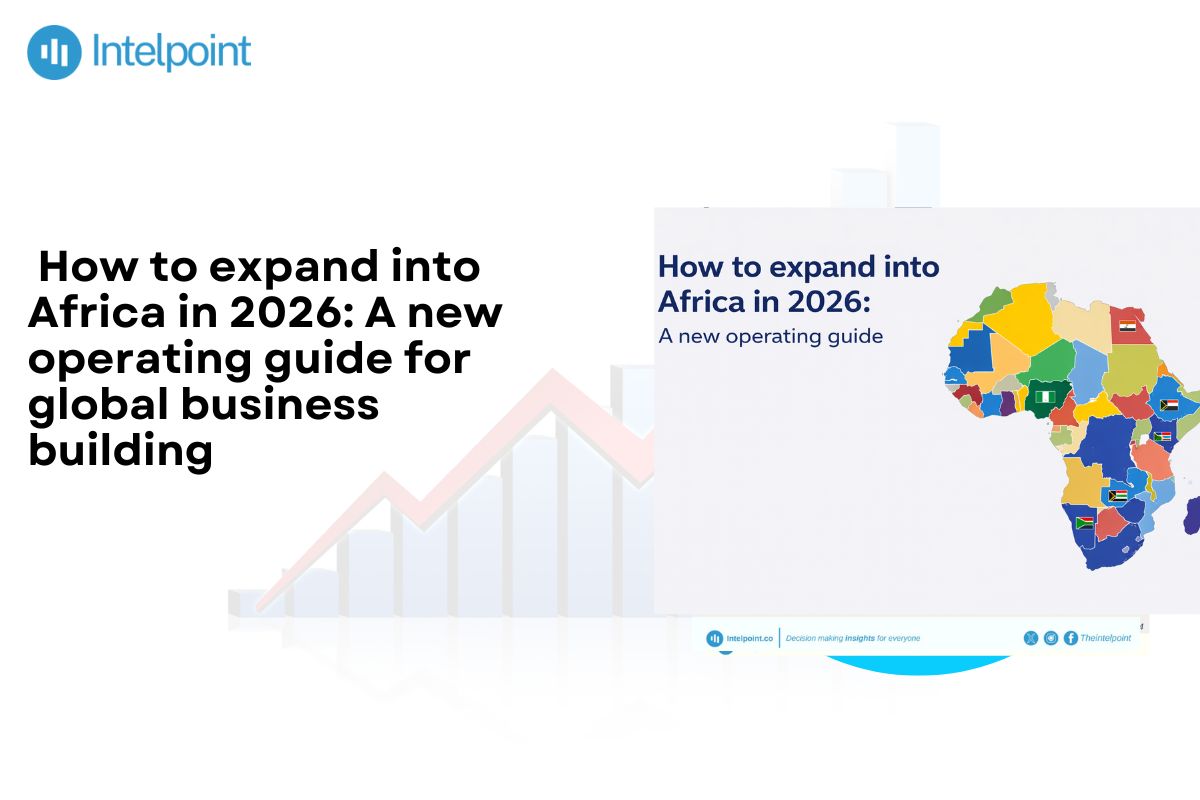
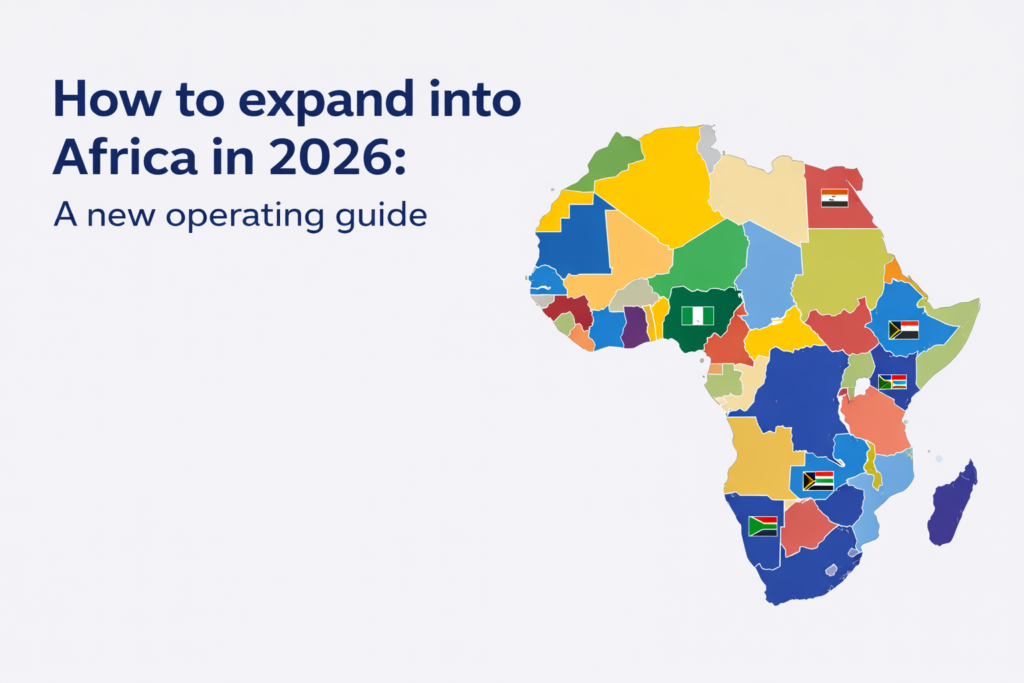
Africa has 1.57 billion people, many of whom are young and highly tech-savvy. Cities are growing rapidly, with new customers every day, making the continent an exciting opportunity for international companies to expand. This article draws on insights from our “How to Expand into Africa – A New Operating Playbook”, which outlines the realities of doing business across African markets.
But having a large market doesn't always guarantee success.
To thrive, companies need to understand the real challenges of operating in Africa. These include currency fluctuations, different payment methods in each country, varying laws and regulations, and limited infrastructure, which can make operations more costly.
Because of these challenges, a one-size-fits-all approach won’t work. Businesses need country-specific plans that are practical and achievable.
Our guide focuses on five key markets: Nigeria, South Africa, Egypt, Kenya, and the Democratic Republic of the Congo, while offering insights that can be applied across other countries as well.
Download your copy now to access actionable strategies and practical tips for successfully expanding your business across Africa.
Key takeaways
- Africa comprises distinct markets requiring tailored country strategies, not a uniform continental approach
- Special Economic Zones provide streamlined regulatory pathways and financial advantages unavailable in traditional setups
- Currency management and cross-border payment infrastructure are strategic priorities rather than operational afterthoughts
- Tax and compliance frameworks vary significantly across markets, demanding early professional guidance and disciplined documentation
5 thriving African markets: Region influence, trade blocs, access, advantages & challenges explained
Diversity is Africa's market strength, but each primary economy measures scale, risk, and return differently.
Nigeria
With over 200 million people, Nigeria is Africa's largest economy and offers unmatched consumer potential.
Key Advantages:
- Access to 380 million-strong ECOWAS market
- Massive domestic consumer base
- Thriving tech and fintech ecosystem
- English-speaking workforce with entrepreneurial spirit
Infrastructure Reality:
Nigeria's unreliable power grid forces most businesses to rely on generators and alternative power sources. Road networks are often congested and in disrepair, though improvements are ongoing.
However, innovation parks and special economic zones offer more reliable infrastructure and streamlined logistics.
Political Environment:
Despite internal security issues and election-season tensions, Nigeria operates a stable federal democracy. Its political index score was -1.77 points in 2023, up from -1.78 in 2022.
Talent:
Over 750 higher institutions and numerous edtech platforms are filling skill gaps. The country excels in finance, tech, and creative industries, though brain drain remains a challenge.
South Africa
South Africa offers institutional depth and mature financial markets ideal for complex regional headquarters.
Key Strengths:
- Sophisticated banking and financial infrastructure
- Experienced, multilingual talent pool
- Strong democratic institutions and an independent judiciary
- Advanced telecommunications and port facilities
Energy Challenge:
Severe load shedding by the utility company Eskom creates massive operational burdens. Despite this, South Africa maintains one of Africa's most advanced infrastructures.
Political Stability:
Strong democratic institutions, but faces political volatility linked to corruption scandals and high inequality. Political index: -0.67 points in 2023.
Regional Access:
As a member of SACU and SADC, South Africa is the natural gateway to the sophisticated Southern African market.
Egypt
The Suez Canal connects Africa, the Middle East, and Europe, offering unique strategic positioning.
Population & Investment:
With over 116 million people and growing infrastructure investment, Egypt attracts the highest levels of foreign investment in Africa.
Infrastructure Development:
Heavy investment in infrastructure includes:
- New smart cities (like the New Administrative Capital)
- Expanded ports and vast road networks
- Modern telecommunications
Talent Pool:
Large, educated, relatively low-cost workforce, robust in engineering, IT, and multilingual customer service.
Politics:
The current system is widely described as autocratic with limited political dissent. Political score: -0.87 points in 2023, up from -0.98 in 2022.
Regional Positioning:
Membership in COMESA and the Arab League makes Egypt a perfect logistics and export hub for multiple regions.
Kenya
Kenya is East Africa's innovation hub, leading in fintech, agritech, and logistics with a pro-business government.
Tech Leadership:
Renowned for M-Pesa's success and influence, Kenya has:
- Strong English-speaking tech talent pool
- Vibrant startup ecosystem
- World's 14th fastest mobile internet (as of 2017)
Infrastructure Quality:
Modern hub with excellent internet connectivity. The standard-gauge railway and ongoing port developments in Mombasa enhance its role as an East African gateway.
Power outages are less frequent than in other markets.
Politics:
Vibrant democracy with brief election-period tensions. The current government is viewed as pro-business and stable. Political index: -0.94 points in 2023.
Regional Integration:
As the economic engine of the EAC and a COMESA member, Kenya provides efficient access to fast-growing East African markets.
DR Congo
Rich in minerals and natural resources, the DRC is Africa's resource frontier, requiring investors prepared for complexity.
Resource Wealth:
The DRC holds vast mineral wealth, particularly cobalt and copper, which are critical to global supply chains.
Infrastructure Challenges:
Outside major mining areas, infrastructure is deplorable with unreliable electricity, limited paved roads, and poor internet connectivity.
Talent Gap:
Critical shortage of skilled managerial and technical talent outside extractive industries. Significant training investment is often required.
Political Instability:
The DRC faces significant challenges, including political instability, corruption, and ongoing conflict in the eastern regions. Political index: -2.04 points in 2023.
Regional Access:
Recent EAC admission offers access to East African markets. SADC membership provides access to the Southern African market.
Tax and compliance operations
Across Africa, tax and compliance rates, enforcement intensity, and administrative maturity differ widely.
Nigeria
(High Complexity, High Opportunity)
Nigeria recently underwent significant tax reforms through the Nigeria Tax Act (NTA) and the Nigeria Tax Administration Act 2025.
Corporate Tax Rates:
- Turnover ≤ ₦25m: 0%
- Turnover ₦25m - ₦100m: 20%
- Turnover > ₦100m: 30%
VAT: 7.5% standard rate
Key Compliance Requirements:
- Register with the Corporate Affairs Commission (CAC)
- Obtain Taxpayer Identification Number (TIN)
- File VAT returns by the 21st day of the following month
- File income tax returns within 18 months of incorporation (new entities)
- Remit PAYE to the relevant authorities
Special Economic Zone Advantage:
FTZ enterprises enjoy full tax exemption if their total sales arise from the export of goods/services, with no more than 25% going to Nigeria’s customs territory. Otherwise, a 15% tax rate applies.
South Africa
(Structured but Compliance-Heavy)
South Africa offers institutional depth with mature tax codes, but strict compliance requirements.
Tax Rates:
- Corporate Income Tax: 27%
- VAT: 15%
- Dividends Tax: 20% (reduced by DTAs where applicable)
Small Business Concessions:
For businesses with gross income ≤ ZAR 20 million:
- 0% on first ZAR 95,750
- 7% on ZAR 95,750 - ZAR 365,000
- 21% on ZAR 365,000 - ZAR 550,000
- 27% above ZAR 550,000
SEZ Benefit: 15% corporate tax rate
Key Compliance:
Annual audited financial statements, monthly/bi-monthly VAT returns, monthly PAYE and UIF remittances, plus heavy sector-specific compliance for finance/telecom.
Kenya
(Digitalised but Scrutiny-Heavy)
Kenya combines administrative agility with increasing regulatory scrutiny through the Kenya Revenue Authority.
Tax Rates:
- Corporate Income Tax: 30%
- VAT: 16%
- Withholding Tax: Varies (3-25%)
Recent Changes (Finance Act 2025):
- Digital Service Tax replaced with Significant Economic Presence Tax
- Expanded Withholding Tax scope
- Enhanced compliance through the iTax platform
SEZ Advantages:
- 10% tax for the first 10 years
- 15% tax for the next 10 years
- Simplified compliance processes
Key Requirements:
KRA PIN registration (1-3 days), monthly VAT filing via iTax, NHIF, and NSSF contributions.
Egypt
(Structured with State Influence)
Egypt offers a structured tax environment with strict documentation rules.
Tax Framework:
- Corporate Income Tax: 22.5%
- VAT: 14-15%
- WHT: 10% (dividends), varying rates for interest/royalties
SME Incentives:
Qualifying SMEs can opt for a reduced tax rate on turnover instead of the standard rate.
FTZ Benefits:
Companies in approved free zones are generally exempted from corporate income tax on licensed activities.
Compliance Notes:
Late-payment penalties are capped at 100% of the original tax; Arabic documentation is required, and VAT refund delays are common.
DR Congo
(Decentralized and Complex)
The DRC has the most complex tax environment, with significant provincial involvement.
New Tax Reform (Effective January 1, 2026): - Corporate Income Tax: 30% of net taxable profits (or 1% of declared turnover if in deficit) - VAT: 16% - WHT: 20% standard (dividends/interest/royalties)
FTZ Enterprise Benefits: - Years 1-6: CIT and dividend tax exempt - Years 7-10: 5% CIT and dividend tax - After Year 10: 15% CIT, 10% dividend tax - Single tax on remuneration: 2.5%
Critical Challenges: Provincial variations in tax application, slow, paper-heavy processes, and limited digital infrastructure, all of which require strong local partnerships.
Financial infrastructure and currency management
Money is valued differently across markets.
- Nigeria's naira fluctuates frequently, so FX buffers and hedges are needed
- South Africa's rand responds to global sentiment but offers deep hedging markets
- Egypt's pound faces controlled devaluation with managed exchange rates
- Kenya's shilling stays sensitive to external capital flows
- DRC's Congolese franc remains illiquid, forcing most transactions into US dollars
For payment infrastructure,
- Nigeria and Kenya lead with mobile money platforms and fintech innovation, enabling faster, cheaper transactions
- South Africa operates the continent's most sophisticated banking sector with reliable real-time settlement
- Egypt's government-controlled infrastructure provides stability but limits flexibility
- DRC's underdeveloped systems rely on expensive international banking networks
So, an effective strategy would be this:
| Financial Strategy | When to Use | Primary Benefit | Main Challenge |
| Multi-currency accounts | Multi-country operations | Hold funds in needed currencies | Bank eligibility requirements |
| Natural hedging | Local revenue exists | Match costs with revenue currency | Requires business model alignment |
| Forward contracts | Predictable large payments | Lock in exchange rates | Requires credit/margin with banks |
| Local banking partners | Single-market focus | Better rates, local expertise | Limited cross-border capability |
Special Economic Zones (SEZs) as Market Entry Accelerators
Special Economic Zones function as operational shortcuts for companies entering African markets.
Here are the major SEZs across 5 markets:
Nigeria
Itana (Digital SEZ):
- The most advanced digital SEZ model in Africa, offering:
- 100% virtual incorporation (no physical presence required)
- Tax benefits: 0% CIT for qualifying enterprises
- Multi-currency accounts: Operate in any currency
- 100% repatriation allowance
- Community access: 72,000 sqm campus with accelerator support
- Strategic partnerships: DiFZIN member, Future Africa backing
Other Major Zones:
- Lekki Free Zone: Manufacturing and logistics
- Calabar Free Trade Zone: Export-oriented industries
Best For: Tech companies, digital services, pan-African operations
South Africa
Major Zones:
- Coega IDZ: Largest industrial development zone
- Dube TradePort: Aviation and logistics
- OR Tambo IDZ: Manufacturing focus
Incentives:
- 15% corporate tax (vs. 27% standard)
- VAT relief and customs duty concessions
- Building tax allowances
- Focus on export-oriented industries
Best For: Manufacturing, heavy industry, logistics operations
Egypt
Suez Canal Economic Zone (SCZONE):
World-class logistics and manufacturing hub with:
- Strategic positioning bridging Africa, Europe, and Asia
- Tax exemptions and simplified customs
- Massive infrastructure investment
Qualifying Industrial Zones (QIZs):
- Duty-free access to the US market for goods with Israeli input
- Unique trade advantage unavailable elsewhere
Best For: Export manufacturing, global logistics, MENA-Africa operations
Kenya
Major SEZs:
- Mombasa SEZ: Port-adjacent logistics
- Tatu City SEZ: Mixed-use development
- Konza Technopolis: Silicon Savannah tech hub
Tax Benefits:
- 10-year corporate tax holiday
- Investment deductions and zero-rated VAT
- Focus on agro-processing, textiles, tech
Best For: Tech startups, agribusiness, and regional manufacturing
DR Congo
Developing SEZs:
- Lubumbashi SEZ: Mineral processing
- Maluku SEZ: Planned development
Tax Advantages:
- Years 1-6: CIT and dividend tax exempt
- Years 7-10: 5% CIT and dividend tax
- After Year 10: 15% CIT, 10% dividend tax
- 50% reduced rate on transfer deeds
Challenges:
- Severe infrastructure underdevelopment
- High political and regulatory risk
- Primary focus on extractive industries
Best For: Mining operations, mineral processing, resource extraction
How to choose the right African market for your business: Strategic breakdown
Throughout this guide, we’ve shown that Africa is not a single market, but a set of structurally different operating environments. The question is: which market should anchor your operations and why? The anchor market influences decision speed, cost structure, regulatory exposure, talent access, and the ease of scaling across regions.
The framework below helps translate market theory into a practical location strategy.
1. Market size and demand alignment
- Nigeria supports mass consumer models and the West African scale.
- South Africa favors enterprise, financial services, and complex headquarters functions.
- Egypt suits export manufacturing and MENA-Africa trade positioning.
- Kenya supports digital-first and East African expansion
- DR Congo aligns with resource-driven and mineral supply chain strategies.
2. Operational infrastructure match
| Factor | Nigeria | South Africa | Egypt | Kenya | DR Congo |
| Power reliability | Poor | Strained | Improving | Better than peers | Very poor |
| Internet/telecom | Good in cities | Excellent | Good | Excellent | Weak outside cities |
| Ports & logistics | Congested | World-class | Strategic (Suez) | Modern (Mombasa) | Limited |
| Road networks | Poor, upgrading | Good | Extensive upgrades | Improving | Extremely poor |
3. Regulatory and compliance environment
Kenya offers the most streamlined processes. South Africa and Egypt are structured but compliance-heavy. Nigeria and DR Congo involve multi-agency complexity. Special Economic Zones materially simplify approvals and administration across all markets.
4. Currency and financial exposure
South Africa provides the deepest hedging and easiest repatriation. Egypt and Kenya offer moderate stability. Nigeria and DR Congo involve higher volatility and administrative friction, making treasury structure a strategic decision, not a back-office detail.
A 90-day African expansion action plan
This 90-day roadmap lays out a practical path from intent to real expansion.
Weeks 1–2: Internal readiness and market fit
Begin with a structured internal assessment to clarify whether your organization is truly prepared for African operations. Evaluate your operational maturity, jurisdictional preferences, compliance capacity, risk tolerance, and market alignment.
- This phase is designed to surface capability gaps early and ensure that your expansion strategy reflects both your growth objectives and your internal operating realities.
Outcome: A precise diagnosis of readiness and the specific adjustments required for a low-friction market entry.
Weeks 3–4: Market validation through operator insight
Connect with companies already active in your target market to move beyond reports and projections. These conversations provide grounded insight into regulatory practices, customer behavior, talent availability, logistics, and day-to-day operating challenges.
- This phase helps pressure-test your assumptions and refine your expansion model using real market experience rather than theoretical benchmarks.
Outcome: A validated expansion thesis informed by firsthand market intelligence.
Weeks 5–8: SEZ shortlisting and entry pathway design
Identify and evaluate Special Economic Zones that align with your business model and operational needs. Compare zones based on infrastructure reliability, regulatory support, incentives, eligibility criteria, and the speed and clarity of onboarding processes.
- This phase focuses on selecting a structure that reduces administrative burden and accelerates market entry.
Outcome: A prioritized SEZ and entry pathway that supports regulatory clarity, operational efficiency, and long-term scalability.
Weeks 9–12: Incorporation and operational activation
Transition from planning to execution by incorporating within a structure designed for agility and scale. Establish your legal presence, activate compliance and banking frameworks, and plug into the support systems and infrastructure required for growth.
- This phase converts strategy into a live operating entity positioned to scale efficiently from day one.
Outcome: A legally established, operational foundation optimized for growth, cost control, and regional expansion.
Conclusion
Africa demands tailored strategies across 54 distinct markets.
Thriving companies here don't wait for perfect conditions but adapt to complexity and build lasting relationships.
Start by strategically selecting your anchor market: Nigeria for scale, South Africa for infrastructure, Egypt for continental access, Kenya for innovation, and the DRC for resources. After, leverage tools that reduce friction. Special Economic Zones like Itana offer tax incentives, streamlined regulations, and operational advantages that accelerate setup. Finally, commit long-term to local integration.
Ready to expand? Discover how Itana simplifies your African expansion at itana.africa.