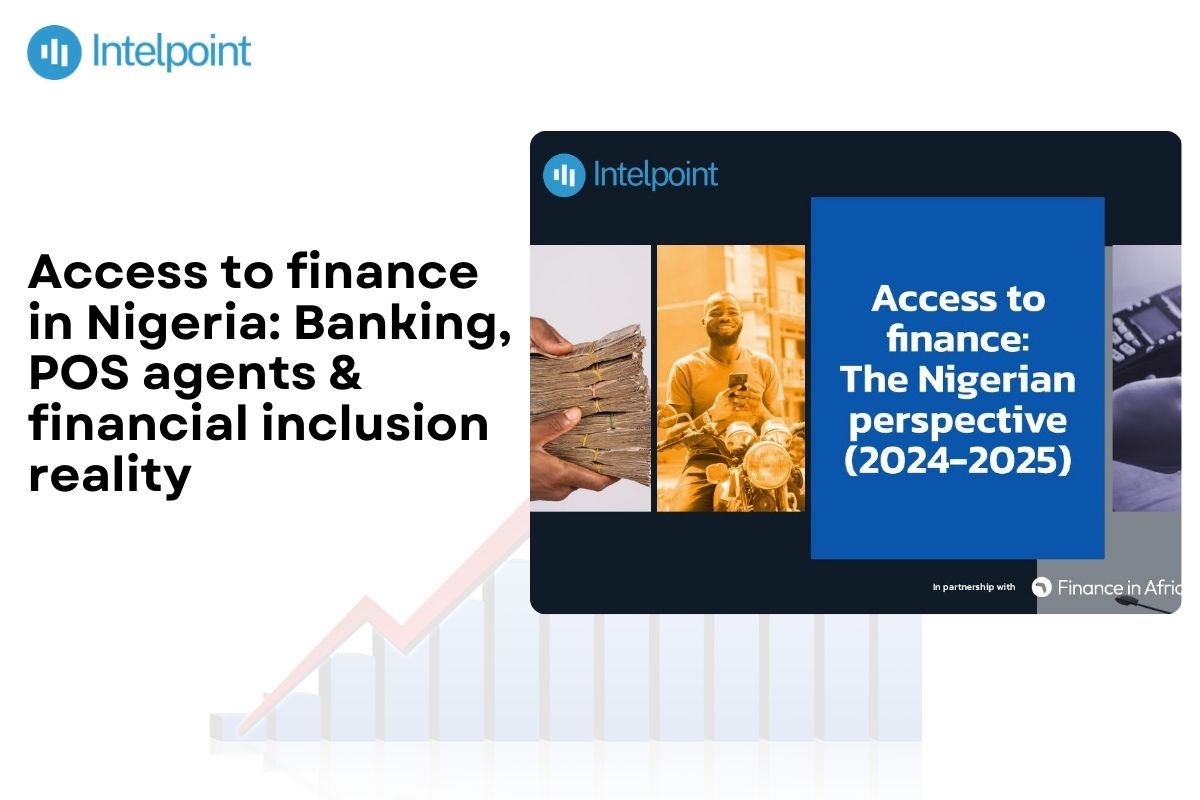
Nigeria has 311 million active bank accounts but only 64.9 million Bank Verification Numbers (BVNs), revealing a massive gap between account ownership statistics and the reality of financial inclusion.
This contradiction raises critical questions: if more than 4 bank accounts are linked to a BVN, how many Nigerians truly have access to formal financial services?
Intelpoint partnered with Finance in Africa to survey over 3,000 Nigerians across all 36 states and the Federal Capital Territory, uncovering the real story behind access to finance in 2025.
The Access to Finance Report goes beyond surface-level banking statistics to explore how Nigerians actually save, borrow, and interact with financial institutions, from commercial banks to POS agents.
Key takeaways
- 96.4% of respondents claim to own a bank or mobile money account, yet only 64.9M BVNs exist for 133M adults, exposing the gap between survey responses and actual financial inclusion
- 80.8% of people own at least two bank accounts, explaining why 311M accounts exist despite far fewer BVN holders
- 95.4% of Nigerians use POS agents, making agency banking the dominant channel despite complaints about high fees
- Gender gap persists, with only 46.7% of women owning accounts compared to 62.4% of men
- 47.3% cite high fees as the biggest challenge to accessing financial services, ahead of security or infrastructure concerns
- 29% of people borrow from friends and family, double the 19% who take loans from commercial banks
- Only 9.1% of people choose agency banking as their preferred channel, despite 95.4% actually using it regularly
- 19.2% of unbanked cite 'not enough income' as the reason, while another 19.7% don't trust financial institutions
- 79.3% plan to adopt new financial services in 2025, with savings and investment products topping the list
- 90.9% now live close to a bank compared to 72.4% in 2022, showing improved infrastructure spread
The BVN reality check: Nigeria's true financial inclusion numbers
Let's start with the numbers that don't add up, because they reveal everything about Nigeria's financial inclusion challenge.
As of January 2025, only 64.9 million Nigerians have Bank Verification Numbers, yet NIBSS reports 311.6 million active bank accounts as of December 2024.
That's 4.8 bank accounts for every BVN holder, and when you consider that 14.3% of BVNs became inactive as of 2021, the real number of financially included Nigerians drops even further to around 55.6 million people
The World Bank estimates Nigeria's adult population at 133 million people aged 15 and above, meaning fewer than 50% of adults hold a BVN and therefore have adequate access to formal financial services.
| Financial System Indicator | Figure |
| Total BVNs (Jan 2025) | 64.9 million |
| Active bank accounts (Dec 2024) | 311.6 million |
| Adult population (15+ years) | 133 million |
| POS agents nationwide | 1.96 million |
| Commercial bank branches | Less than 5,000 |
This massive discrepancy between account numbers and actual users explains why 80.8% of survey respondents own at least two bank accounts, with 40.1% owning exactly two and another 40.8% owning three or more.
The survey found that 96.4% of respondents reported having bank or mobile money accounts, which contradicts BVN data and suggests significant selection bias in who responds to financial surveys.
Who actually has access: Demographics of financial inclusion
Nigeria doesn't distribute financial access equally across demographics, with factors such as gender, education, age, and location creating visible gaps in inclusion and exclusion.
The gender gap in account ownership
Women face a significant disadvantage in accessing formal financial services, with only 46.7% owning bank or mobile money accounts, compared to 62.4% among men.
This gender gap means that for every 100 women, only 47 have financial accounts, while for every 100 men, 62 do, creating a 15.7 percentage-point disparity.
Among people without accounts, 80.8% are women, revealing that exclusion from financial services disproportionately affects women across all regions and socioeconomic backgrounds.
Education's impact on financial access
Education level dramatically affects account ownership: 71.7% of people with no formal education lack bank accounts, while 99.1% of those with a bachelor's degree have one.
| Education Level | Have Account | No Account |
| No formal education | 28.3% | 71.7% |
| Primary education | 80.5% | 19.5% |
| SSCE/WAEC | 94.9% | 5.1% |
| OND/NCE | 97.6% | 2.4% |
| HND/BSc | 99.1% | 0.9% |
| Postgraduate degree | 98.5% | 1.5% |
The gap narrows significantly with each level of education, suggesting that formal education directly correlates with financial inclusion, likely due to both knowledge and income factors.
Among respondents, 34.4% hold bachelor's degrees, another 6% hold postgraduate degrees, 25.1% stopped at SSCE/WAEC, and 28.8% hold OND/NCE qualifications.
Age and account ownership patterns
Younger Nigerians have higher account ownership rates: 98.7% of 26-35-year-olds have accounts, compared to 90.5% of those 56 and above.
The 18-25 age group shows 96.2% account ownership, while the 36-45 bracket has 96.6%, suggesting that middle age doesn't significantly affect access once people are already in the system.
However, the sharp drop among those aged 56 and above (90.5%) indicates that older Nigerians face barriers, possibly due to lower digital literacy or retirement from formal employment.
Banking infrastructure: How close are Nigerians to financial services?
Access to finance requires physical proximity to financial institutions, and Nigeria has made significant progress in bringing banking closer to people over the past two years.
In 2024, 90.9% of respondents reported a bank nearby, up from 72.4% in 2022, representing an 18.5 percentage-point improvement in the spread of banking infrastructure.
However, proximity doesn't always translate to accessibility: 88.8% of people still need transportation to reach the nearest financial institution, while only 11.2% can walk.
With over 4,400 commercial bank branches serving 133 million adults, that's roughly 30,008 adults per branch, which explains why agency banking networks of 1.96 million POS agents have become essential infrastructure.
| Closest Financial Institution | Share |
| Commercial Bank | 66.4% |
| Microfinance Bank | 20.1% |
| Payment Services Bank | 13.5% |
Commercial banks remain the closest institution for most Nigerians at 66.4%, followed by microfinance banks at 20.1% and payment service banks at 13.5%.
This underscores the importance of agency banking networks, which are often within walking distance in both cities and rural areas, expanding financial access where traditional banks can't reach.
POS agents: The Backbone of Nigeria's financial system
POS agents have become Nigeria's dominant financial services channel despite widespread complaints about high fees, processing 95.4% of all respondents’ financial transactions.
In 2023, CBN recorded 9.8 billion POS transactions worth ₦110 trillion, compared with 1 billion ATM transactions worth ₦28.2 trillion, underscoring POS dominance by both volume and value.
The first half of 2024 alone saw 6.4 billion POS transactions valued at ₦85.9 trillion, with transaction volumes spiking significantly in 2021 when 2.7 billion transactions occurred compared to just 665 million in 2020.
What people actually use POS agents for
Cash withdrawals account for 28.3% of POS usage, followed by cash deposits at 22.8% and fund transfers at 20%, indicating that basic banking transactions drive agency banking adoption.
| POS Agent Service | Share |
| Cash withdrawal | 28.3% |
| Cash deposit | 22.8% |
| Fund transfer | 20% |
| Airtime purchase | 11.7% |
| Bill payment | 11.3% |
| Account opening | 5.9% |
Airtime purchases account for 11.7%, while bill payments account for 11.3%. Notably, 5.9% use POS agents for account opening, indicating that agents handle more than simple cash transactions.
The high fees problem everyone complains about
High fees dominate complaints about agency banking: 58.6% cite them as their biggest challenge, exactly matching the 58.6% who want lower charges as the main improvement.
In most cases, withdrawals or deposits of ₦5,000 or less incur a ₦100 charge, with subsequent ₦5,000 transactions adding another ₦100, resulting in a 2% fee on small transactions.
The federal government's Electronic Money Transfer Levy (EMTL) imposed an additional ₦50 charge on electronic transfers of ₦10,000 and above, which POS agents passed directly to customers.
Despite these complaints, 96.3% of people with bank accounts still use POS agents, and even 70.1% of those without bank accounts rely on them, showing that convenience outweighs cost concerns.
How Nigerians without bank accounts survive financially
The 3.6% of respondents without bank or mobile money accounts reveal important patterns about financial exclusion, with gender, trust issues, and income levels creating persistent barriers.
Why people stay outside the banking system
Not having enough income tops the reasons at 19.7%, tied with distrust of financial institutions at 19.7%, showing that poverty and skepticism equally drive financial exclusion.
| Reason for Not Having an Account | Share |
| Not enough income | 19.7% |
| Can't trust financial institutions | 19.7% |
| Too much documentation is required | 19.2% |
| Don't see the need for an account | 11% |
| No identity document | 10.8% |
Third is too much documentation, at 19.2%, even though Tier 1 savings accounts exist that don't require ID, proof of address, or extensive KYC, suggesting awareness gaps about accessible account options.
Not seeing the need for an account affects 11%, while 10.8% lack identity documents, and another 10.3% find banking too expensive, showing multiple barriers work together to exclude people.
How the unbanked save money
People without bank accounts rely heavily on informal savings mechanisms: 42% use thrift contributions and community associations, while 25.5% keep money in piggy banks at home.
Thrift contributions alone account for 15.2% of savings methods, community associations for 10.8%, while age-grade associations and cooperatives account for 9.6% and 6.9%, respectively.
EFInA's 2023 Access to Financial Services report confirms this trend, showing that informal financial services usage rose from 29% in 2016 to 46% in 2023, despite increased formal banking touchpoints.
Receiving money without bank accounts
POS agents serve as the critical bridge for the unbanked, with 41.3% using agents combined with other people's accounts and waybill/bus drivers to receive money from outside their communities.
Another 17.8% use POS agents and other people's bank accounts, while 12.6% rely solely on other people's accounts, showing that informal intermediaries remain essential for financial transactions.
This widespread adoption of agency banking, with low barriers to entry, makes POS agents an integral part of the formal financial ecosystem, even for those completely outside traditional banking.
Where Nigerians get credit: banks vs friends and family
When Nigerians need to borrow money, they overwhelmingly turn to informal sources rather than banks: 29% obtain loans from friends and family, compared with only 19% from commercial banks.
Cooperative associations account for 19.2% of loans, essentially tied with commercial banks, while other loan apps account for 17.3%, and microfinance banks account for 15.5%.
Friends and family lending dominates because they're less likely to charge interest, while cooperatives charge lower interest rates than commercial banks, making informal credit more affordable and accessible.
What financial services Nigerians actually want
Beyond basic banking, Nigerians express clear preferences for additional financial services; investment products top the list, with 31.8% of people wanting only investment services.
Another 26.2% want two services combined, while 20.7% want all three services (investment, insurance, and mortgage), showing growing sophistication in financial needs beyond simple savings accounts.
Insurance alone accounts for 12.1%, while mortgage services attract 9.2%, both representing significant untapped markets given Nigeria's low penetration in these sectors relative to banking.
Preferred channels for accessing financial services
Mobile banking apps lead channel preferences at 21.1%, followed closely by debit cards at 20.1% and physical bank branches at 18.8%, showing digital channels slightly edge out traditional ones.
USSD codes account for 17.7%, online banking for 13.2%, and agent networks last at 9.1%, despite 95.4% of users regularly using POS agents.
This significant gap between actual usage (95.4%) and preference (9.1%) indicates that Nigerians use agency banking out of necessity rather than by choice, preferring digital or branch options when available.
The cost barrier: High fees dominating access challenges
High fees and charges represent the single biggest challenge to accessing financial services, cited by 47.3% of respondents, significantly ahead of any other barrier.
Inefficient services rank second at 22.8%, limited access to financial institutions affects 19.8%, and security concerns rank last at 10.1%, indicating that cost matters more than safety.
EFInA's 2023 report confirms consumers' high price sensitivity when using formal financial services, with the Electronic Money Transfer Levy adding ₦50 to transfers above ₦10,000.
The suspended plan to impose a 0.5% cybersecurity levy on electronic transactions would have further increased costs, which is why fee concerns dominate conversations on financial access.
Trust in financial institutions: the transparency problem
Trust levels in financial institutions show concerning patterns: only 43.9% express high trust, 48.7% moderate trust, and 7.4% low trust.
To improve trust, 46.2% want transparent policies and fees, 30.2% demand improved security features, 17% need better customer service, while only 6.6% call for stronger regulatory oversight.
The emphasis on transparency over regulation suggests Nigerians believe the rules exist, but enforcement and clarity remain problems, with hidden fees eroding confidence more than the lack of oversight.
Biggest threats to financial progress in 2025
Lack of income dominates concerns about financial hindrances in 2025 at 38.2%, followed by the high cost of financial services at 35.3%, showing that poverty and fees create a double barrier.
Limited access to financial institutions affects 16.8%, low financial literacy concerns 8.7%, while high cost of living and government policies barely register at 0.7% and 0.3% respectively.
To overcome these challenges, 34.6% want access to affordable financial services, 33.8% need better job opportunities, 16.4% require financial education, and 15.2% seek government policies supporting low-income earners.
The solutions focus on affordability and employment rather than education or policy, suggesting Nigerians believe they understand finance but lack the income to participate meaningfully.
Conclusion
Access to finance in Nigeria presents a paradox: infrastructure has improved dramatically (90.9% now live near banks vs 72.4% in 2022), yet fundamental barriers persist.
The gap between 311 million accounts and 64.9 million BVNs shows account proliferation doesn't equal inclusion. Women account for 80.8% of the unbanked, while 71.7% of those without formal education lack accounts. The path forward requires reducing costs, improving transparency, and focusing on 68.1 million adults without BVNs.
Download the free, complete Access to Finance in Nigeria 2025 Report for detailed regional breakdowns and actionable insights.