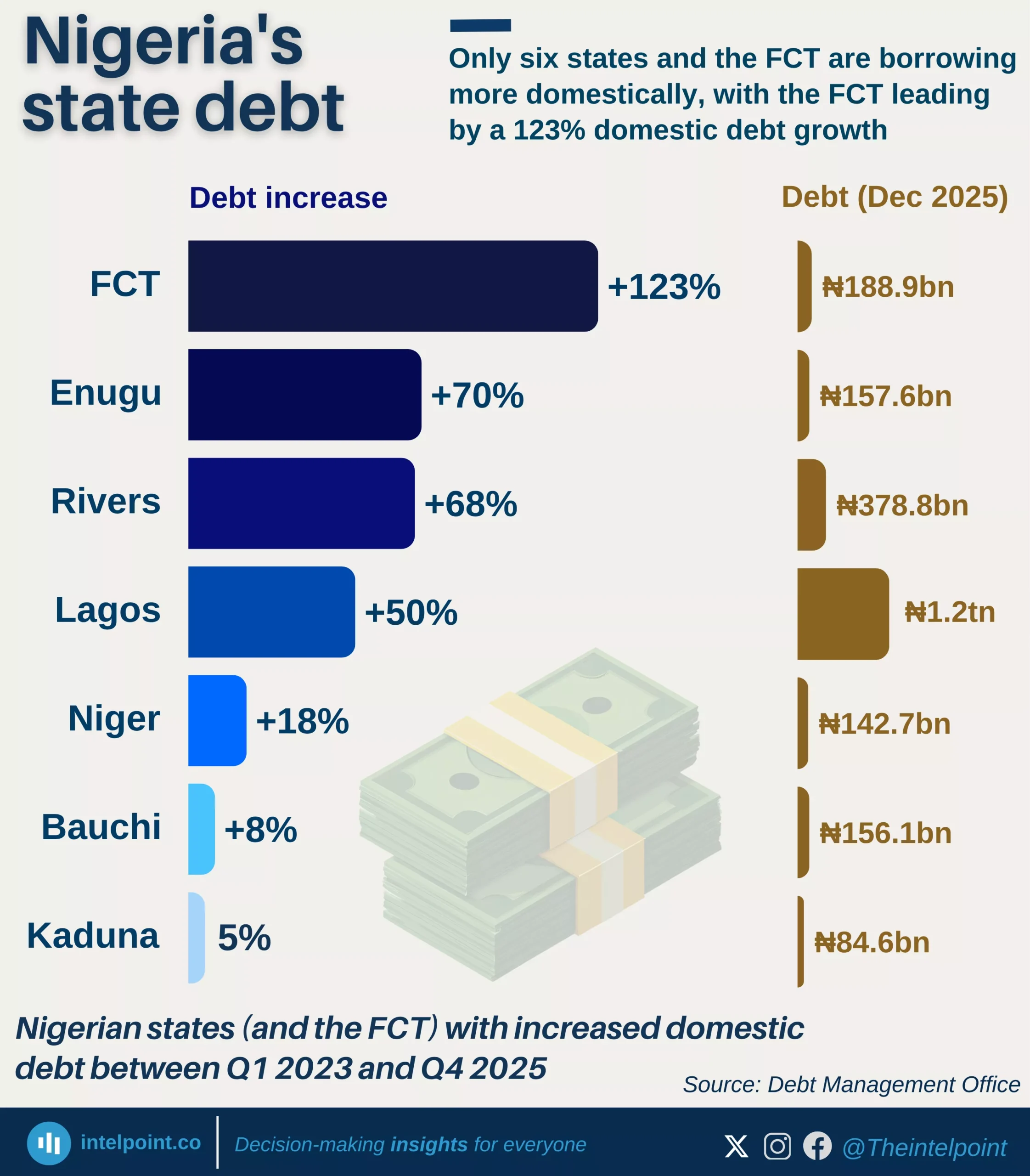
Between Q1 2023 and Q4 2025, only six states and the FCT increased domestic debt, while others reduced it. The FCT leads by growth with 122.8%, followed by Enugu (70%), Rivers (68%), and Lagos (50.1%). By size, though, Lagos still stands apart, with its domestic debt stock reaching ₦1.2 trillion in December 2025, far above that of any other state.
Sharper increases in debt tend to accompany larger budgets, capital-heavy spending plans, or financing gaps. Lagos’ ₦3.37 trillion 2025 budget carried a strong infrastructure push and explicitly included deficit financing through internal loans, external loans, and bond issuance.
Enugu’s 2025 budget rose to about ₦972 billion, with capital expenditure projected at about ₦838 billion, pointing to a much more aggressive expansion in public spending.
Bauchi’s 2025 budget also shows substantial capital allocations and domestic loan lines linked to housing and roads. This suggests that in at least some states, higher domestic debt is tied to front-loaded spending ambitions.
The FCT’s domestic debt likely rose the fastest because its spending needs expanded faster than internally generated cash, forcing it to rely more on domestic borrowing. The capital’s debt sustainability framework already anticipated the continued use of domestic financing channels, including instruments such as state bonds, as part of its financing structure. That suggests the rise in its domestic debt was not random; it already had a borrowing framework in place. The FCT’s debt grew because it appears to have leaned more heavily on domestic borrowing to meet spending needs within an existing debt-financing framework during a period of broader fiscal pressure.