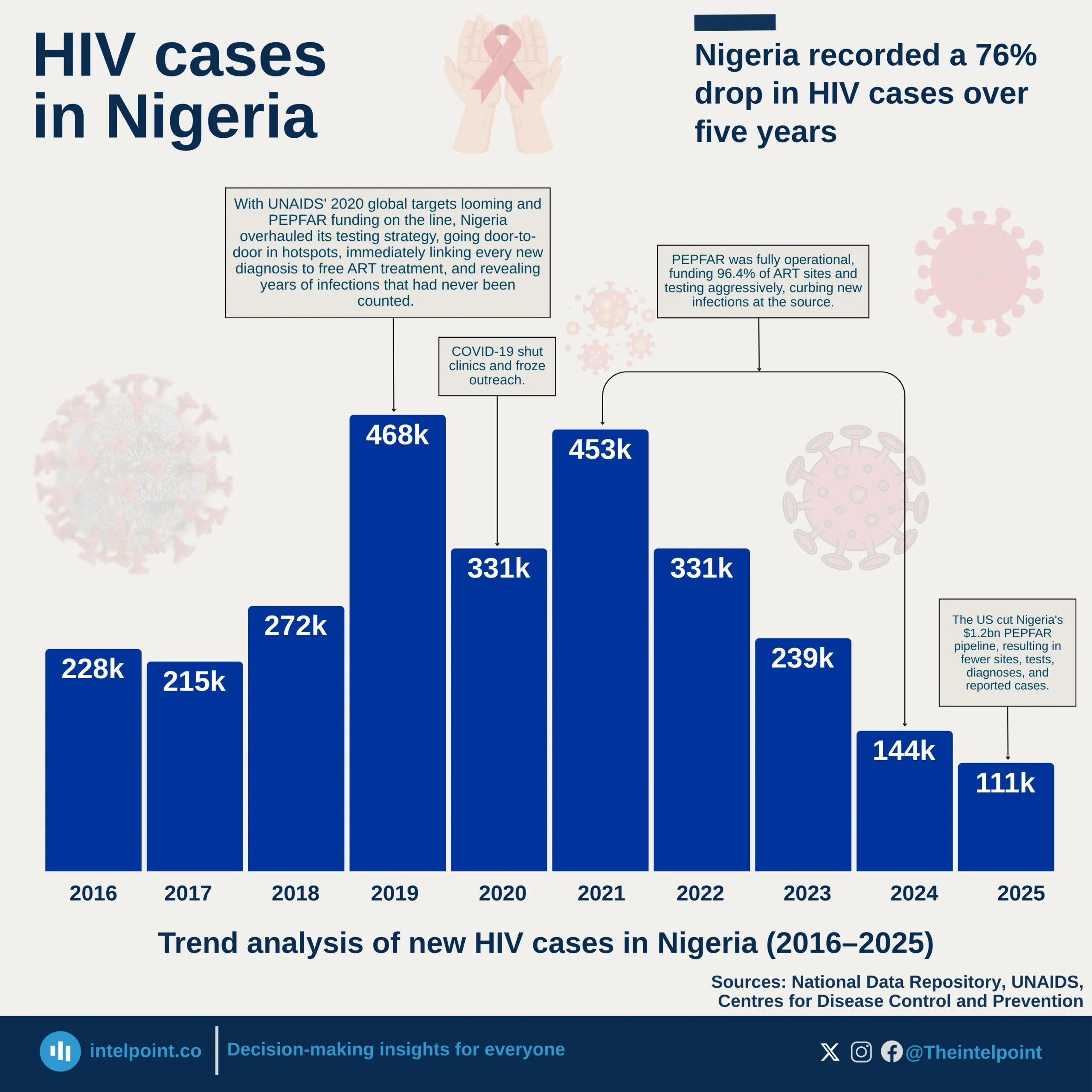
Nigeria's HIV data between 2016 and 2025 tells a story of losing the funding that made proper counting and investment in treatment possible. From 2016 to 2018, Nigeria reported between 215,000 and 272,000 new cases annually. These numbers felt stable but were largely a reflection of a weak testing system that couldn’t capture existing but undiscovered cases.
In 2019, everything changed. With UNAIDS' global 90-90-90 deadline a year away and the US President's Emergency Plan for AIDS Relief (PEPFAR) —America's flagship HIV funding programme — tying its allocations to measurable progress, Nigeria overhauled its entire testing infrastructure; the result was 468,000 new diagnoses because Nigeria finally went looking properly. Then COVID hit. Cases dropped to 331,000 in 2020, when COVID hit, as clinics closed, outreach froze, and thousands of infections went undetected. The 2021 rebound to 453,000 was simply the backlog clearing.
The real story began in 2022. With PEPFAR funding 96.4% of Nigeria's treatment sites, nearly two million Nigerians were placed on Antiretroviral Therapy (ART), a daily medication that suppresses HIV to undetectable levels, making transmission impossible. Cases fell every year without exception: 331,000 in 2022, 239,000 in 2023, and 144,000 in 2024 — a 70% decline in three years, driven by treatment working exactly as the science said it would. Then, in early 2025, the US froze its foreign assistance. Nigeria lost $1.2 billion in HIV funding; testing sites closed, outreach reduced, and diagnostics collapsed. Cases fell to 111,000, the lowest in the dataset.
This time the fall is not a victory; with fewer people being tested, fewer cases appear on paper, while the virus spreads freely. Nigeria may be returning to 2016 levels not because HIV has retreated, but because the system monitoring it has stopped working.