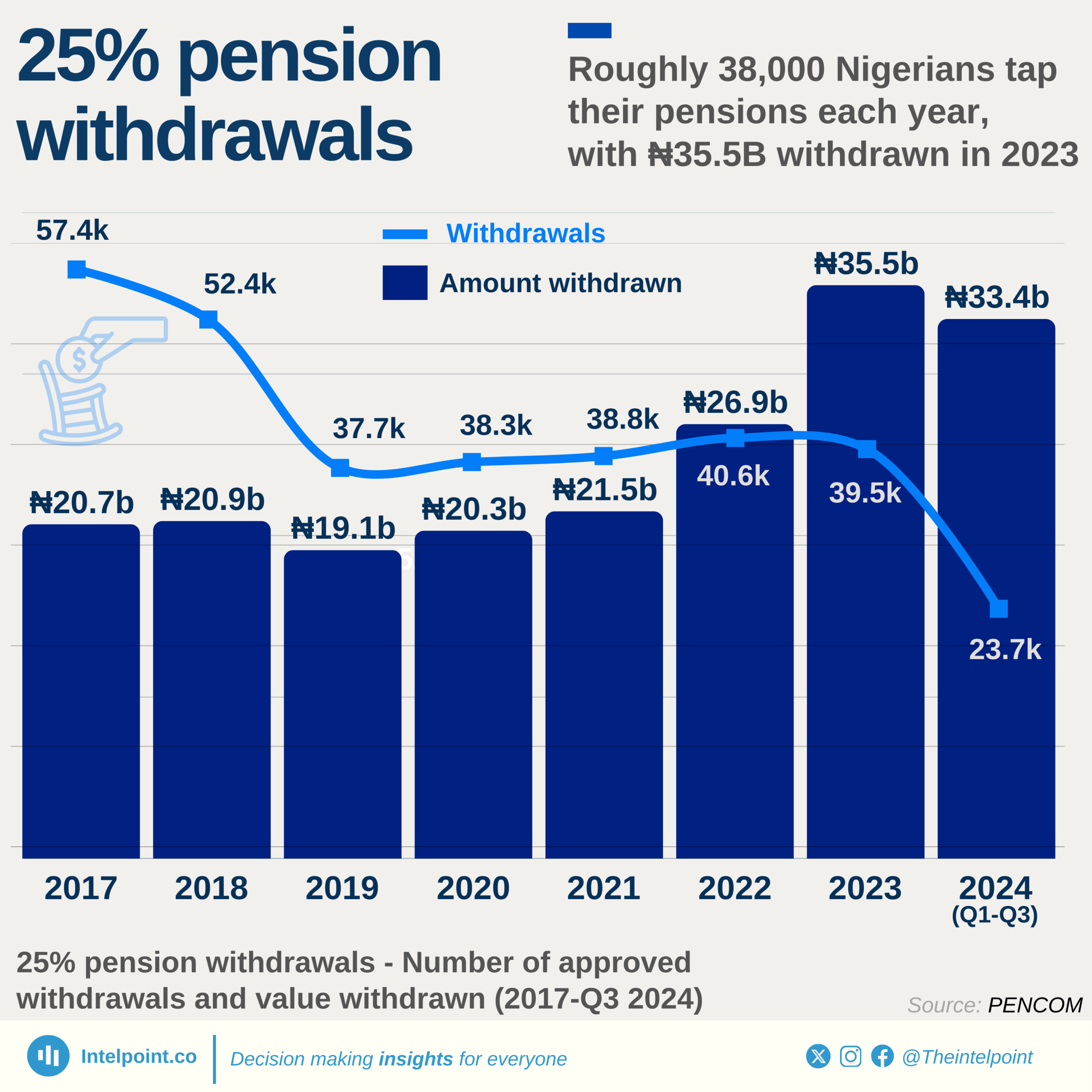
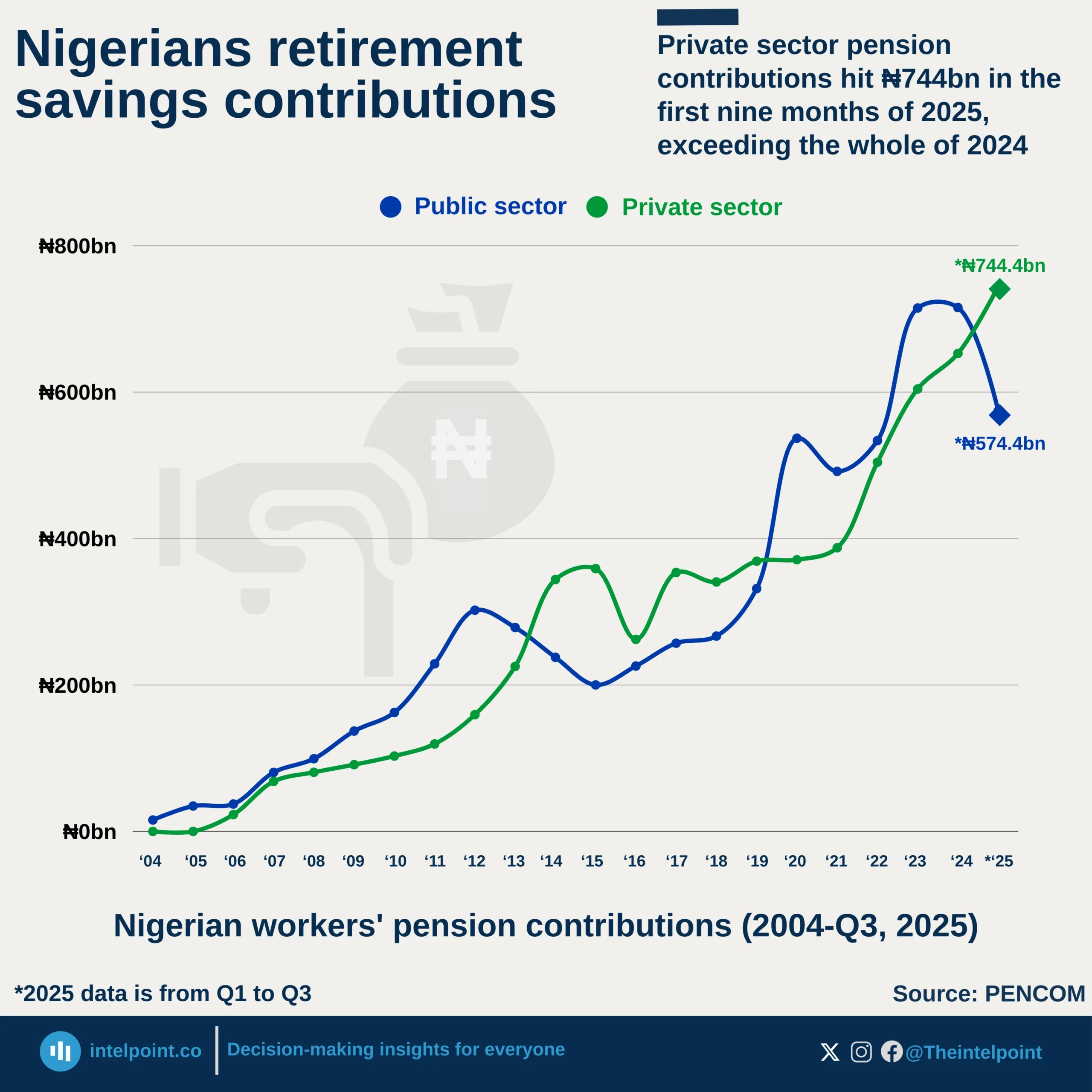
When Nigeria launched its Contributory Pension Scheme in 2004, total contributions stood at ₦15.6 billion — every kobo from government and nothing from the private sector. Twenty years later, that figure has grown by more than 85-fold. The journey was not without turbulence; Contributions declined in 2015 and 2016 as crashing oil revenues choked government remittances, and again in 2021 amid COVID-19 disruptions. Yet the system proved resilient, recovering sharply by 2017 and crossing the ₦1 trillion threshold for the first time in 2022, a milestone that confirmed Nigeria's pension architecture had entered an entirely different league.
But the most consequential shift is structural, not just numerical. For most of the system's history, the government led, and the private sector followed; but that era is over. In just the first nine months of 2025, Nigeria's private-sector workers contributed ₦744 billion to the pension fund, already surpassing the sector's full-year 2024 figure of ₦652 billion, with a full quarter still unaccounted for. The public sector, by comparison, contributed ₦574 billion in the same period. At this pace, full-year 2025 contributions are on track to hit approximately ₦1.76 trillion — the largest single-year total in the scheme's history. What began as a government project has become a private sector-led movement.