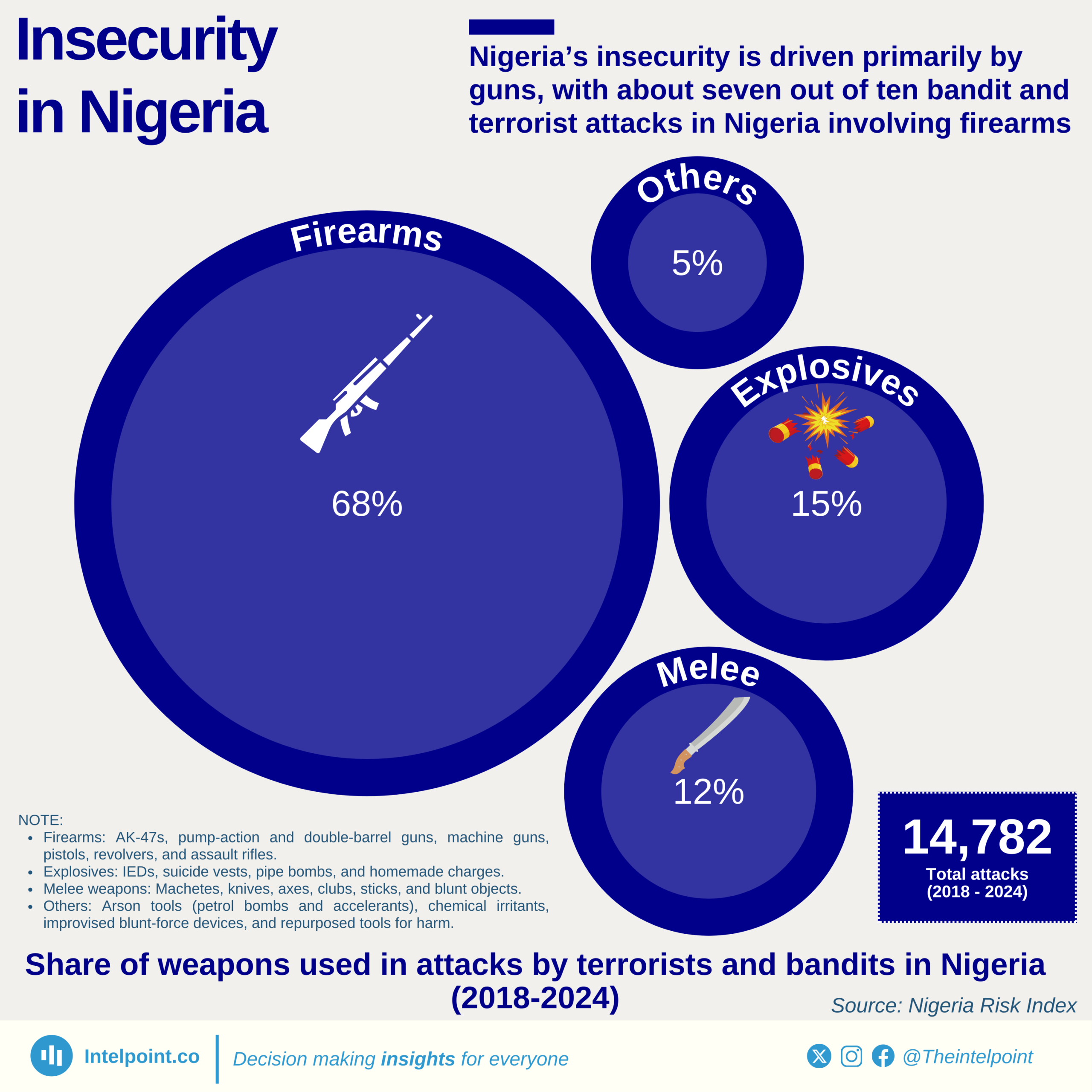
Nigeria’s insecurity is driven primarily by guns, with about seven out of ten bandit and terrorist attacks in Nigeria involving firearms

  • Firearms were used in about 70%% of all attacks, making them the single most important driver of violent insecurity in Nigeria.
  • 14,782 attacks were recorded between 2018 and 2024, underscoring the scale of sustained armed violence.
  • Explosives accounted for 15% of incidents, showing continued but secondary use of IEDs and bombings.
  • Melee weapons made up 12%, reflecting close-range violence but far lower impact than gun attacks.

Between 2018 and 2024, firearms were used in 68% of all terrorist and bandit attacks, far outweighing explosives (15%) and melee weapons (12%). Out of 14,782 recorded attacks, guns were the primary tool of violence—highlighting how access to firearms, more than any other weapon type, is fueling persistent insecurity across the country.
Source:

Beacon Security & Intelligence

Period:

2018-2024
HTML code to embed chart
Want a bespoke report?
Reach out
Tags
Related Insights

Nigeria has lost more senior military officers in early 2026 than in any year since 2016
  • 2026 is already Nigeria’s deadliest year, with six senior officer deaths as of April.
  • Borno accounts for most of the deaths.
  • 2025 already showed renewed pressure before the rise in 2026.
  • Lieutenant colonels account for the largest share of deaths by rank.
  • The pattern suggests attacks are increasingly targeting military command structures.

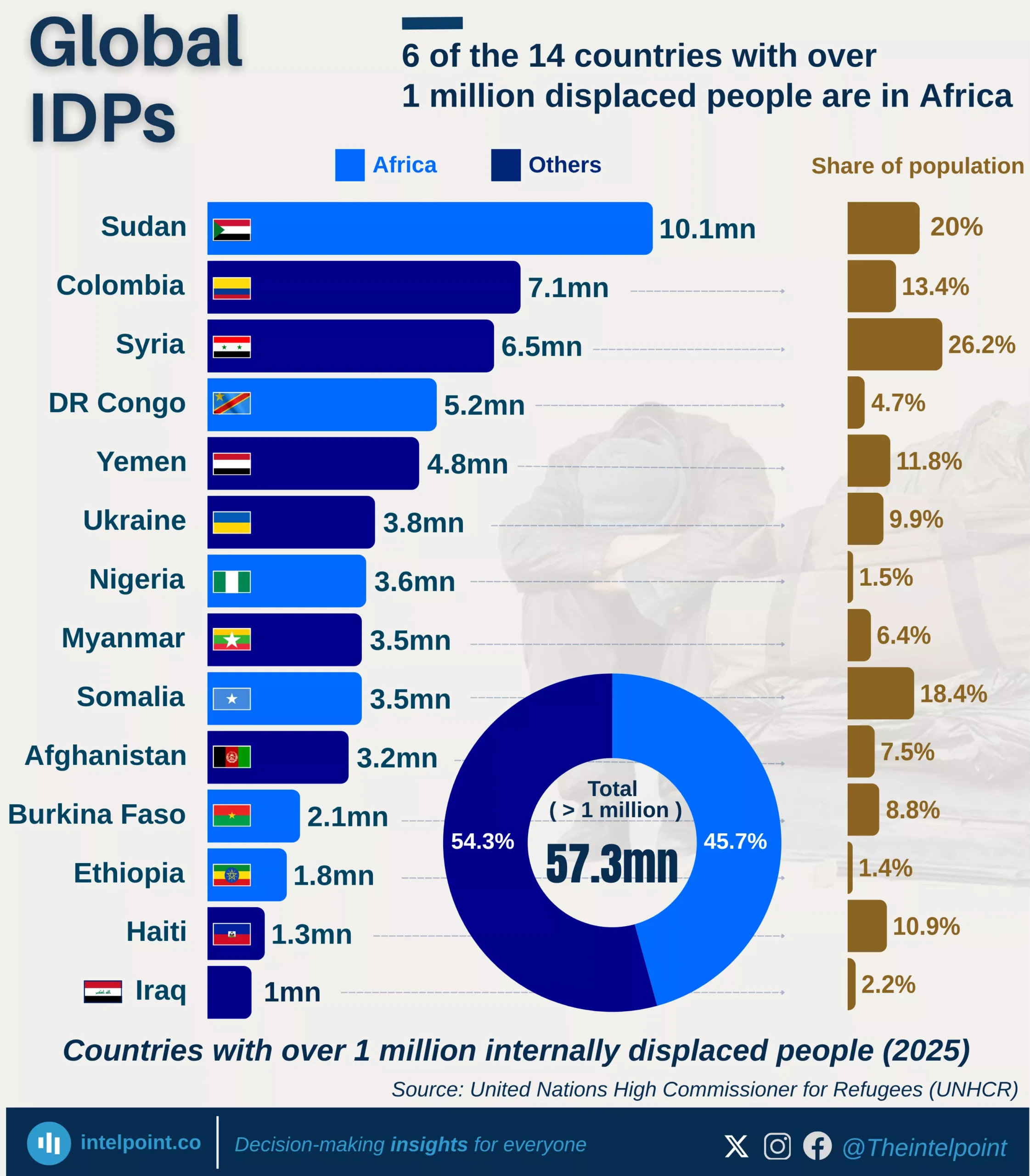
6 of the 14 countries with over 1 million displaced people are in Africa
  • Sudan leads globally with 10.1 million IDPs.
  • 6 out of 14 countries with over 1 million IDPs are in Africa.
  • Syria has the highest displacement intensity (26.2% of its population).
  • Nigeria’s 3.6 million IDPs are large in absolute terms but represent only 1.5% of its population.
  • DR Congo (5.2mn) and Somalia (3.5mn) continue to face chronic, multi-year displacement crises.
  • Non-African countries like Colombia (7.1 million) and Ukraine (3.8 million) show that displacement is a global issue.

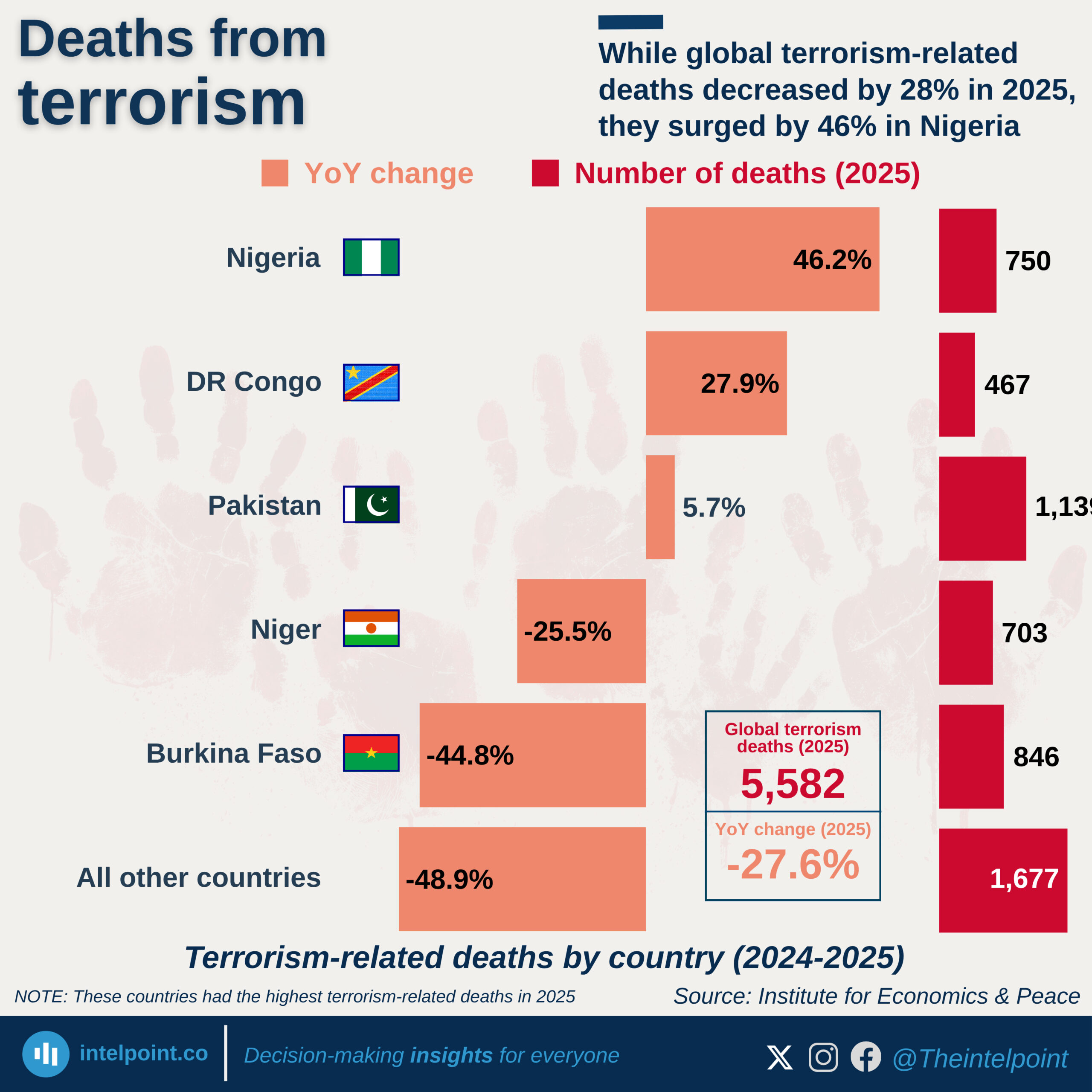
While global terrorism-related deaths decreased by 28% in 2025, they surged by 46% in Nigeria
  • Global terrorism deaths declined significantly by about 27.6%, from 7,714 in 2024 to 5,582 in 2025.
  • Nigeria recorded a sharp 46.2% increase in terrorism-related deaths, rising from 513 to 750.
  • Burkina Faso saw a major decline of 44.8%, dropping from 1,532 to 846 deaths.
  • Niger also improved, with deaths falling by 25.5% to 703.
  • Democratic Republic of the Congo recorded an increase of 27.9%, showing mixed trends within Africa.
  • Pakistan saw a slight increase of 5.7%, indicating relatively stable but still elevated risk.

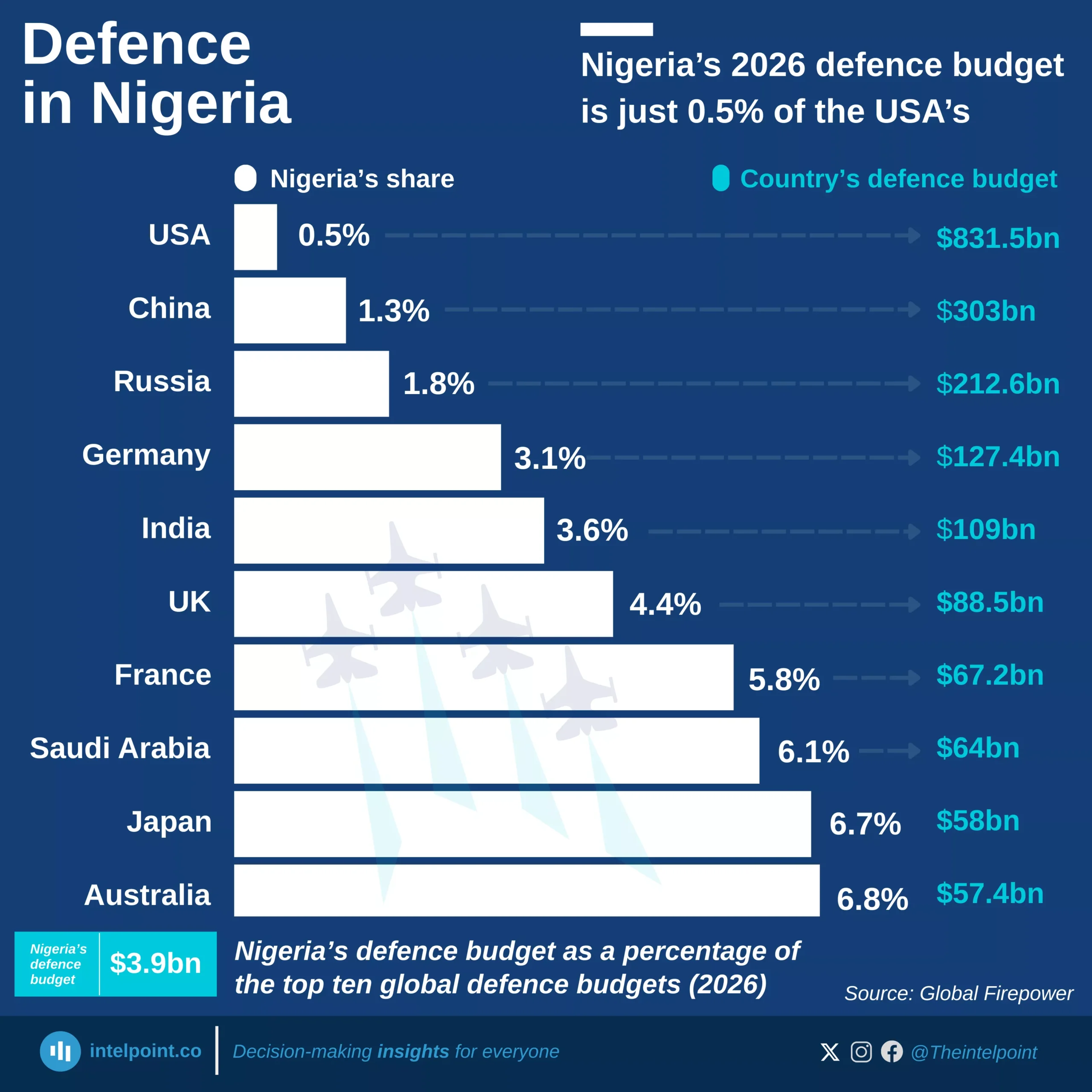
Nigeria’s 2026 defence budget is just 0.5% of the USA’s
  • Nigeria’s 2026 defence budget is $3.9 billion, placing it far below the top global spenders.
  • It is just 0.5% of the US’ $831.5 billion budget, highlighting a massive scale difference.
  • Compared to China ($303 billion), Nigeria’s budget is only 1.3%.
  • Nigeria’s allocation equals 1.8% of Russia’s $212.6 billion allocation.
  • Even a mid-tier top spender like Australia ($57.4 billion) has a budget almost 15x Nigeria’s.
  • Nigeria’s budget is only 3.6% of India’s $109 billion defence allocation.
  • European powers such as the UK ($88.5 billion), France ($67.2 billion), and Germany ($127.4 billion) all have defence budgets that dwarf Nigeria’s allocation

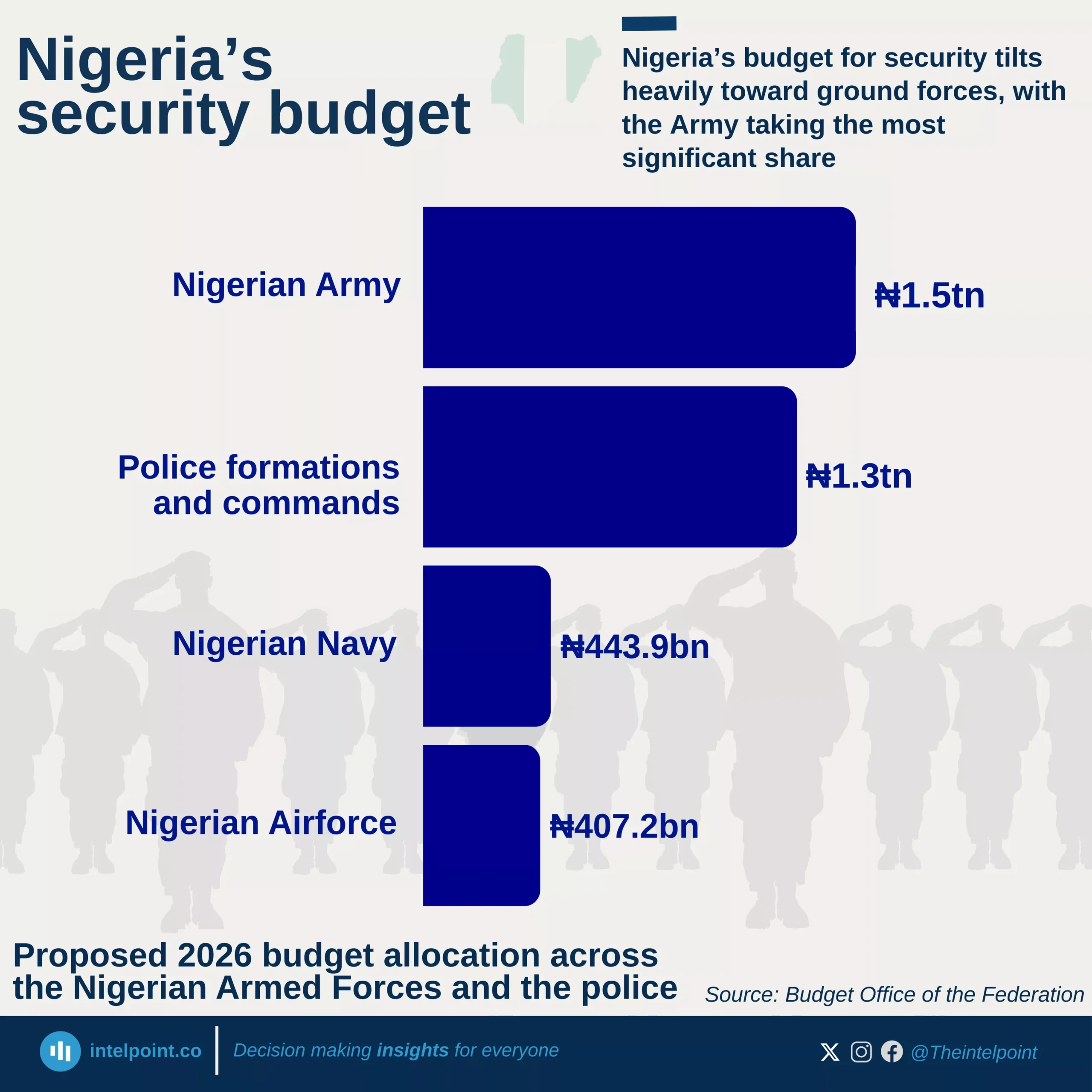
Nigeria’s budget for security tilts heavily toward ground forces, with the Army taking the most significant share
  • The Nigerian Army is allocated ₦1.5 trillion, surpassing the ₦1 trillion mark and making it the highest-funded force in the proposal.
  • Police formations and commands receive ₦1.3 trillion, exceeding the ₦ 1 trillion threshold in the 2026 budget.
  • The Nigerian Navy’s proposed allocation stands at ₦443.9 billion, keeping it well below the trillion-naira range reached by the top two.
  • The Nigerian Air Force is allocated ₦407.2 billion.

Kidnapping for ransom accounted for 40% of terrorist funding in Nigeria (2018-2024)
  • Kidnapping for ransom is the largest source of terrorist and bandit funding in Nigeria, accounting for 40%.
  • Resource extraction contributes 25%, highlighting the importance of illegal mining and natural-resource exploitation in sustaining armed groups.
  • Extortion makes up 15% of total funding, demonstrating the broad reach of coercive levies imposed on communities and businesses.
  • Illegal taxation (10%) remains a steady revenue stream.
  • External support accounts for 7%, indicating some level of international or cross-border backing for these groups.

POPULAR TOPICS
SIGN UP TO OUR NEWSLETTER
Get periodic updates about the African startup space, access to our reports, among others.
Subscribe Here
Subscription Form

A product of Techpoint Africa. All rights reserved